In March 2024, BlackRock launched BUIDL, a tokenized money market fund, on Ethereum; within roughly a year its assets under management (AUM) surpassed $1 billion, and by the end of 2025 it held approximately $2.5 billion to $2.9 billion [1]. Over the same period, the Depository Trust & Clearing Corporation (DTCC) explored blockchain-based T+0 atomic settlement [2], the European Investment Bank issued a €100 million digital bond on Ethereum in 2021 [3], Siemens issued a €60 million digital bond on a public blockchain in 2023 [4], Visa ran stablecoin settlement tests on Solana [5], and the Monetary Authority of Singapore's Project Guardian pursued institutional-grade DeFi [6]. These initiatives come from core institutions of the global financial system—asset managers overseeing more than $10 trillion in assets, settlement-infrastructure operators processing more than $2 quadrillion in securities transactions each year, sovereign-level investors, and global payment networks—and they represent not the tentative adoption of a new technology but strategic deployment grounded in cost-benefit analysis. By the end of 2025, the total market capitalization of stablecoins worldwide stood at roughly $310 billion, with annualized on-chain settlement volume of approximately $33 trillion (Artemis/Bloomberg [7]; this figure includes internal DeFi flows and maximal extractable value (MEV) and is not netted, and payment-adjusted estimates diverge widely by method, ranging from roughly $0.4 trillion to $10 trillion [8]). Even at the adjusted figure, this volume remains within the same order of magnitude as Visa's annual net payment volume [9]. The functional boundary between on-chain finance and traditional finance continues to narrow.
Chapters 1 and 2 were, at bottom, still answering questions internal to the crypto world: what makes digital assets different, and how those differences gave rise to perpetual futures. This chapter shifts the vantage point—from inside the crypto world to the global financial system—to answer a more fundamental question: is the distinctiveness of digital assets merely a specialized tool serving a particular constituency, or does it represent the universal direction in which the entire financial infrastructure is evolving? The answer here rests on evidence and analytical frameworks, not on vision.
This chapter advances five named theoretical concepts to organize its argument. The institutional convergence thesis holds that traditional finance and on-chain finance are moving toward each other, driven by the competitive compression of the trust tax. The trust-tax compression curve shows that the difficulty of moving different financial functions on-chain runs along a gradient from the easy-to-compress to the hard-to-compress, which explains why stablecoins moved on-chain before Treasuries and Treasuries before equities. The stablecoin settlement-layer migration thesis argues that the $33 trillion in annual settlement volume marks a structural migration of the settlement layer. The three-horizon framework divides the evolution of on-chain finance into three overlapping horizons with fundamentally different levels of maturity and standards of judgment. The impossibility boundaries identify three permanent structural constraints—the sovereignty boundary, the physical-world interface, and the governance paradox—that separate obstacles which effort can overcome from constraints that must be lived with, establishing the mature epistemological stance of maximizing within constraints. Together, these five concepts give the reader a complete analytical toolkit for judging the real prospects of on-chain finance, and they show how the economic logic behind perpetual futures (the most successful product of the first horizon) extends to broader financial functions.
3.1 An economic reexamination of the four distinctive properties
Four pain points pervade traditional financial markets: barriers to entry, the fragmentation of liquidity along the time dimension, persistent counterparty risk during settlement, and the high cost of manual execution. These do not exist in isolation; they are interwoven, mutually reinforcing systemic problems. Each of the four distinctive properties of digital assets responds to one of them. Figure 3-1 maps this full relationship, from pain point to distinctive property to value creation. The mapping is not a simple one-to-one correspondence, because the four properties reinforce one another across categories: programmability combined with atomic settlement gave rise to flash loans, and permissionless access combined with around-the-clock trading makes the global liquidity rotation of perpetual futures possible.
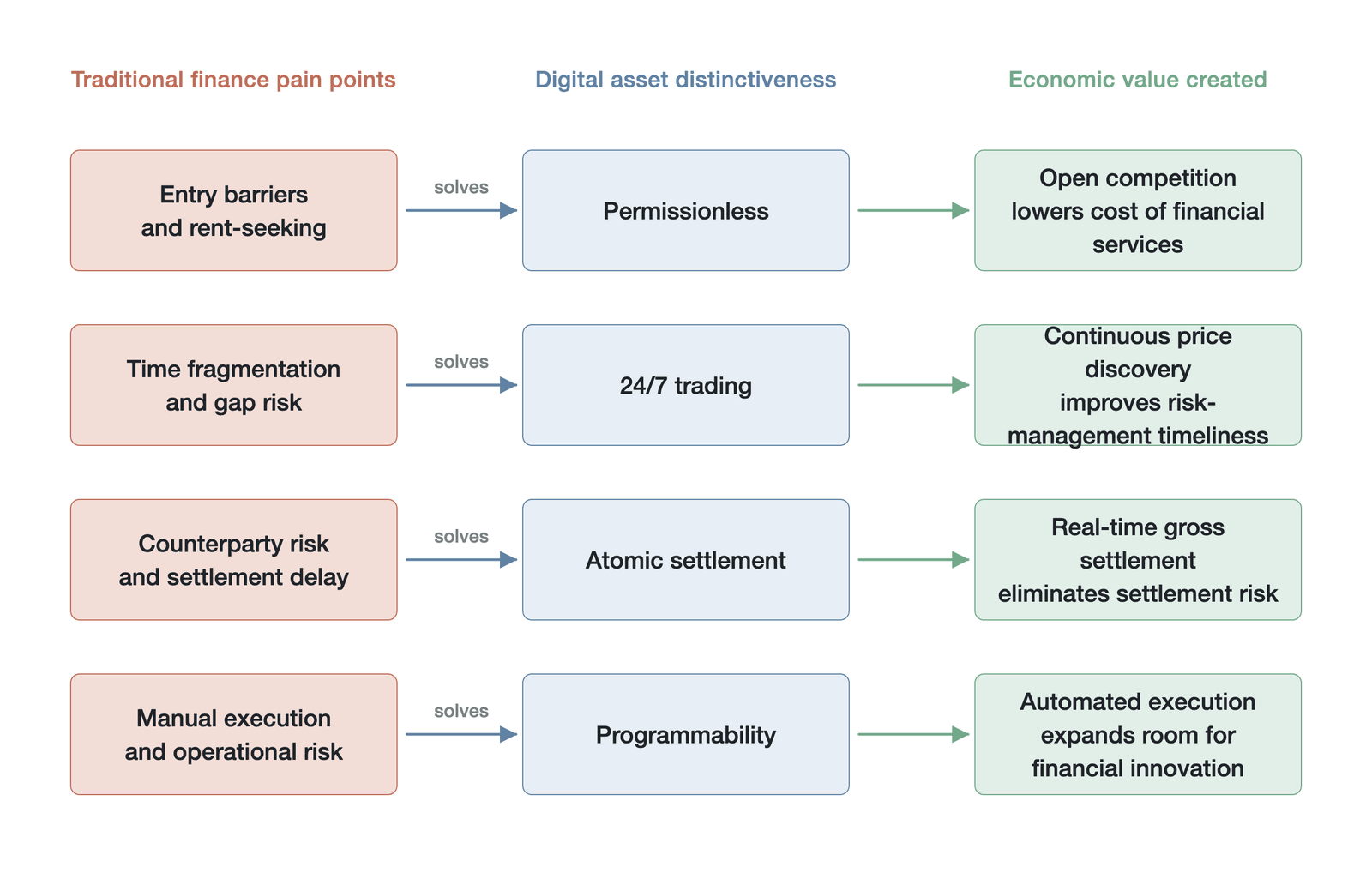
Figure 3-1. The correspondence between the four pain points of traditional finance and the four distinctive properties of digital assets
3.1.1 Permissionlessness and contestable markets
The traditional financial system is, at its core, a finely engineered permission-based structure. A company seeking to raise capital through a listing, an innovator offering financial services, and a trading firm hoping to become an exchange member must each pass through a complex admission process built from regulatory approval, capital requirements, industry relationships, and technical standards. This permission regime provides a foundational framework for financial stability and investor protection, but its high thresholds also, inevitably, breed muted competition and pervasive rent-seeking. The steep underwriting fees that investment banks charge during an initial public offering (IPO) stem in part from the limited number of banks able to win underwriting mandates; becoming a designated market maker on the New York Stock Exchange requires millions of dollars in capital and months of approval.
This phenomenon can be explained through the theory of contestable markets. The central proposition of Baumol, Panzar, and Willig (1982) [10] is that in a market with very low sunk costs, even a single incumbent behaves as it would under perfect competition; it is the persistent threat of potential competition, rather than the number of actual competitors, that forces the incumbent to keep prices near marginal cost. Traditional financial markets are a textbook case of non-contestable markets: becoming a regulated bank or exchange requires enormous outlays to obtain licenses, build infrastructure, and satisfy compliance requirements, and because most of these costs are sunk, they confer substantial market power on incumbents. Shepherd's (1984) [11] critique of contestable-market theory notes that the conditions for a purely contestable market are extremely difficult to satisfy in full, and that brand effects, user inertia, and hidden switching costs often form barriers to entry that Baumol's model does not adequately account for. This critique matters equally for assessing the contestability of on-chain finance: although decentralized exchanges (DEXs) eliminate the sunk costs of licensing and technical infrastructure, liquidity depth itself is a hidden barrier, and a new protocol must overcome the cold-start problem of liquidity before it can compete effectively. On-chain financial markets are therefore more contestable than traditional finance, but they are not frictionless, perfectly contestable markets.
This cost differential can be quantified. According to industry estimates from firms such as Autonomous Research and Oliver Wyman, a traditional licensed exchange faces regulatory compliance costs of roughly $50 million, technical infrastructure costs of roughly $20 million, and product-listing costs of roughly $5 million, for total sunk costs exceeding tens of millions of dollars [12]; by contrast, deploying a simple automated market maker (AMM) protocol on a public blockchain (such as a Uniswap V2 fork)—including development, audit, and deployment gas fees—typically costs from a few thousand to a few tens of thousands of dollars, with an exit cost close to zero. A fully featured order-book DEX (with a matching engine, risk-control system, liquidation engine, and its own consensus layer, such as Hyperliquid or dYdX v4) costs millions to tens of millions of dollars to develop, markedly less than a traditional exchange, though the gap narrows to one or two orders of magnitude.
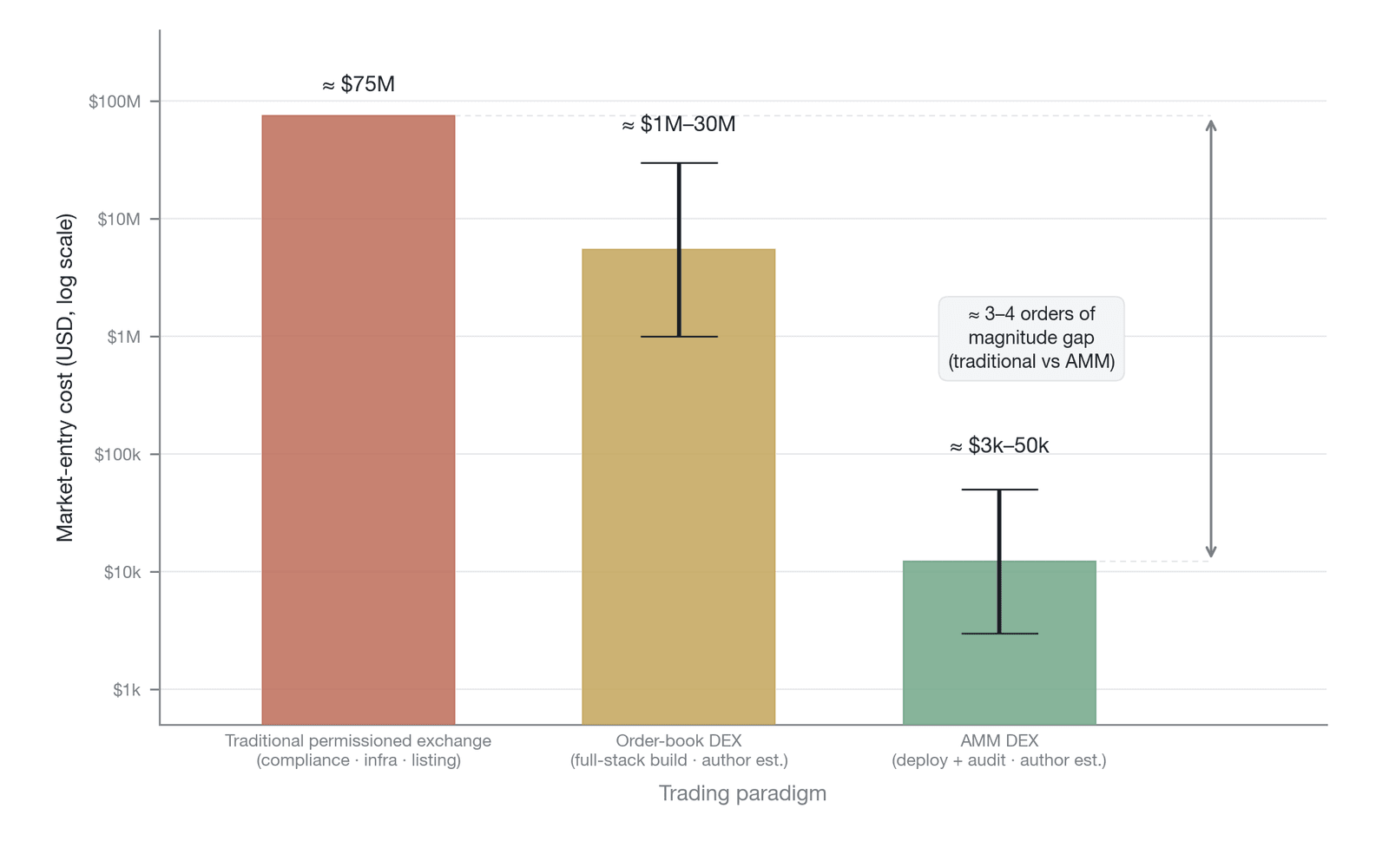
Figure 3-2. A comparison of the market-entry (sunk) cost magnitudes of three trading paradigms (logarithmic scale; a traditional licensed exchange runs to roughly $75 million, of which regulatory compliance is about $50 million, technical infrastructure about $20 million, and product listing about $5 million, based on industry estimates from Autonomous Research, The Cost of Running a Regulated Exchange, 2023, and Oliver Wyman, 2023 [12]; the order-book DEX figure of roughly $1 million–$30 million and the AMM DEX figure of roughly $3,000–$50,000 are the author's order-of-magnitude estimates based on public data; the gap between traditional and AMM exchanges is roughly 3–4 orders of magnitude; this figure is an order-of-magnitude illustration rather than precise accounting, mixing empirical data with the author's estimates)
Figure 3-2 reveals a fact easily underestimated on a linear scale: for AMM-type DEXs, the cost difference along the two dimensions of regulatory compliance and technical infrastructure is not a marginal gap of a few tens of percent but a structural chasm of 3–4 orders of magnitude; for high-performance order-book DEXs, the gap narrows to 1–2 orders of magnitude but remains structural. It is this order-of-magnitude difference that fundamentally alters the contestability of the market, expanding the pool of potential competitors from a handful of licensed institutions to a far broader set of technical teams worldwide.
Permissionless finance built on public blockchains satisfies, in theory, the conditions for a contestable market almost perfectly. The direct cost of deploying a smart contract is minimal and involves almost no sunk cost; open-source code sharply lowers the technical barrier; and the exit cost is likewise zero. This low-sunk-cost property means that any protocol attempting to charge excessive fees risks being forked, as competitors can copy its open-source code and deploy a functionally identical version at lower fees. The effectiveness of fork competition, however, is constrained by brand trust, developer community, and liquidity inertia. The "vampire attack" that SushiSwap launched against Uniswap in 2020 drew substantial liquidity in the short term, but after Uniswap counterattacked by issuing the UNI governance token, it retained its market dominance over the long run. Even in a zero-sunk-cost environment, then, sustained innovation and brand trust still form a substantive moat. Hyperliquid's rapid growth is a direct case study in this economic logic. This perpetual-futures order-book DEX, built on its own application-specific chain, lets anyone list new perpetual-futures trading pairs through governance proposals at very low cost; its cumulative trading volume surpassed $3 trillion by the end of 2025, its user base grew to more than 1.4 million, and the number of listed perpetual-futures pairs exceeded 200 [13][14]. Listing a new futures product on a traditional exchange often takes months or even years of internal review and regulatory dialogue, whereas the permissionless mechanism lets the market respond quickly to new assets and new trading demand. Hyperliquid's permissionlessness appears at the user-access level (anyone can register and trade), but its infrastructure layer remains markedly centralized: its validator set consists of roughly 16–20 nodes, most operated by the team and its affiliates; order matching runs on a centralized sequencer at millisecond latency; and geofencing is enforced through front-end IP detection, which a virtual private network (VPN) can bypass. This architecture—permissionless at the user layer, only partly decentralized at the infrastructure layer—is common to today's high-performance order-book DEXs, whose degree of decentralization is far lower than that of general-purpose public blockchains such as Ethereum.
While the permissionless property lowers the cost of innovation, it also lowers the cost of fraud. According to CertiK, crypto-asset losses from security incidents totaled roughly $3.35 billion over the course of 2025 [15], and losses from scams and fraud ran higher still, into the tens of billions of dollars. The net social benefit of permissionlessness ultimately depends on the maturity of supporting institutions—that is, on whether effective disclosure mechanisms, decentralized reputation systems, and investor-protection tools can be established.
3.1.2 Around-the-clock continuous trading and the transformation of constraints
Traditional financial markets run on clocks and calendars. When markets are closed, information keeps being produced but cannot be priced immediately; it accumulates until the next session opens, when it is released all at once as an opening gap. These gaps interrupt the management of risk exposure and leave capital idle while the market is closed. The deeper economic value of around-the-clock, uninterrupted trading lies in continuous price discovery: it transforms what is a hard constraint in traditional markets, the inability to trade when the market is closed, into a soft constraint in which only trading costs vary across time periods. Trading by participants around the world produces a cyclical rotation of liquidity across the global day.
This transformation from hard constraint to soft constraint is not costless. Around-the-clock markets do not eliminate differences in liquidity; they convert those differences from a binary state (open versus closed) into a continuous but uneven distribution. The data show that liquidity in crypto markets peaks during the overlap of the European and U.S. morning sessions (roughly 14:00–18:00 UTC) and falls to a trough after the U.S. market closes, with order-book depth differing by as much as 40% between peak and trough [16]. The trading cost of large orders therefore varies systematically by time of day. For market makers, the absence of a close means they cannot recalibrate inventory risk within a protected window, so they must maintain around-the-clock operational capacity or rely on algorithmic risk-management systems that run continuously without human supervision.
Chapter 2 argued that the high leverage of perpetual futures makes positions extremely sensitive to price volatility. Were there closed sessions, traders could not manage their risk exposure while the market was shut, which could produce the extreme case of an opening-gap liquidation. Around-the-clock trading is thus a necessary precondition for the perpetual-futures funding-rate mechanism to work: if the market did not run continuously, the funding-rate calculation would be interrupted and its anchoring effect would weaken markedly. More concretely, a 10x-leveraged position held through an overnight close would face unmanageable gap risk, and the funding rate's continuous anchoring would break, producing persistent basis deviation. This is the fundamental reason perpetual futures could not have emerged in a market with trading-hour restrictions. The three implicit protective functions that market closure provides in traditional markets, analyzed in Chapter 1—a risk-repricing window for market makers, a cooling-off period for panic, and a maintenance window for the system—all disappear under around-the-clock trading.
Blonien and Ober (2024) [17] point out that for smaller markets, concentrated trading sessions may be more efficient than around-the-clock trading because they pool liquidity. The value of around-the-clock trading thus depends on market size and liquidity depth; it is not a universally superior solution. Traditional markets are exploring extended trading hours, and institutions such as DTCC and BlackRock are discussing a transition toward around-the-clock operation—itself one dimension of institutional convergence.
3.1.3 The scope of atomic settlement
In traditional financial markets, the execution and settlement of a trade are two separate processes, typically requiring two business days to complete. This time window builds in a structural weakness: counterparty risk. Any party's default within the settlement window can trigger a chain reaction, producing a systemic settlement cascade. The collapse of Lehman Brothers during the 2008 financial crisis was the starkest embodiment of this risk. The atomic-settlement property of digital assets uses cryptography to guarantee that the delivery of an asset and the payment of funds occur simultaneously within a single, indivisible on-chain transaction, fundamentally eliminating counterparty risk during settlement.
Treating atomic settlement as a fundamental solution to systemic risk is an oversimplification. To understand its true effect, one must draw a distinction that shapes the conclusions of any risk assessment.
A settlement cascade is triggered by the settlement failure of a trading counterparty and propagates downstream as a chain of defaults through the breaking of a trust chain; a liquidation cascade, by contrast, is triggered by a decline in asset prices and forms a negative feedback loop of price decline–liquidation–further decline through the forced closure of leveraged positions. Atomic settlement effectively eliminates the former, but for the latter it cannot prevent the cascade and may even accelerate its propagation through efficient execution. Table 3-1 compares the two risks along four dimensions: triggering mechanism, propagation path, the effect of atomic settlement, and time scale.
| Risk type | Trigger | Propagation mechanism | Effect of atomic settlement | Time scale |
|---|---|---|---|---|
| Settlement cascade | Settlement failure of a trading counterparty | A broken trust chain triggers a chain of defaults | Effectively eliminated: simultaneous delivery and payment removes the possibility of default | Traditional finance: days to weeks |
| Liquidation cascade | A decline in asset prices triggers forced closures | Forced liquidation of leveraged positions intensifies selling pressure in a negative feedback loop | Cannot be prevented and may even be accelerated: efficient liquidation execution compresses propagation from days to minutes | Instant mark-price liquidation architecture: seconds to minutes; auction-based liquidation architecture: minutes to hours; insurance funds and auto-deleveraging (ADL) mechanisms can act as propagation dampers |
Table 3-1. A comparison of settlement cascades and liquidation cascades—the scope of atomic settlement (Data source: compiled by the author)
Figure 3-3 contrasts the divergent paths of the settlement cascade (linear propagation) and the liquidation cascade (circular propagation), along with the scope of atomic settlement.
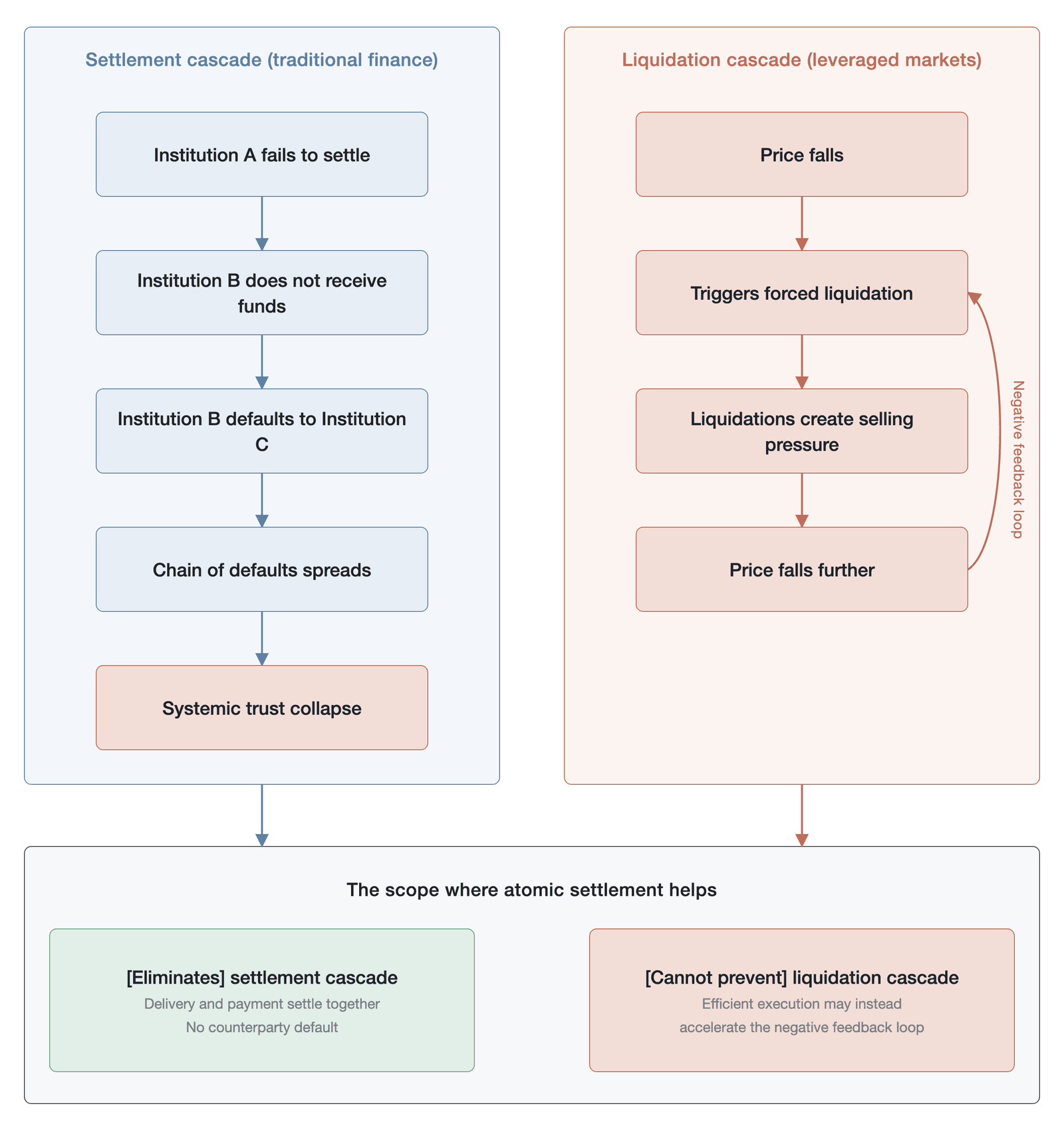
Figure 3-3. The propagation paths of settlement cascades and liquidation cascades and the scope of atomic settlement
In its 2024 report, the Financial Stability Board noted that tokenization can reduce counterparty risk through atomic settlement but may increase market participants' demand for liquidity [18]. This is a textbook risk-surface transformation—converting settlement risk into liquidity risk. Atomic settlement shifts the focus of risk from whether the counterparty will default to whether the market can withstand a rapid liquidation cascade and whether the protocol code is correct—a concrete mapping of the risk-surface transformation framework introduced in Chapter 1, namely that technological change does not eliminate the total quantity of risk but converts one set of risks into another of a different nature.
The crypto-market crash of March 12, 2020, provides an empirical case of a liquidation cascade. BitMEX, a centralized exchange, went down repeatedly during the event (the exchange attributed this to a distributed denial-of-service (DDoS) attack that overwhelmed its API and database layers, though it initially and mistakenly described it as a hardware failure), showing that even in a traditional, non-atomic settlement architecture, infrastructure failure during a surge in liquidations is already a systemic threat. In the same event, MakerDAO suffered zero-bid liquidations of its Vaults (triggered when Ethereum network congestion delayed oracle price updates) for a loss of roughly $8 million, illustrating how underlying network congestion in an on-chain environment can intensify the propagation of a liquidation cascade. The collapse of FTX, in turn, revealed another layer of problems with the "atomic settlement" of centralized exchanges: the "instant" fills that users saw were merely digital changes in a private database, and when such trust is abused, so-called atomic settlement loses any substantive meaning. By contrast, in an on-chain order-book DEX the settlement of each trade is guaranteed by publicly verifiable cryptographic consensus, a stronger trust guarantee than a centralized exchange can offer. Chapter 1 defined this trust model—based on cryptography and protocol design rather than institutional reputation—as architectural trust.
3.1.4 The power and cost of programmability
The operation of traditional finance depends heavily on legal contracts and manual execution; the pricing, execution, and settlement of complex derivatives require large back-office staffs and multiple layers of intermediaries, a model that is both costly and rife with operational risk. Smart contracts—which Szabo (1997) [19] described as a set of promises, specified in digital form, including the protocols within which the parties perform on these promises—encode the terms and execution logic of a financial agreement directly into computer programs that run on a blockchain, replacing informal natural language with deterministic computational logic and labor-intensive fulfillment with automated execution. The perpetual-futures funding-rate mechanism analyzed in Chapter 2 is a textbook success of programmable finance, using automated, code-based payment flows to keep the derivative's price tightly anchored to the spot price. Programmability expands the design space of financial innovation; AMMs and decentralized lending are successful products of programmability interacting with the other distinctive properties, whereas algorithmic stablecoins (in particular the May 2022 collapse of UST/LUNA, which wiped out roughly $40 billion in total ecosystem value, of which the UST stablecoin component accounted for roughly $18 billion) warn that programmability can just as readily create mechanisms with endogenous fragility. The design space that programmability opens up contains both fertile and dangerous regions; the composability thesis of Chapter 1 finds continuing validation here, though it must now be qualified by careful design evaluation.
The value of programmability lies less in automation than in creating entirely new financial mechanisms with no counterpart in traditional finance. An AMM replaces the centralized order-book matching engine with a mathematical pricing function, giving any token pair a liquidity market without any market maker actively quoting prices. The flash loan permits uncollateralized borrowing within a single atomic transaction—an instrument that is logically impossible in any non-atomic settlement system. These innovations are not the result of adapting traditional financial products to a blockchain; they are native products of the programmable environment and cannot exist apart from it.
The cost of programmability manifests at three levels. First, determinism means rigidity. The incomplete-contracts theory of Hart and Moore (1999) [20] holds that no contract can exhaust all contingent states, and that residual control rights are therefore needed to address unforeseen situations. Smart contracts push this theoretical difficulty to an extreme: the deterministic execution of code precludes any possibility of discretion, and situations the designer failed to foresee cannot be handled flexibly. In March 2023, Euler Finance suffered a flash-loan attack for a loss of $197 million; the attack was executed entirely within the bounds the code permitted, and the vulnerability was not a program defect in the traditional sense but a logical edge case the designers failed to anticipate. Attack losses over the course of 2025 reached $3.35 billion [15], of which the single Bybit incident accounted for $1.45 billion. These losses stem not only from code vulnerabilities but also from economic attacks that turn the deterministic nature of smart contracts against the designers' intent. Second, the cost of security audits constitutes a new form of trust tax; replacing legal compliance with code audits is not costless.
The third and more fundamental problem is one of governance: who has the right to modify the code itself requires an institutional answer. The ideal of "code is law" cannot entirely escape human governance. Contracts form a spectrum, from fully immutable (no one can modify them) to the upgradeable-proxy model (an administrator can change the logic), a continuous space of choices. This spectrum embodies a fundamental tension: immutability gives users confidence that the rules will not change, but upgradeability is a necessary condition for fixing vulnerabilities and adapting to new conditions. Between full immutability and full upgradeability, every protocol must choose a position, and that choice is essentially a governance decision rather than a technical one. Chapter 30 discusses design approaches for embedded compliance in detail.
3.2 The institutional convergence thesis
Institutional convergence is a classic research topic in comparative political economy. The institutional-isomorphism theory of DiMaggio and Powell (1983) [21] identifies three mechanisms that drive organizational convergence: coercive isomorphism (regulatory pressure), mimetic isomorphism (imitative behavior under uncertainty), and normative isomorphism (the diffusion of professional standards). This section applies the framework of institutional convergence to the relationship between traditional finance and on-chain finance and identifies a fourth mechanism not covered by DiMaggio and Powell: the competitive compression of the trust tax. Traditional finance and on-chain finance are moving from mutual opposition toward functional convergence, a convergence driven not only by regulatory pressure (coercive isomorphism) and industry imitation (mimetic isomorphism) but, more fundamentally, by the competitive compression of the trust tax—that is, as the two compete for the same user base, each compresses its own trust tax from a different direction. Traditional finance adopts on-chain technology to compress its trust tax, while on-chain finance introduces institutional elements to raise its level of trust. The BUIDL fund is the landmark case of convergence proceeding in both directions at once.
3.2.1 The on-chain deployment of traditional finance
The move on-chain by traditional financial institutions has moved from the 2020–2022 proofs of concept into a phase of strategic deployment in 2024–2026. This is not incremental exploration but a systematic strategic turn.
Table 3-2 surveys the on-chain strategic actions of six representative institutions. These institutions span six domains—asset management, securities settlement, sovereign-level issuance, industrial-enterprise financing, global payments, and sovereign regulation—and the significance of their collective turn lies in this: the adoption of on-chain finance is no longer confined to crypto-native institutions but has extended to core participants in the traditional financial system.
| Institution | Action | Signaling significance |
|---|---|---|
| BlackRock | BUIDL fund—a tokenized money market fund on Ethereum, with AUM near $3 billion | The world's largest asset manager chose a public blockchain rather than a private one |
| DTCC | Exploring T+0 atomic settlement, the Smart NAV project [2] | Core U.S. financial infrastructure exploring on-chain settlement |
| European Investment Bank | Issued a €100 million digital bond on Ethereum [3] | A sovereign-level institution chose a public blockchain for issuance |
| Siemens | Issued a €60 million digital bond on a public blockchain [4] | A European blue-chip industrial enterprise adopted on-chain issuance |
| Visa and Mastercard | Stablecoin settlement integration; Visa tested USDC settlement on Solana [5] | Global payment networks view on-chain settlement as an efficiency gain |
| Monetary Authority of Singapore | Project Guardian—institutional-grade DeFi | A regulator proactively driving rather than reactively responding |
Table 3-2. The strategic on-chain deployment of traditional financial institutions (Data source: public disclosures from each institution [1][2][3][4][5][6])
What drives these institutions is not technological idealism but rigorous cost-benefit analysis. Their core economic logic is this: when the compression of the trust tax exceeds the cost of migration, migration is rational. Each year, DTCC and its participants incur settlement costs measured in the billions of dollars (including reconciliation, dispute resolution, margin management, and the maintenance of multiple intermediary layers [22]); if atomic settlement can eliminate most of that, migration is not innovation but cost optimization. BlackRock's BUIDL fund turns money market fund subscriptions and redemptions from T+1 into instant, around-the-clock operations, and turns fund shares from a closed account system into globally tradable tokens. Most of the on-chain experiments of 2020–2022 took place on private or consortium chains, signaling that these institutions acknowledged the value of blockchain technology but did not trust public blockchains; the strategic deployment of 2024–2026 has shifted markedly toward public blockchains, where the signal has become that the security, transparency, and network effects of public blockchains now exceed the controllability advantages of private ones. Traditional finance is not merely adopting on-chain technology; it is accepting the architectural-trust paradigm of on-chain finance.
3.2.2 The institutionalization of on-chain finance
Convergence is bidirectional. On-chain finance is undergoing systematic institutionalization, moving from a state that lacked any regulatory framework toward compliant innovation within one. The European Union's Markets in Crypto-Assets (MiCA) regulation came fully into force in 2024, and as of April 2025, 17 crypto-asset service providers had been authorized by their respective national competent authorities (NCAs) and entered into the ESMA public register [23][24]. Hyperliquid has introduced partial compliance mechanisms, dYdX has set up geofencing to restrict users in specific jurisdictions, and Coinbase, as a public company, has obtained comprehensive regulatory licenses. The infrastructure layer of on-chain finance is upgrading from crypto-native to institutional-grade: custodians such as Fireblocks and Anchorage provide multi-signature wallets and insurance coverage, while on-chain analytics platforms such as Chainalysis and TRM Labs provide anti-money-laundering and transaction-monitoring services to financial institutions.
The governance of on-chain finance is evolving from the early ideal of "code is law, no human intervention" toward a more mature, multi-layer architecture: smart contracts define and automatically enforce core rules, a governance committee deliberates on parameter adjustments, an emergency multi-signature executes interventions of limited scope in extreme crises, and a time-lock provides a community-review window for all non-emergency changes. The March 2025 JELLY incident at Hyperliquid, in which validators voted to force the delisting of a token, is a practice of exactly this hybrid governance; although it sparked wide debate over the degree of decentralization, it showed that institutionalized human intervention is a necessary condition for the system's survival [25]. What drives on-chain finance toward institutions is not regulatory pressure but the demands of scale: to expand from serving millions of crypto-native users to serving billions of traditional-finance users, it must provide legal recourse, investor protection, compliance frameworks, and professional-grade security guarantees.
3.2.3 The competitive compression of the trust tax
The previous two sections described each one-directional movement separately: traditional finance toward the chain, and on-chain finance toward institutions. Recasting the trust-tax concept from Chapter 1 (all the direct and indirect costs paid in a financial transaction to establish and maintain trust: intermediary fees, compliance costs, the opportunity cost of settlement delay, and the information-asymmetry premium) from static to dynamic, competitive analysis unifies these two directions within a single economic framework. The logic here is deductive rather than inductive: when two financial-service systems offering overlapping functions compete for the same user base, the transaction-cost theory of Coase (1937) [26] and the governance-structure analysis of Williamson (1985) [27] predict that users will flow toward the system with lower transaction costs, and the resulting competitive pressure forces both systems to compress their own trust tax. Deriving convergence—rather than one side replacing the other, or a market split—from transaction-cost competition, however, requires an additional condition: that each system possess an irreplaceable comparative advantage along certain dimensions. The institutional trust of traditional finance (legal recourse, regulatory protection, deposit insurance) and the architectural trust of on-chain finance (transparency, composability, around-the-clock operation) cannot at present be fully replicated by the other, which provides a structural basis for convergence rather than replacement. Traditional finance and on-chain finance are in the midst of just such a competitive compression of the trust tax, converging from different directions toward the same equilibrium range. Figure 3-4 plots time on the horizontal axis and trust tax or trust level on the vertical axis, showing the declining trust-tax curve of traditional finance and the rising trust-level curve of on-chain finance converging into an equilibrium range of functional convergence.
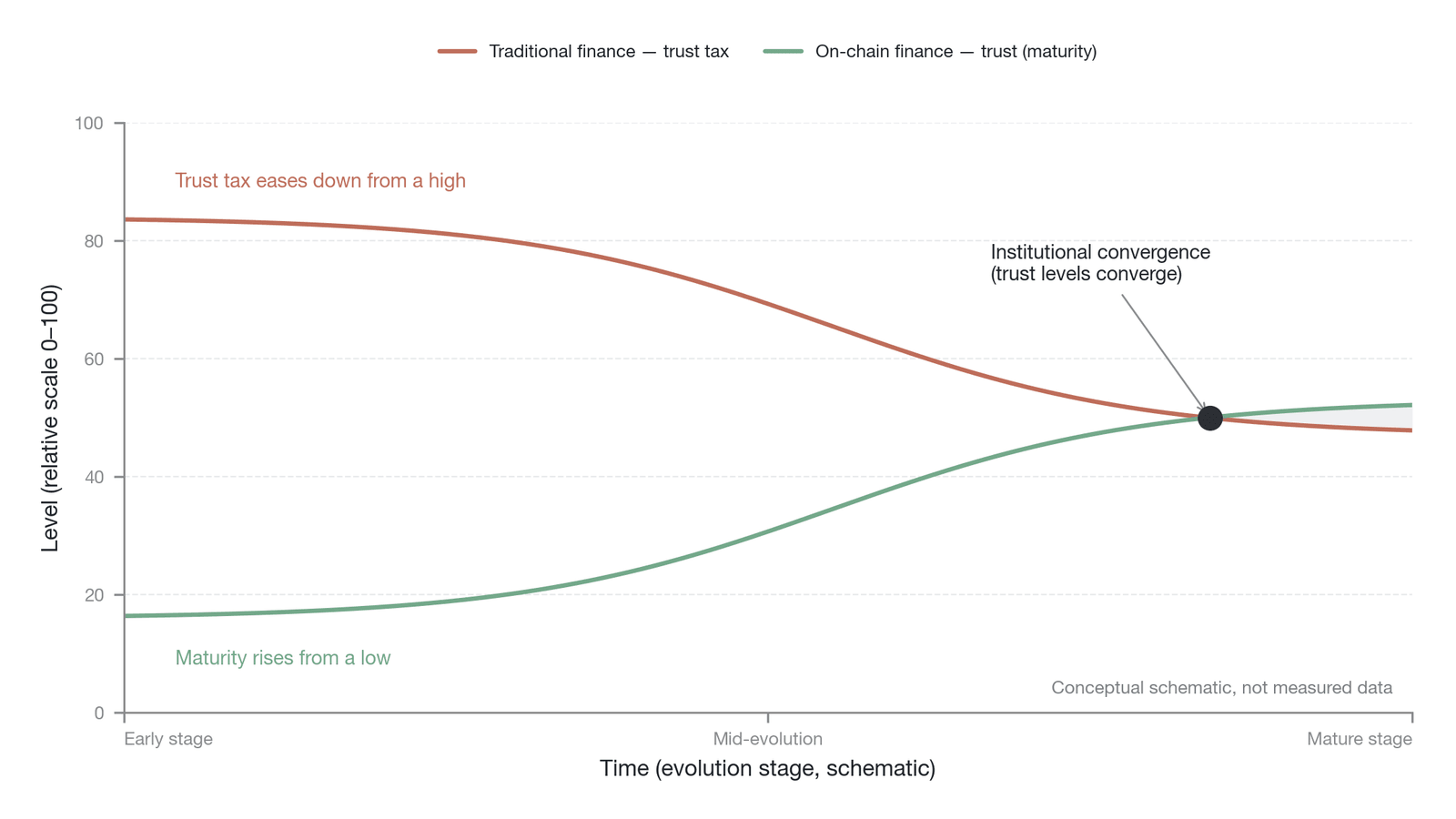
Figure 3-4. Institutional convergence—the converging trend of the declining trust tax of traditional finance and the rising trust level of on-chain finance (drawn by the author)
The two sides pursue different compression strategies. Traditional finance introduces on-chain technology to compress its own trust tax: DTCC explores atomic settlement to compress the time tax, BlackRock uses tokenization to compress the intermediary tax, SWIFT pilots blockchain to compress the jurisdiction tax, and traditional exchanges extend trading hours to compress the time-fragmentation tax. On-chain finance introduces institutional elements to raise its own level of trust: Hyperliquid adds a market-making vault as protocol-level insurance, Ethena obtains traditional-finance custody to strengthen architectural trust, and Circle obtains an electronic-money license that upgrades USDC from a crypto token to regulated electronic money. Both are moving toward the same destination—a lower trust tax and a higher level of trust—and that is convergence.
Once set in motion, this competitive process is hard to reverse. Competitive pressure makes retreat economically infeasible: once BlackRock has lowered its operating costs with a tokenized fund, its competitors must follow or lose market share on price. The on-chain infrastructure already built represents tens of billions of dollars in investment; this investment will not be scrapped but will continue to generate user inertia and network effects. Tens of thousands of engineers have mastered the on-chain finance technology stack, and thousands of institutions have built on-chain operational capacity; this human capital and organizational capability are likewise irreversible. Yet the irreversibility of convergence is not absolute. At least three scenarios could slow or partly reverse it: a systemic crisis of trust triggered by a large-scale security incident (such as confirmation that a stablecoin issuer's reserves are insolvent), a coercive ban by a sovereign state (such as a major economy comprehensively prohibiting financial activity on public blockchains), and a collapse of institutional confidence triggered by a governance failure internal to on-chain finance. In 2022, the Australian Securities Exchange (ASX) abandoned its blockchain settlement project, writing off more than A$250 million—a reminder that institutional adoption follows a narrative cycle, and that enthusiasm for a blockchain strategy can contract sharply during a phase of disillusionment. In a more extreme scenario, the infrastructure already built would not physically vanish, but the user activity and capital allocation atop it could flow back to the traditional system on a large scale. A more prudent formulation is therefore this: under current institutional conditions and the current trajectory of technological development, convergence is highly path-dependent and self-reinforcing, and its reversal would be extremely costly—but not logically impossible. The end state of convergence is more likely to be the optimal combination of the three trust paradigms described in Chapter 1: selecting, at each layer, the trust paradigm best suited to that layer's needs.
3.2.4 The institutional-convergence significance of the BUIDL fund
The significance of BlackRock's BUIDL fund lies not in BlackRock's stature but in its simultaneous demonstration of convergence in both directions, which makes it the most complete single piece of evidence for the institutional convergence thesis. In the direction of traditional finance moving on-chain, BUIDL chose the Ethereum public blockchain rather than a private one, adopted the ERC-20 token standard so that fund shares can be used in any compatible Ethereum application, partnered with Circle to enable instant, around-the-clock subscription and redemption in USDC, and let BUIDL serve as collateral in DeFi protocols [1]. In the direction of on-chain finance moving toward institutions, BUIDL strictly complies with U.S. securities law, is registered with the SEC, is open only to accredited investors, has its assets held in custody by BNY Mellon, and uses Securitize as the tokenization platform providing compliant on-chain securities issuance and management.
BUIDL introduced a key resource that on-chain finance had previously lacked: high-quality, low-risk collateral that generates a stable yield. Before BUIDL, DeFi protocols relied mostly on highly volatile crypto assets as collateral, which built in enormous systemic risk: when the crypto market fell as a whole, collateral values dropped and triggered liquidations, those liquidations triggered further selling pressure, and the reflexive downward spiral analyzed in Chapter 1 took hold. BUIDL gave on-chain finance, for the first time, low-volatility, high-quality collateral anchored to U.S. Treasury yields. As an ERC-20 token, BUIDL is inherently composable and can serve as Aave collateral, perpetual-futures margin, and more (this composability derives from a shared settlement layer, the mechanism of which is discussed in Section 3.4.3).
BUIDL's composability is also subject to three practical limitations. The first is liquidity: the depth of BUIDL's on-chain secondary market may be far below what its AUM implies; when BUIDL tokens must be sold quickly during a liquidation event, the on-chain market may be unable to absorb them, forcing a discounted sale—the classic traditional-finance problem of using an illiquid asset as collateral. The second is timing: BUIDL subscription and redemption are available only on business days, creating a structural mismatch with the margin needs of around-the-clock perpetual-futures trading, just as the USDC depegging event analyzed in Section 3.4.4 reveals the break between on-chain 24/7 operation and off-chain 5×8 banking hours. The deepest effect is systemic: once tokenized Treasuries are embedded at scale in DeFi, volatility in the U.S. Treasury market (such as the sharp decline in Treasury prices during the rapid rate-hike cycle of 2022) transmits directly to on-chain finance through the collateral-value channel, opening a cross-system risk-transmission path that did not previously exist and leaving on-chain finance no longer independent of the interest-rate risk of the traditional financial system.
Moreover, BUIDL's composability is permissioned, not the permissionless, fully open composability of native DeFi tokens. As an SEC-registered security, BUIDL uses Securitize's whitelist mechanism (a transfer restriction) to limit on-chain transfers to accredited investors, and an address not on the whitelist cannot hold BUIDL tokens. Regulators have not yet clearly tested the boundaries of this restriction within a composable DeFi environment: when BUIDL serves as collateral for a lending protocol, whether the protocol can ensure that all interacting parties meet the accredited-investor requirement—and the SEC's stance on the circulation of tokenized securities within DeFi—remains in flux. This compliance constraint is itself another instance of on-chain finance introducing institutional elements, exactly as the convergence thesis predicts: the technical potential of composability must be realized within an institutional framework.
3.3 The trust-tax compression curve and the three-horizon framework
Institutional convergence does not advance uniformly. The difficulty of moving different financial functions on-chain varies systematically, and this variation can be explained through the trust-tax compression curve. The three-horizon framework, in turn, divides the evolution of on-chain finance into three stages with different levels of maturity and standards of judgment.
3.3.1 The compression-difficulty gradient
Institutional convergence is under way, but it advances unevenly: stablecoin settlement has already reached the tens of trillions, Treasury tokenization is breaking through, and equity tokenization is still nascent. This unevenness is not random but reflects a gradient in the difficulty of compressing the trust tax. Different financial functions have different trust-tax structures. In some, the trust tax is primarily technical and can be compressed with code, because algorithms and cryptography can directly replace what users need to trust; in others, it is primarily institutional and must be maintained through law, regulation, and politics, because the trust involves domains that code cannot replace—sovereign power, the physical world, and human discretion.
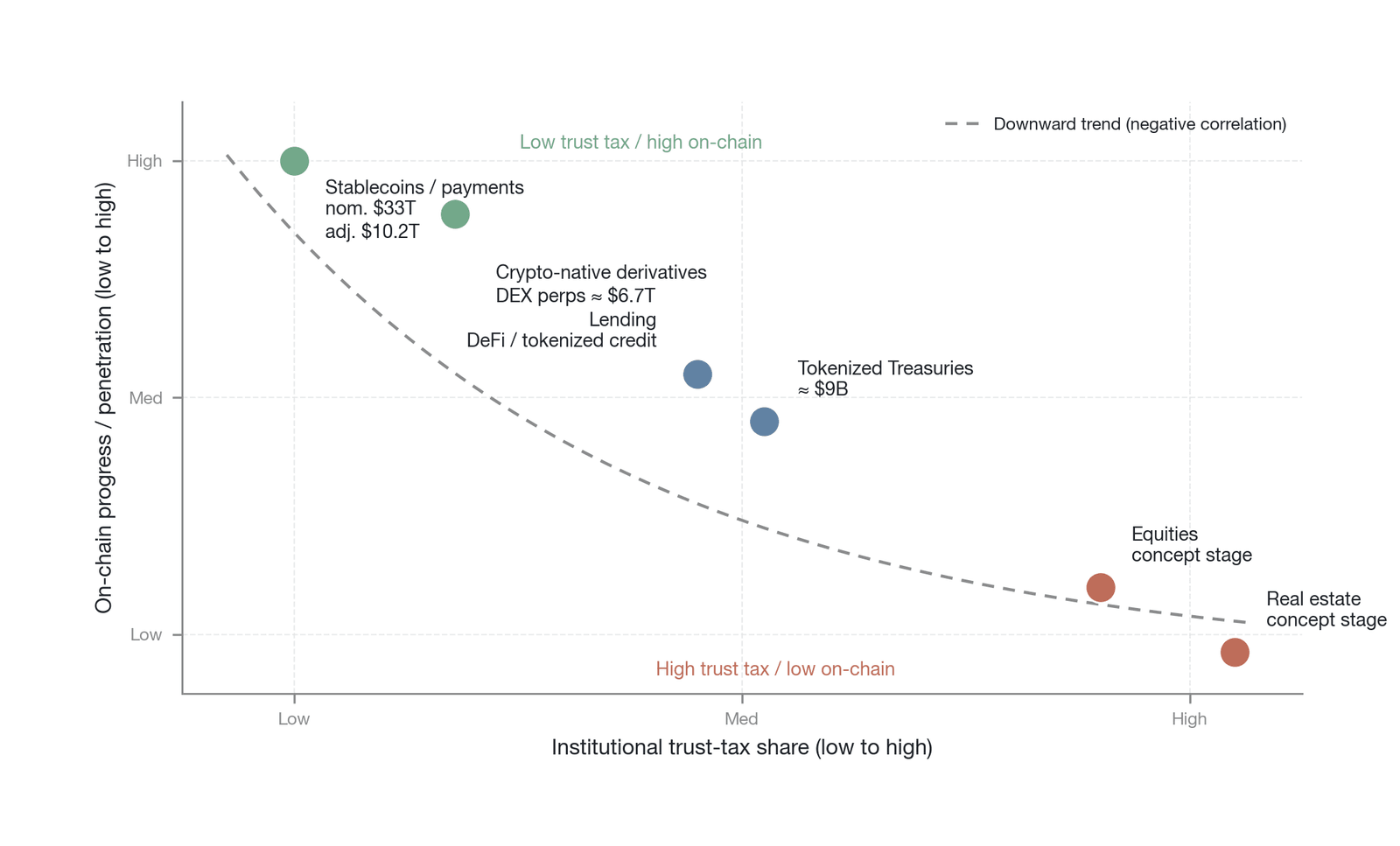
Figure 3-5. The trust-tax compression curve—the higher the share of the institutional trust tax in a financial function, the lower its on-chain progress (the scatter points of the various financial functions in the figure lie along a single negatively sloped trend line and represent the author's empirical judgment and estimates: the share of the institutional trust tax is the author's qualitative assessment of each financial function's trust structure, and the data anchors for on-chain progress are sourced by item—stablecoin nominal and adjusted transaction volumes are from Visa Onchain Analytics [38], data provided by Allium, raw/adjusted figures, accessed June 2026; DEX perpetual-futures trading volume is from CoinGecko [39]; and the size of tokenized Treasuries is from RWA.xyz [28])
In Figure 3-5, the horizontal axis is the share of the institutional trust tax (increasing from left to right) and the vertical axis is current on-chain progress (increasing from bottom to top); six categories of financial function appear as scatter points along a downward-sloping trend line, showing a clear negative correlation. Payments and settlement sit in the upper left, with the lowest share of institutional trust tax and the highest on-chain progress; real estate sits in the lower right, with the highest share of institutional trust tax and the lowest on-chain progress. This inverse relationship is not coincidental but causal: the higher the proportion of a financial function's trust needs that are technically replaceable, the lower the resistance to moving it on-chain and the faster its progress.
Table 3-3 arranges the six categories of financial function along the trust-tax compression-difficulty gradient, revealing a clear pattern: from payments and settlement to real estate, the share of the technical trust tax declines, the share of the institutional trust tax rises, and current on-chain progress correlates positively with the share of the technical trust tax.
| Financial function | Share of technical trust tax | On-chain compression difficulty | Current progress | Key bottleneck |
|---|---|---|---|---|
| Payments and settlement | Very high | Low | $33 trillion in annual stablecoin settlement; escape velocity reached | Anti-money-laundering compliance |
| Fixed income | Medium-high | Medium | Roughly $9 billion in tokenized Treasuries, with BUIDL in the lead | Adapting the legal framework |
| Lending | Medium | Medium | Tens of billions of dollars in total value locked (TVL) across Aave, Compound, and others | Credit-assessment systems |
| Derivatives | Medium | Medium | $6.7 trillion in annual perpetual-futures DEX volume | Regulatory classification and extraterritorial jurisdiction (CFTC swap-jurisdiction claims, extraterritorial application of the Commodity Exchange Act, or CEA) |
| Equities and equity stakes | Low | High | Very early exploration | Corporate-law reform |
| Real estate | Very low | Very high | Conceptual stage | Cooperation of the entire legal system |
Table 3-3. The trust-tax compression-difficulty gradient—from payments to real estate (Data sources: RWA.xyz [28], CoinGecko [9])
The current progress of on-chain finance unfolds along this curve from left to right—not because payments are simpler than equities, but because the trust tax of payments is primarily technical: correspondent banks, SWIFT nodes, and settlement delays can all be replaced by smart contracts and public blockchains, whereas the trust tax of equities is primarily institutional, and corporate governance, shareholder voting rights, dividend rights, securities registration, and annual audits require the cooperation of the entire legal framework.
This curve explains the past and also predicts the future: the next breakthrough is very likely to come in structured products and complex derivatives, whereas breakthroughs in equities and real estate require not technological progress but fundamental legal and institutional innovation. In 2022, the Boston Consulting Group and ADDX predicted that tokenized-asset volume could reach $16 trillion by 2030 [29]; McKinsey, in 2024, was more cautious, projecting that tokenized assets (excluding stablecoins and deposits) could reach $2 trillion by 2030, and roughly $4 trillion in an optimistic scenario [30]. The order-of-magnitude difference between the two projections reflects differing assumptions about how fast institutional obstacles will be overcome. Actual progress will more likely depend on the speed of the transition along the curve from fixed income to equities, and the bottleneck of that transition lies in the structural constraints analyzed in Section 3.6: the sovereignty boundary and the physical-world interface.
3.3.2 H1: Stablecoin settlement and crypto-native derivatives
The first horizon comprises those on-chain financial functions that have already reached significant scale, whose trust tax is primarily technical and has been effectively compressed by on-chain infrastructure. The two pillars of H1 are stablecoin settlement and crypto-native derivatives. The total market capitalization of stablecoins is roughly $310 billion, and their annual settlement volume reaches $33 trillion (Section 3.4 analyzes the statistical basis and the economically effective settlement volume in detail); escape velocity has been reached [9]. On the crypto-native derivatives side, perpetual-futures DEXs have annual trading volume exceeding $6.7 trillion, and the entire crypto-derivatives market has annual trading volume of roughly $92.9 trillion, split between centralized exchanges (CEXs) at roughly $86.2 trillion and DEXs at roughly $6.7 trillion. Chapter 2 analyzed the mechanism design of perpetual futures in detail; they are the most successful product in H1 and the central object of analysis throughout the rest of this book.
The total nominal economic activity of H1 products—including the $33 trillion in stablecoin settlement (see Section 3.4.1 for the basis) and the roughly $92.9 trillion in nominal derivatives trading volume (CEXs roughly $86.2 trillion, DEXs roughly $6.7 trillion; nominal volume is amplified by leverage and may include non-organic components such as rebate trading)—is within a comparable order of magnitude to the corresponding products of the traditional derivatives market. Of this, DEX perpetual futures running entirely on on-chain architectural trust contributed roughly $6.7 trillion, and achieving this scale does not rely on traditional financial infrastructure: no clearinghouse, no membership requirement, no central counterparty. The absence of a central counterparty (CCP) eliminates the risk of a centralized single point of failure, but it also means forgoing the three key functions a CCP provides: multilateral netting (which lowers systemic margin requirements), a default fund (which absorbs extreme losses), and an institutionalized default-management process. On-chain DEXs use insurance funds and ADL as substitutes, but the risk-bearing capacity of these mechanisms has not yet been tested under extreme stress with the same systemic intensity as a CCP; the losses that Hyperliquid's insurance vault faced during the March 2025 JELLY incident exposed the limits of these substitutes. Their economic significance lies not in the absolute numbers but in demonstrating that financial infrastructure based on architectural trust can operate at significant scale, even as its risk-management architecture continues to evolve from minimum viable toward systemically robust.
The trust profile of H1 is architectural trust as the mainstay, plus a minimum of institutional trust: users primarily trust cryptography and smart-contract code, while institutional trust is embodied mainly in stablecoin issuers' reserve management and exchanges' operational security. Its risk profile differs qualitatively from that of traditional finance. Protocol risk (smart-contract vulnerabilities) replaces operational risk (back-office human error), depegging risk (a stablecoin losing its peg) replaces credit risk (a bank's insolvency), and liquidation-cascade risk replaces settlement-cascade risk. Each of these conversions replaces a familiar, well-studied risk with a newer one that is not yet fully understood—a concrete manifestation of the risk-surface transformation analyzed in Chapter 1.
The success of H1 provides the empirical foundation for all of this book's analysis. Perpetual futures, as the highest-volume product in H1, prove that the four distinctive properties can generate a financial instrument superior in specific dimensions to its traditional counterpart, the quarterly future: continuous trading eliminates gap risk, a continuous funding rate achieves sustained price anchoring, permissionless global access broadens the participant base, and atomic settlement eliminates counterparty risk. Chapters 4 through 33 analyze this product's microstructure, risk dynamics, and future evolution in depth.
3.3.3 H2: Tokenized securities and institutional DeFi
The second horizon comprises the on-chain financial functions moving from proof of concept toward large-scale application, whose trust tax is a mixture of the technical and the institutional. Tokenized real-world assets (RWAs, excluding stablecoins) stood at roughly $24 billion to $28 billion by the end of 2025 (depending on the statistical basis, per RWA.xyz) [28] (note: Figure 3-9 ranks by the size of each subsegment, in which private credit uses an active-outstanding basis, so the sum of the subsegments exceeds the distributed total given here). Private credit is roughly $18.9 billion, with platforms such as Apollo and Securitize tokenizing long-illiquid private-credit assets; Treasuries and money market funds are roughly $9 billion, the fastest-growing segment, with BUIDL and Ondo Finance's USDY as representative products. Private credit's dominant position within H2 is no accident: this asset class has historically been plagued by extreme illiquidity, with lock-up periods typically of 3–7 years and a secondary market that barely exists. Tokenization addresses this structural weakness by enabling fractional ownership and around-the-clock secondary trading, lowering the liquidity premium that investors demand and expanding the pool of potential investors from large institutions to a broader group of accredited investors. The collaboration between Apollo and Securitize is a textbook case of this logic: accredited investors can enter a tokenized private-credit fund at a markedly reduced minimum investment, while the fund benefits from more efficient capital formation.
Treasury tokenization occupies a strategically different position. Unlike private credit, U.S. Treasuries already have extremely high liquidity in traditional markets. The value of tokenizing Treasuries lies not in improving liquidity but in achieving DeFi composability: once a U.S. Treasury fund exists in the form of an ERC-20 token, it can serve as collateral in lending protocols, as margin in derivatives trading, and as yield-bearing reserves in stablecoin mechanisms. BUIDL's rapid growth in AUM to near $3 billion proves that market demand for this composability is substantive. The core thesis of Treasury tokenization is this: the most trusted asset class in traditional finance, sovereign debt, can become the collateral backbone of the entire DeFi ecosystem (the mechanism by which it replaces highly volatile crypto assets and lowers systemic risk is discussed in Section 3.2.4).
The breakthrough of H2 depends more on institutional conditions than on technical capability. The full implementation of MiCA, the U.S. shift from enforcement-driven to legislation-driven regulation, and the regulatory sandbox regimes of Singapore and Hong Kong together turn the compliance risk of institutional participation from unassessable into assessable and manageable [23]. The years 2024–2030 are a critical window: if regulatory certainty continues to improve and early H2 products show reliable operational performance, institutional capital may flow into tokenized assets at a nonlinearly accelerating pace.
3.3.4 H3: Programmable money and autonomous finance
The third horizon comprises domains still at the conceptual and early-exploration stage, whose trust tax is almost entirely institutional. Central bank digital currency is the most direct intersection of programmability and monetary sovereignty. As of 2025, more than 130 countries (the Atlantic Council tracker now lists roughly 146) are exploring central bank digital currency [31], and China's digital yuan had a cumulative transaction value of roughly ¥16.7 trillion by the end of 2025 (¥7 trillion was a mid-2024 milestone) [32]. Its transformative potential lies in programmable monetary policy: targeted stimulus spending can be restricted to specific consumption categories, interest rates can be set differentially by holder type, and taxes can be collected automatically at the transaction level. Yet this programmability also raises fundamental concerns: a currency that the state can program can equally be used for surveillance, censorship, and behavioral control. The design choices around the privacy architecture of a central bank digital currency will define the boundary between efficient governance and authoritarian overreach.
AI agents are evolving from tools that assist human traders into independent entities that autonomously evaluate opportunities, execute trades, and manage portfolios. In 2025, projects such as Virtuals Protocol and Spectral had already deployed AI agents with their own wallets and the ability to trade on-chain. The long-term implications go beyond the automation of trading itself: if AI agents become the primary participants in DeFi markets, the market-microstructure assumptions on which current protocol design rests (human reaction times, behavioral biases, information-processing limits) may need fundamental revision. Chapters 31 through 33 analyze in detail how AI agents interact with perpetual-futures markets.
A cross-sovereign global settlement layer (a single neutral infrastructure serving all value transfer) is the logical endpoint of the stablecoin settlement-layer migration analyzed in Section 3.4. Yet this vision conflicts directly with the sovereignty boundary analyzed in Section 3.6.1. A more realistic direction of evolution is federated global settlement: multiple sovereign jurisdictions each define their own rules—know-your-customer (KYC) requirements, asset restrictions, tax reporting—while sharing a common technical infrastructure layer. This model captures the efficiency gains of a unified settlement network while preserving sovereignty. The standards for judging H3 are inherently uncertain: no established metrics for the progress of programmable money or autonomous finance yet exist, and premature quantification would bring only misleading precision.
3.3.5 Differences in the trust needs of the three horizons
The trust needs of the three horizons are fundamentally different and should not be judged by a single standard. Using the logic of "stablecoins have already succeeded, so blockchain will change everything" to infer the prospects of H3, and using the logic of "real-estate tokenization has not yet succeeded, so blockchain is worthless" to deny the achievements of H1, commit the same methodological error: conflating the maturity levels and standards of judgment of different horizons.
Figure 3-6 uses a timeline to show the evolutionary path and differing trust needs of the three horizons (H1, H2, and H3).
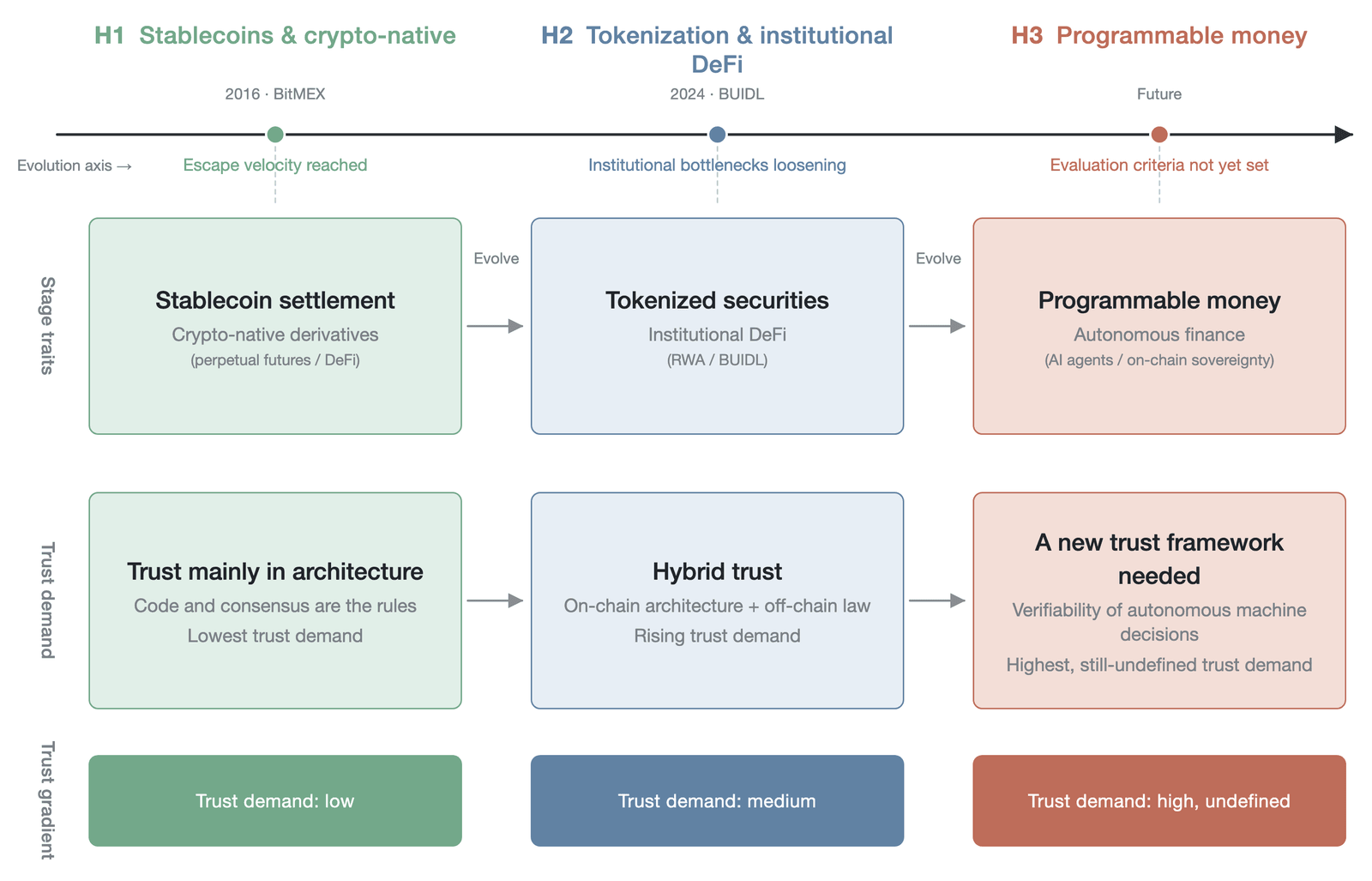
Figure 3-6. The three-horizon framework—the evolutionary path and differing trust needs of on-chain finance from H1 to H3 (drawn by the author)
The differences can be compared along five dimensions: trust paradigm, regulatory need, current scale, standard of judgment, and time scale. Table 3-4 summarizes the structural distinctions among the three horizons along these dimensions.
| Dimension | H1: Stablecoins and crypto derivatives | H2: Tokenized securities and institutional DeFi | H3: Programmable money and autonomous finance |
|---|---|---|---|
| Primary trust paradigm | Architectural trust as the mainstay | A mix of architectural and institutional trust | Requires an entirely new trust framework |
| Regulatory need | Anti-money-laundering and reserve transparency | Securities-law compliance and investor protection | Requires an entirely new regulatory paradigm |
| Current scale | $33 trillion in annual settlement (roughly $0.4–10 trillion adjusted to a payment basis), roughly $92.9 trillion in nominal derivatives trading (CEX roughly $86.2 trillion, DEX roughly $6.7 trillion) | Roughly $25 billion in tokenized RWAs | Concept and early pilots |
| Standard of judgment | Trading volume, settlement efficiency, and stability | AUM growth and institutional adoption rate | No established standard yet |
| Time scale | Scale already reached | Breaking through; 2024–2030 the critical window | Long-term vision, the 2030s and beyond |
Table 3-4. A systematic comparison of the trust needs of the three horizons (Data source: compiled by the author)
The most notable feature of Table 3-4 is the difference in the standard-of-judgment row. The success of H1 can be measured directly with hard metrics such as trading volume and settlement efficiency; the progress of H2 can be tracked through AUM growth and the institutional adoption rate; but H3 has not even a commonly accepted standard of judgment, which means any quantitative assessment of it should be treated as highly preliminary. This difference also explains why public discussion of the prospects of on-chain finance so often becomes polarized: optimists extrapolate from the hard data of H1, pessimists dismiss the field on the uncertainty of H3, and the two sides are in fact debating different questions on different horizons.
3.4 Stablecoins: a structural migration of the settlement layer
Stablecoins are the largest and most far-reaching product category in the first horizon of on-chain finance. The scale of their annual settlement volume marks not merely the success of an asset class but a structural migration under way in the settlement layer of the financial system.
3.4.1 The meaning of $33 trillion in settlement volume
As of the end of 2025, the total market capitalization of stablecoins worldwide was roughly $310 billion, with annualized on-chain settlement volume of approximately $33 trillion (Artemis/Bloomberg [7]), exceeding the combined annual processing volume of Visa (roughly $14 trillion; FY2025 payment volume, roughly $17 trillion including cash) and Mastercard (roughly $10.6 trillion) [9][33]. Figure 3-7 compares these magnitudes. The significance of the comparison lies not in the absolute numbers (differences in statistical basis are discussed below) but in the fact that an on-chain settlement infrastructure less than 10 years old already stands, in aggregate terms, within a comparable order of magnitude of the world's most mature payment networks.
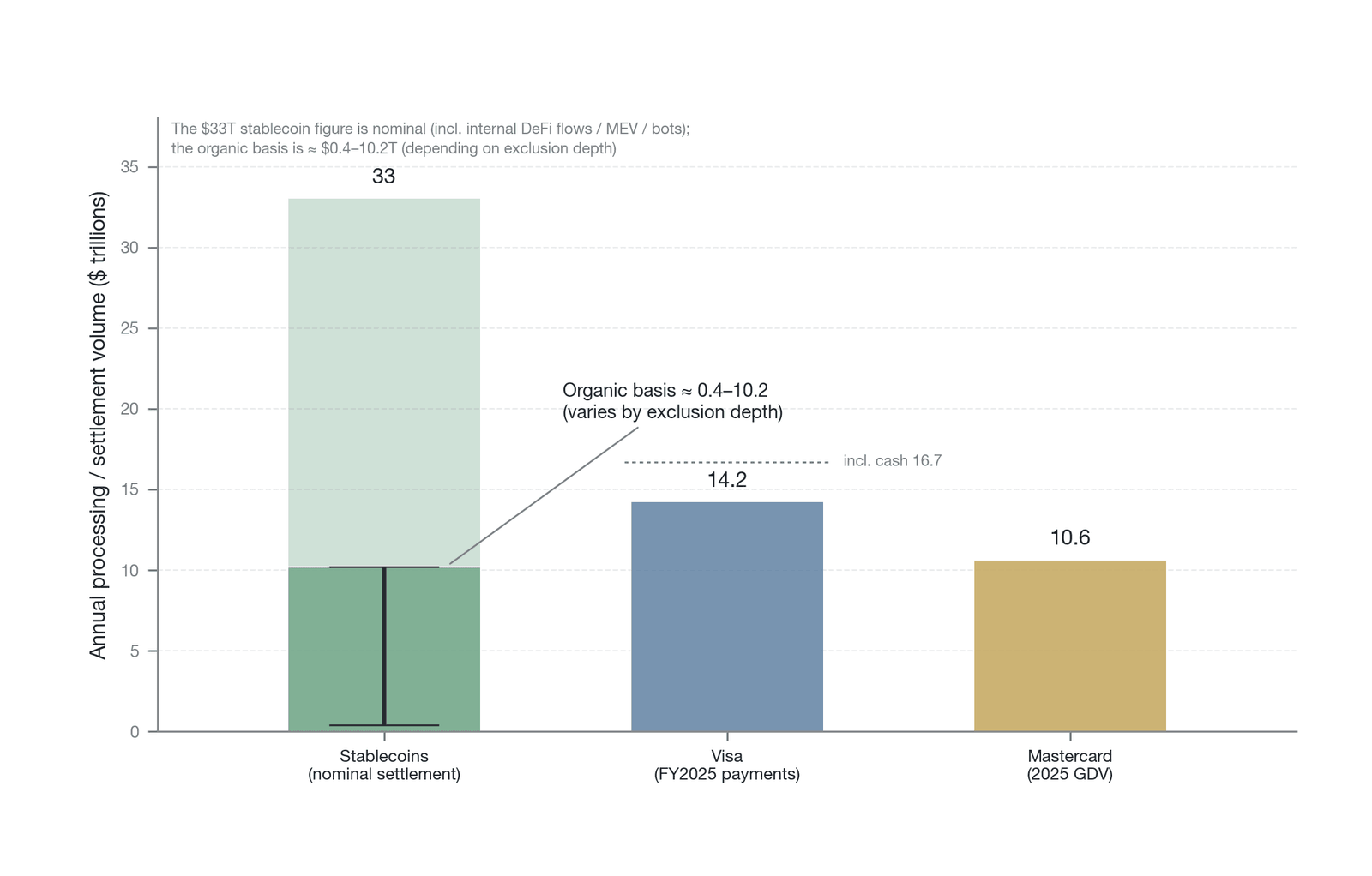
Figure 3-7. A comparison of the annual magnitudes of stablecoins and the card networks (nominal basis vs. organic basis; the nominal volume of stablecoin on-chain transfers for all of 2025 was roughly $33 trillion, up 72% year over year, including non-payment activity such as internal DeFi flows, MEV, arbitrage, and market-making bots, and is not directly comparable to card-network payment volume; the organic basis, after excluding non-payment activity, is roughly $0.4 trillion–$10.2 trillion, with the lower bound being roughly $0.39 trillion in true payments annualized and the upper bound roughly $10.2 trillion in adjusted transfer volume, the width of the range depending on the degree of exclusion, as marked with a range in the figure; Visa's payment volume of $14.2 trillion and Mastercard's gross dollar volume (GDV) of $10.6 trillion are shown for comparison, with Visa's cash-inclusive figure at $16.7 trillion; data sources: Artemis/Bloomberg [7]; Visa Onchain Analytics adjusted basis, trailing 12 months, accessed June 26, 2026; McKinsey × Artemis, annualized as of December 2025; Visa FY2025 10-K, as of September 30, 2025 [33]; Mastercard FY2025 results)
The statistical basis requires clarification: the on-chain settlement volume of stablecoins includes all on-chain transfers, a considerable share of which are internal DeFi flows, MEV arbitrage, and bot loop trades—not fully comparable to the consumer payments of Visa and Mastercard. Estimates after excluding these non-economic transactions diverge widely by method: Visa's on-chain analytics gives roughly $10.2 trillion (adjusted); Chainalysis gives roughly $28 trillion (true economic activity); McKinsey and Artemis estimate that only roughly $0.39 trillion is true real-world payments (roughly 1% of the total, as of January 2026); and the heuristic of Brevan Howard Digital (2024) [8] gives an organic share of roughly 10%. Even at the higher adjusted figure, this scale remains within the same order of magnitude as Visa's annual net payment volume, and its growth rate far exceeds Visa's.
The core economic advantage lies in extremely low marginal cost and global reach. Traditional cross-border payments must pass through multiple correspondent banks layer by layer, taking 3–5 business days at a cost of 5–10% of the transaction amount. On-chain stablecoin transfers, regardless of amount, complete within minutes, at a cost typically under $1 on Layer 2 networks (though the Ethereum mainnet can reach several to tens of dollars during congested periods). This efficiency difference stems from an architectural one; the specific comparison of serial versus parallel trust is detailed in Section 3.5.2.
3.4.2 The network effects and escape velocity of stablecoins
Stablecoins have reached escape velocity. This chapter operationalizes escape velocity as follows: a network has reached it when the marginal user-growth rate driven by network effects persistently exceeds the natural attrition rate, and when growth no longer depends on an exogenous impetus (such as price speculation or subsidy incentives) but has become endogenous and self-maintaining. The network-externality theory of Katz and Shapiro (1985) [34] provides a standard framework for this dynamic: when a user's utility increases as the network grows, a critical size threshold exists beyond which growth becomes self-accelerating. This judgment must withstand cyclical testing. During the 2022 bear market, the total market capitalization of stablecoins shrank from roughly $180 billion to roughly $120 billion (about 33%), showing that growth is not entirely endogenous. But the key distinction is this: the contraction came mainly from the ebbing of speculative demand (the collapse of the algorithmic stablecoin UST alone accounted for roughly $18 billion of it), whereas the cross-cycle trend in settlement volume and active-address count indicates that actual usage demand kept growing. A more stringent test will come after the next complete bear-market cycle: if stablecoin settlement volume and active-user count keep growing through the next downturn, the escape-velocity judgment will gain stronger empirical support. A threefold network effect gives stablecoin growth this self-reinforcing character.
The first is a liquidity network effect. The more traders use USDC and USDT, the deeper the market liquidity and the narrower the bid-ask spread, which in turn attracts more traders, forming a positive feedback loop. This effect explains the extreme concentration in which USDT and USDC hold more than 85% market share. A newly entering stablecoin faces a cold-start dilemma: without liquidity, traders will not adopt it, and without traders, liquidity cannot form. This dynamic gives the current duopoly a self-reinforcing character, much as the joint market position of Visa and Mastercard in card payments has held firm over decades despite persistent competitive entry.
The second is an integration network effect. The more DeFi protocols support USDC, the greater USDC's utility as an on-chain dollar, which in turn attracts more protocols to integrate it. USDC is already natively supported by hundreds of DeFi protocols, serving as the default quote currency in AMM pools, standard collateral in lending protocols, and the primary settlement token in perpetual-futures trading. Each additional integration raises the cost of switching to an alternative stablecoin, producing a standard lock-in effect.
The third is a settlement network effect. The more institutions and individuals settle in stablecoins, the lower the friction of cross-border settlement, which in turn drives broader adoption. The moves by Visa and Mastercard to integrate stablecoin settlement amplify this effect, connecting on-chain settlement to the vast user base of traditional payment networks. Once escape velocity is reached, growth becomes self-maintaining, no longer dependent on new technological breakthroughs; the network effect itself is the engine of growth.
3.4.3 The upper-layer effects after the settlement layer is established
The financial system is layered, and settlement is the bottommost layer. Once the settlement layer is established on-chain, upper-layer applications naturally migrate to the same layer, because composability works within a single settlement infrastructure but cannot span different ones. When the BUIDL fund exists as an ERC-20 token on Ethereum and settles in USDC, it automatically gains composability with all other Ethereum DeFi protocols: it can serve as Aave collateral, trade on Uniswap, be incorporated into structured products, and serve as margin for perpetual futures. This cross-application interoperability, which would require months of legal negotiation and technical integration in traditional finance, is a natural property of shared settlement infrastructure on-chain.
The upper-layer effect produces a self-reinforcing dynamic. Perpetual-futures DEXs use stablecoins as margin, tokenized Treasuries subscribe and redeem in USDC, DeFi lending protocols denominate in stablecoins—all upper-layer applications already run atop the on-chain settlement layer. As more upper-layer applications accumulate, the settlement layer becomes ever more entrenched: migrating away from it would require migrating every dependent application at once, which grows less and less realistic as the ecosystem expands. This lock-in dynamic explains why the stablecoin settlement-layer migration, once past the escape-velocity threshold, becomes structurally irreversible. To see stablecoins merely as an on-chain dollar substitute is to underestimate their systemic significance: they are the foundation on which the entire on-chain financial technology stack is built.
3.4.4 The structural risks of stablecoins
Stablecoins also carry structural risks. The first is reserve-transparency risk. The controversy over the composition of Tether's reserves has persisted for years. For a financial instrument with a market capitalization exceeding $100 billion, incomplete or delayed reserve disclosure constitutes a systemic risk. Tether has improved transparency by releasing quarterly attestation reports, but a significant gap remains between these reports and the comprehensive, independent, real-time audit that a traditional financial instrument of comparable size would face. This gap between attestation and audit is a residual trust deficit.
The second is depegging risk. The clearest empirical case is USDC's depeg to $0.87 after the collapse of Silicon Valley Bank (SVB) in March 2023. Circle held $3.3 billion at SVB, roughly 8% of its reserves [35]. During the 48-hour depegging period, cascade effects propagated throughout the DeFi ecosystem: the declining value of USDC-denominated collateral triggered liquidations in lending protocols, traders rushing to exit USDC positions unbalanced DEX pools, and USDC's function as the default settlement token was temporarily disrupted. The collapse of SVB occurred after banks closed on a Friday, and Circle was unable throughout the weekend to confirm the safety of its $3.3 billion in reserves or to process redemptions—exposing a structural operational break: on-chain stablecoins claim to run around-the-clock and instantly, but redeeming their reserves depends on the working hours of traditional banks (Monday through Friday), so depegging risk peaks precisely when the traditional financial system is least available. The depeg was resolved only after the U.S. government guaranteed SVB's depositors, which means USDC's stability ultimately depended on sovereign intervention rather than any algorithmic or architectural mechanism.
The third is systemic concentration risk. USDT and USDC together hold more than 85% market share. The failure of either issuer (whether due to reserve insolvency, regulatory action, or an operational-security incident) could trigger a systemic crisis across the entire on-chain financial system. This concentration creates a single-point-of-failure architecture, at odds with the decentralization ethos of blockchain. Diversification into alternative stablecoins has made limited progress, precisely because of the liquidity network effect analyzed in Section 3.4.2.
The fourth is the effect on monetary sovereignty. The global adoption of dollar-denominated stablecoins in effect extends U.S. monetary influence into economies that may not welcome it. For emerging-market countries with volatile local currencies, the adoption of USDC and USDT provides citizens and enterprises with de facto dollar accounts, potentially weakening the transmission of local monetary policy and capital-account controls. The central bank digital currency programs of several countries are an explicit defensive response to this dynamic. The EU's MiCA sets capital requirements and reserve rules for stablecoin issuers [23]; the United States is advancing stablecoin legislation, bringing stablecoins into the framework of regulated financial infrastructure.
3.5 Asset tokenization and on-chain settlement
The previous two sections made the macro case: the direction of convergence (Section 3.3) and the evidence of settlement-layer migration (Section 3.4). This section turns to the technical path, analyzing the engineering process of asset tokenization and the architectural advantages of on-chain settlement, to give those macro arguments a micro-technical foundation.
3.5.1 The economic logic of asset tokenization
Asset tokenization is the process of cryptographically mapping the ownership of and associated rights in a real-world asset onto a digital token on a blockchain; its core function is to lower transaction costs through standardization, transforming non-standardized, low-liquidity real-world assets into standardized, highly liquid, globally tradable digital-native assets. Chapter 1 answered why digital assets are distinctive; this section answers how to give traditional assets those distinctive properties as well.
The trust-tax compression curve of Section 3.3 showed that tokenization progress correlates positively with the share of the technical trust tax. Tokenization is not a simple digital mapping but a multi-stage engineering process spanning law, technology, and compliance, and understanding it helps explain why different asset classes tokenize at systematically different speeds. Figure 3-8 shows the full life-cycle process of a tokenized asset, from a traditional asset to on-chain circulation.
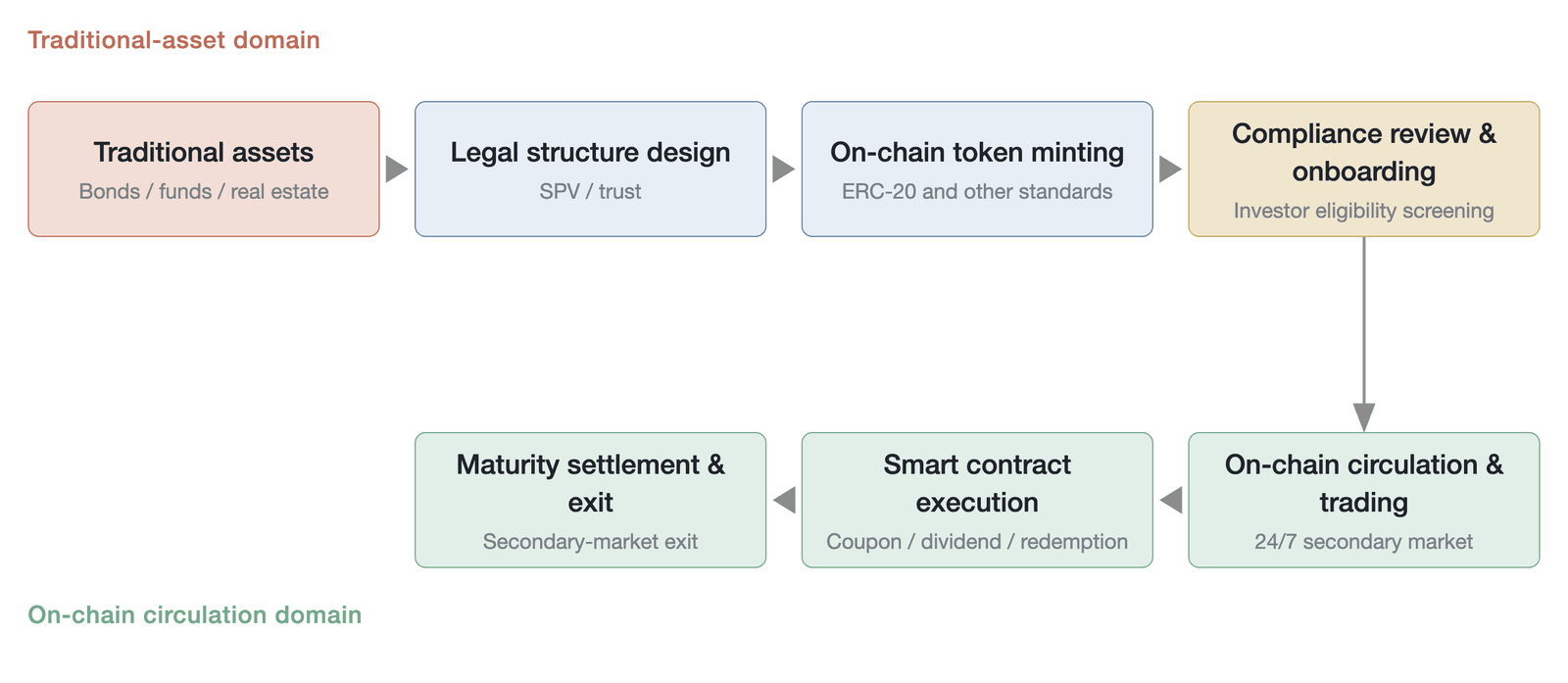
Figure 3-8. The full life-cycle process of a tokenized asset—from a traditional asset to on-chain circulation
The size distribution of tokenized assets is highly concentrated. Figure 3-9 shows that private credit, together with Treasuries and money market funds, constitutes the two largest categories, which together account for the vast majority of total tokenized RWAs; the remaining domains are still below tens of billions of dollars. This concentration reflects the prediction of the trust-tax compression curve: asset classes with a high share of technical trust tax move on-chain first.
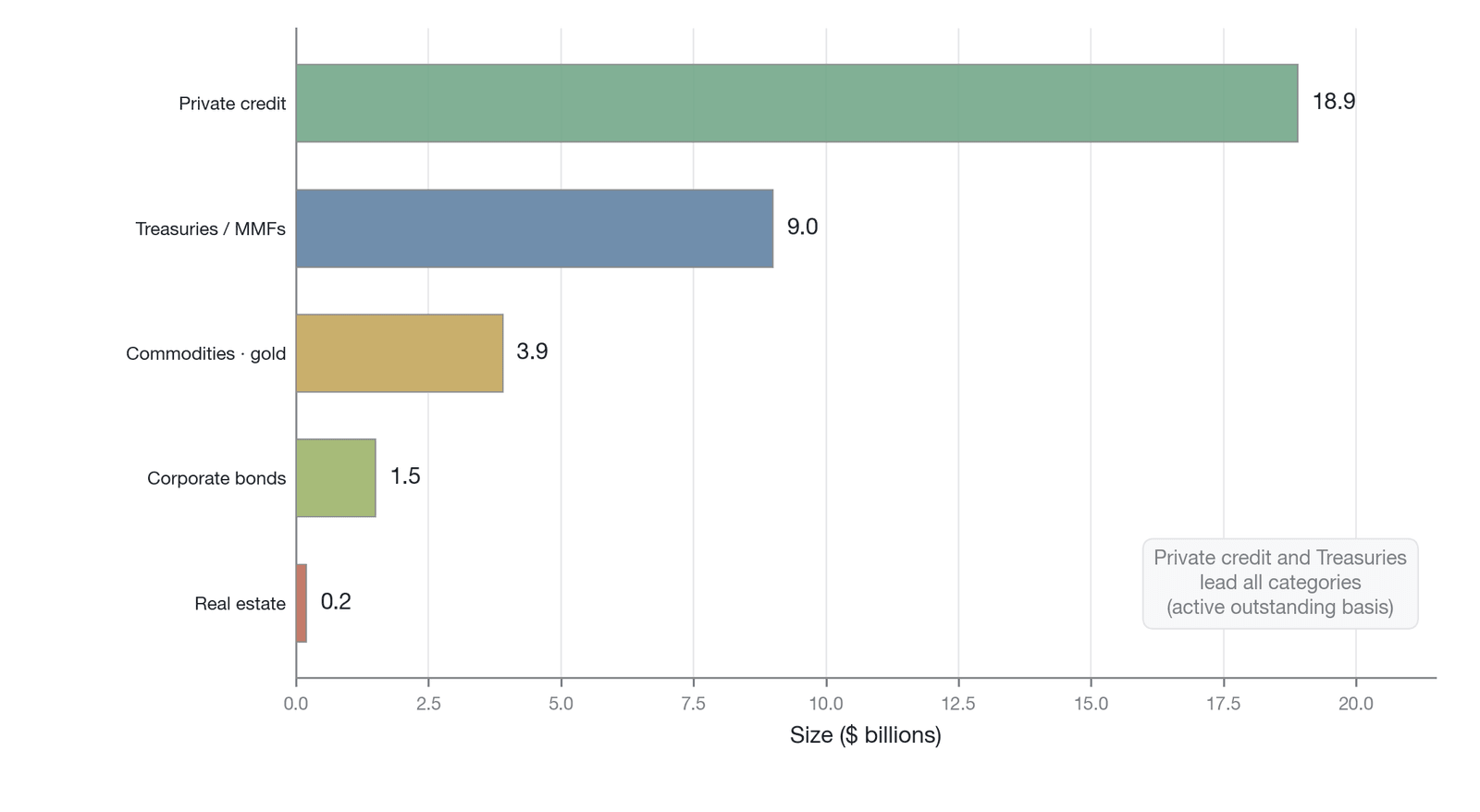
Figure 3-9. A size ranking of the major subsegments of on-chain RWAs (in billions of dollars, as of the end of 2025; private credit leads at roughly $18.9 billion, followed by Treasuries and money market funds at roughly $9 billion, the two together accounting for the vast majority of tokenized RWAs; commodities dominated by gold, corporate bonds, and real estate remain a long tail at tens of billions of dollars and below; private credit uses an active-outstanding basis, dominated by Figure's on-chain home equity line of credit (HELOC) loan book, while the rest use a market-value/distributed basis; data source: RWA.xyz [28])
Table 3-5 summarizes the current progress of on-chain finance in four core domains—private credit, Treasury funds, sovereign and corporate bonds, and cross-border payments—along three dimensions: size, representative projects, and key advantages relative to traditional finance.
| Domain | Size | Representative projects | Key advantages |
|---|---|---|---|
| Private credit | Roughly $18.9 billion | Apollo and Securitize, Centrifuge | Solves poor liquidity, lowers the participation threshold |
| Treasuries and money market funds | Roughly $9 billion | BUIDL, Franklin Templeton, Ondo | Around-the-clock subscription and redemption, DeFi composability |
| Sovereign and corporate bonds | Hundreds of millions of euros | European Investment Bank, Siemens | T+0 settlement, lower issuance costs |
| Cross-border payments | $33 trillion in annual settlement | Circle USDC, Tether USDT | Near-real-time, extremely low cost, globally reachable |
Table 3-5. The application progress of on-chain finance in key domains (Data source: RWA.xyz [28])
Table 3-5 reveals a pattern consistent with the trust-tax compression curve: the two largest domains, cross-border payments ($33 trillion in annual settlement) and private credit (roughly $18.9 billion), correspond exactly to the asset classes with a higher share of technical trust tax and an obvious efficiency gap in traditional markets. The pain point of cross-border payments is speed and cost; that of private credit is illiquidity—both domains that code and architecture can directly improve. By contrast, sovereign and corporate bonds remain at the level of hundreds of millions of euros, and their issuance involves more institutional approval steps, confirming the constraint that the institutional trust tax places on on-chain speed.
3.5.2 The architectural advantages of on-chain settlement
On-chain settlement uses a blockchain as the underlying network for value transfer and clearing, on a globally unified, neutral, around-the-clock ledger whose trust is guaranteed by decentralized cryptographic consensus. Traditional payments rest on the serial relay of bilateral trust relationships, in which each additional intermediary node adds a layer of cost; on-chain settlement rests on a single global consensus, in which all participants share the same trust foundation.
Figure 3-10 compares the two settlement paths. In the traditional cross-border payment path, the SWIFT network performs a messaging function, conveying payment instructions rather than moving funds, while the funds themselves move through the nostro/vostro account relationships between correspondent banks. In this multi-node serial relay, each node adds delay and fees, and the failure of any node breaks the entire chain (SWIFT itself is raising payment speed and transparency through innovations such as SWIFT GPI to meet the competition). In the on-chain settlement path, the sender initiates a transfer directly on the blockchain through a wallet, and once blockchain consensus verifies it, the funds arrive at the recipient's wallet—only three nodes, with the intermediate consensus layer decentralized and free of any single point of failure.
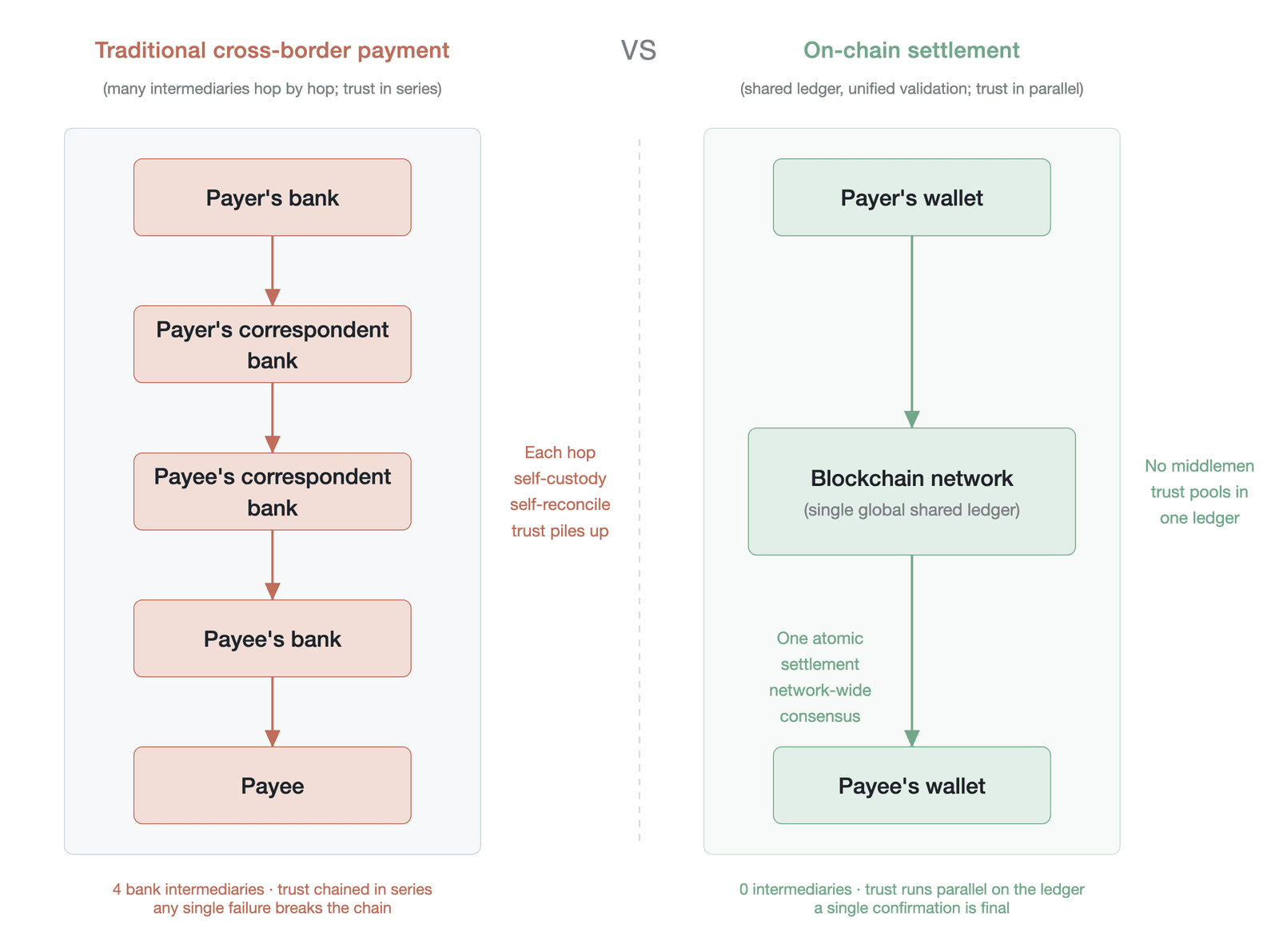
Figure 3-10. A process comparison of traditional cross-border payments and on-chain settlement—the architectural difference between serial trust and parallel trust
Parallel trust is superior to serial trust in both efficiency and resilience. In regions such as Latin America and sub-Saharan Africa, many small and medium-sized enterprises are increasingly adopting stablecoins as their primary means of payment and receipt, cutting the in-transit time of funds from days to minutes and transaction costs by as much as 90%—a cheaper, faster global-payment option for enterprises underserved by the traditional financial system.
3.5.3 Three surmountable challenges
On-chain finance faces three surmountable challenges. They are not independent of one another but form a mutually reinforcing feedback loop. Figure 3-11 uses a triangular structure to depict the bidirectional dependencies among technical maturity, regulatory certainty, and market size. This means that a breakthrough in any single dimension requires the cooperation of the other two to produce a lasting effect; it also means that once one dimension makes substantive progress, a positive feedback loop may accelerate the whole.
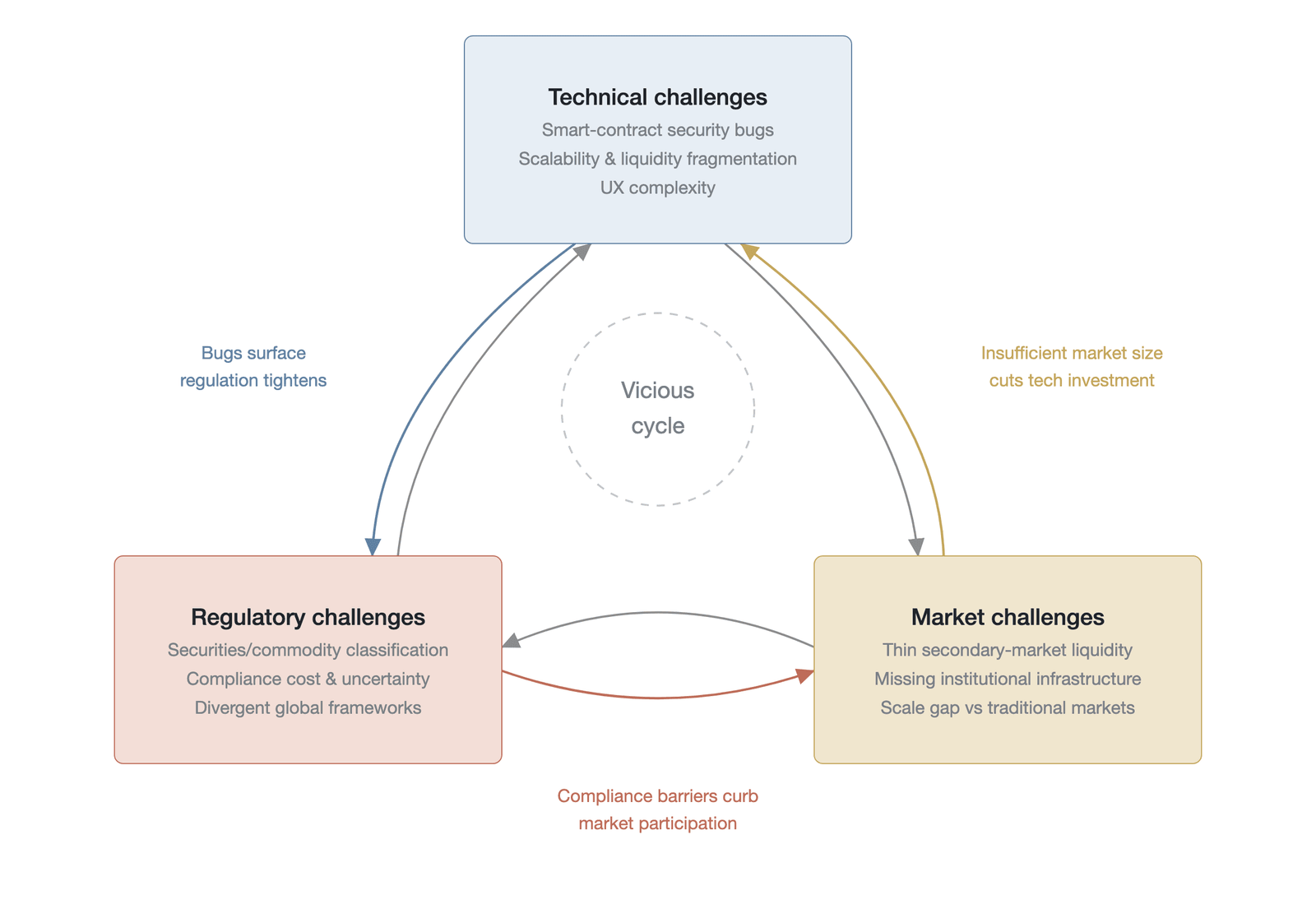
Figure 3-11. The interrelationship of the three major challenges of on-chain finance—the feedback loop among technology, regulation, and the market
On technical maturity, smart-contract security risk remains prominent (see Section 3.1.4 for the scale of security losses in 2025). The operational reliability of underlying blockchains still falls below that of traditional financial infrastructure: Solana suffered several multi-hour network outages between 2021 and 2023, and surging gas fees on the Ethereum mainnet during periods of high load make small transactions uneconomical, whereas the availability of traditional financial infrastructure such as Fedwire typically exceeds 99.99%. TVL on Layer 2 networks—which L2BEAT now reports as total value secured (TVS)—grew from roughly $5 billion to more than $40 billion, with a 2024–2025 peak approaching $50 billion [36], but this brought a fragmentation problem, and the user experience remains overly complex. On regulatory certainty, MiCA leads but is still being implemented, the U.S. jurisdictional dispute between the SEC and the CFTC is unresolved, and fragmentation leaves institutions facing high compliance risk. On market size, roughly $25 billion in tokenized RWAs is still a negligible fraction of the hundreds of trillions in the global traditional financial market, and illiquidity and a weak secondary market form a negative loop.
These three challenges are obstacles that effort can overcome, distinct from the impossibility boundaries of the next section. The essential difference is this: the former are matters of degree—technical security will keep improving, the regulatory framework will gradually clarify, and market size will grow with the adoption rate; their solution paths are known, and the only bottleneck is the speed of execution. The latter are matters of kind—sovereignty will not vanish, the physical world will not become digital, and the logical constraints of decentralization cannot be engineered away; even infinite technological progress cannot break through them. This distinction is the first analytical step in assessing the prospects of any specific on-chain financial innovation.
3.6 The impossibility boundaries
The three structural constraints—the sovereignty boundary, the physical-world interface, and the governance paradox—are not obstacles that can be overcome through technological progress or institutional innovation but permanent constraints that must be lived with. Identifying these boundaries is the premise of a mature analytical framework and the methodological basis for distinguishing surmountable challenges from impassable constraints.
3.6.1 The sovereignty boundary
At bottom, the permissionlessness and globalization of on-chain finance challenge the state's jurisdiction over financial activity. This challenge is not technical but political: financial sovereignty is a core component of national sovereignty, and the transmission of monetary policy, foreign-exchange controls, capital-account management, and sanctions enforcement all depend on jurisdiction over financial activity. If a state cannot track, restrict, or freeze the flow of funds within its territory, its monetary policy, tax system, and sanctions capability will all be fundamentally weakened.
Empirically, no major country has chosen to relinquish financial jurisdiction, and national responses form a full spectrum from comprehensive prohibition to framework-based regulation. In 2021, China comprehensively banned cryptocurrency trading and mining while advancing the research, development, and pilots of the digital yuan. The logic of this strategy is to reject permissionless on-chain finance while retaining the technical potential of programmable money, provided that control over programmability stays with the central bank. The United States has adopted a strategy of selective enforcement: in 2022, OFAC sanctioned Tornado Cash, freezing all Ethereum addresses associated with the mixing protocol—the first time a sovereign state imposed sanctions on immutable open-source smart-contract code rather than on a specific individual or organization [37] (the sanction was later overturned by the Fifth Circuit in November 2024, and OFAC removed it in March 2025, though criminal proceedings against the founders continue as a separate matter). This action sparked a constitutional debate over whether code constitutes protected speech, but its policy signal was clear: even a technically unstoppable on-chain protocol cannot transcend sovereign jurisdiction. The CFTC's enforcement actions between 2023 and 2024 against offshore DeFi protocols such as Opyn, ZeroEx, and Deridex further confirmed its swap-jurisdiction claim over crypto derivatives; U.S. users trading perpetual futures on offshore DEXs may technically violate the CEA, which bears directly on the central subject of this book. The EU, through MiCA, brings crypto assets into a unified regulatory framework—neither prohibiting them wholesale nor letting them run free, but framing jurisdiction and seeking a balance between room for innovation and regulatory capacity [23].
What these different strategies have in common is this: no country has chosen to cede financial jurisdiction. Fully permissionless global finance (anyone able to transact any amount with any counterparty at any time without government review) is politically impossible so long as the system of states endures. The realistic end state is conditional permissionlessness: technically permissionless but conditional on compliance. The zero-knowledge-proof compliance credentials discussed in Chapter 30 are one technical exploration of maximizing freedom within this boundary, letting users prove to a smart contract that they meet compliance requirements without exposing their identity or transaction details. The sovereignty boundary also explains why compression difficulty is so high at the right end of the trust-tax compression curve: the trust tax of equities and real estate is supplied primarily by sovereign institutions—corporate law defines shareholder rights, property law defines real-estate ownership—and sovereign institutions will not voluntarily withdraw from these domains.
3.6.2 The physical-world interface
The efficiency advantage of architectural trust is clearest when on-chain finance handles purely digital assets, but it hits a fundamental interface problem when it touches assets in the physical world: a blockchain can transfer the ownership of a token frictionlessly, but it cannot frictionlessly transfer control over the physical entity that the token represents.
The theoretical root of this problem lies in a generalized form of the oracle dilemma. A blockchain is a closed, deterministic system whose internal state can be fully verified cryptographically, but its interface with the external world depends on oracles—intermediaries that feed off-chain information on-chain. For price data, decentralized oracle networks such as Chainlink have provided relatively reliable solutions. But for the state of physical assets (such as whether a house still exists, whether a batch of goods is still in the warehouse, or who actually possesses a plot of land), no decentralized verification mechanism exists. Verifying the state of the physical world ultimately depends on human observation and institutional enforcement.
Real-estate tokenization illustrates these constraints layer by layer. At the title-confirmation layer, property-registration systems differ enormously across jurisdictions, and many emerging-market countries lack even a complete digitized registry, so the mapping between on-chain tokens and off-chain title needs legal institutions to establish and maintain it. At the rights-enforcement layer, an on-chain token can record a change in home ownership, but when the occupant refuses to leave, a smart contract cannot enforce it; that requires a court summons and the physical action of law-enforcement personnel. At the valuation layer, the value of real estate depends on many off-chain factors—location, physical condition, urban-planning policy—that on-chain data cannot capture. At the cross-border enforcement layer, even if on-chain records were globally unified, the degree of judicial recognition of on-chain title certificates varies across national courts. Tokenization can make a home's transaction records more efficient and transparent, but it cannot make title confirmation and enforcement more efficient; the latter will always depend on the offline legal system.
Commodity tokenization faces similar constraints. Tokenized gold requires trusted third-party custody and periodic audits to ensure a one-to-one correspondence between the on-chain token and the physical gold, and this trust still rests on institutional trust in the auditor and custodian rather than on architectural trust. For physical assets, architectural trust will always require the cooperation of institutional trust, and the optimal solution is a hybrid model of on-chain records plus off-chain enforcement. This also explains why the asset classes making the fastest progress (stablecoins, Treasuries, private credit, and corporate bonds) are all purely financial assets: their value is defined entirely by contractual terms and cash flows and involves no transfer of control over a physical entity.
3.6.3 The governance paradox
The ideal of on-chain finance is that rules are defined by code, enforced by consensus, and independent of the discretion of any centralized entity. Under normal operating conditions this ideal holds, with smart contracts executing automatically according to predetermined logic and requiring no human intervention. In an extreme crisis, however, ideal and reality collide: a decentralized system is by design averse to centralized decision-making, yet in a crisis it most needs a rapid, discretionary, centralized response.
The 2016 Ethereum DAO incident is the defining case of this paradox. An attacker exploiting a recursive-call vulnerability in the DAO smart contract moved roughly 3.6 million ETH (worth roughly $50 million–$60 million at the time) within hours, about one-third of the DAO's total assets. From the standpoint of "code is law," the attacker's behavior was compliant at the code level: he invoked the contract's functions in a manner the code permitted. The community faced an impossible choice: respect the determinism of the code, thereby accepting the attack's outcome, or modify the blockchain's history to return the stolen assets, thereby repudiating the founding principle that code is law. In the end, the Ethereum community redirected the stolen funds to a recovery contract through a hard fork—in essence, a centralized decision repairing a decentralized system. The cost of this decision was the permanent split of Ethereum into two chains, ETH and ETC, the latter refusing the rollback out of fidelity to the "code is law" principle. The DAO incident proves that when a decentralized system encounters an extreme situation its rules cannot foresee, it must either accept the consequences of its rules or introduce human discretion to repair them; there is no third option.
The March 2025 JELLY incident at Hyperliquid brought this paradox into the domain of perpetual futures. A trader manipulated the liquidation mechanism by opening a large JELLY short position on Hyperliquid while pumping the JELLY price in the spot market, exposing Hyperliquid's insurance vault to tens of millions of dollars in potential losses [25]. Hyperliquid's validators voted to force the delisting of the JELLY token and settle all positions at a specific price, effectively preventing further losses. This decision technically protected the system and most users, but it raised a fundamental governance question: if validators can vote to change the rules in response to a crisis, then the system differs from a traditional centralized exchange only in that the decision-making body is a small set of validators rather than a single management team.
These two cases reveal an intrinsic logical constraint of decentralized governance: a fundamental trade-off between full decentralization and efficient crisis response. Full decentralization means no entity holds the power to modify the rules unilaterally, but crisis response requires action that is rapid, decisive, and potentially rule-breaking. Current practice in on-chain finance is evolving toward a hybrid governance architecture: under normal conditions, smart contracts execute automatically to maximize decentralization; in an emergency, a multi-signature or validator committee executes interventions of limited scope to introduce the minimum necessary centralization; and all interventions are subject to time-locks and after-the-fact review to limit the abuse of centralization. Chapter 30 discusses this dual architecture of time-locks and emergency powers in detail.
3.6.4 Maximizing within boundaries
The three impossibility boundaries do not negate the value of on-chain finance; they are a necessary premise for building a rigorous analytical framework. System design that lacks boundary awareness will spend resources trying to break through impassable constraints rather than finding the optimal solution within them.
The analytical value of identifying boundaries lies in matching each category of financial function with the most suitable trust paradigm. In the domain of purely digital assets (such as cryptocurrency trading, perpetual futures, and decentralized lending), the architectural trust of on-chain finance has been thoroughly validated, and its advantage lies in permissionless global participation, around-the-clock operation, and automated execution. In the purely sovereign domain (such as currency issuance, equity as defined by corporate law, and property registration), institutional trust is irreplaceable, and the value of on-chain technology lies in raising efficiency rather than replacing institutions. The hybrid domain (such as tokenized Treasuries, compliant stablecoins, and institutional-grade DeFi) requires the synergy of architectural and institutional trust, and the BUIDL fund is a successful case of exactly that.
As an epistemological stance, maximizing within constraints has practical significance at three levels. At the level of technical design, protocol designers should treat the compliance interface as a native component of the architecture rather than an after-the-fact patch, reserving programmable access points for regulatory requirements while keeping the core logic decentralized. At the level of business strategy, entrepreneurs and investors should focus first on the left and middle of the trust-tax compression curve—the domains with a high share of technical trust tax and manageable institutional obstacles—rather than confronting sovereign institutions head-on at the right end. At the level of analytical method, in assessing any on-chain financial innovation one should first ask whether it touches the three impossibility boundaries, thereby distinguishing engineering problems that iteration can solve from structural constraints that will not vanish with technological progress. This stance is the epistemological foundation of all analysis that follows in this book.
3.7 Chapter summary
The value of digital assets lies not in creating a better Bitcoin but in providing a systematic technical toolkit for compressing the trust tax of finance. This chapter has organized that argument through five named theoretical concepts, each answering an analytical question at a different level.
The economic reexamination of the four distinctive properties raises the inherent attributes of digital assets from technical description to economic proposition: permissionlessness raises the contestability of financial markets by several orders of magnitude by lowering sunk costs, although liquidity barriers keep it short of the theoretical standard of perfect contestability; around-the-clock trading transforms the time fragmentation of traditional markets from a hard constraint into a soft one; atomic settlement eliminates the settlement cascade but cannot prevent the liquidation cascade; and programmability, while expanding the design space of financial innovation, introduces code rigidity and governance tension because of the completeness constraint of smart contracts. These four properties do not function independently but combine to produce novel financial mechanisms unachievable in traditional finance: the funding rate of perpetual futures, the automated market-making of AMMs, and the atomic, uncollateralized borrowing of flash loans—all products of this combinatorial effect.
The institutional convergence thesis (which grafts a competitive trust-tax-compression mechanism onto DiMaggio and Powell's institutional-isomorphism theory) reveals a bidirectional process: traditional finance adopts on-chain technology to compress the trust tax, on-chain finance introduces institutional elements to raise the level of trust, and under competitive pressure the two move from opposite directions toward the same equilibrium range. The BUIDL fund demonstrates convergence in both directions at once and is the landmark empirical evidence for this thesis. The trust-tax compression curve further explains the unevenness of convergence: from payments to real estate, the share of the institutional trust tax rises and the difficulty of moving on-chain rises accordingly, and the current sequence of progress closely matches this gradient. On this basis, the three-horizon framework distinguishes an H1 that has reached scale, an H2 that is breaking through, and an H3 that remains a long-term prospect, providing differentiated analytical standards for assessing the on-chain prospects of different domains. The stablecoin settlement-layer migration thesis argues that the $33 trillion in annual settlement volume already marks a structural migration of the financial system's settlement layer, that the threefold network effect gives this migration a self-reinforcing and irreversible character, and that once the settlement layer is established, the on-chain migration of upper-layer applications becomes an architectural inevitability. The impossibility boundaries, in turn, draw clear limits around the optimistic arguments above: the sovereignty boundary means that fully permissionless global finance is politically infeasible, the physical-world interface means that architectural trust cannot independently handle assets involving physical entities, and the governance paradox means that a decentralized system inevitably requires a centralized response in a crisis. Identifying these three constraints is the premise for the epistemological stance of maximizing within constraints and the methodological basis for distinguishing engineering problems from structural constraints.
The three chapters of Part One constitute a complete cognitive framework. Chapter 1 established what the differences between digital assets and traditional finance are, Chapter 2 what those differences gave rise to in derivatives, and Chapter 3 why all of this carries systemic significance for the entire financial system. Perpetual futures—the highest-volume product in the first horizon of on-chain finance—will be the central object of analysis for the 30 chapters that follow. The next chapter enters Part Two, turning these macro frameworks into an empirical analysis of microstructure: who trades, how they behave, and how profits flow.
References
[1] BlackRock. (2024). BlackRock USD Institutional Digital Liquidity Fund (BUIDL). Securitize. https://securitize.io/buidl
[2] Depository Trust & Clearing Corporation. (2024). Smart NAV pilot report: Bringing trusted data to the blockchain ecosystem. https://www.dtcc.com/-/media/Files/Downloads/DTCC-Connection/Smart_NAV-Report.pdf
[3] European Investment Bank. (2021). EIB issues its first ever digital bond on a public blockchain [Press release]. https://www.eib.org/en/press/all/2021-141-european-investment-bank-eib-issues-its-first-ever-digital-bond-on-a-public-blockchain
[4] Siemens. (2023). Siemens issues first digital bond on blockchain [Press release]. https://press.siemens.com/global/en/pressrelease/siemens-issues-first-digital-bond-blockchain
[5] Visa Inc. (2023). Visa expands stablecoin settlement capabilities to merchant acquirers [Press release]. https://usa.visa.com/about-visa/newsroom/press-releases.releaseId.19881.html
[6] Monetary Authority of Singapore. (2023). Project Guardian: Open, interoperable networks for digital assets. https://www.mas.gov.sg/schemes-and-initiatives/project-guardian
[7] Artemis Analytics. (2026). Stablecoin annual transaction volume data (reported by Bloomberg, January 2026). Artemis. https://www.artemis.xyz/
[8] Brevan Howard Digital. (2024). On stablecoins. https://www.brevanhoward.com/research
[9] CoinGecko. (2025). 2025 annual crypto industry report. https://www.coingecko.com/research/publications/2025-annual-crypto-report
[10] Baumol, W. J., Panzar, J. C., & Willig, R. D. (1982). Contestable markets and the theory of industry structure. Harcourt Brace Jovanovich.
[11] Shepherd, W. G. (1984). "Contestability" vs. competition. American Economic Review, 74(4), 572–587.
[12] Autonomous Research. (2023). The cost of running a regulated exchange. Autonomous Research Reports. (See also Oliver Wyman. (2023). Global capital markets: Structural shifts.)
[13] Hyperliquid. (2025). Hyperliquid documentation. https://hyperliquid.gitbook.io/hyperliquid-docs
[14] DeFiLlama. (2025). Hyperliquid protocol statistics. https://defillama.com/protocol/hyperliquid
[15] CertiK. (2026). Hack3d: 2025 annual security report. https://www.certik.com/resources/blog/hack3d-2025-annual-report
[16] Kaiko Research. (2024). Crypto market liquidity: Intraday patterns and depth analysis. https://www.kaiko.com/research
[17] Blonien, P., & Ober, A. (2024). Is 24/7 trading better? (SSRN Scholarly Paper No. 4942934). https://doi.org/10.2139/ssrn.4942934
[18] Financial Stability Board. (2024). The financial stability implications of tokenisation. https://www.fsb.org/2024/10/the-financial-stability-implications-of-tokenisation/
[19] Szabo, N. (1997). Formalizing and securing relationships on public networks. First Monday, 2(9). https://doi.org/10.5210/fm.v2i9.548
[20] Hart, O., & Moore, J. (1999). Foundations of incomplete contracts. Review of Economic Studies, 66(1), 115–138. https://doi.org/10.1111/1467-937X.00080
[21] DiMaggio, P. J., & Powell, W. W. (1983). The iron cage revisited: Institutional isomorphism and collective rationality in organizational fields. American Sociological Review, 48(2), 147–160. https://doi.org/10.2307/2095101
[22] UK Finance & Oliver Wyman. (2023). Unlocking the power of securities tokenisation. UK Finance. https://www.ukfinance.org.uk/policy-and-guidance/reports-and-publications/unlocking-power-securities-tokenisation
[23] European Parliament & Council of the European Union. (2023). Regulation (EU) 2023/1114 on markets in crypto-assets (MiCA). Official Journal of the European Union. https://eur-lex.europa.eu/legal-content/EN/TXT/?uri=CELEX:32023R1114
[24] TRM Labs. (2025). What the first quarter of MiCA tells us about CASP authorizations. TRM Labs Blog. https://www.trmlabs.com/resources/blog/what-the-first-quarter-of-mica-tells-us-about-casp-authorizations
[25] Hyperliquid. (2025). Post-mortem: JELLY token incident, March 2025. https://hyperliquid.gitbook.io/hyperliquid-docs
[26] Coase, R. H. (1937). The nature of the firm. Economica, 4(16), 386–405. https://doi.org/10.1111/j.1468-0335.1937.tb00002.x
[27] Williamson, O. E. (1985). The economic institutions of capitalism. Free Press.
[28] RWA.xyz. (2025). Real-world asset tokenization dashboard. https://www.rwa.xyz/
[29] Boston Consulting Group & ADDX. (2022). Relevance of on-chain asset tokenization in 'crypto winter'. https://www.bcg.com/publications/2022/relevance-of-on-chain-asset-tokenization-in-crypto-winter
[30] McKinsey & Company. (2024). From ripples to waves: The transformational power of tokenizing assets. https://www.mckinsey.com/industries/financial-services/our-insights/from-ripples-to-waves-the-transformational-power-of-tokenizing-assets
[31] Atlantic Council. (2025). Central bank digital currency tracker. https://www.atlanticcouncil.org/cbdctracker/
[32] People's Bank of China. (2025). Shuzi renminbi shidian jinzhan baogao [Digital yuan pilot progress report]. http://www.pbc.gov.cn/
[33] Visa Inc. (2025). Annual report 2025. https://www.visa.com/annualreport
[34] Katz, M. L., & Shapiro, C. (1985). Network externalities, competition, and compatibility. American Economic Review, 75(3), 424–440. https://doi.org/10.2307/1814809
[35] Circle. (2023). USDC and Silicon Valley Bank update. Circle Blog. https://www.circle.com/blog/usdc-update
[36] L2BEAT. (2025). Layer 2 total value locked. https://l2beat.com/scaling/tvl
[37] U.S. Department of the Treasury. (2022). OFAC designates Tornado Cash [Press release]. https://home.treasury.gov/news/press-releases/jy0916
[38] Visa Onchain Analytics. (2026). Onchain stablecoin transaction volume: Raw and adjusted (bot/MEV-filtered) estimates (data by Allium). Retrieved June 2026, from https://visaonchainanalytics.com
[39] CoinGecko. (2025). Rise of perpetuals and perp DEXs. https://www.coingecko.com/research/publications/rise-of-perpetuals-perp-dexs