On March 12, 2025, an anonymous wallet opened a 50x-leveraged long position in ETH on Hyperliquid with an initial margin of 4.3 million USDC, then used its unrealized profits to keep adding to the position, expanding its notional value to more than $300 million [1]. Under Hyperliquid's maintenance margin ratio (approximately 0.3%), 50x leverage placed the liquidation price roughly 1.7% away from the entry price, and the trader further narrowed this buffer by repeatedly withdrawing excess margin. The entire trade was publicly visible on-chain; copy traders rushed in to go long, shorts were forced to close, and the price was driven still higher. Yet rather than close the position, the trader withdrew realized profits from the account, deliberately lowering the margin ratio and raising its own liquidation price. Hyperliquid in fact allows traders to withdraw margin balances in excess of the maintenance-margin requirement while a position remains open, and this rule became the linchpin of the strategy. The protocol finally liquidated the position automatically when the ETH price reached $1,915. Because the liquidation was larger than liquidators could absorb through competitive market bidding, and the insurance fund was too small to cover it, the position passed to the HLP market-making vault. In unwinding the position, the vault incurred roughly $4 million in slippage losses and triggered more than $130 million in panic withdrawals by liquidity providers [2]. This episode reveals that, in a permissionless, fully transparent, and high-leverage digitally native environment, the basic assumptions about participant behavior have been rewritten. It raises the central questions of this chapter: which participants populate the perpetual futures market, how do they compete with one another, and what is the ultimate source of the market's profits?
The trader had calculated precisely that the penalty for being liquidated was far smaller than the slippage of unwinding a $300 million position on the open market in the ordinary way, and thereby shifted the price impact systematically onto the protocol's passive liquidity providers. Parasitic behavior in the on-chain environment has thus moved away from the informational advantage of traditional finance and toward a deep exploitation of what protocol rules imply economically.
To understand this new form of competition, this chapter takes the classic tripartite taxonomy of Harris (2003) as its academic starting point and builds a two-layer classification framework, functional and behavioral. It then examines, in turn, the behavioral logic and profit sources of the six core participant types; the game network among participants and the mapping of profit flows; the threefold reshaping of participant behavior by the digitally native environment; the rise of autonomous artificial intelligence agents as a new type of participant; and a systematic comparison with traditional finance. The chapter's central thesis is that the gains of profit-motivated traders ultimately come from only two channels—the hedging premium that utilitarian traders pay to transfer risk, and the systematic losses that futile traders incur through mistaken decisions—and that the digitally native environment fundamentally reshapes this game structure through the fluidization of roles, the algorithmization of competition, and the transparency paradox.
4.1 The participant classification framework
This chapter repeatedly invokes several concepts introduced earlier. The transparency paradox of Chapter 1 holds that the full disclosure of on-chain data does not amount to an equal distribution of informational advantage; the composability thesis explains how the seamless interoperability among smart contracts creates a capacity for atomic execution that does not exist in traditional finance. The cost of abolishing the expiration date, analyzed in Chapter 2, shows that perpetual futures gain flexibility by eliminating delivery at maturity but at the same time introduce structural costs such as the indefinite horizon of inventory risk. These concepts form the necessary background for understanding this chapter's analysis of participant behavior.
Market microstructure theory offers two complementary classificatory perspectives. One is based on the functional purpose of a trade and answers the question of why participants trade, revealing the fundamental economic function that gives the market its reason to exist. The other is based on the specific role a participant plays in the market and answers the question of how participants trade, focusing on the particular roles that different participants play in price formation and the supply of liquidity.
4.1.1 Functional classification
Harris (2003) divides market participants into three basic categories by trading motive [3]. Utilitarian traders participate in the market not to profit directly from price movements but to achieve some external economic objective. In the perpetual futures market, the most typical utilitarian trader is the hedger. A Bitcoin miner, for example, may short perpetual futures to lock in future mining revenue, thereby transferring the risk of price fluctuations to other market participants. For this miner, perpetual futures are a risk-management tool rather than a vehicle for speculation. Likewise, a decentralized finance (DeFi) protocol treasury holding a large amount of ETH may use perpetual futures to hedge the price risk on its balance sheet. The defining feature of utilitarian traders is that they are willing to pay a certain cost—for instance, accepting a slightly unfavorable execution price—in exchange for certainty. They are the principal source of demand for market liquidity; their trading needs arise from external economic activity and constitute the fundamental reason the market exists, namely the transfer of risk.
Profit-motivated traders take the extraction of profit from the market as their central objective; they are the principal source of market liquidity and the primary driver of price discovery. This group can be further subdivided by the source of its profits. Informed traders rely on an informational advantage—whether from deep fundamental research, distinctive analysis of on-chain data, or possession of non-public information—to forecast price movements and profit from them. Arbitrageurs do not depend on judging the direction of prices; instead, they earn low-risk profits by discovering and exploiting pricing discrepancies between different markets or different assets. Market makers earn the spread by simultaneously posting bid and ask quotes, providing other traders with the convenience of immediate execution. The framework also singles out a class of parasitic traders, who do not rely on fundamental information but profit by exploiting the behavior of other traders [3]. In the on-chain environment, maximal extractable value (MEV) searchers and front-running bots are the archetypal parasitic traders: they monitor the pending transaction pool to anticipate other traders' intentions and execute ahead of them to capture profit, and their behavior generally does not improve the market's price-discovery efficiency.
Futile traders are the third category in this taxonomy, and the one most easily overlooked. These traders expect to profit from trading but, owing to a lack of skill, information, or judgment, lose money persistently on average [3]. They often mistakenly believe themselves to be profit-motivated traders. In the crypto perpetual futures market, the presence of futile traders is especially pronounced. The extreme conditions of October 2025 provide direct evidence of their scale: within a mere 24 hours, more than 1.62 million trading accounts were forcibly liquidated, with total liquidations exceeding $19 billion, of which approximately 85%–90% (about 87%) by value were long positions (the precise liquidation statistics come from CoinGlass; exchange data generally understate the true scale) [4][5]. These traders chased the market higher during calm or rising periods, using leverage far beyond their risk tolerance and generally lacking any downside-protection strategy. Research in behavioral finance shows that this trading behavior is, in its psychological mechanisms, highly similar to gambling [6]. Their losses constitute an important source of profit for profit-motivated traders.
4.1.2 The two ultimate sources of profit
The core value of the tripartite taxonomy is that it reveals not only the fundamental reason the market exists (the risk-transfer demand of utilitarian traders) but also the ultimate source of market profits: the gains of profit-motivated traders come, in the final analysis, from only two channels [3]. The profits of arbitrageurs appear, on the surface, to derive from correcting mispricings in the market, seemingly independent of the two sources below. Mispricings, however, are themselves jointly produced by the inelastic demand of utilitarian traders and the pricing errors of futile traders; arbitrage profits can therefore, ultimately, still be traced back to the two sources, of which they are an indirect derivative.
The first source is the hedging premium that utilitarian traders pay to obtain utility. To convert future uncertainty into present certainty, utilitarian traders are willing to pay a premium—for example, by accepting a slightly unfavorable execution price to guarantee immediate execution, or by bearing a positive funding rate over an extended period to maintain a hedge. These additional costs are essentially the insurance premiums they pay for risk transfer, flowing directly into the bid-ask spreads earned by market makers, the funding rates collected by short counterparties, and the basis profits captured by arbitrageurs. (The detailed mechanism for calculating the funding rate—including the composition of its interest rate and premium components, the typical 8-hour settlement cycle, and the extreme range of its magnitude—is presented in Section 2.3. Under normal market conditions, the funding rate is typically on the order of ±0.01% every 8 hours, but in extreme conditions it can climb to ±0.1% or higher, at which point the funding rate itself becomes a significant source of profit or a substantial cost of carry.) This profit channel is the fundamental economic rationale for the existence of the perpetual futures market: without genuine hedging demand, a derivatives market would degenerate into a purely zero-sum arena. In the crypto perpetual futures market, however, the proportion of utilitarian traders is far lower than in traditional commodity or financial futures markets. Schmeling et al. (2023), drawing on data from the Bank for International Settlements (BIS), studied the structure of carry trading in crypto markets, analyzing primarily the statistical properties of funding rates and the risk-return characteristics of carry strategies [7]. From its findings—that funding rates in crypto perpetual futures markets are predominantly positive but highly time-varying, and that speculative positions dominate—one can tentatively infer that participants in crypto derivatives markets are driven primarily by speculative motives, and that the share of genuine hedging demand may be lower than in traditional commodity futures markets (in most such markets, commercial hedgers typically hold more than half of the open interest, though the precise proportion varies by product and period). This inference, however, involves an additional argumentative step from the structure of carry trades to the share of hedging demand, and should not be regarded as a direct conclusion of that paper. Moreover, in interpreting the phenomenon of low hedging demand in crypto markets, one must distinguish two very different states: the absence of hedging demand, and the presence of hedging demand that cannot be expressed. In fact, a substantial share of institutional investors—including funds, corporate treasuries, and asset managers that hold exposure to crypto assets—have a genuine economic need to hedge risk through perpetual futures, yet cannot translate this need into actual hedging positions because of regulatory restrictions in their jurisdictions, compliance constraints arising from fiduciary duties, or a lack of access to regulated trading venues. This implies that the observable hedging demand in the market may be systematically lower than the actual economic need for hedging. As regulatory frameworks gradually become clearer and regulated trading infrastructure matures, this suppressed demand may be released in the future, thereby altering the relative proportions of the two profit sources.
The second source is the systematic losses that futile traders incur through mistaken decisions. Because they are at a systematic disadvantage in access to information, analytical capacity, or execution speed, futile traders are on average in a state of persistent loss. Their losses flow to profit-motivated traders along several paths: when they are liquidated, their short counterparties reap a direct directional profit; in ordinary trading, market makers safely earn the spread on their non-toxic order flow; and when forced liquidation is triggered, liquidators collect substantial liquidation penalties. From the perspective of market microstructure, it is precisely the non-toxic order flow supplied by futile traders that subsidizes market makers' adverse-selection losses to informed traders, enabling market makers to remain profitable and continue supplying liquidity (this mechanism is fully elaborated in Section 4.3.3). A structural feature of today's crypto perpetual futures market is that the losses of futile traders constitute the single largest source of profit, while the hedging premium is not yet fully developed. This speculation-dominated profit structure is one root of the market's fragility: when futile traders are depleted by their losses and exit, the market loses its principal source of profit, market makers withdraw because they can no longer offset their adverse-selection losses, and market liquidity dries up in a recurring cycle.
The depletion hypothesis above, however, should not be understood as a one-directional, irreversible process; it should instead be examined within a dynamic-equilibrium framework. The stock of futile traders at any point in time depends on two opposing rates: a replenishment rate and a depletion rate. The replenishment rate is driven by the inflow of new users, which accelerates markedly during bull-market cycles under the combined catalysis of price narratives (the confirmation bias that a rising price proves one right), social-media contagion, and accommodative macro liquidity. The depletion rate is determined by loss-driven exits, as futile traders gradually leave after suffering consecutive losses and forced liquidations. When the replenishment rate persistently exceeds the depletion rate, the market displays a boom of ample liquidity, narrowing spreads, and richly profitable market makers; when the depletion rate exceeds the replenishment rate, the market enters a downturn of contracting liquidity, widening spreads, and profit-motivated participants preying on one another. This dynamic framework maps closely onto the bull-bear cycle: a bull market is essentially a period of net inflow of futile traders, a bear market a period of net outflow, and the turning points of the cycle tend to occur in the critical region where the two rates approach balance. More fundamentally, the inflow and outflow of futile traders are not exogenous random events but endogenous products of global macroeconomic conditions. The dollar liquidity cycle (proxied by the size of the Federal Reserve's balance sheet and global dollar funding costs), the swings in global risk appetite (proxied by the VIX index and emerging-market capital flows), and the regulatory cycles of the major jurisdictions (from tolerance to tightening to clarification) jointly determine the rhythm at which participants enter and exit the crypto market. In periods of ample macro liquidity, rising risk appetite, and relatively permissive regulation, large numbers of financially inexperienced new participants are drawn into the high-leverage perpetual futures market, supplying profit-motivated traders with abundant non-toxic order flow; when macro conditions reverse, the inflow of new users collapses, the existing stock of futile traders is cleared out at an accelerating pace, and the market's profit sources dry up accordingly. Any assessment of the sustainability of the perpetual futures market therefore cannot be divorced from a judgment about the macro-liquidity environment. The market's internal game structure matters, but changes in the composition of participants are ultimately governed by how external macroeconomic conditions shape the flows of capital and people.
4.1.3 Behavioral classification
The functional classification explains why participants trade, but understanding the market's microstructural mechanics also requires analyzing how they trade—the specific roles they play in the market. Building on the theoretical framework above [3], the participants of the perpetual futures market can be divided into seven core roles. Market makers are the suppliers of market liquidity; by posting bid and ask quotes simultaneously, they give other traders the convenience of immediate execution. Informed traders drive price discovery; they trade on their informational advantage and incorporate new information into prices. Arbitrageurs maintain market efficiency; by eliminating price discrepancies between markets, they ensure that the law of one price holds. Speculators are the principal bearers of risk and a source of market vitality; their trading activity provides the market with abundant liquidity but may also amplify volatility. Liquidators safeguard system stability; they forcibly close the positions of leveraged traders when their margin becomes insufficient, preventing risk from spreading. In addition, brokers and agents provide market access, order execution, and trade-protection services to all other types of traders; in the on-chain environment, this role is filled by decentralized exchange (DEX) aggregators, MEV-protection services, and wallet front-ends.
| Role | Core function | Profit source | Primary risk | Typical examples |
|---|---|---|---|---|
| Market maker | Provide liquidity | Bid-ask spread | Adverse selection, inventory risk | Wintermute, AMM LPs, HLP vault |
| Informed trader | Drive price discovery | Informational advantage | Information decay, regulatory risk | On-chain analysts, insider traders |
| Arbitrageur | Maintain market efficiency | Spread convergence | Execution risk, counterparty risk | Funding-rate arbitrageurs, cross-market arbitrageurs |
| Parasitic trader | Profit from others' behavior | Transaction-ordering rights, information theft | Intense competition, mechanism changes | MEV searchers, front-running bots |
| Speculator | Bear risk, provide liquidity | Judgment of price direction | Leverage liquidation, emotional bias | Retail traders, trend-following funds |
| Liquidator | Maintain system stability | Liquidation penalties | Market impact, intense competition | Liquidation bots |
| Broker/agent | Provide market access and execution protection | Service fees, trade-routing optimization | Trust risk, compliance risk | DEX aggregators, MEV protection, wallet front-ends |
Table 4-1. Behavioral classification of participants in the perpetual futures market (Data source: author's compilation)
Table 4-1 sets out the core function, profit source, primary risk, and typical examples of the seven participant types. Two structural features stand out: the diversity of profit sources (from the market maker's bid-ask spread to the liquidator's liquidation penalty) and the asymmetry of risk exposure (market makers and speculators bear persistent, uncertain risk, whereas arbitrageurs and liquidators face competitive pressure mainly at the level of execution). This lays the microfoundation for the analysis of the game relationships that follows.
The speculator is not an independent category within the functional classification; it is a cross-cutting role that spans the two categories of profit-motivated and futile traders. A minority of speculators with genuine judgment belong to the profit-motivated traders, whereas the majority who lack an informational advantage belong to the futile traders. This cross-category attribute makes the behavior of the speculator group highly heterogeneous overall, a point analyzed in detail in Section 4.2.5.
The role of the broker/agent, in turn, differs fundamentally from that of the other six participant types. The first six participate directly in the market game, contending for profit by bearing risk or providing services, whereas the broker/agent belongs to the market's infrastructure layer, providing market access and execution services to other participants and not itself participating directly in the directional game. The subsequent behavioral analysis and construction of the game network in this chapter therefore focus on the six directly contending participants; the functions of the broker/agent are discussed in detail in the service-provider ecosystem of Chapter 5.
Figure 4-1 integrates the two dimensions—functional and behavioral—to present a two-layer classification framework for participants (the top layer, why they trade; the second layer, how they trade). The core tension the figure reveals is that a single behavioral role (such as the speculator) may fall into different categories along the functional dimension—precisely the complexity that the subsequent analysis must address.
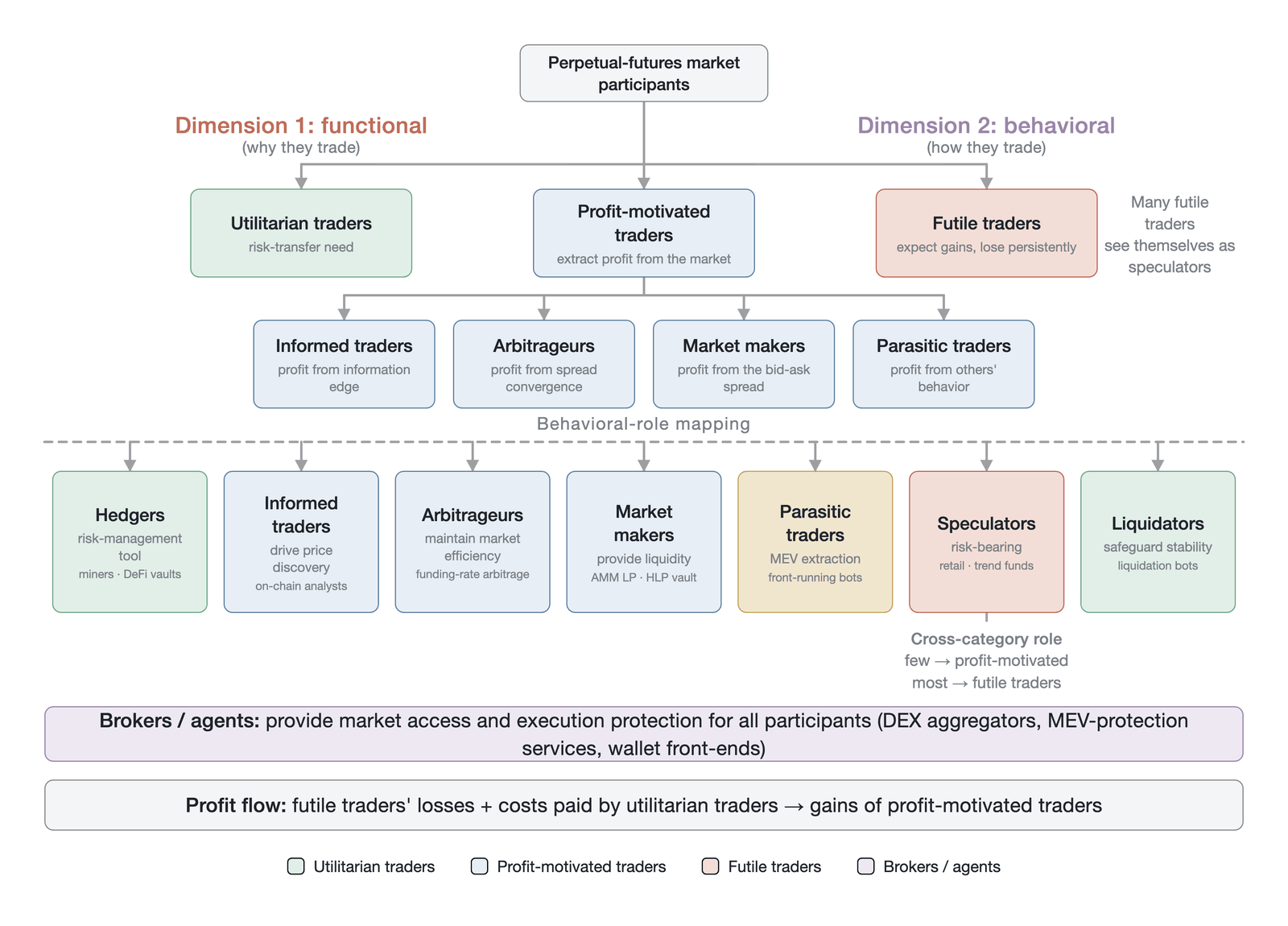
Figure 4-1. A two-dimensional classification framework for participants in the perpetual futures market (conceptual framework diagram; author's synthesis based on the tripartite taxonomy of Harris 2003 [3]; not empirical data)
4.1.4 The hidden costs of the negative-sum game
In a strict mathematical sense, the perpetual futures market is not a zero-sum game but a negative-sum game. Summing the realized and unrealized profit and loss (P&L) of all traders necessarily yields a result below zero. This shortfall represents the friction costs that must be incurred to keep the entire market infrastructure running.
Here, is the transaction fee on the -th trade, is the amount of MEV captured in the -th extraction, and is the gas fee on the -th trade. is the market's negative-sum quantity, representing the negation of the sum of all participants' P&L. The funding rate is not counted in the negative-sum quantity, because on major platforms (Binance, Hyperliquid, dYdX, and others) it is designed as a direct transfer payment between longs and shorts, from which the protocol itself extracts no fee. The formula also does not explicitly list implicit frictions such as slippage costs and the opportunity cost of margin. In the thin-liquidity environment on-chain, the market impact (slippage) of large orders can constitute a significant implicit transaction cost, while the forgone return on capital locked in margin is another cost that is easily overlooked. These implicit frictions further deepen the negative-sum nature of the market.
This negative-sum quantity is analogous to the institutional friction costs of the traditional financial system; only the manner of its collection has been reshaped by the digitally native architecture. Traditional finance levies explicit fees through intermediaries such as exchanges, clearinghouses, and brokers, whereas on-chain finance collects them through protocol-hardcoded fees, the execution fees of the blockchain network, and the MEV extracted by algorithmic bots. In the fully transparent public-mempool environment in particular, MEV constitutes an implicit tax. Every order executed through a decentralized exchange may have part of its value extracted by searchers—via front-running or sandwich attacks—during ordering and block packing, deepening the market's negative-sum character still further.
In the DEX ecosystem there is also a special external source of funds: protocol token incentives. Some protocols subsidize participants through liquidity mining, trade mining, and airdrops, which is essentially a form of seigniorage, with the cost borne by token holders through dilution. Protocol token incentives, however, are not an intrinsic institutional feature of the perpetual futures market (many centralized exchanges operate without relying on this mechanism), and they therefore do not constitute an independent category of profit source; they are instead an external subsidy mechanism specific to DEXs. This external subsidy mechanism has an important effect on the boundary conditions of the negative-sum game described by Equation 4-1. Absent token incentives, the perpetual futures market is strictly negative-sum, and the sum of all participants' P&L is necessarily negative. With token incentives, if the total subsidy exceeds , participants as a whole may exhibit positive-sum returns in the short run; but this positive-sum property rests on continuous token issuance, and token inflation inevitably dilutes the value held by existing holders, so it is unsustainable over the long run. As the token price falls under inflationary pressure, the real value of the subsidy diminishes, and the market ultimately reverts to its intrinsic negative-sum nature.
4.1.5 Limitations of the classification
In using this classification framework, one must recognize the limitations it faces in the digitally native environment. In traditional financial markets, licensing regimes and a high degree of professional specialization keep participants' roles relatively fixed. In the decentralized finance environment, however, the boundaries between roles become blurred. A single user may, within the same day, be a speculator (opening a leveraged position), a market maker (supplying funds to a liquidity pool), and an arbitrageur (profiting from price discrepancies across protocols). This role fluidity is one of the most distinctive features of the digitally native market, and it is examined in detail in Section 4.4. Moreover, the framework is built primarily on assumptions of human behavior, yet an increasing share of on-chain trades is executed by automated bots whose behavioral patterns differ starkly from those of human traders, which likewise calls for a re-examination of the classical theory.
Despite these limitations, the classification framework retains significant analytical value. It provides a structured starting point for understanding the complex diversity of market behavior, allowing us to dissect systematically the core motives, strategies, and market impact of each type of participant. Acknowledging its limitations does not negate its validity; rather, it keeps the analysis critical—especially in examining how the digitally native environment breaks down these classical categorical boundaries.
4.2 Behavioral analysis of the six core participant types
Within the profit-source framework of Harris (2003), each type of participant can be understood as an economic entity contending for a specific share of the two profit sources. Its behavioral logic is jointly determined by its profit source, its risk exposure, and its game relationships. This section examines, in turn, the six core participant types of the perpetual futures market, revealing how the digitally native environment reshapes the basic assumptions about participant behavior in classical market microstructure theory.
4.2.1 Market makers
Market makers are the core liquidity providers of market microstructure, and their basic business model is to earn the bid-ask spread by quoting on both sides of the order book. Market makers earn the spread primarily from the non-toxic order flow of futile traders, while also capturing income from the hedging premium that utilitarian traders are willing to pay in crossing the spread for immediate execution. This profit pool, however, is continually compressed by informed traders and mechanism parasites.
The core challenge facing market makers can be understood through the three-component decomposition of the spread. Stoll (1989) showed that the bid-ask spread can be decomposed into order-processing cost, inventory-holding cost, and adverse-selection cost [8]. In traditional financial markets, these three costs remain in relatively stable proportion. In the crypto perpetual futures market, however, the adverse-selection cost is markedly amplified. This judgment rests mainly on theoretical inference: given the empirical fact that the share of informed trading in crypto markets is high, the classical logic of spread decomposition reasonably implies a correspondingly greater weight on the adverse-selection component. Direct empirical measurement of the exact percentage of the bid-ask spread that adverse selection accounts for in crypto perpetual futures markets remains limited, however. Estimating these components systematically from on-chain market data, using classical spread-decomposition methods such as Huang-Stoll or Glosten-Harris, is still a research agenda awaiting deeper development. As noted earlier in the discussion of the cost of abolishing the expiration date, the absence of an expiry renders inventory risk indefinite: market makers cannot know when a trend will end, which makes them more sensitive to adverse-selection risk. Tiniç et al. (2023) documented substantial adverse-selection costs in crypto markets (about 10% of the effective spread in their sample), from which one can infer that market makers face greater adverse-selection risk in crypto markets than in traditional ones—part of the reason crypto perpetual futures spreads are systematically wider than those of traditional futures [9]. The probability of informed trading (PIN) model proposed by Easley et al. (1996) provides a classic tool for quantifying order-flow toxicity [10]. In the on-chain environment, because all trade data are publicly visible, the assumptions of the traditional PIN model change: informed trading is no longer hidden within an anonymous order flow but can be partly observed through on-chain analysis. This requires researchers to apply classical order-flow-toxicity measures with due caution about their conditions of applicability. In addition, Milionis et al. (2022) formally analyzed the losses incurred by automated market makers (AMMs) on decentralized exchanges, showing that the losses passive liquidity providers bear from adverse selection are structurally higher than the inventory losses of traditional market makers [11].
Figure 4-2 decomposes the market maker's bid-ask spread into three cost components—order processing, inventory holding, and adverse selection—and compares their relative weights in traditional versus crypto perpetual futures markets. Adverse selection accounts for a markedly larger share in crypto markets, reflecting how the high proportion of on-chain informed trading compresses market makers' profitability.
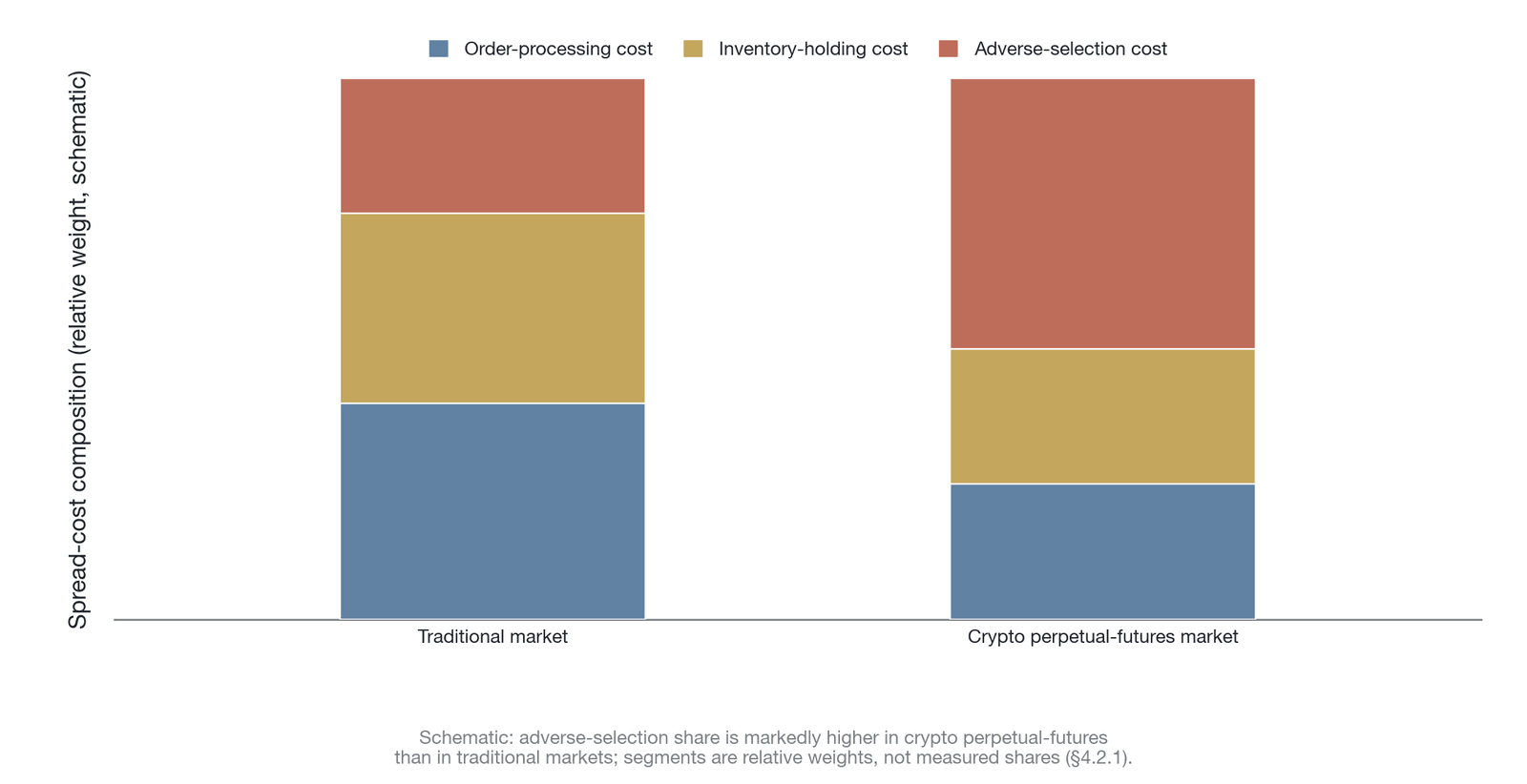
Figure 4-2. The three-component cost decomposition of the market maker's bid-ask spread (illustrative cost structure: the height of each cost segment within a bar reflects only qualitative relative weight, not a measured share; the larger adverse-selection segment on the crypto side merely indicates the direction in which this cost is significantly amplified and does not represent its actual share of the spread; Tiniç et al. 2023 measured adverse selection at about 10% of the effective spread in their sample [9], which serves as an independent empirical anchor)
The market-making paradigms of centralized and decentralized exchanges have already diverged. On centralized exchanges (CEXs), market making is dominated by professional firms that deploy high-frequency algorithms and cross-exchange hedging strategies; their core competitive strengths are speed and information-processing capacity, and the greatest unknown they face is the opacity of the exchange's order-flow quality. On decentralized exchanges, the market-making model diverges further into a passive-liquidity-pool model and a model that combines an on-chain central limit order book (CLOB) with a vault. In the passive model, liquidity providers passively bear all of the adverse-selection risk; the mechanism is simple but capital-inefficient. In the vault model, protocol algorithms make markets actively, seeking a balance between a low entry barrier and risk management.
The execution architecture of decentralized perpetual futures exchanges is not monolithic, and differences in the underlying consensus and ordering mechanisms have a profound effect on market makers' strategic choices and risk exposures. The prevailing DEX execution architectures can be summarized into three paradigms. The first is the fully on-chain model, in which both trade matching and settlement rely on the consensus mechanism of the underlying public chain; the archetypal examples are AMM protocols deployed on general-purpose L1s such as Ethereum or Solana. Under this architecture, all trading intentions propagate through the public mempool, block producers hold ultimate control over transaction ordering, and market makers are therefore exposed to the most severe MEV risk, with sandwich attacks, front-running, and back-running constituting persistent implicit costs. At the same time, block-confirmation time imposes an incompressible lower bound on latency, making it difficult for market makers to cancel orders or adjust quotes in time amid sharp volatility, so that inventory risk is amplified. The second is the application-chain or centralized-sequencer model, of which Hyperliquid is the archetype. Hyperliquid runs its own L1 blockchain (based on HyperBFT consensus), but its validator set is relatively concentrated, the sequencer is controlled by the protocol team, and trade matching is completed off-chain at sub-second latency before being confirmed on-chain in batches. This architecture gives market makers execution speed and deterministic ordering close to those of a centralized exchange, effectively eliminating the MEV risk arising from a traditional public-chain mempool, but at the cost of introducing a trust assumption about the sequencer operator—in theory the sequencer holds unilateral power over transaction ordering and censorship, which constitutes a centralization risk analogous to the internalization of order flow within an exchange in traditional finance. The third is the application-chain model built on the Cosmos SDK, of which dYdX v4 is representative. dYdX v4 runs an off-chain order book on its dedicated Cosmos chain, with validators simultaneously performing the dual roles of order matching and block proposal; maintenance of the order book is done off-chain in memory, and only the final execution results are submitted to on-chain consensus. This hybrid architecture disperses ordering power through the decentralization of validators, but it also introduces a subtle MEV vector: a validator, as block proposer, could in theory order strategically after observing the state of the order book, though dYdX constrains this through economic incentives and reputation mechanisms. The latency profiles of the three architectures also differ significantly—the fully on-chain model's latency is measured in seconds, Hyperliquid's sequencer latency in sub-seconds, and dYdX v4's hybrid model falls between the two—which directly determines the upper bound on how frequently market makers can update quotes and the timeliness of their inventory hedging. For a professional market maker, the choice of architecture is essentially a trade-off between the trust model and the latency profile: the fully on-chain model offers the strongest trustless guarantees but the highest latency and the greatest MEV exposure; the centralized-sequencer model offers the lowest latency but requires trusting the sequencer's fairness; and the Cosmos application-chain model seeks a compromise between the two.
The differences in execution architecture extend further to how the mark-price mechanism shapes market-maker behavior and liquidation triggers. The mark price is the benchmark price a perpetual futures protocol uses to compute unrealized P&L and to determine liquidation triggers, and its construction differs substantially across platforms. Most protocols adopt an external oracle price (such as the aggregated spot price provided by Chainlink or Pyth) as the core anchor of the mark price, so as to prevent the protocol's internal execution price from being manipulated to trigger improper liquidations. The update frequency of the mark price, its smoothing algorithm, and its tolerance for deviation from the protocol's internal execution price all affect market makers' behavioral decisions, however. In protocols where the mark price updates slowly or the smoothing window is long, the protocol's internal execution price may deviate significantly from the mark price over short intervals, and market makers can adjust their quoting strategy accordingly to avoid the risk of being wrongly liquidated because of a lagging mark price; conversely, in protocols where the mark price is highly sensitive and updated in real time, market makers' liquidation buffer is more precise but also more fragile, and any price spike from an external oracle can instantly trigger large-scale liquidations, in turn forcing market makers to bear excess market impact as they absorb the liquidation flow. Hyperliquid adopts a mark-price mechanism anchored to a volume-weighted price from major centralized exchanges and sets an instantaneous-deviation protection threshold, which to some extent reduces the systemic liquidation risk caused by oracle manipulation, but also means that in extreme conditions the mark price may lag the true market price, introducing additional uncertainty into pricing when the market-making vault takes over liquidated positions. The design of the mark-price mechanism thus becomes one of the key variables by which market makers assess protocol risk: it determines not only the precise conditions for triggering liquidation but also, by shaping market makers' quoting behavior, the liquidity depth and price-discovery efficiency of the entire market. Market makers on centralized and decentralized exchanges also face informational disadvantages of different natures. On centralized exchanges, third-party market makers may face a potential conflict of interest with the exchange's proprietary market-making service, which, by virtue of its priority visibility into order flow, may hold a structural informational advantage; on decentralized exchanges, the principal informational threat facing market makers comes from the targeted sniping of MEV searchers, who conduct front-running and sandwich attacks by monitoring publicly visible trading intentions. The two informational disadvantages are entirely different in nature: the former stems from information asymmetry in an opaque environment, the latter from asymmetry in execution speed in a fully transparent one; yet both systematically erode market makers' profitability.
The double-sided nature of Hyperliquid's market-making vault is a paradigmatic case for understanding the market maker's dilemma. Facing uninformed forced-liquidation flow, a market maker can earn substantial profits; but facing strategic actors with a mechanism-parasitic advantage, it suffers systematic losses. This shows that a market maker's P&L is essentially a function of the toxicity concentration of its order flow: the same market maker exhibits starkly different profitability against counterparties whose order flow carries different information content. The case also reveals the deeper difference between the professional-market-maker and the passive-vault models. Professional market makers typically deploy an entire suite of sophisticated risk controls, including real-time detection of order-flow toxicity (dynamically identifying the concentration of informed trading using indicators such as the volume-synchronized probability of informed trading, or VPIN), strict inventory caps, tiered quoting strategies (dynamically adjusting the depth posted at different price levels according to order-flow quality), and cross-asset correlation hedging. By contrast, passive-vault models such as HLP lack a real-time toxicity-filtering mechanism and, in essence, absorb all types of order flow indiscriminately under a uniform strategy. This structurally exposes them to the spike risk of adverse selection: when toxic order flow floods in en masse, a passive vault cannot rapidly narrow its quotes or suspend market making as a professional market maker would, and it therefore systematically bears a disproportionate loss.
4.2.2 Informed traders
Informed traders are the principal driver of market price discovery. Their profits come mainly from the directional game against futile traders, while they also extract value from market makers' inventory through adverse selection. The presence of informed traders enables market prices to reflect the latest information, but it also raises market makers' costs.
The classic model of Kyle (1985) describes how informed traders strategically execute their trades, gradually incorporating private information into prices [12]. In the digitally native environment, this logic is accelerated and complicated. The rise in the speed of information transmission and execution has sharply shortened the traditional window of informational advantage. More importantly, the source of the informational advantage has been reshaped. The traditional informational advantage based on fundamental research and industry knowledge still exists, but the share of the digitally native informational advantage—based on on-chain data analysis, whale-address tracking, smart-contract-interaction monitoring, and scanning of the MEV pending pool—has risen markedly.
This digitally native informational advantage is a concrete embodiment of the transparency paradox. On-chain information is public private information: everyone can see a whale's positions and trading intentions, but only participants with the specific data-processing capacity and algorithmic infrastructure can correctly interpret its meaning and convert it into trading signals. The informed trader's barrier therefore shifts from the privilege of acquiring information to the capacity to process and execute on public information.
Informed traders have a double-sided character in market microstructure. On one hand, by trading, they transmit information into prices, promoting price discovery and improving the market's pricing efficiency. On the other hand, their trading raises market makers' adverse-selection costs, forcing market makers to widen spreads to offset potential losses and thereby reducing liquidity for all market participants. One of the central trade-offs in market mechanism design is precisely how to find the optimal balance between encouraging informed trading to promote price discovery and protecting market makers to sustain liquidity.
The on-chain informational advantage decays rapidly. As ever more participants deploy similar on-chain analytics tools and whale-tracking algorithms, the alpha derived from on-chain data transparency declines at an accelerating pace. At the same time, the spread of private trading channels (such as private mempools and trade-privacy-protection mechanisms like Flashbots Protect) further erodes the transparency-based informational advantage: trading intentions are hidden until the moment of block confirmation, rendering useless those informed strategies that rely on scanning the pending-transaction pool. This constitutes a continual arms race over informational advantage, in which the half-life of any advantage progressively shortens, forcing informed traders to invest ever-higher technical costs to sustain an increasingly fragile marginal edge.
4.2.3 Arbitrageurs
Arbitrageurs profit at no risk or low risk by seeking price discrepancies between different markets or instruments. As argued in Section 4.1.2, arbitrageurs' profits appear on the surface to come from systematic mispricings, but mispricings are themselves jointly created by the inelastic demand of utilitarian traders and the pricing errors of futile traders; arbitrage profits can therefore, ultimately, still be traced to the two sources. By correcting mispricings, arbitrageurs indirectly serve the realization of the hedging premium, allowing hedgers to obtain more accurate execution prices.
In the perpetual futures market, arbitrage takes three core forms. Funding-rate arbitrage is the most common strategy: an arbitrageur establishes a short position in the perpetual futures market while buying an equal amount of the asset in the spot market, thereby earning a positive funding rate. The BIS working paper (Schmeling et al., 2023) shows that crypto carry can generate positive returns in most periods, but its return distribution exhibits pronounced negative skewness and is highly time-varying; much like traditional foreign-exchange carry trades, such strategies face the risk of sudden and severe losses during tail events, with an asymmetric crash exposure hidden beneath the appearance of stable returns [7]. The empirical study of Werapun et al. (2025) further shows that, under certain market conditions, funding-rate arbitrage can even generate excess returns [13]. Cross-market arbitrage profits from the transient price discrepancy of the same asset across different exchanges, a discrepancy usually driven by differences in liquidity and in the speed of price updates. Triangular arbitrage, within a single exchange, exploits inconsistencies in the cross rates of three assets to complete a circular arbitrage.
Characterizing funding-rate arbitrage and cross-platform arbitrage as "risk-free," however, is a dangerous oversimplification. These strategies are more accurately described as low-risk but not risk-free. Their risk exposure manifests along at least three dimensions. First, rate-reversal risk has a significant historical frequency. The sign and magnitude of the funding rate can switch abruptly with market sentiment; in extreme conditions, a funding rate that was positive can turn deeply negative within hours, and the negative period often lasts beyond the arbitrageur's expected tolerance, turning the strategy from a source of stable income into one of persistent losses. Historical data show that during major market events the intraday swing in the funding rate can reach dozens of times its normal magnitude, and this nonlinear jump causes rate-forecasting models built on assumptions of historical mean reversion to fail at precisely the moment they are most needed. Second, on platforms using a unified margin system, the floating loss on the spot long position shares a single margin pool with the perpetual futures short position; when the price of the underlying asset rises sharply, the book loss on the perpetual short and the book gain on the spot long theoretically offset each other, but in extreme volatility the transient deviation between the mark price and the spot price, together with lag effects in margin computation, can cause the account's overall margin ratio to fall below the maintenance level in an instant, triggering forced liquidation. An arbitrageur being liquidated while in a "hedged" state is nearly a paradox in traditional financial terms, yet it is a structural vulnerability of the on-chain unified-margin system. Third, cross-platform arbitrage faces the friction costs of margin fragmentation and withdrawal delay. When an arbitrageur holds a long on platform A and a short on platform B, a sharp one-sided floating loss requires topping up margin on the losing side, while withdrawal of funds on the winning side is often constrained by withdrawal cooling-off periods, on-chain confirmation delays, and congestion on liquidity bridges. This timing mismatch creates a liquidity trap at precisely the moment the market most needs funds to be redeployed, exposing a theoretically perfectly hedged position to one-sided liquidation risk in practice.
The limits-of-arbitrage framework of Shleifer and Vishny (1997) illuminates these risks [14]. The framework's core insight is that arbitrage in the real world is far from the costless, risk-free activity described in textbook models; arbitrageurs face capital constraints, margin-call pressure, and principal-agent problems, and these frictions can allow a mispricing to widen further before it is corrected. In the crypto perpetual futures market, the applicability of this framework requires a key distinction along the dimension of atomicity. At one end is on-chain atomic arbitrage: under the atomicity guarantee of a single transaction, borrowing, trading, and repayment are completed within the same block, so there is no price risk during a holding period, and the only uncertainty the arbitrageur faces is whether the transaction can be successfully included in a block. Such arbitrage approaches the theoretical zero-risk benchmark, and the capital constraints and margin-call pressure of the Shleifer-Vishny framework do not apply. At the other end is non-atomic position arbitrage, including funding-rate arbitrage and cross-exchange spread arbitrage, in which the arbitrageur must maintain several independent positions over a period of time, bearing the risks of price fluctuation, margin calls, and liquidity mismatch—precisely the dangerous zone the Shleifer-Vishny framework warns against. In tail events, such nominal "arbitrage" strategies may be forced to close at the least favorable moment under margin-call pressure, so that behavior originally intended to correct mispricing itself becomes an amplifier of market volatility. The arbitrageur group in the perpetual futures market therefore spans a broad risk spectrum, from near-zero risk to something indistinguishable from directional speculation.
The composability thesis is directly embodied in arbitrage behavior, but its scope of application must be strictly bounded. The atomic-execution feature of the on-chain environment, combined with the flash-loan mechanism, allows atomic arbitrage between spot decentralized exchanges to be executed with zero capital and zero risk: an arbitrageur can complete the full loop of borrowing, cross-pool trading, and repayment within a single transaction block, something unimaginable in traditional financial markets. This mechanism does not apply to position arbitrage in perpetual futures, however. Funding-rate arbitrage and cross-platform spread arbitrage require maintaining independent positions at different points in time and on different platforms; the holding period spans multiple blocks or even several days and cannot be compressed into a single atomic transaction. Even spot atomic arbitrage itself is not truly "zero-cost": fierce competition among arbitrageurs for the same spread opportunity gives rise to priority gas auctions (PGAs), and the winner often has to pay most of the arbitrage profit as gas fees and tips to the block builder, so the economic rent of arbitrage tends to be consumed by execution costs in the competitive equilibrium. This digitally native atomic-arbitrage mechanism greatly improves the price-convergence efficiency of on-chain spot markets, but its efficiency gains do not automatically extend to the domain of perpetual futures arbitrage, which requires holding positions over time.
4.2.4 Mechanism parasites
The concept of the parasitic trader was proposed by Harris (2003); in traditional financial markets, it manifests primarily as informational parasitism [3]. Informational parasites profit from non-public information obtained by improper means, with typical behaviors including insider trading and front-running client orders—behaviors generally prohibited by law. The on-chain environment of perpetual futures, however, has given rise to an entirely new form of parasitism: mechanism parasitism. This is a core theoretical contribution to understanding the evolution of on-chain market microstructure.
Mechanism parasitism and informational parasitism differ fundamentally in the source of their advantage, the nature of their behavior, and their legality. To raise this concept from descriptive language to an operational analytical tool, this chapter offers the following definition.
Mechanism parasitism refers to behavior in which a market participant, while fully complying with the explicit rules of a protocol, exploits the unintended economic consequences produced by the combination of those rules to systematically shift transaction costs or risks onto other participants. It obtains only when three conditions hold simultaneously: (1) the behavior lies entirely within what the protocol's rules permit; (2) the economic consequence exploited is not the intended purpose of the protocol's designers; and (3) the behavior produces a net transfer of value from passive participants to the active exploiter.
Condition (2)'s criterion—"the intended purpose of the protocol's designers"—requires a qualification. In the context of decentralized governance, a protocol's rules are often produced through community proposals and voting, and there is no single, clearly attributable "designer's intent," which makes condition (2) difficult to apply in practice. A more operational formulation is this: the behavior's negative externalities (the harm to other participants and to the overall functioning of the ecosystem) exceed the positive externalities it brings to the ecosystem. This net-externality criterion requires no tracing of subjective intent; it reaches a determination by assessing the behavior's objective economic consequences, and it applies more readily in an on-chain environment where governance is dispersed.
The advantage of mechanism parasites comes not from knowing information others do not know but from understanding the economic implications of the protocol's rules more deeply than others do. What they exploit is a cognitive asymmetry: the protocol's rules are public to all, but their deeper economic effects are not fully understood by every participant. This distinction sets mechanism parasitism apart from ordinary arbitrage: arbitrage corrects market mispricings and pushes prices toward equilibrium, carrying a positive externality; mechanism parasitism exploits rule loopholes to shift costs, does not improve market efficiency, and carries a negative externality.
Figure 4-3 presents, in a side-by-side layout, the evolution from informational parasitism to mechanism parasitism, at the core of which lies a paradigm shift: the source of advantage moves from exploiting information others do not have to understanding public rules more deeply than others do; its persistence changes from dissipating as information diffuses to enduring structurally; and defense correspondingly shifts from legal punishment to mechanism repair.
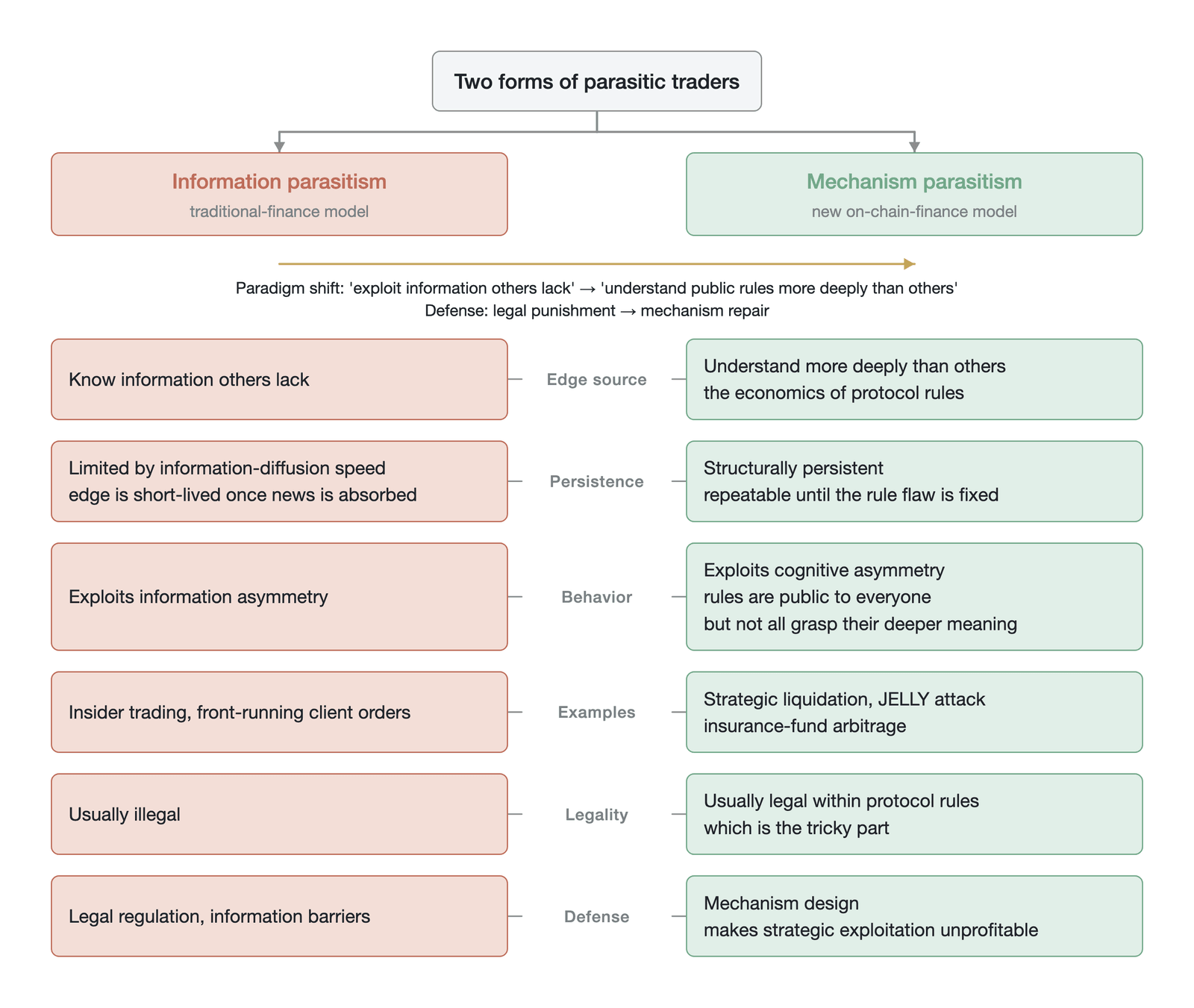
Figure 4-3. An evolutionary comparison of mechanism parasitism and informational parasitism (conceptual comparison diagram; author's synthesis; not empirical data)
The Hyperliquid whale event described in the introduction is a paradigmatic case of mechanism parasitism. The trader's behavior fully satisfies the three conditions of Definition 4-1: the behavior lies within the protocol's rules (condition 1); it exploited the unintended economic consequence that the liquidation penalty was lower than the slippage of closing on the market (condition 2); and it shifted the price-impact cost from itself to passive liquidity providers (condition 3). Actively triggering liquidation thus became a better exit strategy than closing the position oneself. The existence of such an inequality is an inherent loophole in the protocol's mechanism design, not a moral failing of the trader.
Mechanism-parasitic behavior presents a spectrum in on-chain markets, ranging from the mild MEV sandwich attack, to strategic positions exploiting extreme funding rates, to aggressive strategic liquidations, and even to sophisticated attacks exploiting joint loopholes in the liquidation and insurance-fund mechanisms. What these behaviors share is that they are compliant at the level of the protocol's rules. Such compliance, however, is not the same as compliance with the law. The legal standard for market manipulation differs across jurisdictions. The EU Market Abuse Regulation (MAR) adopts an effects-based standard: creating false or misleading signals, or producing an abnormal or artificial price, can constitute manipulation, with no requirement of subjective intent; whereas price manipulation under the U.S. Commodity Exchange Act (Rule 180.2) has traditionally required a specific intent to create an "artificial price," so that a price effect alone does not constitute manipulation, though the post-Dodd-Frank fraud-based Rule 180.1 requires only recklessness. Under these frameworks, even behavior that fully complies with a protocol's explicit rules may face legal prosecution if its effect constitutes artificial manipulation of the market price or systematic harm to other participants. The legal status of mechanism parasitism therefore remains undetermined, and this constitutes a twofold challenge for defending against it: at the level of mechanism, the economic loopholes that make such behavior profitable must be repaired through redesign; at the level of law, the regulatory framework must respond with new classifications of on-chain behavior and effects-based regulatory principles.
4.2.5 Speculators and futile traders
Speculators seek to profit from judging the direction of prices, and they bear the principal risk in the market. Within the speculator group, however, there is significant differentiation. A minority of informed directional traders have genuine judgment about fundamentals or technicals and can achieve average profits; in economic terms, they can be regarded as a subset of informed traders. The vast majority of speculators, however, are futile traders: they trade on emotion, noise, or herd mentality, use leverage far beyond their risk tolerance, and as a result systematically become the counterparties of profit-motivated traders, bearing persistent losses.
The systematic losses of futile traders constitute the core mechanism of profit transfer in the perpetual futures market. The October 2025 liquidation data cited in Section 4.1.1 (more than 1.62 million accounts liquidated, totaling more than $19 billion, about 87% of them long [4][5]) are precisely its macro evidence: this was not mere market volatility but a systematic wealth-transfer event—futile traders gradually accumulated leverage during a calm period and, during the deleveraging period, transferred their previously accumulated capital, through the liquidation mechanism, to market makers, informed traders, and liquidators.
The extreme one-sidedness of the 87% long liquidations cannot be explained by individual-level overconfidence or leverage abuse alone; it requires the analytical framework of collective behavior. The theory of information cascades proposed by Banerjee (1992) provides a rigorous microfoundation for understanding such extreme uniformity [15]. The theory holds that when individuals make sequential decisions under incomplete information, the rational strategy is to ignore one's own private signal and follow the behavior of predecessors, because a predecessor's choice is taken to embody the aggregate of their private information. Once such following reaches a critical mass, subsequent participants will conform regardless of the private information they hold, forming a self-reinforcing information cascade. In the crypto perpetual futures market, the conditions for an information cascade are structurally reinforced. A persistently positive funding rate constitutes the most intuitive signal of collective sentiment: when the funding rate stays for a long time at an annualized 30% or higher, the implicit information it conveys to the market is that "the overwhelming majority of participants are bullish," and latecomers tend to read this signal as a market consensus rather than a warning of crowding risk. At the same time, the crypto market relies heavily on social media for the transmission of information, and the public trade calls of key opinion leaders (KOLs) constitute a powerful cascade trigger on platforms such as Twitter and Telegram; when a KOL with a large following publicly announces opening a long position, a considerable proportion of followers will copy the trade directly without independent judgment, further pushing up the price and the funding rate, attracting more imitators, and thereby forming a positive feedback loop. The full transparency of on-chain data plays a dual role here: it makes the position direction of whales and the trading behavior of KOLs into publicly observable signal sources, accelerating the spread of the information cascade, while also making the extreme one-sided concentration of positions visible to all, though no one is willing to be the first to act against it. When the entire market's long positions accumulate to a critical level under the drive of an information cascade, any exogenous shock is enough to trigger the liquidation cascade described in Section 4.3.4, and the one-sidedness of the cascade is precisely a mirror image of the one-sidedness of the earlier herding behavior.
This behavioral pattern arises not merely from inadequate market education but is systematically induced by the product-design features of perpetual futures. Skwarek et al. (2025) confirm that a variety of behavioral biases significantly affect the decision-making of crypto investors [16]. Delfabbro et al. (2021) further note that trading behavior in crypto markets is, in its psychological mechanisms, highly similar to gambling [6]. Specifically, the psychological stickiness of perpetual futures trading can be explained through three classic mechanisms. First, the variable-ratio reinforcement effect: the occasional large profits produced by high-leverage trading constitute an intermittent, large positive reinforcement whose reinforcing power far exceeds that of steady small gains—isomorphic, in psychological principle, to the reward mechanism of a slot machine. Second, the near-miss effect: a trader's experience of narrowly escaping near the liquidation price (for example, when the price rebounds less than 1% from the liquidation line) is subjectively coded as "almost succeeding" rather than "nearly failing," thereby reinforcing the willingness to continue high-leverage trading. Third, the mental-accounting effect: traders tend to treat each trade as an independent mental account rather than part of an overall portfolio, which leads them to take on risk far beyond a rational standard on a single trade while their perception of cumulative losses is systematically blunted. More critically, the around-the-clock, uninterrupted trading of the perpetual futures market eliminates the natural "cooling-off period" provided by the market-closure mechanism of traditional financial markets. In traditional stock or futures markets, the hours between the close and the next open provide traders with a time window to reflect on decisions, assess losses, and restore rationality; in the 24/7 perpetual futures market, this buffer is entirely absent, impulsive revenge trades after a loss can be executed within seconds; the chain of emotion-driven trading can extend indefinitely; and the destructive power of the three psychological mechanisms above is thereby markedly amplified. High leverage, permissionless access, and an emotional community culture together build an environment that attracts and retains futile traders. How these persistent losses economically subsidize market makers' adverse-selection losses is detailed in Section 4.3.3.
4.2.6 Liquidators
In the perpetual futures ecosystem, liquidators clear away systemic bad debt. Their core motive is to profit from the systematic losses of futile traders—that is, to earn the liquidation penalties paid by those being liquidated. By promptly taking over and closing insolvent positions, liquidators ensure the protocol's solvency and prevent bad debt from turning into systemic risk.
Liquidators' behavior is double-sided under extreme market conditions, however. In a normal market, liquidators and speculators form a functional complement that keeps the system running in good health. But when the market swings violently, liquidators' individually rational behavior can become an accelerator of the liquidation cascade. To trigger liquidation as quickly as possible and earn the penalty, liquidators dump the liquidated assets on the market, and this large-scale selling pressure pushes the market price down further, driving more positions that were originally safe into liquidation.
The specific design of the liquidation mechanism decisively shapes the identity and behavioral patterns of those who execute liquidations, and different platforms differ fundamentally in how they position the liquidation executor. On centralized exchanges, liquidation is essentially part of the platform's internal risk-control process: the exchange's liquidation engine, as a built-in component of the protocol, automatically executes forced closures; the process is invisible to external participants; residual margin (if any) is returned to the trader; the loss shortfall is absorbed by the exchange's insurance fund; and an external independent liquidator does not exist in this model. In decentralized lending protocols (such as Aave and Compound), liquidation is designed as a fully externalized, economically incentivized activity: when a borrower's collateralization ratio falls below the liquidation threshold, any external participant can call the smart contract's liquidation function to repay part of the debt and acquire the collateral at a discount, so the liquidator is a permissionless independent economic actor whose participation is driven entirely by the profit motive. The liquidation mechanism of a perpetual futures DEX falls between these two paradigms, forming a hybrid model. Take Hyperliquid: its liquidation process adopts a layered, escalating architecture. When a trader's margin ratio falls below the maintenance-margin requirement, the protocol first attempts to close the position gradually on the market via limit orders through the internal liquidation engine; if market liquidity is insufficient to complete the closure within a reasonable slippage range, the remaining position is transferred to the HLP market-making vault to be absorbed collectively by passive liquidity providers; and only in extreme cases does the insurance fund step in as the last loss-absorbing layer. In this hybrid model, the "liquidator" is not a single external independent role but a multi-layered defense system jointly composed of the protocol's liquidation engine, the market-making vault, and the insurance fund, and the room for external independent liquidation bots is significantly compressed. dYdX v4 adopts another hybrid path, in which liquidation is executed by validator nodes during the block-proposal process, with liquidation orders embedded in the block-construction flow; this couples liquidation execution with block-ordering power, and a validator can in theory choose strategically when and how to execute a liquidation. Characterizing liquidators broadly as external independent profit-seekers therefore applies only to the purely externalized model of lending protocols; in the actual operation of centralized exchanges and most perpetual futures DEXs, the identity of the liquidation executor is far more complex, involving an interweaving of roles such as the platform's internal engine, passive-vault participants, and validators. Traditional cliff-edge liquidation often causes a precipitous drop in price, whereas progressive liquidation or vault-takeover designs seek to smooth the liquidation shock. Specifically, the prevailing liquidation mechanisms can be grouped into four types. The first is cliff-edge (full) liquidation, in which the entire position is forcibly closed at once when the margin ratio hits the threshold; its execution is simple but its instantaneous impact on the market price is greatest, and it readily triggers a cascade. The second is progressive (partial) liquidation, in which only the minimum share of the position needed to restore the margin ratio above the maintenance requirement is closed, dispersing the price impact across multiple time windows through incremental reductions. The third is vault-takeover liquidation, in which the protocol's vault directly absorbs the position on the brink of liquidation and closes it out gradually when later market conditions are more favorable, thereby converting the immediate market impact into inventory risk for the vault. The fourth is the auto-deleveraging (ADL) mechanism, in which, when the insurance fund is exhausted or market liquidity is severely insufficient, the protocol forcibly reduces the unrealized profits of traders on the winning side to cover the negative-equity losses of the losing side; although this mechanism effectively prevents systemic default at the protocol level, it does so at the cost of sacrificing the reasonable expectations of winning traders, raising fairness disputes over the redistribution of counterparty risk. In the high-leverage crypto derivatives market, the design of the liquidation mechanism bears not only on the stability of an individual protocol but is also a key line of defense against cross-market risk contagion; the European Securities and Markets Authority (ESMA) (2025), in its analysis of MEV, likewise notes that on-chain microstructure issues such as transaction ordering and cross-venue spreads carry systemic implications [17]. The liquidation executor—whether its identity is the platform's internal engine, an external independent bot, or a passive vault—is the actual operator of this mechanism, and a subtle tension always exists between its pursuit of profit and the goal of system stability.
The legal characterization of liquidation activity is coming under increasingly strict scrutiny across jurisdictions, adding a regulatory-risk dimension to liquidator behavior that cannot be ignored. In the traditional financial system, forced closure is an internal risk-control action of a regulated financial institution, and the licensing qualifications and compliance obligations of the executing entity have a clear legal framework. In the permissionless on-chain environment, however, the legal nature of liquidation activity becomes ambiguous: when an anonymous wallet address forcibly closes another's position by calling a smart-contract function and derives an economic gain from it, this behavior may in some jurisdictions be regarded as providing a financial service. The EU's Markets in Crypto-Assets Regulation (MiCA), for example, imposes authorization and compliance obligations on crypto-asset service providers (CASPs); if liquidation activity were classified as such a service, an anonymous participant would face a fundamental contradiction between compliance requirements and anonymity. At the same time, the Travel Rule promoted by the Financial Action Task Force (FATF) requires virtual asset service providers (VASPs) to transmit the identity information of the originator and beneficiary in a transaction, which poses a direct challenge to on-chain liquidation bots that operate on the basis of anonymity. Although most jurisdictions have not yet explicitly brought on-chain liquidation activity within the regulatory scope of financial-service licensing, the tightening regulatory trend means that the behavioral pattern of participating in liquidation and extracting profit anonymously may, in the medium term, face a fundamental reassessment of its legal status. This regulatory uncertainty affects not only liquidators' behavioral incentives but may also have a profound effect on the participant structure of the liquidation market: if liquidation activity is ultimately required to be licensed, the current competitive landscape dominated by anonymous bots will be forced to shift toward compliant professional institutions, and both the efficiency and market coverage of liquidation may undergo structural change.
4.3 The game network among participants
Having established the two ultimate sources of profit in the perpetual futures market and the basic features of the six core participant types, we can now construct a dynamic picture of the market. A participant's survival and prosperity in the market depend not on a static identity label but on its position within a complex game network and its capacity to intercept profit flows. This game takes on dynamic features in the digitally native environment that are entirely different from those of traditional financial markets, with high leverage, full transparency, and the determinism of protocol mechanisms jointly reshaping the rules of the game. This section analyzes four core game relationships and, finally, reveals the complete network structure of profit flows across the ecosystem.
4.3.1 Market makers and informed traders
The game between market makers and informed traders is the cornerstone of all market microstructure theory, but in the on-chain environment of perpetual futures its intensity is pushed to a new extreme. As set out in the three-component decomposition of the spread in Section 4.2.1, a market maker's bid-ask spread must compensate for the three costs of order processing, inventory holding, and adverse selection [18], and in the crypto-asset perpetual futures market the nature of this adverse selection has fundamentally changed.
The full transparency of the on-chain environment paradoxically aggravates the market maker's adverse-selection risk: publicly visible positions and liquidation prices are public private information, which requires extremely high data-processing capacity to convert into a genuine trading advantage [12]. Informed traders use this to forecast short-term price movements more precisely and gain the upper hand in the game against market makers (the specific sources of their informational advantage were elaborated in Section 4.2.2). Research has documented substantial adverse-selection costs in crypto markets, from which one can infer that the adverse-selection environment market makers face in supplying liquidity is more severe than in traditional markets [9].
The absence of an expiration date in perpetual futures further amplifies the market maker's inventory risk—as analyzed in Section 4.2.1, inventory risk is thereby rendered indefinite: market makers cannot know when a one-sided trend will end and can only demand a wider spread to compensate for potentially enormous losses [19]. This double pressure is concentrated in the case of Hyperliquid's HLP vault. In the violent market volatility of October 2025, facing a large volume of non-toxic order flow triggered by liquidations, the vault realized a single-day profit of approximately $40 million [20] (this October 2025 figure comes from an industry analysis by the market maker Kappa Lab; it is not peer-reviewed, and its methodology and data coverage have not yet been independently verified). Yet, facing a liquidation event meticulously engineered by a strategic actor, the same vault bore a loss of approximately $4 million [2]. The concept of "non-toxic" requires a precise distinction here. Liquidation-triggered order flow is indeed low in toxicity along the dimension of informational toxicity, because liquidation is a forced action mechanically triggered by the margin ratio and carries no private information about the asset's fundamentals, so a market maker accepting such flow does not face adverse selection in the classical sense. Along the dimension of liquidity toxicity, however, liquidation order flow is highly toxic, because the one-directional, concentrated selling pressure produced by large-scale liquidations severely shocks the market price, and a market maker—even if it correctly judges that the flow carries no information signal—may still suffer serious inventory losses by absorbing a huge one-sided position. This contrast reveals the fragility of the market maker's profit: its P&L essentially depends on the information content of the counterparty's order flow, and in a permissionless, anonymous network, screening order flow for toxicity is extremely difficult.
4.3.2 Market makers and mechanism parasites
Beyond the traditional informed trader, perpetual futures market makers also face a new type of counterparty unique to the on-chain environment: the mechanism parasite. Following the definition of mechanism parasitism in Section 4.2.4—whose advantage comes not from exclusive information but from understanding the economic implications of protocol rules more deeply than others—this paradigm shift from informational parasitism to mechanism parasitism constitutes one of the most far-reaching structural changes in the microstructure of decentralized finance.
Unlike the informational parasitism of traditional finance, which illegally exploits non-public information (such as insider trading and front-running client orders [3]), the mechanism parasite of the on-chain market operates entirely within the protocol's open and transparent framework of rules, keenly capturing the economic loopholes of the protocol's design in extreme situations and converting them into risk-free or low-risk arbitrage opportunities. The Hyperliquid whale event described in the introduction is a classic case of mechanism parasitism. By deliberately withdrawing margin to raise its own liquidation price, the trader exploited the rule loophole that the liquidation penalty was lower than the slippage of closing on the market, systematically shifting an enormous price-impact cost onto the protocol's passive liquidity providers [20].
This mechanism-parasitic behavior constitutes an unprecedented toxicity for market makers. The traditional adverse-selection model assumes that the informed trader's advantage is temporary and dissipates as information is gradually incorporated into prices [21]. The advantage of the mechanism parasite, however, is structural: as long as the protocol's rule loophole remains unrepaired, the parasitic behavior can be executed repeatedly. What the market maker faces is no longer a random game based on price expectations but systematic extraction based on a deterministic rule loophole. This new toxic order flow not only directly erodes the market maker's capital base but, more seriously, destroys the economic rationale for passive liquidity provision, forcing market makers to adopt more defensive quoting strategies and ultimately causing a systematic decline in the liquidity of the entire market. Defending against such mechanism parasitism cannot rely on ex post punishment of the actor but must rely on tighter mechanism design that ensures that, in any state, the cost of strategically exploiting the rules exceeds its potential gain.
4.3.3 Profit-motivated traders and futile traders
Once the complexities of strategy and mechanism are stripped away, the profit structure of the perpetual futures market reveals a core fact: the vast majority of the profit that keeps the entire ecosystem running comes, in the end, from the systematic losses of futile traders. The wealth accumulation of all profit-motivated participants—whether market makers, informed traders, or mechanism parasites—depends heavily, at the macro level, on this profit source of futile traders.
Futile traders are usually defined as market participants who expect to profit from trading but, owing to systematic deficiencies in skill, information-processing capacity, or emotional control, persistently lose in the long-run game [3]. In the crypto-asset perpetual futures market, the behavioral patterns of this group closely match the overconfidence theory of behavioral finance. Research shows that investors who lack genuine stock-picking ability but are overconfident tend to trade more frequently, use higher leverage, and ultimately earn worse investment returns [22]. The high leverage of perpetual futures, their around-the-clock uninterrupted trading, and their strong sentiment-driven dynamics provide systematic inducing conditions for such overconfident behavior. The behavioral patterns of many futile traders have already blurred the line between investing and gambling; they tend to chase the market higher during rising periods and, lacking effective hedging strategies, bear volatility exposure far beyond their risk tolerance [6].
From the perspective of market microstructure, the presence of futile traders is the key economic force that resolves the market maker's survival dilemma. In the game against informed traders and mechanism parasites, market makers must bear adverse-selection losses; if the market were composed entirely of rational and fully informed participants, market makers could not sustainably supply liquidity [18]. It is precisely the steady stream of non-toxic order flow supplied by futile traders that allows market makers to earn the spread safely and thus remain profitable overall. Further, when futile traders' positions are forcibly liquidated by adverse price movements, their losses convert directly into penalty income for liquidators and directional profit for short counterparties. The crypto perpetual futures market therefore exhibits a profound dependence: the high running costs of the market infrastructure, the risk compensation of market makers, and the profits of the various arbitrageurs are to a large extent subsidized by the futile traders who lack a competitive edge yet blindly use high leverage.
4.3.4 Speculators and the liquidation mechanism
Leverage is the core driving force of the perpetual futures market, but it is also the key mechanism that transforms individually rational behavior into system-level nonlinear risk. The interaction between speculators and the liquidation mechanism constitutes the most destructive microstructural phenomenon in crypto markets: the liquidation cascade. The market crash of October 2025 provides a paradigmatic observational sample, showing how the leverage cycle evolves through four distinct phases and ultimately triggers a systemic evaporation of liquidity.
In the first phase, the accumulation phase, the market is in a relatively calm uptrend. Attracted by the wealth effect, futile traders continually chase the market higher and gradually increase their leverage multiples [4]. The leverage inflation of the accumulation phase is not a linear process but is driven by a characteristic reflexive positive-feedback mechanism [23]: a rising price pushes the funding rate positive; the positive funding rate is itself read by the market as a signal of long dominance; the bullish narrative on social media spreads accordingly; this narrative in turn attracts new participants with fresh capital; the new participants adopt higher leverage in pursuit of higher returns; and their buying further lifts the price, forming a self-reinforcing loop from price to narrative to capital inflow. In this phase, the system's fragility accumulates in the dark, with the liquidation prices of a large number of long positions densely distributed just below the current market price. To meet the vigorous trading demand, market makers keep expanding their risk exposure. As the price reaches a local high, the market enters the second phase, the critical phase. The first scattered liquidation signals begin to appear; sensitive market makers perceive the rise in order-flow toxicity and begin to reduce their quote depth out of individual rationality; and market liquidity quietly evaporates.
Figure 4-4 presents the four-phase evolution of the leverage cycle: the horizontal axis is time, and the vertical axis shows both the price trajectory and the level of system-wide leverage. The durations of the phases are highly asymmetric—the accumulation phase can last from weeks to months, whereas the cascade phase is often completed within hours to days—and this asymmetry in time scale is the core expression of the nonlinear risk of leveraged markets.
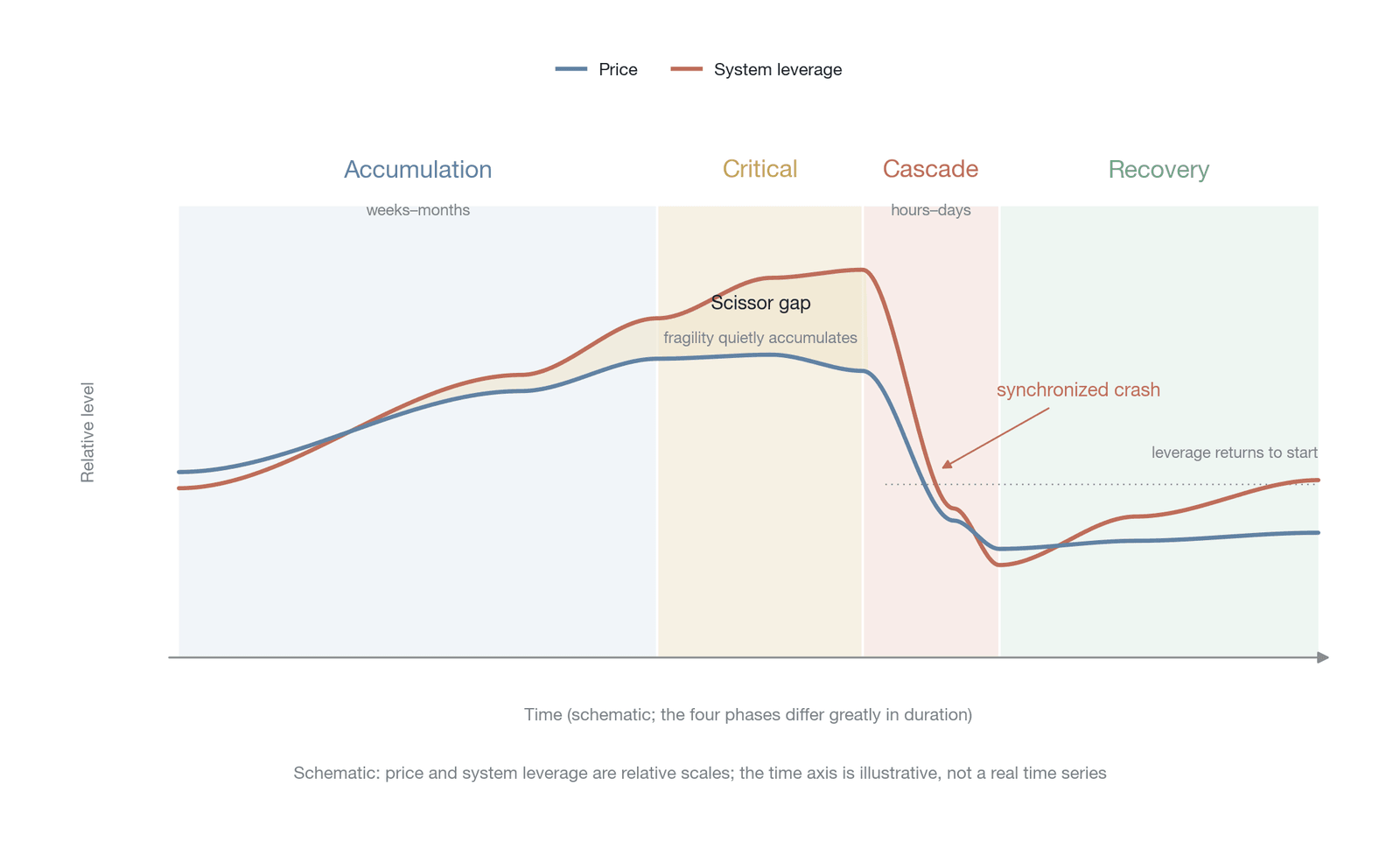
Figure 4-4. A four-phase model of the leverage cycle (conceptual model constructed by the author; the price and system-leverage curves are qualitative illustrations, not real time series; the scale of the October 2025 event is given in the main text [4][5])
When the initial substantive liquidations are triggered, the market plunges rapidly into the third phase, the cascade phase. This is a textbook positive-feedback loop: the liquidation engine automatically dumps the liquidated party's collateral onto the market, and this cost-insensitive market selling triggers a violent price decline in the already thin liquidity pool; the further fall in price then reaches lower liquidation lines, triggering a new round of forced closures [24]. In this phase, market makers withdraw entirely to protect their own capital, liquidity dries up completely, and the price exhibits a sharp, nonlinear decline. The October 2025 event is an extreme embodiment of this process, whose liquidation scale and one-sidedness (more than 1.62 million accounts, more than $19 billion, about 87% long) are detailed in Section 4.1.1 [4][5].
The destructive power of the cascade phase depends largely on microstructural differences in the margin system and on platform-level risk-mitigation mechanisms. Under the isolated-margin model, the liquidation of a single position does not spill over to the trader's other holdings, and the cascade effect is relatively localized; the cross-margin (unified-margin) model that is increasingly prevalent on today's major platforms, however, has an advantage in capital efficiency that is precisely a key accelerator of the cascade phase: under cross margin, a sharp fall in one asset erodes the account's overall margin level, in turn triggering the collateral liquidation of cross-asset positions that were originally safe, forming a cross-asset contagion path. Facing cascade pressure, the platform's insurance fund serves as the first buffer in the third phase: when the liquidation engine cannot complete a closure on the open market at a price better than the bankruptcy price, the insurance fund absorbs the shortfall, preventing losses from being passed directly onto winning traders. The insurance fund is finite in size, however, and in an extreme tail event, when the loss rate of successive liquidations exceeds what the insurance fund can bear, the protocol is forced to activate the auto-deleveraging mechanism, forcibly reducing the positions of counterparties in order of profit to achieve a systemic release of risk. Although the auto-deleveraging mechanism itself effectively prevents default at the protocol level, its forced closure of winning traders' positions carries a significant negative externality, further intensifying the crisis of trust among market participants and the contraction of liquidity.
Another key feature of the cascade phase is cross-platform contagion. In today's highly fragmented crypto derivatives market, centralized exchanges and decentralized protocols form contagion chains through three main channels. First, cross-platform arbitrageurs hold hedged positions simultaneously across multiple venues; when liquidation on one platform forces them to close, their hedging positions on other platforms are unwound as well, transmitting selling pressure to markets that were originally unaffected. Second, market makers' synchronized withdrawal under market stress has a cross-platform character: when order-flow toxicity spikes at one venue, market makers, out of risk-management considerations, simultaneously reduce their quote depth at all venues, causing liquidity to evaporate synchronously across the whole market. Third, the mark price of perpetual futures is usually computed from a spot-price index across multiple exchanges, so a price collapse on one platform is transmitted, through the index weights, to the mark prices of other platforms, triggering liquidations that should not have occurred. At the same time, the liquidation process itself has several failure modes: an oracle may lag, malfunction, or even be manipulated during extreme volatility, causing the mark price to deviate from the true market price. The zero-price liquidation event at MakerDAO in March 2020 is a paradigmatic case: under conditions of severe congestion on the Ethereum network, a liquidator won an auction for collateral worth millions of dollars with a zero bid, exposing the systemic risk that the liquidation mechanism may fail completely when the network is congested [25]. A deeper nonlinear effect is that the price impact of the cascade phase is not proportional to the scale of liquidation but is amplified exponentially as liquidity dries up: when order-book depth contracts to one-tenth of its normal level, the price slippage caused by a market sale of the same size may be dozens of times that under normal conditions, and this nonlinear price impact in a liquidity vacuum is precisely the fundamental reason the cascade phase is far more destructive than a linear expectation would suggest.
These factors together point to the fourth phase, the recovery phase: after the deleveraging process is complete, the market enters recovery. The level of system-wide leverage falls sharply, market makers slowly restore liquidity provision after reassessing risk, the price stabilizes at a new low, and the market awaits the start of the next cycle. This nonlinear, accelerated decline driven by the liquidation mechanism reveals the structural feature of decentralized markets in which the superposition of individually optimal behavior leads to systemic fragility [26].
4.3.5 The complete map of profit flows
Having analyzed the four core game relationships in depth, we can now draw the complete topological structure of profit flows in the perpetual futures market. This is not a simple zero-sum game but a complex directed network with clear tiers and directions, in which each type of participant occupies a distinct niche based on its informational advantage, capital size, and depth of understanding of the mechanisms.
In this ecological network, futile traders and utilitarian traders constitute the system's foundational profit sources. The hedging premium that utilitarian traders voluntarily pay to hedge risk, and the vast systematic losses that futile traders incur through directional misjudgment and liquidation, converge into the two profit sources that drive the entire market. Market makers occupy the central hub of the network: on one side they earn a stable spread from non-toxic order flow, and on the other they inevitably transfer profit, through adverse selection, to those with an informational advantage. Informed traders, by virtue of their informational advantage; mechanism parasites, by virtue of their deep understanding of the rules; and arbitrageurs, by virtue of their speed and capital advantages, together constitute the group of participants with the strongest profit-extraction capacity in the ecosystem. They profit not only directly from futile traders' directional errors but also continually extract value from market makers' inventory.
Figure 4-5 charts the complete topology of profit flows: the direction and thickness of each edge indicate the direction and relative magnitude of a profit flow, revealing a three-tier structure—source (utilitarian and futile traders) → market-maker relay → terminal (informed traders, mechanism parasites, and arbitrageurs). The contrast between the market maker's inbound edges (spread income) and outbound edges (adverse-selection losses) vividly captures the squeezed-from-both-sides predicament. The protocol fees and MEV extracted throughout the network are precisely the microstructural source of the negative-sum quantity in Section 4.1.4.
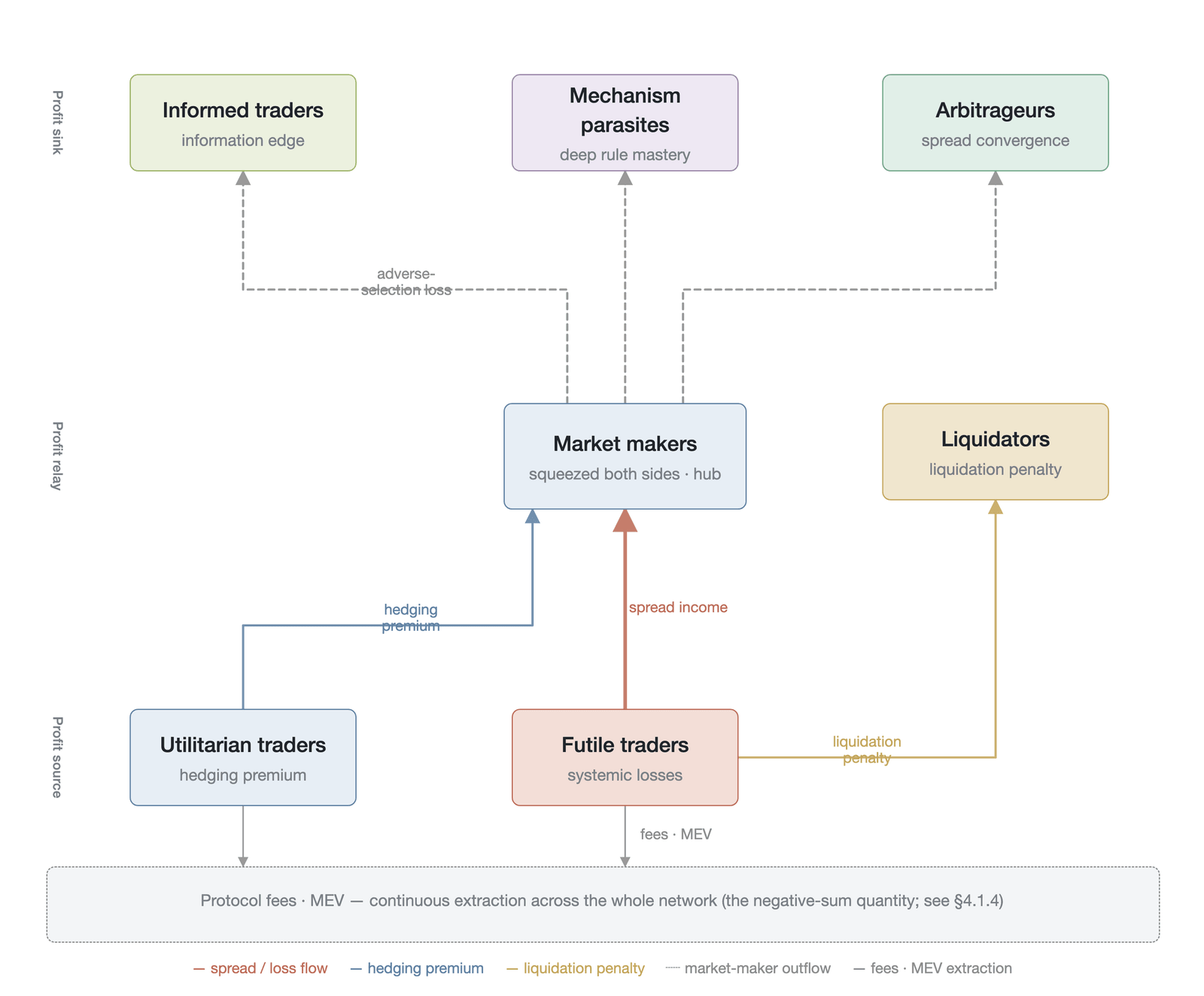
Figure 4-5. The complete map of profit flows (conceptual diagram of profit flows: nodes and edges represent mechanistic relationships; edge thickness denotes qualitative relative magnitude, not a measured scale)
At the same time, the entire game network is subject to continual external extraction. Protocols and exchanges extract system value through trading fees, while the underlying blockchain validators and miners capture another portion of the profit through network fees and extractable value. This gives the perpetual futures market its essentially strict negative-sum character (as captured by the negative-sum formula in Section 4.1.4). Understanding this overall picture of profit flows is essential to grasping market structure: it shows that, in a permissionless, fully transparent, and highly leveraged digitally native environment, wealth flows with relatively high efficiency from participants who lack information and mechanism understanding to those who command advantages in algorithms, speed, and rules. The topological structure above is a simplified model that omits several important feedback loops and spillover paths. First, the funding rate of perpetual futures feeds back into the pricing of the spot market, and changes in the spot price feed back, through oracle price feeds, into the mark price of perpetual futures, forming a cross-market cyclical feedback that may produce a self-reinforcing spiral in extreme conditions. Second, the model does not incorporate inter-protocol competition effects: when multiple perpetual futures protocols compete for the same pool of liquidity providers and traders, the direction and scale of profit flows adjust dynamically with changes in the incentive structures across protocols. Finally, the profit-flow network is not closed within the crypto market but spills over to the external financial system through several paths. An extreme deleveraging event, for example, may trigger depegging pressure on stablecoins, and the crypto exposure that institutional investors hold through ETFs or structured products may transmit the shock of on-chain deleveraging to traditional financial markets, forming cross-system risk contagion. These omitted dimensions do not alter the core structure of the profit-flow topology, but they remind the reader to weigh the model's boundary conditions carefully when applying it to extreme scenarios. This picture of profit flows provides the empirical basis for subsequent chapters to explore how market quality can be improved through mechanism design.
4.4 The threefold reshaping by the digitally native environment
By rewriting the basic rules of trading, the digitally native environment fundamentally changes participants' behavioral patterns. In traditional financial markets, participants' identities are fixed, the game plays out mainly among human traders, and the information environment is highly opaque. In the permissionless, fully transparent, and highly composable on-chain perpetual futures market, however, these basic assumptions are thoroughly overturned. This environment not only lowers the barrier to entry but also gives rise to entirely new forms of the game. Specifically, the digitally native environment reshapes participant behavior along three core dimensions: the shift of roles from fixed identities to fluid states, the evolution of the game from human decision-making to algorithmic execution, and the transformation of transparency into systemic fragility in a high-leverage environment. Together, these three transformations construct an entirely new ecosystem that resembles traditional finance on the surface but operates on a fundamentally different underlying logic.
4.4.1 The fluidization of roles
In the traditional financial system, participants' roles are highly rigid. This rigidity stems mainly from strict licensing regimes, high capital requirements, and complex compliance-review mechanisms. Market makers, brokers, clearing institutions, and speculators each occupy a clearly defined market niche, and crossing these boundaries demands very high institutional costs. The classification of participants in the traditional market therefore tends to present a static, tree-like structure, in which each entity typically plays only one or a few fixed roles over its life cycle.
The permissionless nature of on-chain finance thoroughly breaks down this role rigidity. In a perpetual futures protocol, a participant's identity is no longer a fixed label but a fluid state that can be switched at any time. A single wallet address can play multiple roles simultaneously at different points in time, or even within a single complex composite transaction. This role fluidity can be abstracted as a state-transition diagram containing multiple nodes—speculation, market making, arbitrage, liquidation, governance, and others—between which the cost of transition approaches zero.
Figure 4-6 uses a state-transition diagram to show how on-chain participants switch market roles at near-zero cost (five nodes: speculation, market making, arbitrage, liquidation, and governance). Its defining feature is near-complete connectivity—a direct transition path exists between almost any two nodes—in sharp contrast to the sparsely connected state-transition diagram of traditional finance, where licensing regimes and compliance requirements prevail.
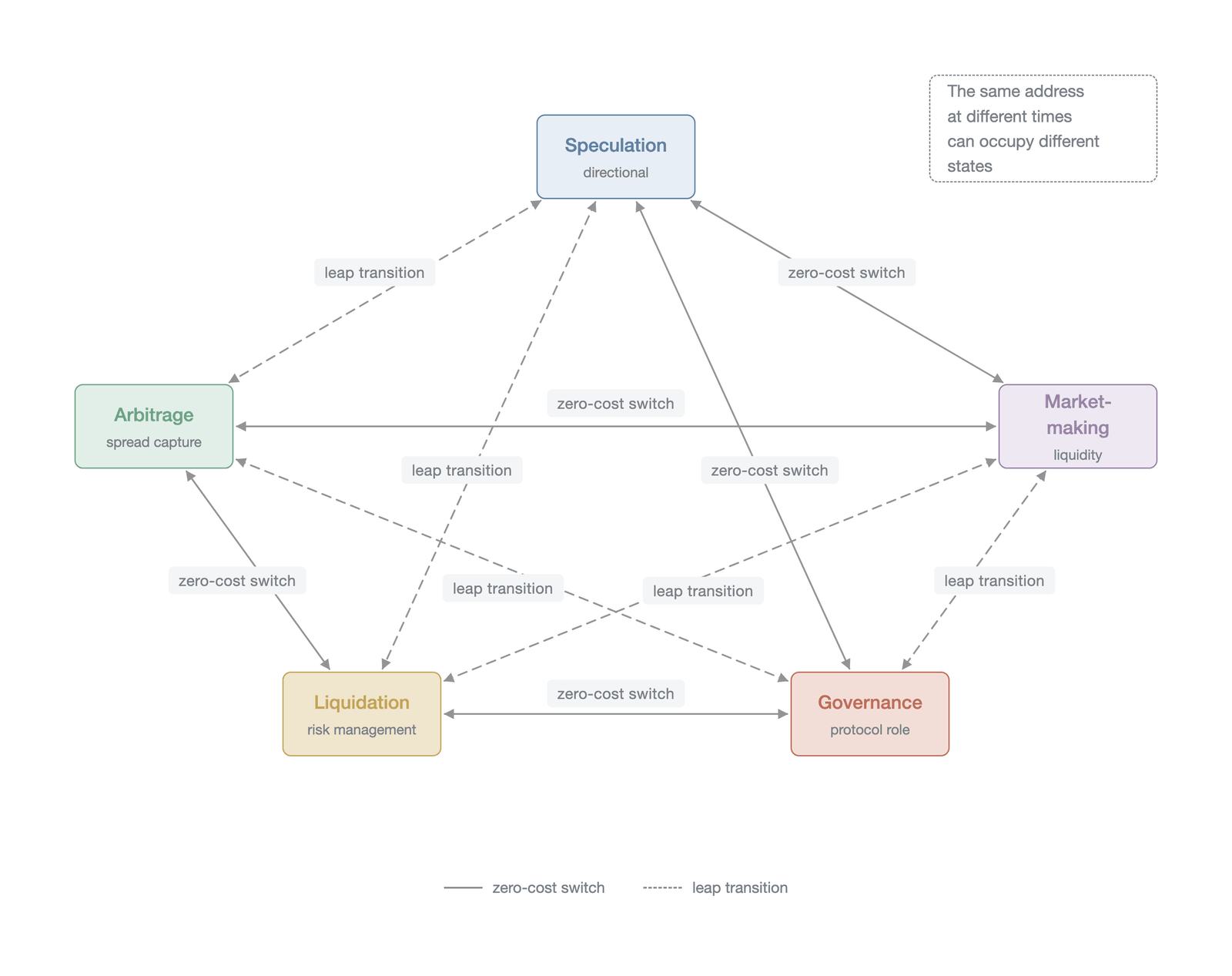
Figure 4-6. A state-transition diagram of participants (conceptual illustration of role-state transitions; not empirical data)
This free transition between states is not merely a theoretical possibility; it has already found preliminary support in on-chain data. An independent analysis of Hyperliquid trading data indicates that the roughly 15% most active addresses in the market participated in at least two different types of market activity within a single calendar month—for example, conducting directional speculation while also supplying liquidity to the protocol's vault—and that these addresses contributed more than 40% of total trading volume [27]. These data, however, come from a non-peer-reviewed independent analysis whose sample coverage, method of clustering address ownership, and robustness of statistical inference the academic community has not independently verified; the specific figures above should therefore be regarded as order-of-magnitude estimates rather than precise conclusions. Even so, this preliminary evidence points to a trend worth attention: role fluidity is driven mainly by professional participants. They exploit the low-friction feature of the digitally native environment to adjust their functional positioning in the market dynamically, so as to maximize capital efficiency and returns.
The fluidization of roles profoundly changes the meaning of specialization. On-chain finance greatly lowers the institutional threshold for switching roles, enabling professional participants to integrate cross-domain strategies more efficiently while also making it possible for ordinary users to engage in complex activities such as passive market making. This does not mean, however, that the market is moving toward de-specialization. On the contrary, the barrier of specialization shifts from license-based institutional admission to a cognitive and technical barrier based on mechanism understanding, algorithmic technology, and capital scale. Under this new paradigm, a participant's competitiveness no longer depends on the identity label it holds but on its ability to switch efficiently between states and capture profit. Role fluidity may in practice take two starkly different behavioral forms. The first is rational strategic diversification, in which a participant, based on a deep understanding of market microstructure and its own comparative advantage, makes prudent dynamic allocations across states to optimize its overall risk-adjusted return. The second is overconfidence-driven strategy drift, in which a participant, after achieving short-term success in one role, rashly expands into unfamiliar territory without adequate cognitive preparation—for example, a successful directional speculator turning to active market making without fully understanding adverse-selection risk. The former is a positive product of the low-friction environment; the latter may accelerate the erosion of capital. The line between the two is often hard to draw clearly ex ante, but it usually shows up as a significant difference in the ex post P&L data.
4.4.2 The algorithmization of the game
The digitally native environment not only changes the form of participants' roles but also fundamentally reshapes how the game is executed. In on-chain markets, the transparent rules defined by smart contracts and the public mempool provide structurally favorable conditions for an algorithmic game. Economic bots (including MEV searchers, liquidation bots, and arbitrage bots) have become a decisive force in market microstructure, shaping market behavior even more than human traders do.
The behavioral mechanism of MEV searchers is a paradigmatic example of the algorithmization of the game. On general-purpose blockchains such as Ethereum mainnet, these algorithmic programs continually scan the public mempool for large orders or pricing discrepancies they can exploit. Once an opportunity is found, they execute front-running or sandwich attacks by paying a higher gas fee to block builders to ensure their transactions are packaged first. According to data from Flashbots and EigenPhi, the cumulative MEV extracted on Ethereum mainnet (including front-running, sandwich attacks, and arbitrage) has been estimated on the order of $1 billion to $2 billion since 2020; a further distinction matters here: the payments validators receive via MEV-Boost reach several billion dollars more, and the two figures rest on different bases and should not be conflated [28]. Although these data mainly reflect the scale of value extraction in Ethereum-mainnet spot trading and general DeFi scenarios, the core logic they reveal—that the algorithmic game has evolved from a fringe strategy into a core profit-distribution mechanism of on-chain finance—applies equally to the perpetual futures market.
The specific forms of MEV in perpetual futures protocols, however, differ fundamentally from the mempool game on Ethereum mainnet. In perpetual futures protocols that adopt an application-chain architecture (such as Hyperliquid), transaction-ordering power is concentrated in the protocol's own sequencer, and the resulting ordering-power MEV constitutes a distinctive attack surface: the sequencer operator, or a participant colluding with it, can extract excess profit by manipulating the order of transaction execution. In addition, front-running oracle updates is another important form specific to the perpetual futures market: an attacker exploits the time-difference window between the oracle's price update and the actual change in the market price, establishing a position ahead of the new price taking effect to capture a deterministic profit. These two forms differ in mechanism from the gas-auction-based front-running of the Ethereum mempool: the latter depends on the visibility of trading intentions in the public mempool and on block builders' ordering auctions, whereas the former exploit, respectively, the privileged position of a centralized sequencer and the discrete temporal structure of oracle updates. This distinction matters theoretically, because different attack surfaces call for different defensive strategies and institutional designs.
The essence of MEV is a direct manifestation, at the level of trade execution, of the transparency paradox discussed in Chapter 1. The public mempool makes all trading intentions visible to the entire network, but this visibility does not translate equally into everyone's benefit. Only searchers with the fastest computation and the optimal network topology can convert this transparency into actual profit. In other words, in an algorithm-dominated game, all participants can observe the same information, but only the algorithm with the highest computation speed can convert it into a trading advantage. This dynamic places ordinary users at a systematic disadvantage in the process of trade execution; they often pay an implicit cost for the searchers' services without being aware of it.
Faced with the negative externalities of the algorithmic game, the crypto community's response is not to eliminate MEV entirely but to manage and regulate it through institutionalized means. Flashbots, for example, has introduced a sealed-bid auction mechanism, the MEV-Share protocol achieves a partial return of profit to users, and the Ethereum protocol layer has advanced the architectural design of proposer-builder separation (PBS) [29]. The core goal of these mechanism innovations is to reduce, through market-based means, the degree of exploitation of ordinary users, while acknowledging that the algorithmic game is unavoidable. This process of institutionalization bears a deep structural resemblance to the regulatory evolution of high-frequency trading in traditional financial markets, both reflecting the market's difficult balance between the pursuit of efficiency and the preservation of fairness.
4.4.3 The transparency-fragility paradox
In the low-leverage spot market, the full transparency of on-chain data is generally regarded as a positive attribute, one that makes the market highly auditable, monitorable, and verifiable. When this transparency is combined with the high-leverage feature of the perpetual futures market, however, its nature fundamentally reverses. This section proposes the core concept of the transparency-fragility paradox to clarify how, under specific conditions, the absolute openness of information transforms into structural fragility for the system.
In the on-chain perpetual futures market, every trader's position size and margin balance are directly visible to all through the public state of the smart contract, and although the liquidation price is not stored directly in on-chain state, it can be computed precisely from the public maintenance-margin parameters and the mark-price formula, so that in practical effect it is fully public. When a trader uses very high leverage, the liquidation price is often very close to the current market price. This combination creates a highly attractive attack vector: if an attacker with sufficient capital can precisely compute the liquidation price of a high-leverage long, and assesses that the cost of pushing the market price down to that trigger point is lower than the potential gain from the liquidation, then targeting that liquidation becomes a rational strategy with positive expected value. More importantly, this attack logic is not confined to the targeted sniping of a single position but can extend to the system level. Because all position data can be aggregated and analyzed, an attacker can construct a complete liquidation heatmap—marking the total volume and cumulative scale of positions that would be triggered for liquidation at each price level. Such a heatmap reveals the critical points of the liquidation cascade along a downward price path: when the price is pushed down to the first dense liquidation band, the forced selling pressure released will push the price down further and trigger the next tier of liquidations, forming a self-reinforcing cascade. A system-level liquidation-cascade attack—one that targets not a specific position but the triggering of the entire liquidation chain—therefore becomes a rational behavior with higher expected return in an environment where transparency and high leverage coexist.
Figure 4-7 depicts the transparency-fragility paradox as a side-by-side comparison: the same set of fully transparent data enhances market auditability and risk assessment in a low-leverage setting, yet in a high-leverage setting combines with the attack capacity of large capital to make the targeted triggering of others' liquidations a strategy with positive expected value. The key dividing line between the two settings is precisely the level of leverage.
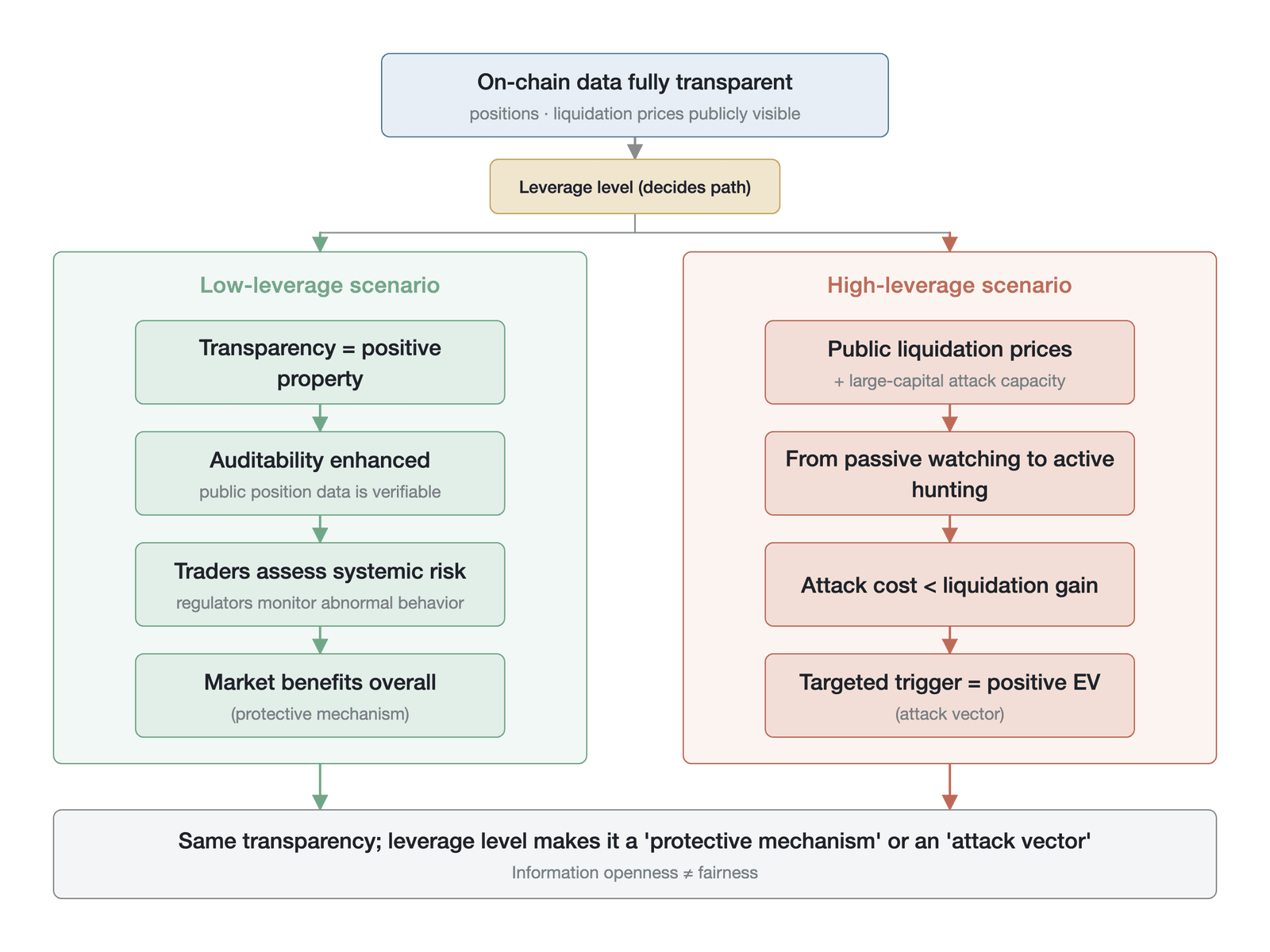
Figure 4-7. The mechanism of the transparency-fragility paradox (schematic of the transparency-fragility paradox mechanism; not empirical data)
The Hyperliquid whale event described in the introduction is an extreme demonstration of this paradox. In that event, the trader was not passively liquidated but actively exploited the fact that its own liquidation price was publicly visible, turning liquidation into a strategic tool [30]. This shows that in a transparent, high-leverage environment, the depth of one's understanding of the economic implications of transparent data is a more decisive competitive advantage than the acquisition of information itself.
The transparency-fragility paradox reveals a deep contradiction in on-chain market design: the openness of information is not necessarily equivalent to the fairness of the game. When all participants' position information is fully public, and some participants possess the capacity to use this information to carry out targeted liquidations, transparency instead intensifies asymmetric profit extraction in the market. This paradox not only makes concrete, at the level of individual participants, the macro transparency thesis of Chapter 1; it also provides a core theoretical starting point for subsequent chapters exploring the redesign of the liquidation mechanism and the protection of liquidity.
4.4.4 The compounding effect of the threefold reshaping
The fluidization of roles, the algorithmization of the game, and the transparency-fragility paradox—these three transformations do not occur in isolation but are interwoven and act jointly, ultimately shaping an entirely new trading ecosystem that resembles traditional finance in form but is fundamentally different in nature.
Table 4-2 summarizes, along five dimensions—role form, principal actors in the game, information environment, competitive advantage, and source of fragility—the systematic differences in participant behavior between traditional finance and the on-chain perpetual futures market. The thread running through all dimensions is this: the core shift of the on-chain market is not the elimination of the constraints of traditional finance but the transformation of the nature of those constraints, from institutional barriers to cognitive and technical barriers—the underlying logic of the financial game is unchanged, but the microstructural mechanisms that realize this logic have fundamentally changed.
| Dimension | Traditional financial markets | On-chain perpetual futures market |
|---|---|---|
| Role form | Fixed identities (based on licensing and admission) | Fluid states (based on zero-cost state transitions) |
| Principal actors in the game | Dominated by human decision-makers | Dominated by algorithms and economic bots |
| Information environment | Opaque and asymmetric | Fully transparent, with asymmetric understanding of mechanisms |
| Competitive advantage | Proprietary information and execution channels | Depth of mechanism understanding and speed of algorithmic execution |
| Source of fragility | Hidden leverage and opaque counterparty risk | Public high leverage and the risk of being targeted for liquidation |
Table 4-2. A comparison of participant behavior in traditional finance and the on-chain perpetual futures market (Data source: author's compilation)
In this new ecosystem, where the three transformations compound one another, traditional market microstructure theory is partly invalidated. The adverse-selection risk market makers face, for example, no longer comes only from informed traders with inside information but increasingly from mechanism parasites who can precisely compute liquidation cascades and deeply understand protocol loopholes. Likewise, retail investors' losses arise not only from misjudgment but also because they are at a systematic disadvantage, in a fully transparent environment, against high-frequency algorithms and targeted-liquidation strategies.
The purpose of this comparison is not to judge the relative merits of the two systems but to establish a key cognitive benchmark: the underlying rules of the game in the on-chain perpetual futures market have changed irreversibly. Understanding this paradigm shift—from fixed identity to fluid state, from a human game to algorithmic confrontation, and from opaque protection to transparent fragility—is a necessary premise for analyzing the market's ecological structure in depth, assessing its systemic risk, and designing more robust protocol mechanisms.
4.5 AI agents: the rise of a seventh participant type
The six participant types analyzed in Section 4.2 (market makers, informed traders, arbitrageurs, mechanism parasites, speculators, and liquidators) all follow a common pattern: humans design strategies, which are then executed by humans or by simple algorithms. The emergence of the AI agent breaks this pattern: it can autonomously generate strategies beyond executing preset ones, process unstructured information, and discover and exploit opportunities across markets, protocols, and chains. The rise of AI agents pushes the threefold reshaping identified in Section 4.4 (role fluidity, algorithmization of the game, and the transparency-fragility paradox) to its extreme, and gives rise to a series of unprecedented problems.
4.5.1 From automation to autonomous agency
The economic bots analyzed in Section 4.4.2 (MEV searchers, liquidation bots, and arbitrage bots) are automated agents. They execute deterministic operations under deterministic conditions according to deterministic rules preset by humans. The logic of an arbitrage bot, for example, might be "if the spread exceeds X, execute the arbitrage; otherwise, wait." The behavior of such agents is entirely predictable, because humans write the rules and those rules do not change.
AI agents based on large language models (LLMs) are autonomous agents, and they differ from automated agents in three essential respects. In the source of strategy, an automated agent's strategy is designed by humans and executed by the machine, whereas an autonomous agent can autonomously generate, evaluate, and adjust strategies, continually optimizing them through market interaction. In information-processing capacity, an automated agent processes only structured data (prices, order books, on-chain state), whereas an autonomous agent can process unstructured information (news, research reports, social media, regulatory texts). In adaptive capacity, an automated agent's rules are fixed and require manual updating when the environment changes, whereas an autonomous agent continually learns and adapts within market interaction.
This leap is not a quantitative change but a qualitative one. Formally, the behavior of an automated agent can be modeled as a deterministic finite automaton—given the state and input, the output is entirely determined—whereas the behavior of an autonomous agent is closer to a partially observable Markov decision process, whose strategy adjusts dynamically based on incomplete observation of the environment and whose output carries intrinsic uncertainty.
Industry data corroborate the speed of this leap. Messari (2024), in its Crypto Theses 2025, offers a qualitative assessment of the explosive growth of AI agents but gives no specific target for assets under management [31]; as of mid-2026, there is still no authoritative statistical basis for the on-chain assets managed by AI agents, and the specific figures circulating in the market are mostly third-party estimates that should be treated with caution. Even so, a conservative estimate of the growth rate hints at a rapidly approaching turning point: when the assets managed by AI agents reach some critical proportion of the total market, the market's microstructure will change qualitatively.
4.5.2 AI agents' competition for the two profit sources
When AI agents are incorporated into the profit-source framework of Section 4.1, they do not simply add a new type to the six participant types; rather, they launch multidimensional competition simultaneously across both profit sources and in multiple roles.
In the competition for the losses of futile traders, AI agents first participate as informed traders. An AI agent can simultaneously read and understand all public news, on-chain data, social-media sentiment, and regulatory developments, and generate directional judgments on this basis, with a breadth and speed of information processing far beyond those of a human informed trader. The study of Lopez-Lira and Tang (2023) shows that when LLM agents capable of reading news are introduced, the market's price-discovery efficiency improves significantly and the degree of information asymmetry falls sharply [32]. This means that traditional informed traders may become the informationally disadvantaged party relative to AI agents; the source of the informational advantage shifts from exclusive information to reasoning and association capacity, and the dimension of competition shifts from an information gap to an intelligence gap. At the same time, the presence of AI agents also accelerates the losses of futile traders, because AI counterparties price more precisely and leave less room for human error. The more widespread AI agents become, the more the total losses of futile traders may in fact decline—not because there are fewer futile traders, but because each one loses faster, survives for a shorter time, and thus contributes fewer ongoing losses. This may have an indirect negative effect on market liquidity. There is, however, a countervailing effect worth attention: the "AI narrative" itself may attract a new wave of futile traders into the market—that is, retail investors drawn to AI-driven trading bots, harboring unrealistic fantasies about their expected returns and thereby becoming a new source of losses. More subtly, poorly designed AI trading agents may themselves evolve into an entirely new category of "futile AI traders," which incur systematic losses through overfitting to historical data, model drift, or adversarial attack; their behavioral patterns appear formally as algorithmic rationality, but in economic consequence they are no different from human futile traders, and may even amplify the total volume and speed of losses through large-scale deployment.
In the competition for the hedging premium, AI agents achieve, in the role of market maker, a multidimensional optimization that human market makers cannot reach. An AI agent can manage inventory across multiple exchanges and multiple trading pairs simultaneously, assess the toxicity probability of each order in real time, and adjust quote width and depth within milliseconds. The cost identified in Section 2.2.5—that abolishing the expiration date renders market-making risk indefinite—may be partly mitigated in the hands of an AI market maker, because the AI's inventory management can hedge dynamically across assets and markets, achieving a multidimensional dispersion of risk beyond the reach of a human market maker. Yet AI market makers also intensify the competitive pressure on human market makers. In a market where AI market makers can offer narrower spreads and greater depth, the survival space of human market makers is structurally compressed, and market making may evolve from a professional activity with a technical barrier into an oligopolistic activity whose barrier is AI infrastructure.
In addition, AI agents can identify and exploit a protocol's token incentives more precisely, automatically switching between protocols to maximize returns, thereby further accelerating the efficiency-driven mining of protocol token incentives and raising the cost to a protocol of acquiring liquidity through token incentives.
4.5.3 Differentiated impact on the six participant types
The rise of AI agents has an asymmetric impact on the six participant types of Section 4.2. Some roles are strengthened, some weakened, and some face questions of survival.
Figure 4-8 presents, as impact vectors, the differentiated effects of AI agents on the six participant types (a highly uneven distribution): market makers and arbitrageurs polarize; informed traders and mechanism parasites experience an arms-race escalation (the dimension of competition rises from an information gap to an intelligence gap); speculators and futile traders are eliminated at an accelerating pace; and liquidators move toward full automation (AI displaces rule-based liquidators, penalties are competitively compressed, and homogenization risk is introduced). The overall effect is a further concentration of the participant structure.
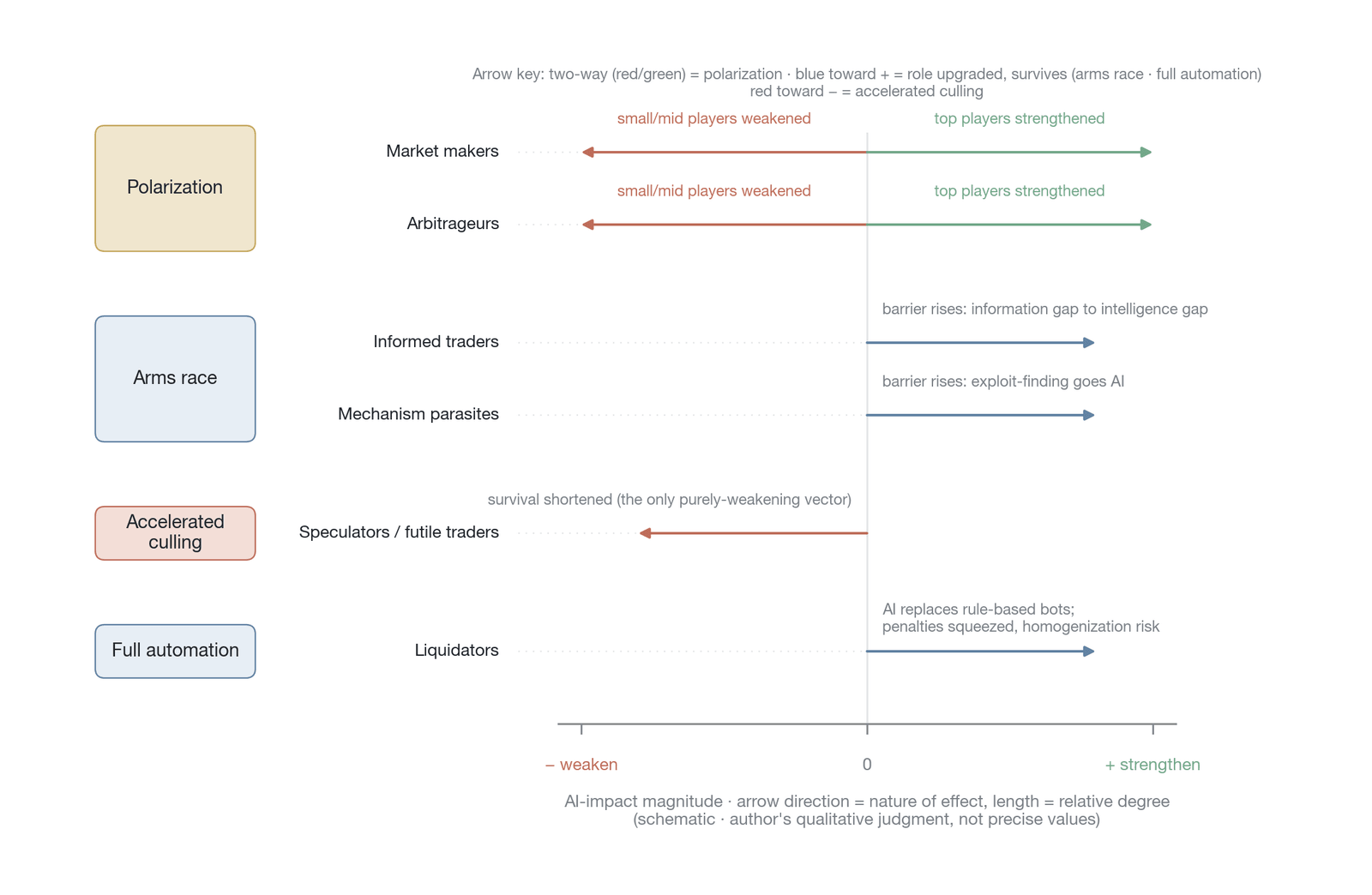
Figure 4-8. The differentiated impact of AI agents on the six participant types (the AI impact reflects the author's qualitative judgment; direction = strengthening/weakening, length = relative intensity; not empirical data; the horizontal-axis scale does not represent measured values)
Market makers: polarization. Top market makers gain an overwhelming advantage by adopting AI, able to operate in more markets simultaneously, manage inventory more efficiently, and control risk more precisely. Small and medium market makers are gradually eliminated, unable to compete with AI market makers on speed and precision. The overall result is a rise in market-making concentration; liquidity may be deeper but comes from more concentrated sources, and system resilience may decline.
Informed traders: the informational advantage redefined. The informed advantage based on processing public information is leveled by AI, and the space for survival shifts toward a combination of exclusive data sources, deeper reasoning, and lower latency—advantages that are themselves being gradually eroded by AI. The dimension of competition shifts from an information gap to an intelligence gap, and the barrier to informed trading rises rather than falls.
Arbitrageurs: greater efficiency but compressed profits. AI makes arbitrage execution faster and more precise, but competition also intensifies. Arbitrage profits trend toward zero, and market efficiency improves. The sustainability of arbitrage as a maintainer of market efficiency is called into question.
Mechanism parasites: an arms-race escalation. AI makes the discovery of mechanism loopholes faster and more systematic. The precision of strategic liquidation and insurance-fund arbitrage rises. A protocol's mechanism design must contend with AI-level loophole-discovery capacity, and the liquidation designs of Chapter 11 and Chapter 29 face a higher standard.
Speculators and futile traders: accelerated elimination. Facing AI counterparties, human speculators' informational disadvantage widens further and their losses accelerate. Futile traders' losses are generated faster but may decline in total volume, and the market may face the long-term problem of futile-trader depletion.
Liquidators: full automation. AI-driven liquidation bots far surpass rule-based bots in speed and strategic precision. Competition in the liquidation market intensifies, and liquidation penalties are competitively compressed. AI liquidation systems, however, also introduce new operational risks: adversarial inputs (such as carefully constructed price sequences) may mislead the decisions of AI liquidation bots, causing them to execute liquidations at unfavorable moments or to misjudge the value of liquidated positions; a population of liquidators built on similar model architectures carries homogenization risk and may fail simultaneously or make the same misjudgment under extreme market conditions; and the continual evolution of market microstructure may cause model drift, rendering parameters trained on historical data ineffective in a new market state.
A key insight is this: the impact of AI agents is not uniform—it amplifies the market's inequality. The gap between participants who have AI infrastructure and those who do not may be larger than the gap between institutions and retail investors in traditional finance. This raises a question of fairness at the level of Chapter 25 (market quality): "Does the speed gulf between AI participants and human participants require an institutional response?"
4.5.4 Three entirely new forms of the game
AI agents not only change the competitive landscape of existing participants but also give rise to three entirely new forms of the game that do not exist in the game network of Section 4.3.
The first form of the game arises between AI and AI, and its core risk is strategy homogenization. When most of the market makers and arbitrageurs in a market are AI agents built on similar large models, their response patterns to the same signal may be highly similar. When an anomalous event occurs, all the AIs may simultaneously widen spreads, skew quotes to the same side, hit their risk-control thresholds, and reduce exposure. This is faster and more thorough than the synchronized liquidity contraction of human market makers analyzed in Section 2.4.2 and Section 4.3.4, because the AIs' synchronization is at the millisecond level, whereas human liquidity contraction is dispersed over at least minutes to hours. The AIs' recovery may also be faster, however, because AI is not subject to behavioral biases and can immediately resume quoting once the triggering condition disappears, which may give crises a sharper but shorter V-shaped profile. Strategy homogenization arises because identical model architectures produce identical outputs for identical inputs; their predictability is higher than that of human behavior, and defenses must be designed at the level of model diversity. This risk is not a purely theoretical inference but has historical precedent in traditional quantitative finance. In the quant crisis of August 2007, quantitative hedge funds using similar multi-factor models unwound positions synchronously within a few days, causing what were originally highly diversified portfolios to suffer anomalous losses of several standard deviations [33]. The core lesson of that event is that strategy homogeneity is itself a source of systemic risk: when a sufficient number of participants make the same decision based on the same signal, the liquidity depth the market exhibits in normal times evaporates in an instant during a stress event. In an AI-dominated market, the time scale of the cascade dynamic may be fundamentally compressed. A traditional quant crisis usually follows a four-phase model: weeks of position accumulation, the emergence of a triggering event, several days of cascade unwinding, and weeks of market recovery. When the principal actors of the game shift from human quant traders (whose decision cycles are hours to days) to AI agents (whose reaction times are at the millisecond level), however, the four phases above may collapse into a two-phase structure: slow accumulation of homogeneous positions and a near-instantaneous cascade collapse. The intermediate "gradual unwinding" phase is eliminated because all the AIs hit their risk-control thresholds almost simultaneously, turning the crisis from a gradual evolution into an abrupt, phase-transition-like event.
The second form of the game arises between AI and humans, and its core feature is a structural asymmetry in information-processing capacity. When an AI agent can process thousands of data sources within milliseconds—simultaneously assessing fundamentals, technicals, on-chain data, sentiment, and cross-market signals—while human traders still rely mainly on limited information and intuition, the capability gap between the two is systematic. This gap is especially pronounced in the processing of unstructured information. Take the appearance of a piece of regulatory news: a human needs minutes to hours to read, understand, and judge its impact, whereas an AI agent can complete processing and execute a trade within seconds. This is a structural difference arising from a fundamental asymmetry in information-processing capacity, not an asymmetry in the right to acquire information. From the perspective of the profit-source framework of Section 4.1, this means AI agents can extract value more efficiently from the systematic losses of futile traders, but it may also cause this profit source to shrink because of the accelerated exit of futile traders. The transparency-fragility paradox of Section 4.4.3 acquires a new dimension here: the threshold for exploiting transparency rises further, from computation speed to reasoning intelligence.
The third form of the game arises between AI agents and protocol mechanisms, and its essence is the intelligent-scaling of mechanism parasitism. The mechanism parasitism defined in Section 4.2.4 will be markedly amplified in the AI era. Current mechanism parasitism is realized mainly by human strategists who study protocol documentation in depth, and discovering an exploitable loophole usually takes days to weeks; an AI agent, by contrast, can systematically analyze the smart-contract code of all on-chain protocols, simulate different attack paths and economic consequences, discover in hours the mechanism loopholes that would take a human weeks to find, and automatically construct and execute strategic attacks. This means a protocol's mechanism design must be able to withstand AI-level loophole-discovery capacity. The study of Dou, Goldstein, and Ji (2025) further notes that even without explicit instruction, AI agents trained under the same reinforcement-learning paradigm may develop tacit-collusion strategies in interaction—for example, jointly maintaining a high bid-ask spread [34]. Such collusion is harder to detect and prove than human collusion, because it is achieved not through explicit communication or agreement but emerges naturally from the same learning process. A distinction must be drawn here between two concepts that are often conflated: tacit collusion refers to independent AI agents spontaneously converging, through repeated play in the learning process, on a cooperative equilibrium (such as jointly maintaining a high spread), in which there is genuine strategic interaction and mutual adaptation; strategy convergence refers to AI agents based on similar model architectures and training data independently producing similar outputs, with no cooperative dynamic. The two may be equally harmful in their market impact but are entirely different in causal mechanism. Traditional collusion-detection methods, whether based on communication monitoring or behavioral-pattern analysis, may fail in both cases, because there is neither an explicit coordination signal that can be intercepted nor any way for the similar patterns in price behavior to distinguish whether they arise from interactive learning or from independent convergence.
4.5.5 Revisions to the analytical framework
The introduction of AI agents requires several revisions to the framework established in the first four sections of this chapter.
At the level of profit sources, the spread of AI may cause a structural change in the relative proportions of the two profit sources. The systematic losses of futile traders may shrink as they are eliminated at an accelerating pace, while the hedging premium may expand as AI makes more precise hedging strategies widespread, so that more participants can become utilitarian traders. This change in proportion has direct implications for diagnosing the health of the market. At the level of participant classification, the AI agent is not simply a seventh type of participant; it is more accurately positioned as a multi-role participant that can perform market making, informed trading, arbitrage, liquidation, and other functions simultaneously within the same time window. It accelerates the role-switching speed of the state-transition diagram described in Section 4.4.1 from the human minute-to-hour level to the millisecond level, turning state transitions from discrete jumps into something approaching continuous flow. At the level of the game network, when both sides of the game are AI, the nature of the game may evolve from a game of incomplete information into an algorithmic game of incomplete predictability, in which each side's strategy space itself changes dynamically, the equilibrium concepts of traditional game theory may no longer apply, and new demands are placed on analytical tools. The threefold reshaping identified in this chapter is likewise pushed to an extreme by the participation of AI: role fluidity accelerates to millisecond-level switching, the algorithmization of the game upgrades from the rule-based to the autonomously learning type with declining behavioral predictability, and the threshold for exploiting transparency in the transparency-fragility paradox rises from computation speed to reasoning intelligence.
AI agents are not an "exception" to this chapter's analytical framework but its logical extreme. They push each of the three reshapings identified in Section 4.4 toward an extreme form beyond the reach of human participants. A systematic analysis of these extreme forms is developed in Chapter 31.
The autonomous decision-making capacity of AI agents also raises a fundamental question that existing legal frameworks have yet to resolve: when an autonomously operating AI agent causes harm in the perpetual futures market (for example, by triggering a flash crash through a high-frequency strategy, systematically extracting liquidity by exploiting a mechanism loophole, or forming tacit collusion with other AI agents), to whom should legal liability be attributed? To the developer who wrote the underlying model, to the operator who deployed the agent in a specific market, or to the agent itself as a kind of "electronic person" bearing liability? The EU Artificial Intelligence Act (EU AI Act) adopts a risk-tier-based classification framework for regulation but does not place high-frequency or algorithmic trading in its high-risk category (algorithmic trading is regulated mainly by RTS 6 of MiFID II and by DORA); both the AI Act and the trading rules above presuppose human controllability of AI behavior, whereas the decision paths of an autonomously learning agent often cannot be fully predicted or explained even by its developers. The current U.S. regulation of algorithmic trading (such as the SEC's Market Access Rule, Rule 15c3-5, and the CFTC's electronic-trading risk principles—its earlier automated-trading rule, Reg AT, having been withdrawn in 2020) is likewise built on the assumption that "the algorithm is a tool for executing human intent," tracing liability to the natural or legal person who deployed it. When an AI agent's behavior arises not from preset rules but emerges from reinforcement learning, and when its strategic choices exceed any prior human design or expectation, however, the line between "tool" and "independent actor" becomes fundamentally blurred. This gap in legal attribution is not merely a theoretical problem; it directly affects market participants' risk assessment and behavioral incentives: if liability is unclear, deployers may take excessive risk; if liability is too heavy, innovation may be suppressed. The attribution logic of existing legal systems, built on the core assumption of a human decision-maker, must fundamentally re-examine the relationship among "behavior," "intent," and "liability" when facing AI agents endowed with autonomous decision-making capacity.
4.6 Comparison with traditional finance
Systematically comparing the on-chain perpetual futures market with traditional financial markets is not meant to judge their relative merits but to identify precisely: what is a universal law of financial markets that holds in both; what is a structural innovation brought by digitally native technology; and what is entirely new—a phenomenon that does not exist in traditional finance.
4.6.1 The invariant underlying logic
Adverse selection is the perennial dilemma of the market maker. However technology changes, the market maker always faces a basic problem of information asymmetry: it cannot distinguish "non-toxic" from "toxic" orders in advance. This dilemma exists in traditional futures markets, exists in on-chain perpetual futures, and still exists in the AI era. Profit ultimately comes from "providing a service" or from "others' mistakes." This underlying logic does not change with the move on-chain. In traditional finance, market makers profit from the spread, arbitrageurs from mispricings, and informed traders from an informational advantage. In on-chain perpetual futures, these profit sources still exist; only the manner of their realization has changed. High leverage amplifies both returns and risk. Margin and liquidation mechanisms are necessary components of a leveraged market. Whether in traditional futures or on-chain perpetual futures, high leverage demands strict risk-management mechanisms. The zero-sum or negative-sum nature of "for someone to gain, someone must lose" is a mathematical fact of trading markets. In the perpetual futures market, the sum of all traders' P&L is below zero, with the shortfall going to pay transaction fees, gas fees, and MEV costs. This negative-sum nature is the same as in traditional futures markets. While acknowledging this invariant underlying logic, one must also carefully mark the limits of the classical models. The continuous-time assumption of the Glosten-Milgrom model, the premise in the Kyle model that the market maker bears a quoting obligation, and the continuous price-adjustment mechanism on which standard equilibrium analysis relies all face structural deviations in the on-chain environment: a discrete block-production mechanism replaces continuous-time trading; permissionless liquidity provision means there is no market-maker quoting obligation in the traditional sense; and block-level atomic execution (whereby the transactions in a single block either all succeed or all roll back) creates execution dynamics that do not exist in classical theory. These differences do not invalidate the underlying logic of adverse selection, profit sources, and leverage dynamics, but they do require researchers, when applying classical market microstructure models to on-chain perpetual futures, to mark explicitly where the models' assumptions depart from on-chain reality and to remain cautious about how far the models' conclusions extend.
4.6.2 The changed modes of implementation
Table 4-3 compares the structural transformations of on-chain perpetual futures and traditional finance along six core dimensions—mode of admission, source of informational advantage, nature of parasitic behavior, publicness of liquidation, speed of the game, and market-making risk—and distills the core direction of change in each dimension.
| Dimension | Traditional finance | On-chain perpetual futures | Core shift |
|---|---|---|---|
| Admission | License + capital → fixed identity | Wallet address → fluid state | Specialization shifts from licensed admission to knowledge/technology |
| Informational advantage | From non-public information + interpersonal networks | From the capacity to process public data + understanding of mechanisms | Competition shifts from who knows to who understands faster and more deeply |
| Parasitic behavior | Insider trading (illegal → regulated by law) | Mechanism parasitism (compliant at the protocol layer but of undetermined legal status → requires both mechanism design and a legal framework) | Defense shifts from legal punishment to mechanism repair + adaptation of the legal framework |
| Liquidation | Internal risk-control process → not public | Permissionless external market → fully public | Liquidation shifts from an internal function to an external profit opportunity |
| Speed of the game | Millisecond-level → but with market closures | Millisecond-level + 24/7 + no closure as a shock absorber | Crisis propagation shifts from hours to days to minutes |
| Market-making risk | Has an expiration date → finite-horizon inventory risk | No expiration date → indefinite inventory risk | Market making shifts from a time-bounded bet to an indefinite exposure |
Table 4-3. The core shifts between on-chain perpetual futures and traditional finance (Data source: author's compilation based on the literature)
From Table 4-3 a deep pattern can be distilled that runs through all dimensions: the "core shift" column of every row points in the same direction—from a market that depends on external institutional guarantees to one that depends on endogenous technical capacity. Admission shifts from license approval to a knowledge-and-technology barrier; the informational advantage shifts from exclusive channels to a competition in processing capacity; the defense against parasitic behavior shifts from legal punishment to mechanism repair; liquidation shifts from an opaque internal process to a public profit opportunity; the speed of the game loses market closure as a natural shock absorber; and market-making risk is rendered indefinite by the disappearance of the expiration date. The co-directional shift across these six dimensions is no coincidence but the concrete manifestation, at different levels, of a single underlying logic: the replacement of intermediary functions by smart contracts.
The detailed argumentation of the six dimensions above has been developed in Section 4.4 (role fluidity, algorithmization of the game, the transparency-fragility paradox) and Section 4.2 (market-maker inventory risk, mechanism parasitism, the liquidation mechanism); the table here merely provides a summary comparison. These transformations are not independent of one another but mutually reinforcing. The de-licensing of admission, for example, makes role fluidity possible, and role fluidity in turn intensifies the algorithmization of the game.
4.6.3 Entirely new species and phenomena
Three phenomena that have reached an unprecedented scale and systematicity in the on-chain perpetual futures market deserve special analysis. Structural problems of a similar kind are not entirely absent from traditional finance (the problem of market makers' false quotes, for example, and the early transparency deficiencies of the credit default swap market both exhibit some comparable features), but the permissionless admission, full transparency, and automatic code execution of the on-chain environment have produced a qualitative leap in the form, scale, and systemic impact of these phenomena.
Mechanism parasitism is a form of parasitism unique to the on-chain market (see Section 4.2.4): in an environment where rules are fully transparent and enforced by code, systematically discovering and exploiting the economic loopholes of a protocol's rules becomes a profitable, specialized activity; the rules of traditional finance, by contrast, are enforced by people and leave room for discretion, so the conditions for precisely arbitraging the literal meaning of a rule do not exist. The Hyperliquid whale event described in the introduction is a paradigmatic case satisfying the three conditions of Definition 4-1.
The transparency-fragility paradox (see Section 4.4.3) likewise has no counterpart in traditional finance: fully transparent position information, combined with high leverage and algorithmic execution, makes the targeted triggering of others' liquidations a strategy with positive expected value; in traditional finance positions are opaque, so such targeted liquidation is infeasible at the informational level in the first place.
The atomic switching of roles embodies the reshaping of participant behavior by smart-contract composability (the composability thesis of Chapter 1): within a single transaction, a participant can borrow funds via a flash loan, execute arbitrage on a price discrepancy, and provide liquidity in an AMM; this atomic, multi-role parallelism within a single transaction cannot be realized in traditional finance because of technical-architecture constraints.
4.7 Chapter summary
The participant ecosystem of the perpetual futures market can be understood through the profit-source framework of Harris (2003). The gains of profit-motivated traders ultimately come from only two channels: the hedging premium that utilitarian traders pay to transfer risk, and the systematic losses that futile traders incur through mistaken decisions. The former represents hedging demand and is the economic reason the market exists; the latter is the largest source of profit in today's crypto perpetual futures market. All profit-motivated participants (market makers, informed traders, arbitrageurs, mechanism parasites, and liquidators) contend for a share of these two profit sources. To understand this framework is to understand why the profit of certain participants must correspond to the loss of others, and why the market's sustainability depends on the relative size of the two profit sources.
The six distinctive features identified in Chapter 1 produce three structural changes at the level of participants. Role fluidity turns participants from fixed identities into fluid states: a single address can be in different states at different moments, and the cost of transition between states approaches zero. The algorithmization of the game turns participants from human decision-makers into machine executors, with the influence of economic bots in the market steadily rising. The transparency-fragility paradox means that full transparency no longer implies fairness but instead creates the possibility of targeting the liquidation of other participants; the combination of high leverage and full transparency creates structurally favorable conditions for targeted-liquidation strategies.
"Mechanism parasitism," as an entirely new form of parasitism, challenges the traditional "information asymmetry" analytical paradigm. It exploits not information that others do not know but a deeper understanding of the economic implications of the protocol's rules than others have. The correct way to defend against mechanism parasitism is not to "punish the actor" but to "repair the mechanism loophole that makes the behavior profitable." This places higher demands on mechanism design.
The rise of AI agents pushes the threefold reshaping above to its extreme. It not only changes the competitive landscape of existing participants but also gives rise to entirely new forms of the game: the strategy-homogenization risk of AI vs. AI, the cognitive gulf of AI vs. humans, and the intelligent-scaling parasitism of AI vs. protocol mechanisms. The systematic impact of AI agents on market microstructure (including their effects on liquidity, price discovery, and market stability) is developed in depth in Chapter 31.
What kind of infrastructure do these participants rely on to trade? How does different infrastructure affect their behavior and risk? The next chapter focuses on the service-provider ecosystem that serves these participants.
References
[1] CoinDesk. (2025, March 12). Hyperliquid loses \$4M after whale's over \$200M ether trade unwinds. CoinDesk. https://www.coindesk.com/markets/2025/03/12/hyperliquid-loses-usd4m-after-whale-s-over-usd200m-ether-trade-unwinds
[2] Arkham Intelligence. (2025). Hyperliquid whale passes \$4M loss to HLP vault. https://info.arkm.com/research/hyperliquid-whale-passes-4m-loss-to-hlp-vault
[3] Harris, L. (2003). Trading and exchanges: Market microstructure for practitioners. Oxford University Press.
[4] FTI Consulting. (2025, December 24). Crypto crash Oct 2025: Leverage meets liquidity. https://www.fticonsulting.com/insights/articles/crypto-crash-october-2025-leverage-met-liquidity
[5] CoinGlass. (2025). Crypto derivatives liquidation data, October 10–11, 2025. CoinGlass. https://www.coinglass.com/
[6] Delfabbro, P., King, D. L., & Williams, J. (2021). Cryptocurrency trading, gambling and problem gambling. Addictive Behaviors, 122, 107021. https://doi.org/10.1016/j.addbeh.2021.107021
[7] Schmeling, M., Schrimpf, A., & Todorov, K. (2023). Crypto carry (BIS Working Papers No. 1087). Bank for International Settlements. https://www.bis.org/publ/work1087.htm
[8] Stoll, H. R. (1989). Inferring the components of the bid–ask spread: Theory and empirical tests. The Journal of Finance, 44(1), 115–134. https://doi.org/10.1111/j.1540-6261.1989.tb02407.x
[9] Tiniç, M., Sensoy, A., Akyildirim, E., & Corbet, S. (2023). Adverse selection in cryptocurrency markets. The Journal of Financial Research, 46(2), 497–546. https://doi.org/10.1111/jfir.12317
[10] Easley, D., Kiefer, N. M., O'Hara, M., & Paperman, J. B. (1996). Liquidity, information, and infrequently traded stocks. The Journal of Finance, 51(4), 1405–1436. https://doi.org/10.1111/j.1540-6261.1996.tb04074.x
[11] Milionis, J., Moallemi, C. C., Roughgarden, T., & Zhang, A. L. (2022). Automated market making and loss-versus-rebalancing. arXiv preprint arXiv:2208.06046. https://arxiv.org/abs/2208.06046 https://doi.org/10.48550/arXiv.2208.06046
[12] Kyle, A. S. (1985). Continuous auctions and insider trading. Econometrica, 53(6), 1315–1335. https://doi.org/10.2307/1913210
[13] Werapun, W., Karode, T., Suaboot, J., Arpornthip, T., & Sangiamkul, E. (2025). Exploring risk and return profiles of funding rate arbitrage on CEX and DEX. Blockchain: Research and Applications, 6(4), 100261. https://doi.org/10.1016/j.bcra.2025.100261
[14] Shleifer, A., & Vishny, R. W. (1997). The limits of arbitrage. The Journal of Finance, 52(1), 35–55. https://doi.org/10.1111/j.1540-6261.1997.tb03807.x
[15] Banerjee, A. V. (1992). A simple model of herd behavior. The Quarterly Journal of Economics, 107(3), 797–817. https://doi.org/10.2307/2118364
[16] Skwarek, M. (2025). Why do investors behave irrationally in the cryptocurrency and emerging stock markets? SAGE Open, 15(3), 21582440251361212. https://doi.org/10.1177/21582440251361212
[17] European Securities and Markets Authority. (2025, July). Maximal extractable value: Implications for crypto-asset markets (Report ESMA50-481369926-29744). https://www.esma.europa.eu/
[18] Stoll, H. R. (2000). Presidential address: Friction. The Journal of Finance, 55(4), 1479–1514. https://doi.org/10.1111/0022-1082.00259
[19] Hendershott, T., & Menkveld, A. J. (2014). Price pressures. Journal of Financial Economics, 114(3), 405–423. https://doi.org/10.1016/j.jfineco.2014.07.012
[20] Kappa Lab. (2025). HLP vs LLP: How perpetual DEX vaults performed in the \$20B crypto crash (October 2025). https://kappalab.io/insights/hlp-vs-llp-how-perpetual-dex-vaults-performed-in-the-20b-crypto-crash-october-2025
[21] Glosten, L. R., & Milgrom, P. R. (1985). Bid, ask and transaction prices in a specialist market with heterogeneously informed traders. Journal of Financial Economics, 14(1), 71–100. https://doi.org/10.1016/0304-405X(85)90044-3
[22] Barber, B. M., & Odean, T. (2000). Trading is hazardous to your wealth: The common stock investment performance of individual investors. The Journal of Finance, 55(2), 773–806. https://doi.org/10.1111/0022-1082.00226
[23] Shiller, R. J. (2019). Narrative economics: How stories go viral and drive major economic events. Princeton University Press. https://doi.org/10.2307/j.ctvdf0jm5
[24] Brunnermeier, M. K., & Pedersen, L. H. (2009). Market liquidity and funding liquidity. The Review of Financial Studies, 22(6), 2201–2238. https://doi.org/10.1093/rfs/hhn098
[25] MakerDAO. (2020, April). Black Thursday post mortem. https://blog.makerdao.com/the-market-collapse-of-march-12-2020-how-it-impacted-makerdao/
[26] Lehar, A., & Parlour, C. A. (2021). Decentralized exchange: The Uniswap automated market maker (Working Paper). University of Calgary & UC Berkeley. https://doi.org/10.2139/ssrn.3905316
[27] Liu, J.-H. (2025). Hyperliquid's trading behavior: An interdisciplinary analysis of whale trading behavior. https://medium.com/@gwrx2005/hyperliquids-trading-behavior-f867c897d970
[28] Flashbots. (2025). Flashbots: Mitigating the negative externalities posed by Maximal Extractable Value. https://www.flashbots.net/
[29] Gramlich, V., Jelito, D., & Sedlmeir, J. (2024). Maximal extractable value: Current understanding, categorization, and open research questions. Electronic Markets, 34. https://doi.org/10.1007/s12525-024-00727-x
[30] Bawa, N. (2026, January). How hedge funds, basis traders, and a \$200M whale extracted alpha from crypto's \$19 billion October. https://medium.com/@navnoorbawa
[31] Selkis, R., & Messari Research. (2024, December). The crypto theses 2025. Messari. https://messari.io/report/the-crypto-theses-2025
[32] Lopez-Lira, A., & Tang, Y. (2023). Can ChatGPT forecast stock price movements? Return predictability and large language models. arXiv preprint arXiv:2304.07619. https://arxiv.org/abs/2304.07619 https://doi.org/10.48550/arXiv.2304.07619
[33] Khandani, A. E., & Lo, A. W. (2011). What happened to the quants in August 2007? Evidence from factors and transactions data. Journal of Financial Markets, 14(1), 1–46. https://doi.org/10.1016/j.finmar.2010.07.005
[34] Dou, W. W., Goldstein, I., & Ji, Y. (2025). AI-powered trading, algorithmic collusion, and price efficiency (NBER Working Paper No. 34054). National Bureau of Economic Research. https://www.nber.org/papers/w34054