In today's crypto derivatives markets, buying a large position—say, a $10 million Ethereum long—is really a multilayered act of transmitting financial information. How this order is ultimately handled depends on the execution architecture chosen. If the limit order is sent to a centralized exchange such as Binance or OKX, it reaches the exchange's private servers instantaneously over an encrypted API. Within the matching engine's memory, the order is processed in sub-millisecond time. If no matching sell order exists in the current order book, it rests there. Apart from the exchange's internal systems and the handful of high-frequency market makers who can observe partial information through private data feeds, the market as a whole cannot access this $10 million buying intent. The trader can cancel the order at any time at zero cost, leaving no public record.
If the trader instead submits the identical order on an on-chain central limit order book protocol such as Hyperliquid or dYdX, the processing flow differs fundamentally. Once signed by the private key, the order is broadcast to the application chain's validator network. Roughly 200 milliseconds later, it is packed into a block and becomes an immutable on-chain commitment, displayed publicly to the entire world. Every full-node operator, on-chain analytics tool, and arbitrage bot can immediately "see" this $10 million buying intent. If the order does not fill immediately, it hangs publicly on the on-chain order book, becoming a focal point for strategic maneuvering among all parties. To cancel it, the trader must submit another on-chain transaction, which not only incurs a network fee but also endures the latency of block confirmation, and every attempt and withdrawal is permanently recorded as historical data.
These two starkly different processing paths reflect the ongoing evolution of the crypto derivatives market microstructure. In 2025, the crypto derivatives market recorded average daily trading volume of approximately $264.5 billion [1]. Within this vast market, perpetual futures have become the instrument with the largest share of trading volume: they have not only surpassed the trading scale of the spot market but have also become the core mechanism for pricing and liquidity discovery across the entire crypto-asset space. Decentralized derivatives exchanges also grew rapidly over the same period. Driven by high-performance application chains such as Hyperliquid, decentralized exchange (DEX) perpetual futures volume surged 346% in 2025 to reach $6.7 trillion [2]. Hyperliquid in particular reached $2.9 trillion in annual volume, surpassing compliant giants such as Coinbase International, and in October set a historical record by processing more than $300 billion in volume in a single month [2]. The DEX share of the perpetual futures market jumped from less than 4% at the start of the year to more than 13% by year-end—a structural shift that marks the arrival of on-chain derivatives trading in the mainstream market.
Migrating complex derivatives trading and high-frequency order books from private servers onto public blockchains, however, is not merely a straightforward replacement of infrastructure. It constitutes a reconstruction at the level of market microstructure. In an on-chain environment, an order is no longer merely an expression of trading intent; it becomes a public signal with high information content in its own right. Starting from the theoretical framework of "the order as a signal," this chapter analyzes information leakage and adverse selection in the transparent on-chain environment, the defensive mechanisms market makers deploy within the order book, the "intent-execution gap" faced by ordinary traders, and—progressing from basic to advanced—the toolbox of order types, the three-dimensional strategic extension of perpetual futures, and how the physical constraints of blockchain reshape the economic meaning of orders.
7.1 The signaling function of orders
In the microstructure theory of financial markets, the order is the most fundamental building block [3]. Traditional textbooks tend to treat the order as a purely operational tool ("a market order means immediate execution at the current price; a limit order means resting at a specified price and waiting"). This understanding is necessary but far from sufficient. In the environment of modern high-frequency trading and transparent on-chain ledgers, every order submitted to the market—whether or not it ultimately fills—transmits rich information to the market. This section establishes a conceptual framework: every order simultaneously performs a "trading function" and a "signaling function," and the trader's core strategic challenge is to find the optimal balance between the two. This "order as a signal" framework runs through the entire chapter and provides a unified explanation of the strategic implications of all order types.
7.1.1 The trading function and the signaling function
In crypto derivatives markets, and especially in the on-chain central limit order book (CLOB), every order has an inseparable dual function: an explicit trading function and an implicit signaling function.
The trading function is the surface-level purpose of an order. When a trader submits a buy order, the direct purpose is to acquire a long position in the target asset at a specific price. This function is deterministic and mechanical, executed strictly by the matching engine according to rules such as price priority and time priority. Whether the trading function succeeds is reflected directly in the trader's account balance and position changes. In the context of perpetual futures, the trading function carries additional dimensions: a buy order not only changes the direction and size of a position but also simultaneously changes the effective leverage, the liquidation price, and the proportion of margin utilized. These derivative effects make order decisions in perpetual futures an order of magnitude more complex than in the spot market.
The signaling function is the deeper attribute of an order. In a market with information asymmetry, a trader's behavior is itself the largest source of information. The type, price, size, and submission time of an order—and even the frequency with which it is canceled—all leak the trader's private information to other market participants, especially market makers and arbitrageurs. Specifically, the signaling function comprises the following dimensions:
| Signal dimension | Information leaked | Inference logic |
|---|---|---|
| Order direction | The trader's view on price movement | A buy order implies a bullish expectation; a sell order implies a bearish expectation |
| Order type | The trader's degree of urgency | A market order signals extreme urgency; a limit order signals a willingness to wait |
| Order size | The trader's capital base and level of conviction | A large order suggests an institutional-grade participant or a strong directional belief |
| Submission time | The timeliness of the information | Orders submitted around major events are more likely to contain private information |
| Cancellation frequency | The order's true intent | Frequent cancellation may suggest "probing" orders or market-making adjustments |
Table 7-1. The five dimensions of the order's signaling function (Data source: compiled by the author)
Table 7-1 systematically lays out the five dimensions of the order's signaling function: a market maker's algorithms analyze an order's direction, type, size, and timing in combination to infer the identity category and information content of the submitter. Figure 7-1 uses a flowchart to show the transmission path of the trading function and the signaling function from order submission to the trader's optimization objective.
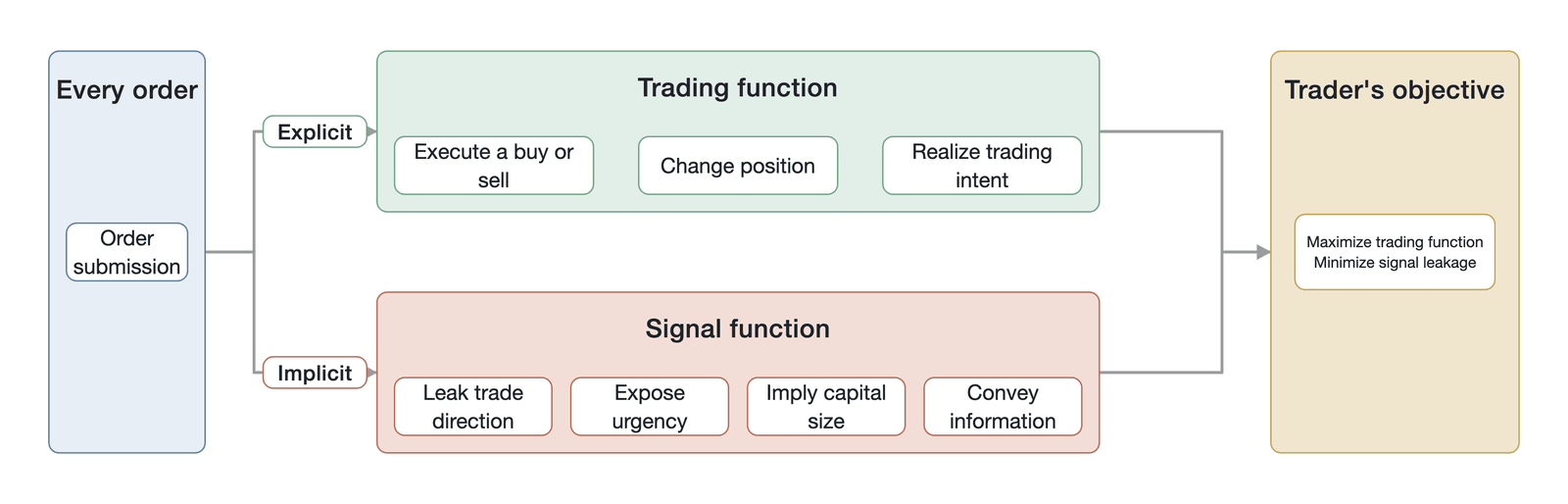
Figure 7-1. The dual function of an order (conceptual/mechanism flow illustration, not empirical data)
This recognition of a dual function can be formalized as a concise optimization framework. For any order, the trader's objective function can be stated as:
Order optimization objective = maximize (trading-function efficiency) × minimize (degree of signal leakage)
The framework above is a normative benchmark: it describes how a rational trader ought to choose an order type, not how actual traders in fact behave. A large body of empirical research shows that retail traders' order choices are often driven by behavioral factors such as platform UI defaults, urgency bias, and the availability heuristic, and thus systematically deviate from this theoretical optimum. Different order types offer different Pareto-optimal solutions within this objective function. A market order pushes trading-function efficiency to its limit (immediate execution) but also maximizes signal leakage; an iceberg order minimizes signal leakage but sacrifices execution speed and certainty. Understanding this trade-off is the theoretical foundation for understanding all of the order-type analysis that follows.
On a centralized exchange, the signaling function is partly masked by dark pools, iceberg orders, and the exchange's internal data-segregation mechanisms. A trader's limit order is visible only to the exchange and to authorized counterparties, cancellation leaves no public trace, and the signal's range of propagation is strictly confined within the walls of the exchange. In an on-chain CLOB protocol, however, the global visibility of the blockchain ledger dramatically amplifies the order's signaling function. Any participant able to run a full node or access an RPC endpoint can monitor every minute change in the order book in real time. In this fully transparent market, every order transmits information, and it does so to all participants.
7.1.2 The signal-strength spectrum
Not all orders transmit signals of the same strength. Depending on the order type and its parameters, we can construct a "signal-strength spectrum." Along this spectrum, different types of orders exhibit a clear trade-off between execution urgency and the degree of signal leakage.
At one end of the spectrum is the large market order. Orders of this kind transmit strong execution urgency, indicating that the trader is willing to accept any price on the current order book in order to complete the trade immediately. In microstructure theory, market orders are generally regarded as containing the highest proportion of "private information" [4]. Their signal content can be read as: "I need to fill immediately, whatever the slippage, because I may hold time-sensitive material information." When market makers observe a run of one-directional large market orders, they immediately infer that an informed trader is building a position, and they promptly withdraw liquidity or adjust their quotes. Yet the signal from a large market order is not noise-free: panic selling and forced liquidations also generate large market orders, and market makers cannot tell the two apart perfectly in advance—which is precisely the root of the adverse-selection problem.
The middle region of the spectrum holds the various limit orders. Aggressive limit orders (priced very close to, or even better than, the current best bid or offer) transmit a signal strength second only to that of market orders; their implicit message is: "I have a directional view, but I am not especially urgent, and I am willing to wait briefly for a better price." Such orders seek a balance between urgency and execution price. Passive limit orders placed far from the market price, by contrast, transmit a relatively weak signal; they are seen more as the passive positioning of a liquidity provider—the typical choice of a market maker—or as the "buy-the-dip" strategy of a long-term investor.
At the other end of the spectrum are algorithmic orders (such as TWAP/VWAP) and iceberg orders. These orders are designed from the outset to conceal the trader's true intent and total size. An iceberg order slices a large order into small blocks displayed in sequence, deliberately hiding the true size; time-weighted average price (TWAP) and volume-weighted average price (VWAP) algorithms spread a large order over a longer time window, so that the signal of each small order is so faint as to be nearly indistinguishable from background market noise. Their goal is to split a large order into subordinate orders small enough that each child order's signal strength approaches the level of market noise.
| Order type | Signal strength | Signal content | Execution certainty | Typical users |
|---|---|---|---|---|
| Large market order | Very strong | Urgent need; may hold material information | Highest | Informed traders, panic traders |
| Ordinary market order | Strong | Has a directional view; needs immediate execution | High | Speculators, trend followers |
| Aggressive limit order | Moderately strong | Has a directional view; willing to wait briefly | Medium-high | Active traders |
| Ordinary limit order | Medium | Conviction about value; not in a hurry to fill | Medium | Market makers, value investors |
| Far-from-market limit order | Weak | Providing liquidity or positioning to buy the dip | Low | Market makers, long-term investors |
| TWAP/VWAP algorithmic order | Very weak | Spreads size across time | Medium (in tranches) | Institutional traders |
| Iceberg/hidden order | Very weak | Deliberately conceals true size | Medium-low | Large traders |
Table 7-2. The correspondence between order types and signal strength (Data source: compiled by the author)
Table 7-2 reveals a core regularity: the true trade-off axis in order selection is not "signal strength ↔ execution certainty" but rather "execution urgency ↔ price improvement and signal concealment." The large market order sits at the high-urgency end, achieving both the highest execution certainty and the strongest signal leakage (the two move in the same direction at this end); iceberg orders and TWAP sit at the low-urgency end, trading away execution speed in exchange for the weakest signal leakage. Signal strength and execution certainty therefore move together at the passive end and diverge at the active end, rather than forming a simple one-dimensional inverse relationship. (Aggressive limit orders and immediate-or-cancel (IOC) orders, for example, may under specific conditions combine relatively high signal strength with high execution certainty; moreover, in an on-chain environment, the execution pattern of TWAP/VWAP child orders may be reassembled through pattern recognition by on-chain analytics tools, so that the actual efficiency of signal concealment is lower than the table suggests.) Figure 7-2 arranges the various order types along the two poles of "execution urgency" and "degree of signal leakage."
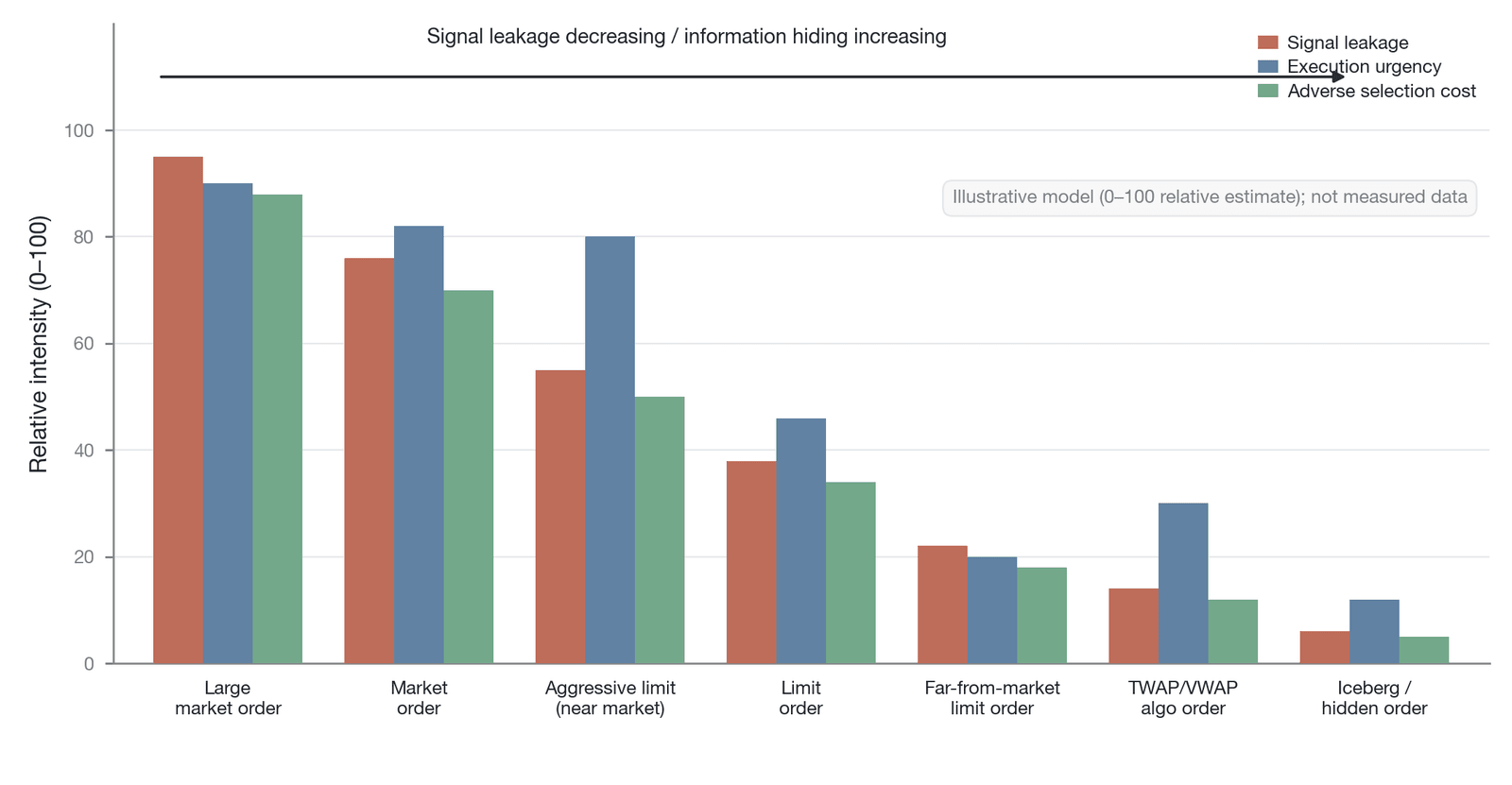
Figure 7-2. The signal-strength spectrum of orders (conceptual model illustration: the 0–100 scale represents relative strength assigned by the author, not empirical data; theoretical basis: Copeland & Galai 1983 [4], Harris 2003 [3], Easley et al. 2012 [29])
Core strategic implication: traders face a fundamental trade-off between execution urgency (speed) and information concealment (and price improvement), rather than a simple opposition of "execution certainty versus information leakage." A market order has the highest execution certainty but the greatest signal leakage; an iceberg order has the smallest signal leakage but lower execution certainty and greater operational complexity. To choose an order type is to choose one's position within this trade-off.
In an on-chain environment, this trade-off becomes especially acute. Because there is no native privacy-preserving mechanism, a genuine iceberg order is difficult to implement (its transparency tension and formal definition appear in Section 7.3.2, and the mitigation via protocol-level selective opacity appears in Section 7.5.4). On today's mainstream on-chain CLOBs such as Hyperliquid and dYdX, traders rely mainly on off-chain computation and high-frequency order splitting to simulate algorithmic execution; but every child order remains visible on-chain, and a sufficiently sophisticated on-chain analytics tool may still re-correlate these fragments through pattern recognition to infer the trader's true intent. The structural limits the on-chain environment places on signal concealment are the core analytical starting point for understanding the microstructural differences between the on-chain CLOB and the CEX. This section only establishes that conceptual framework; Section 7.5 develops the public-commitment property of on-chain orders in depth from the standpoint of MEV exposure and commitment cost.
7.1.3 The microfoundations of adverse selection
When orders "speak," the most important listener in the market is the market maker. Market makers earn the bid-ask spread by simultaneously providing quotes on both the bid and ask sides; they are the core suppliers of market liquidity. This business model, however, faces one central risk: adverse selection.
The concept of adverse selection was first formalized by Copeland and Galai in their seminal 1983 paper [4]. Glosten and Milgrom (1985) subsequently proved, in a sequential-trade model, that the equilibrium level of the bid-ask spread is determined by the market maker's posterior estimate of the proportion of informed traders [5]; Kyle (1985), starting from the optimal strategy of the informed trader, proved that the price-impact coefficient is proportional to the precision of the informed trader's information [6]. Together, these three classic works build the microfoundations of adverse-selection theory. Copeland and Galai's key insight is this: the act of submitting a limit order is, in economic terms, equivalent to giving the market a free option. When a trader posts a buy limit order, they in effect grant anyone in the market the right to sell the asset to them at that price. If the market price remains stable or rises, this "option" is not exercised and the limit order remains unfilled; but if an informed trader learns of information that will cause the price of ETH to crash, they will immediately "exercise" the option, selling their soon-to-depreciate ETH to the limit-order submitter at $3,000. For the limit-order submitter, being passively filled often means bearing an adverse-selection loss.
As the largest providers of limit orders in the market, market makers face adverse-selection risk continuously. To compensate for this potential loss, market makers must charge an "information premium" to all traders—including uninformed ones—by widening the bid-ask spread. This cost is shared across the entire trading population: the presence of a small number of informed traders systematically raises transaction costs for all participants.
In practice, the way market makers "listen" to orders relies mainly on real-time monitoring of order-flow imbalance. By analyzing the volume difference between aggressive buy orders and aggressive sell orders within a given time window, market makers can infer the direction in which market microstructural momentum is tilting. Research by Bieganowski and Ślepaczuk (2026) confirms that order-flow imbalance is one of the strongest predictive signals of short-term price direction [7]. When a market maker's algorithm detects a sharp rise in buy-side aggression (for example, a succession of large market buy orders), it reacts immediately: widening the ask-side quote and reducing ask-side depth. This is the microstructural mechanism of a "rising price": not some abstract "market force," but rather the market maker "hearing" in the order flow the signal that informed traders are entering, and adjusting risk exposure accordingly. Figure 7-3 formalizes this dynamic process as a closed-loop feedback model: the market-order impact of informed traders triggers the market maker's perception of adverse selection; the market maker defends by widening the spread and withdrawing quotes; and this defensive response in turn further intensifies the market's liquidity contraction, forming a self-reinforcing loop of adverse selection.
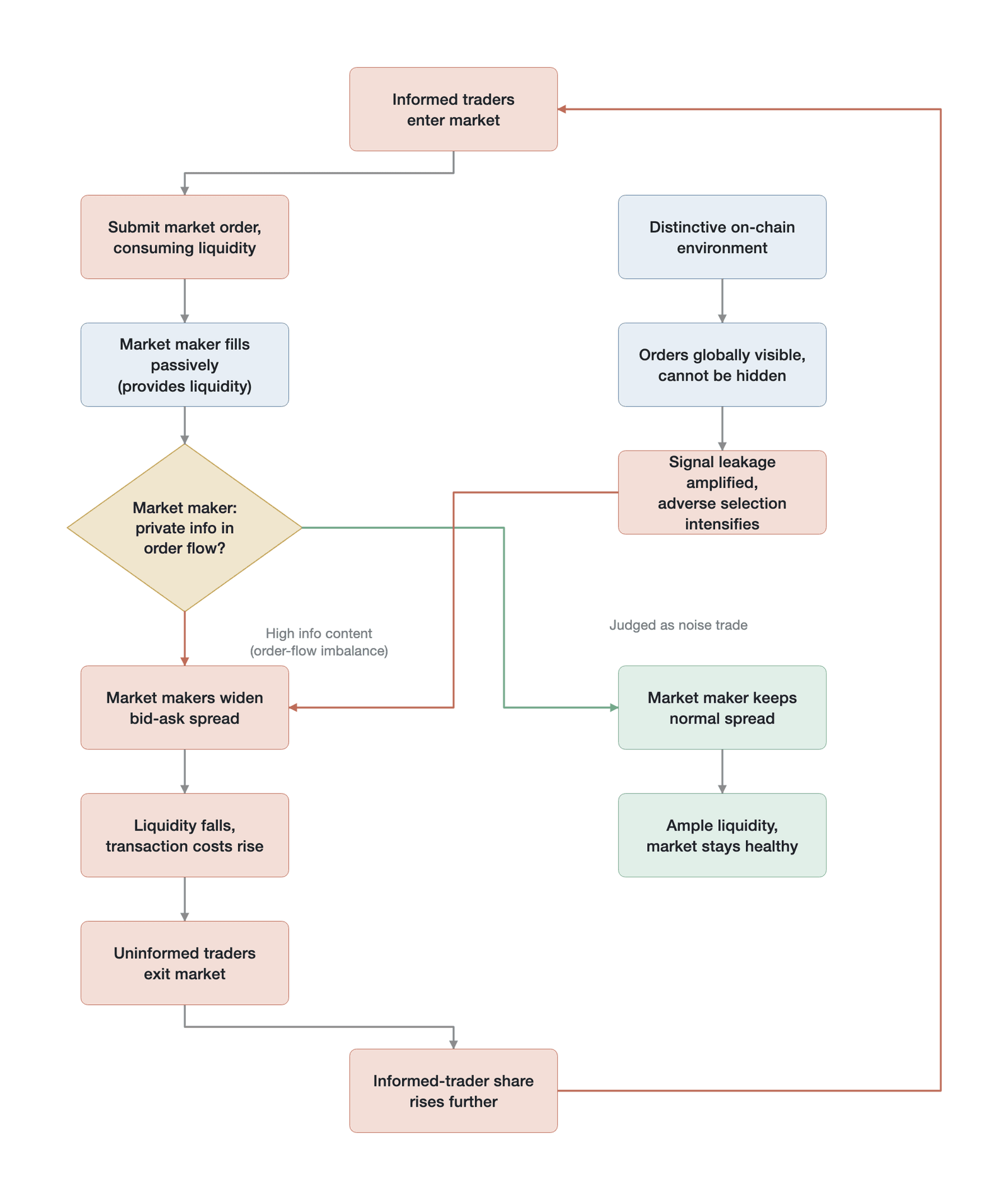
Figure 7-3. The market maker's adverse-selection feedback loop (mechanism feedback-loop illustration, not empirical data; order-flow imbalance is one of the strongest short-term price-prediction signals, per Bieganowski & Ślepaczuk 2026 [7])
Adverse selection in perpetual futures has a distinct amplifying effect. Empirical research by Ruan and Streltsov (2022) finds that a market's transaction costs may actually rise after perpetual futures are introduced [8]. The study's sample period (2020–2022), however, coincided with a period of large-scale retail entry into crypto markets and globally accommodative monetary policy; the rise in transaction costs may partly reflect the dramatic change in the composition of market participants rather than an inherent effect of perpetual futures, and the finding should therefore not be casually generalized as a universal feature of perpetual-futures markets. This seemingly counterintuitive phenomenon is a direct manifestation of an intensified adverse-selection effect. The high-leverage nature of perpetual futures means that an informed trader can command a larger position with less capital, greatly improving the efficiency with which their informational advantage is monetized; at the same time, round-the-clock uninterrupted trading means that market makers must maintain quotes at all times and cannot pause trading after a close as in traditional markets. More fundamentally, the introduction of perpetual futures creates a new source of adverse selection for spot market makers: informed traders can choose to express their informational advantage in perpetual futures rather than in the spot market, so that the informed component of the order flow facing spot market makers rises and their market-making profit falls. These two factors combined force market makers to widen spreads to compensate for the higher adverse-selection risk.
The extreme market conditions of October 10, 2025, provide a representative observation sample. On that day, amid a macro geopolitical shock, the crypto market suffered a flash crash: open interest in perpetual futures market-wide evaporated by roughly $19 billion in about 36 hours, accompanied by forced liquidations of the same order of magnitude [9]. In this event, market makers on the on-chain CLOB monitored the sudden surge of one-directional market sell orders and enormous liquidation orders (a liquidation order is essentially a form of forced market order) and quickly "understood" the market's panic signal. Within milliseconds, market makers' algorithms responded defensively: withdrawing existing buy limit orders on a large scale and sharply lowering new quotes. This behavior caused order-book depth within the ±2% price band for major pairs (such as BTC-USDT and ETH-USDT) to evaporate by more than 90% in a short time, and bid-ask spreads widened sharply [10]. This is precisely the defensive manifestation of the adverse-selection mechanism under extreme stress. Although it protected market makers' capital, it also caused an instantaneous depletion of market liquidity, so that every trader attempting to execute an order at that moment faced slippage costs far above normal levels.
7.1.4 The intent-execution gap
For the ordinary trader, understanding the signaling function of orders and the defensive mechanisms of market makers ultimately serves the purpose of crossing one central obstacle—the "intent-execution gap." This is the second core theoretical contribution of this chapter.
This gap refers to the difference between the theoretical price a trader has in mind when forming a trading decision ("I want to buy 50 ETH long around $2,050") and the price at which the order actually fills in the market ("actual average fill price $2,053.7, slippage 0.18%, gas fee $1.2, an additional $12 lost to a sandwich attack"). The concept derives from the "implementation shortfall" framework proposed by Perold (1988) [11], but in the context of on-chain perpetual futures the composition and drivers of the gap exhibit a distinctive distribution.
In on-chain perpetual futures trading, the intent-execution gap can be decomposed into the following cost components (Table 7-3):
First, the latency cost arises from the time lag between the trader clicking "buy" and the order being packed into a block and processed by the matching engine. On a CEX this is typically a few milliseconds or even sub-millisecond; on-chain, even on a highly optimized application chain like Hyperliquid (block time of about 200 milliseconds), it takes several hundred milliseconds from order signing to final confirmation, and on a DEX built on a general-purpose public chain it may take several seconds or even tens of seconds. Within this seemingly brief time window, the market price may already have moved unfavorably, especially during periods of high volatility. At the same time, the size of the trader's own order consumes liquidity on the order book, causing the average fill price to be worse than the initial best quote; this is the source of price impact. The larger the order size, the more pronounced the price impact; on an on-chain CLOB, where liquidity depth is generally lower than on top-tier CEXs, an order of the same size produces a more severe price impact. In addition, the trader must bear the spread cost—the bid-ask spread paid to market makers—which is essentially compensation for the market maker providing immediate liquidity and bearing adverse-selection risk. As noted earlier, the higher adverse-selection risk in an on-chain environment often results in wider spreads.
Beyond these market-microstructure costs, on-chain trading faces two additional, distinctive frictions. The first is network and protocol fees, including the gas fee paid to validators and the trading fee paid to the protocol. Although application chains such as Hyperliquid have internalized the gas fee (users need not pay gas directly), the protocol fee remains an explicit cost component. The second is slippage and MEV cost—the deviation of the actual fill price from the expected price due to network congestion, front-running, or maximal extractable value (MEV) attacks. The full on-chain transparency makes an order vulnerable, before it is packed (while in the mempool), to exploitation by MEV searchers, who can insert their own buy order ahead of the target buy order (raising the price) and then sell after the target buy order to profit—the classic sandwich attack.
| Gap component | Magnitude on CEX | Magnitude on on-chain CLOB | Core driver |
|---|---|---|---|
| Latency cost | Very small (sub-millisecond) | Small to medium (200 ms to seconds) | Architectural performance and consensus latency |
| Price impact | Small (deep liquidity) | Medium (shallower liquidity) | Order size and order-book depth |
| Spread cost | Small (highly competitive) | Medium (higher adverse selection) | Market maker's adverse-selection compensation |
| Gas/protocol fee | None | Present (application chains typically internalize gas) | The fee model of the underlying chain |
| MEV/slippage | Implicit (internal information use) | Explicit (sandwich attacks/front-running) | Transaction visibility and ordering mechanism |
| Additional liquidation risk | Present | Present, with the liquidation price publicly visible | High leverage layered onto transparency |
Table 7-3. A comparison of the cost components of the intent-execution gap (Data source: compiled by the author)
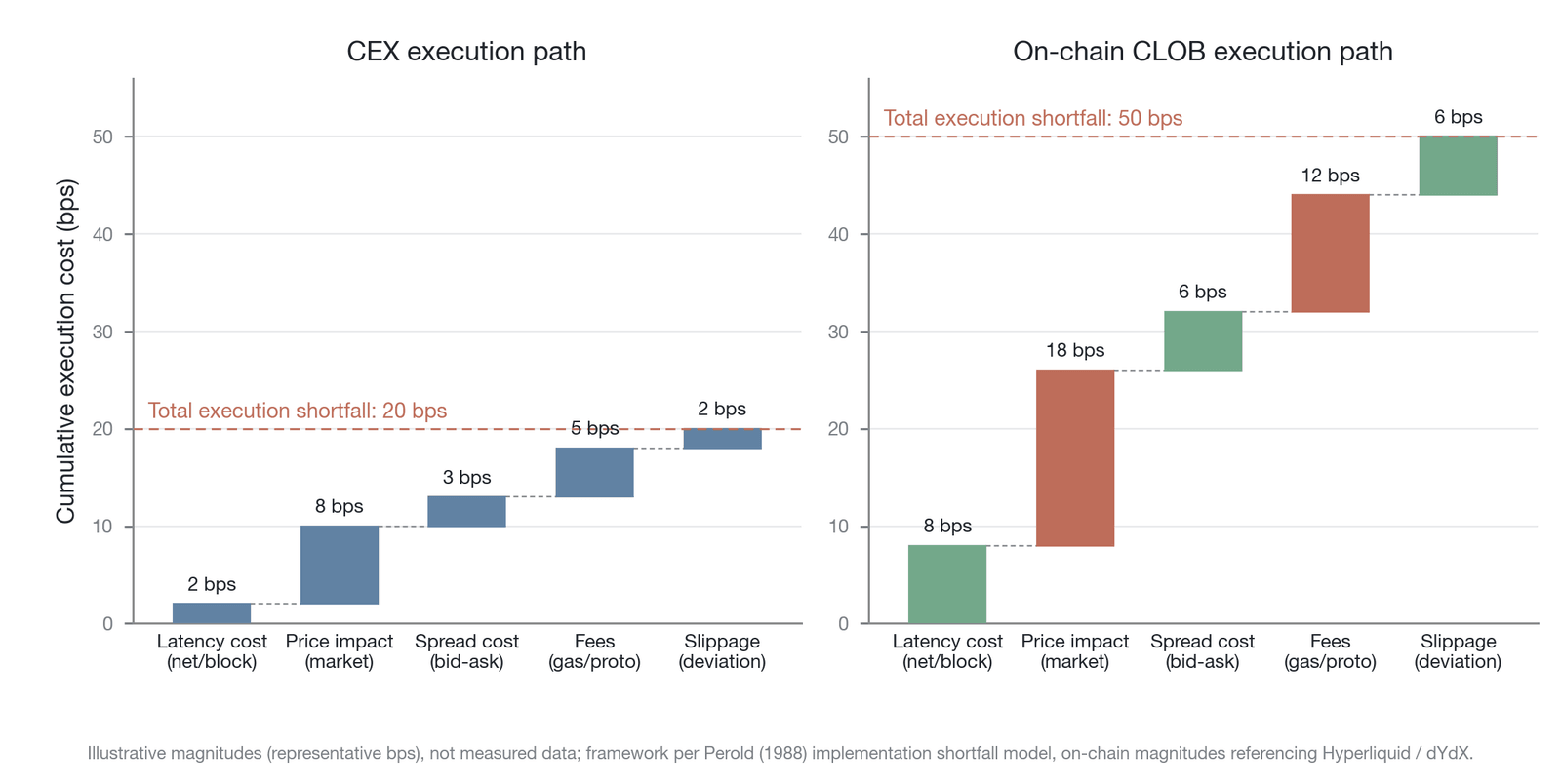
Figure 7-4. A decomposition of the costs of the intent-execution gap (conceptual model illustration: the basis-point components are representative values, not empirical; framework per Perold 1988 [11], with on-chain magnitudes referencing Hyperliquid/dYdX)
The analytical value of the "intent-execution gap" is that it provides a unified metric dimension for assessing execution quality across different market structures. The point is not to judge simply "which is better," but to understand "how the composition and width of the gap differ." The gap on a CEX is generally narrower, but it contains an unquantifiable "implicit" portion—the risk that the exchange internally exploits order-flow information cannot be audited externally; the gap on an on-chain CLOB may be wider, but every component of it is on-chain observable, quantifiable, and auditable. This is precisely the concrete manifestation, at the level of order execution, of the "transparency paradox" discussed in Chapter 1.
The nonlinear widening of the intent-execution gap during a crisis is a particularly critical phenomenon. Kaiko Research's (2025) analysis of the October 2025 market crisis shows that, under extreme conditions, order-book depth plunged by more than 90% and liquidity contracted sharply [10]. The same $10 million market order incurs slippage that, under normal market conditions, varies by platform type: about 1–5 basis points on a top-tier CEX (such as Binance or OKX), about 10–30 basis points on an application-chain DEX (such as Hyperliquid), and possibly 50–100 basis points or more on a general-purpose public-chain DEX; but in a crisis, slippage may spike to 5% or even 10%, implying an additional cost of $500,000 to $1 million. In other words, the intent-execution gap widens nonlinearly at precisely the moment it most needs to be crossed—when the market is swinging violently and the trader urgently needs to adjust their position. This "liquidity illusion" (liquidity that appears ample in normal times collapsing sharply in a crisis) is an inherent fragility of all order-book-based market structures. The game-theoretic mechanism behind it can be explained by the liquidity-spiral model of Brunnermeier and Pedersen (2009) [12]: when an exogenous shock triggers risk-off sentiment, market makers are forced to withdraw their liquidity supply in unison—each market maker's cancellation is an individually rational defensive act, but the simultaneous withdrawal constitutes a fallacy of composition, causing a collective evaporation of order-book depth. The full transmission chain is: macro or geopolitical shock → the spread of risk-off sentiment → cross-market deleveraging → margin calls → forced selling → evaporation of order-book liquidity → amplified price impact → further margin calls. Possible institutional mitigations include imposing minimum-quoting obligations and minimum-quote-time requirements on market makers, but in today's permissionless on-chain DEX environment such constraints are difficult to enforce. Because the on-chain CLOB has a smaller liquidity base, this fragility is even more pronounced.
To bridge this gap, the modern crypto trader must think like an institutional quantitative fund. They no longer focus only on "what to buy" and "when to buy," but devote considerable effort to "how to buy." By allocating orders across multiple liquidity sources through smart order routing, by splitting large orders into smaller ones spread across time through a time-weighted average price algorithm, and by outsourcing order matching to specialized executors through intent-centric solver networks, traders seek to protect their order signals as much as possible in the fully transparent on-chain environment and to secure the optimal execution path. The specific mechanisms of these execution strategies are discussed separately in later sections.
7.2 Basic order types
In the crypto perpetual futures market, the only way for a trader to interact with an exchange's matching engine is to send an order. Orders constitute the basic instruments of trading, and the basic order types—market orders, limit orders, and stop-loss/take-profit orders—are their fundamental types. Understanding these basic order types is not only a prerequisite for mastering a platform's operating interface but also a cornerstone for understanding market microstructure and the price-discovery mechanism.
This section analyzes, from the perspective of microeconomics and market microstructure, the distinctive properties, risk characteristics, and interplay of these three basic order types in the perpetual futures market.
7.2.1 Market orders
A market order is an order that instructs the exchange to execute immediately at the best available price on the current order book. Its core characteristic is to prioritize execution certainty while relinquishing control over the execution price. In microstructure theory, the market order is a "liquidity consumer." When a trader submits a market order, they are in effect "crossing the bid-ask spread," consuming the existing limit-order depth on the order book. The market order is therefore a direct force driving price movement. As Bieganowski and Ślepaczuk (2026) note in their study of crypto microstructure, order-flow imbalance (the net difference between buy market orders and sell market orders) is one of the most critical features for predicting short-term price direction [7].
In the perpetual futures market, market orders have several special properties: high leverage amplifies the impact of slippage. Slippage is the difference between the expected execution price of an order and its actual execution price. In the spot market, 0.1% slippage may be negligible; but in perpetual futures, if a trader uses 50× leverage, 0.1% slippage directly consumes 5% of the initial margin. This means that the implicit cost of a market order is significantly amplified under leverage. At the same time, in extreme market conditions—precisely when certainty is most needed—the cost is often highest. During a liquidation cascade, order-book depth dries up sharply. A market order submitted at that moment, though guaranteed to fill, will keep "eating" down (or up) the order book for lack of counterparties, producing enormous slippage.
Together these factors point to the fact that a market order transmits a strong information signal. In microstructure models, a large market order is generally seen as a mark of an informed trader entering. When a large market order appears, market makers quickly adjust their quotes to guard against adverse-selection risk, which further raises the execution cost of subsequent market orders.
7.2.2 Limit orders
A limit order is an order that specifies a particular price (or better) and executes only when the market price reaches or improves upon that specified price. In contrast to a market order, a limit order prioritizes price certainty while relinquishing execution certainty. Limit orders are "liquidity providers"; they constitute the depth of the order book. In submitting a limit order, a trader is essentially trading "patience" for a price advantage and lower fees. Limit orders, however, are by no means risk-free. As discussed in Section 7.1.3, submitting a limit order is economically equivalent to giving the market a free option [4]: a buy limit order is equivalent to selling a put, and a sell limit order is equivalent to selling a call.
Building on this theory, limit orders face two main risks. The first is execution risk: when the market moves in the direction favorable to the trader, the limit order may fail to fill, causing the trader to miss potential profit. The second is adverse-selection risk: when a limit order does fill, it is often because the market price has already broken through that limit. Specifically, when a limit order fills, the trader is more likely than not to be in a temporary loss position. In perpetual futures, the empirical research of Ruan and Streltsov (2022) shows that the perpetual-futures funding-rate settlement mechanism further amplifies the adverse-selection risk present in the spot market [8].
In perpetual futures, managing limit orders is more complex because they directly affect effective leverage and the liquidation price. A resting limit order, though not yet filled, occupies available margin (available balance), thereby limiting the trader's ability to withstand the unrealized loss on their current position.
7.2.3 Stop-loss and take-profit orders
Stop-loss and take-profit orders are conditional orders that remain dormant until a specific price condition is triggered. Once the market price reaches the trigger price, they convert into market orders or limit orders. Stop-loss orders play a key role in perpetual futures. A stop-loss is a line of defense the trader proactively sets to cut losses before the liquidation price is reached. Yet the execution mechanics of stop-loss orders conceal many pitfalls that are easily overlooked.
Choice of trigger price source: perpetual futures exchanges generally allow traders to choose the "last traded price," the "mark price," or the "index price" as the trigger source. Using the mark price as the stop-loss trigger source is strongly recommended. The mark price is typically computed from the spot index price (a weighted median of spot prices across multiple exchanges) plus an exponential moving average (EMA) of the funding-rate basis; it is designed to filter out price anomalies at any single exchange and transient market distortions. The choice of the EMA window parameter directly affects how smooth the mark price is: the longer the window, the more stable the mark price but the more it lags true price movements; the shorter the window, the more responsive but the more susceptible to disturbance from transient volatility. (For a detailed treatment of how the mark price is computed and how the parameters are chosen, see the in-depth discussion in Chapter 14.) The last traded price, by contrast, is easily affected by a single large market order or a transient price distortion, triggering unnecessary stops.
Stop-loss market order vs. stop-loss limit order: whether the order converts into a market order or a limit order when the trigger price is reached determines the type of risk the trader faces (see Table 7-4).
| Order type | Advantages | Disadvantages and risks | Applicable scenario |
|---|---|---|---|
| Stop-loss market order | Guarantees a fill (certain position closure); timely loss-cutting under normal liquidity | May face enormous slippage in extreme conditions, with an actual closing price far worse than the trigger price | A hard stop where exiting resolutely is mandatory |
| Stop-loss limit order | Strictly controls the closing price, with no slippage risk | In a fast one-directional move, the limit order may be "skipped" and fail to fill, resulting in eventual liquidation | Relatively calm conditions, where the closing cost is a sensitive concern |
Table 7-4. A trade-off comparison of stop-loss market orders and stop-loss limit orders (Data source: compiled by the author)
The interaction of stop-losses and liquidation: many beginners mistakenly believe that setting a stop-loss makes them absolutely safe. This "illusion of stop-loss safety" is not merely a technical misunderstanding; it has deeper roots in behavioral finance. The illusion-of-control theory proposed by Langer (1975) [13] can explain this phenomenon: through the "active behavior" of setting a stop-loss, traders acquire a false sense of control over risk and thereby underestimate the probability that the stop-loss will fail. In addition, anchoring bias causes large numbers of stops to cluster at round-number thresholds (such as BTC $60,000 or ETH $2,000), and this predictable clustering pattern in turn gives stop-loss hunting economic rationale. As shown in Figure 7-5, there is a "safety buffer" between the stop-loss price and the liquidation price. But in extreme conditions (such as the flash crashes of May 19, 2021, April 2024, or October 2025—this book deliberately cites cases from several different periods to show that this type of risk is not an isolated event but a structural feature of perpetual futures markets), enormous slippage may punch through this buffer in an instant, causing the stop-loss order to fill at a price worse than the liquidation price, so that the trader still faces liquidation or even a negative account balance (bankruptcy).
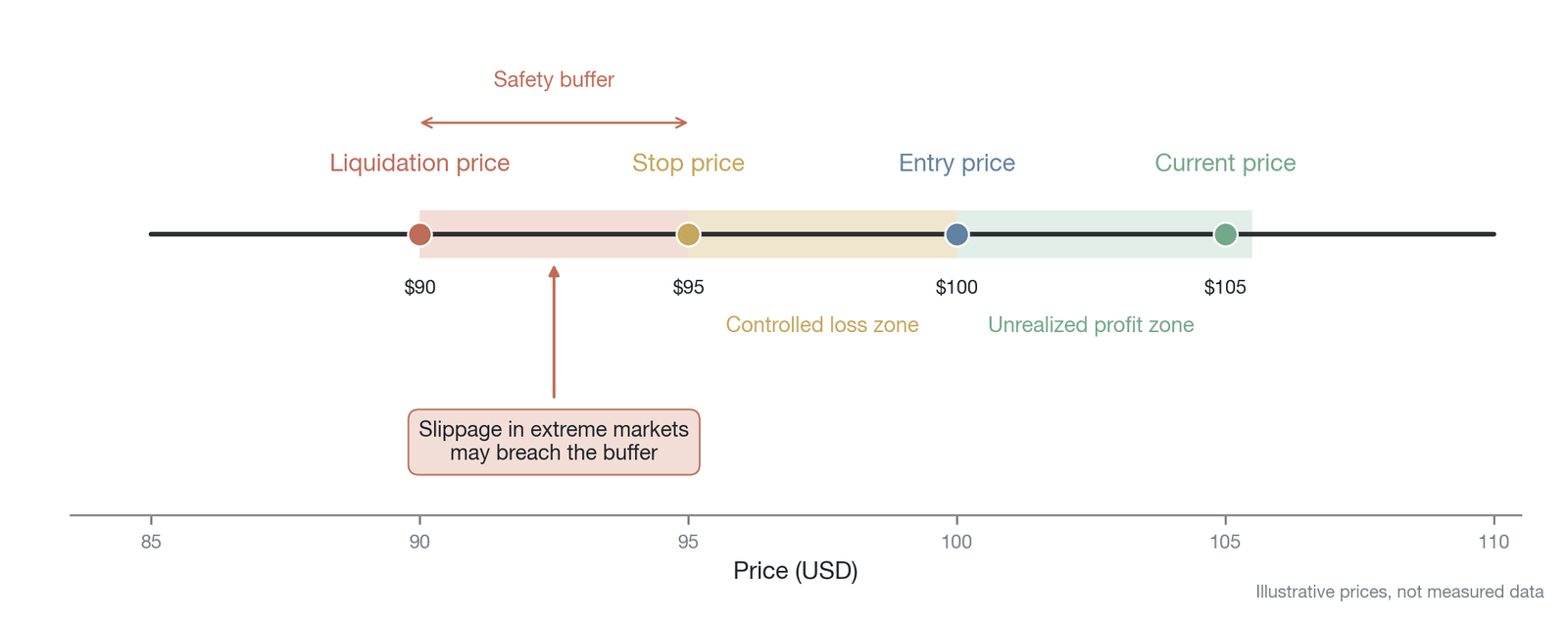
Figure 7-5. The relationship between stop-loss orders and the liquidation price, and the slippage risk under extreme conditions (mechanism illustration: $90/95/100/105 are illustrative values, not empirical; the long-position safety buffer = stop-loss price − liquidation price, which extreme slippage can punch through)
Trailing stop orders: this is an advanced automated risk-management tool. As shown in Figure 7-6, it has a "ratchet mechanism": the stop line automatically follows as the price moves favorably, but holds unchanged when the price pulls back. This allows the trader to protect gains already secured while leaving room for further profit growth.
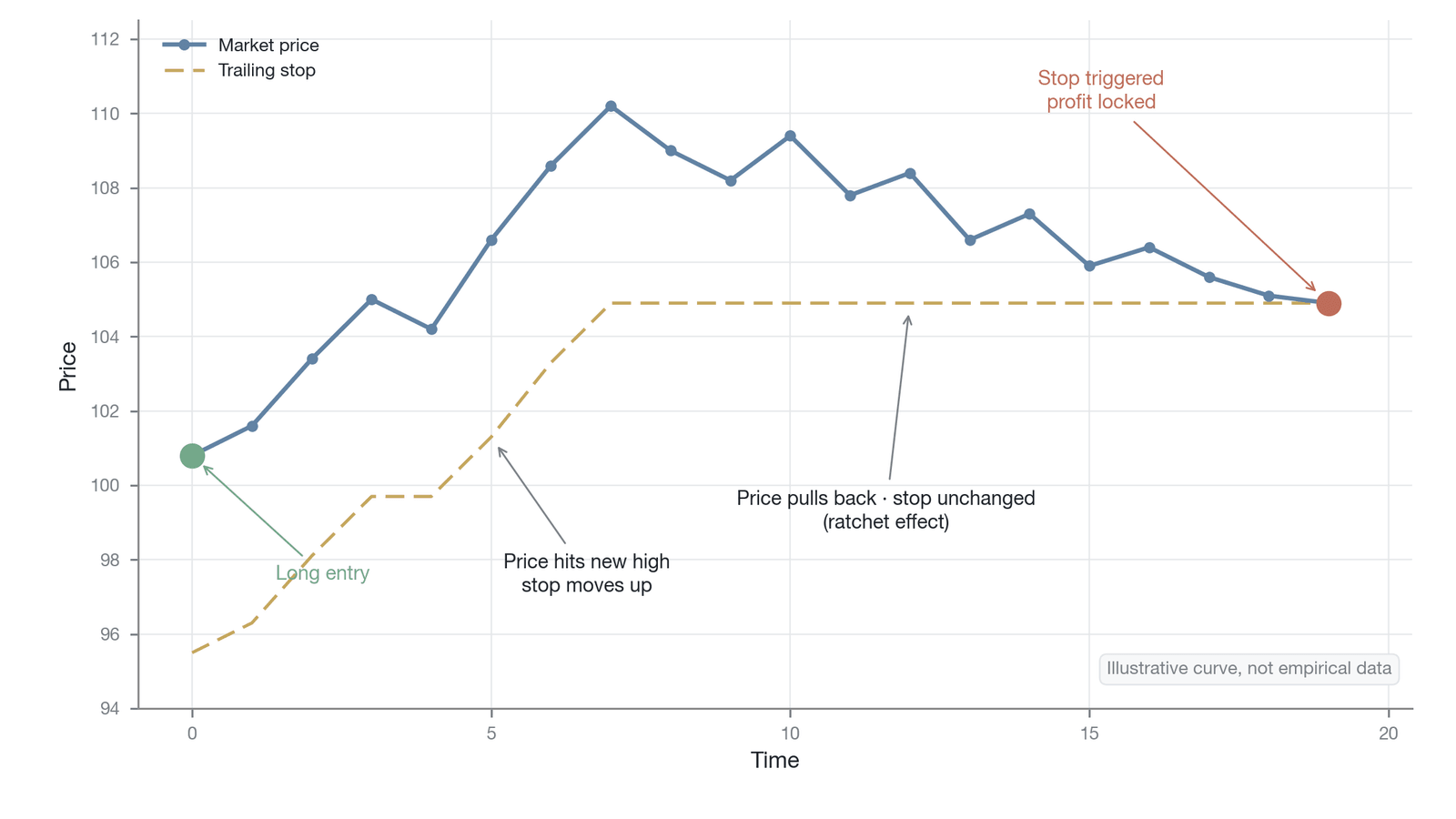
Figure 7-6. The ratchet mechanism of a trailing stop order (long-position example) (ratchet-effect mechanism illustration; the price path uses representative values, not empirical data)
7.2.4 The maker-taker fee model and order selection
Perpetual futures exchanges widely adopt the maker-taker fee model, which is central to understanding the economics of order types. Exchanges incentivize the aggregation of liquidity by charging a higher fee to takers who consume liquidity and a lower fee (or even a rebate) to makers who provide liquidity.
This fee structure strongly shapes a trader's order-selection strategy. As shown in Table 7-5, the difference between maker and taker fees varies enormously across exchanges and VIP tiers. In the fiercely competitive 2025–2026 period, decentralized perpetual futures exchanges such as Hyperliquid have even pushed base fees down to maker 0.015% / taker 0.045% [14].
| Order type | Market-microstructure role | Certainty trade-off | Fee attribute | Hidden cost/risk |
|---|---|---|---|---|
| Market order | Liquidity consumer | Price uncertain, execution certain | Pays the taker fee | Slippage cost; risk amplified under high leverage |
| Limit order | Liquidity provider | Price certain, execution uncertain | Pays the maker fee (typically lower) | Adverse-selection risk; execution risk |
| Stop-loss order | Conditional liquidity consumer | Converts to a market/limit order once the condition triggers | Typically pays the taker fee | Liquidation risk from slippage punching through the buffer |
Table 7-5. A matrix of the microstructural effects of the basic order types (Data source: constructed by the author)
The core message of Table 7-5 is that the three basic order types display a clear gradient in their certainty trade-offs and hidden costs. The market order offers the highest execution certainty, but its hidden cost (slippage and risk amplification under high leverage) is also the most severe; the limit order provides certainty on the price dimension but exposes the trader to execution risk and adverse-selection risk; the stop-loss order layers the uncertainty of a conditional trigger onto the slippage risk of a market order and may produce unexpected adverse outcomes in extreme conditions.
Within this microstructural ecosystem, limit orders, market orders, and stop-loss orders form a dynamic feedback loop (Figure 7-7). Limit orders constitute the depth structure of the order book, market orders drive price movement by consuming that depth, and stop-loss orders convert into market orders once triggered at a specific price level. When market orders push the price to trigger a large number of stop-loss orders, those stops convert into new market orders that further consume limit-order depth—and this positive-feedback mechanism is precisely the microfoundation of the violent volatility of perpetual futures markets.
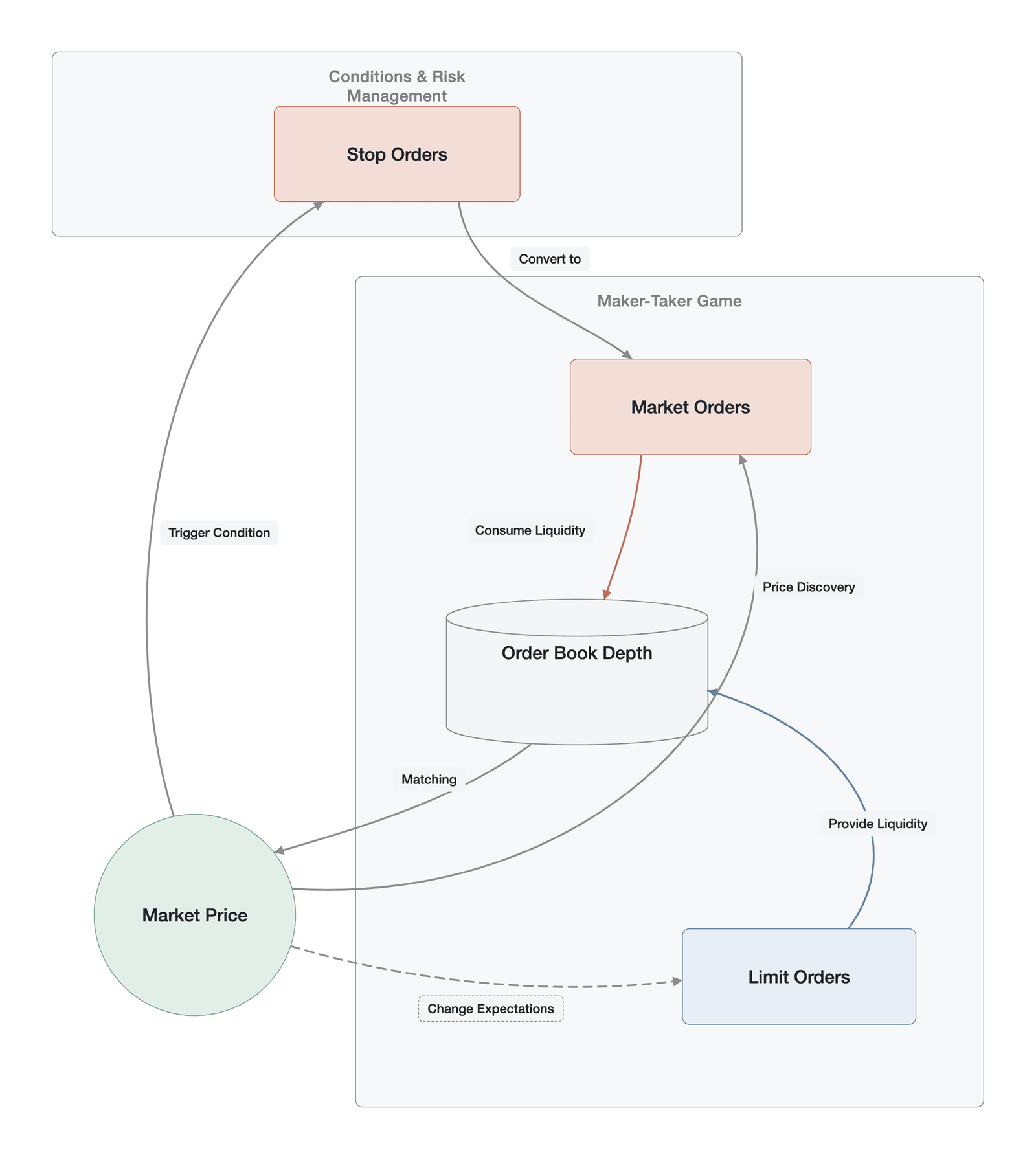
Figure 7-7. The dynamic feedback loop of order flow and price discovery (mechanism feedback-loop illustration, not empirical data)
Having grasped this game mechanism, a trader understands that providing liquidity requires bearing adverse-selection risk and earning corresponding compensation, while execution certainty comes at the cost of higher fees and slippage. In perpetual futures trading, advanced traders rarely enter and exit using market orders alone; instead, they seek the optimal solution between certainty and cost through advanced order types and algorithmic execution. The next section analyzes these in detail.
7.3 Advanced order types
On top of the basic order types, advanced order types allow traders to refine the expression of their strategy along dimensions such as time, size, and execution conditions. As the crypto derivatives market becomes more institutionalized, simple buy and sell instructions can no longer meet complex execution needs. Advanced order types allow traders to express their trading strategies with precision along four dimensions—time, size, execution constraints, and conditional triggers—thereby gaining an edge or lowering costs within a complex microstructure.
7.3.1 Time-control orders
Time-control orders determine the lifespan of an order within the matching engine. They are essential tools for high-frequency trading and arbitrage strategies.
Fill-or-kill (FOK) is an extremely strict order type. It requires the order to fill immediately and in full, or else the entire order is canceled; partial fills are never permitted. FOK has an important role in calendar-spread arbitrage or funding-rate arbitrage. When an arbitrageur spots a price gap between two markets, they need to establish equal positions on both sides simultaneously. Using an ordinary market order might fill one side while the other fills only partially (leg-execution risk), leaving exposure to a one-sided position. FOK ensures the certainty of "all or nothing." Immediate-or-cancel (IOC) requires the order to execute any fillable portion immediately and then cancel the entire unfilled remainder. Unlike FOK, IOC permits partial fills. It is commonly used for "sweeping" operations, in which the trader is willing to consume all favorably priced liquidity on the current order book but unwilling to leave the unfilled portion resting as a limit order, so as not to expose their trading intent. In addition, good-til-time/good-til-block (GTT/GTB): on on-chain order-book decentralized exchanges, GTT often evolves into GTB (good-til-a-specified-block-height). Because blockchain networks are subject to latency and reorganization risk, a trader who does not want their limit order to be unexpectedly executed after market conditions have changed drastically (say, several blocks later) attaches a GTB constraint.
7.3.2 Size-hiding orders
When an institutional investor needs to execute a large order that far exceeds the current order-book depth, they face significant information-leakage risk. Posting a huge limit order directly would immediately alert other market participants (especially high-frequency market makers) to this enormous selling or buying pressure, prompting them to front-run or withdraw quotes, so that the large order becomes difficult to fill or fills at a badly unfavorable price.
The iceberg order was created precisely to solve this pain point. As the name suggests, an iceberg order exposes only a small fraction of its total size to the public order book while hiding the vast majority. Once the visible portion fills completely, the matching engine automatically slices a new visible quantity from the hidden portion and replenishes it onto the order book, until the total order is fully executed.
On a centralized exchange, the logic of the iceberg order is maintained by the centralized matching engine in the background. On an on-chain perpetual futures DEX, however, implementing a genuine iceberg order faces an important technical challenge: there is an inherent tension between the transparency of the blockchain and the need to hide size. All on-chain state is public by default. At present, some cutting-edge DEXs are beginning to explore using zero-knowledge proofs or trusted execution environments to build on-chain dark pools, allowing traders to match large liquidity without broadcasting their true intent to the entire network.
7.3.3 Execution-constraint orders
These two constraint-type orders appear extremely frequently in the daily operations of perpetual futures traders; they target fee optimization and position safety, respectively.
Post-Only (maker-only): for a limit order with the Post-Only attribute attached, the system guarantees that it will never match and fill immediately against an existing order on the book. If the order would immediately match an existing order upon submission (for example, a buy limit priced above the current best ask), the system cancels the order outright rather than converting it into a market order for execution. The core value of Post-Only is to strictly lock in the maker fee. As discussed in Section 7.2, the maker fee is typically far lower than the taker fee (or even negative). Market makers and algorithmic traders use Post-Only to ensure that they only ever provide liquidity and never accidentally consume it, thereby precisely controlling trading costs.
Reduce-Only: this is an order attribute unique to the derivatives market. A Reduce-Only order can only be used to reduce the current position; it never increases a position or establishes a new position in the opposite direction. This feature has an important role when setting take-profit and stop-loss orders. Suppose a trader holds a long position and has set an ordinary sell limit order as a take-profit; if they subsequently close the long manually but fail to cancel the take-profit order, then when the price reaches the take-profit level the sell order will be triggered, unexpectedly establishing a naked short position. If the order has the Reduce-Only attribute attached, then when the long position is zero the system will automatically cancel or refuse to execute the order, entirely eliminating this risk of unintended position-building.
7.3.4 Algorithmic orders: TWAP and VWAP
For truly enormous orders, even an iceberg order may be identified by a clever algorithm because of its frequent replenishment actions (known as "iceberg detection"). At that point, an institution must turn to algorithmic execution strategies, of which the most classic are TWAP and VWAP. Figure 7-8 contrasts the core logical differences among three large-order execution strategies—TWAP, VWAP, and the iceberg order—in terms of execution cadence and information concealment; each is discussed in turn below.
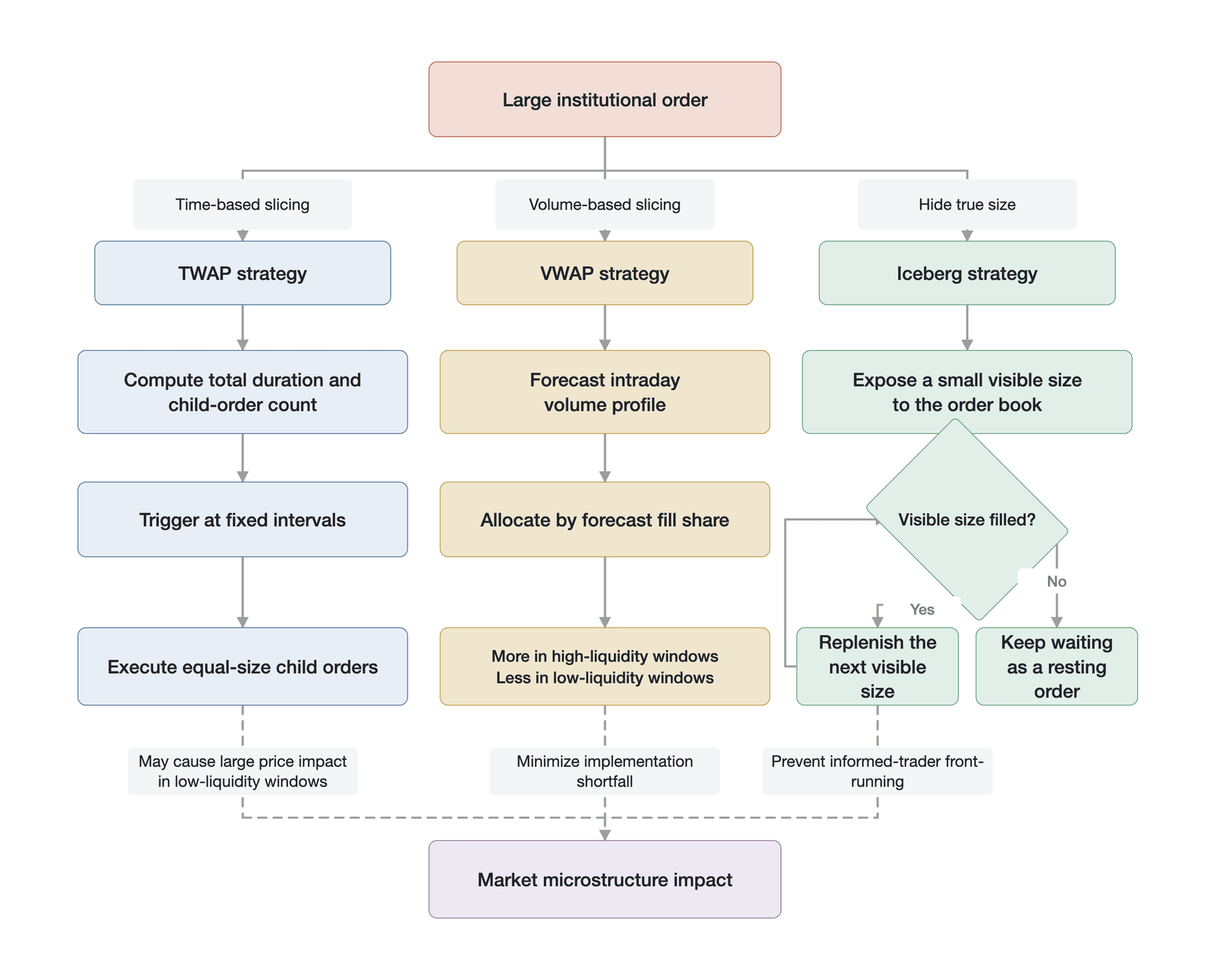
Figure 7-8. A logical comparison of the mainstream large-order algorithmic execution strategies (TWAP, VWAP, and the iceberg order) (conceptual logical-comparison illustration, not empirical data)
The TWAP algorithm divides a large order evenly into many equal-sized child orders over a specified total time and sends them to the market at fixed time intervals. TWAP's advantage lies in its simplicity and robustness; it requires no prediction of market behavior at all. However, liquidity in the crypto market is highly uneven across the intraday cycle. Blindly executing a fixed-quantity TWAP during a low-liquidity window—such as the middle of the night in Asia—will cause considerable price impact.
The VWAP algorithm is more intelligent: it aims to keep its execution cadence aligned with the market's actual volume distribution. In practice, institutional traders typically use adaptive VWAP—re-estimating the volume curve of the remaining window in real time during execution rather than relying entirely on historical data. This distinction is especially important on event-driven days (such as major regulatory announcements or black-swan events), when the historical "twin-peak" volume pattern may fail entirely and the execution performance of a static VWAP deteriorates markedly. As shown in Figure 7-9, according to research by Talos (2025) and Jasiak and Zhong (2024) on the intraday trading characteristics of Bitcoin, crypto-market liquidity exhibits a pronounced "twin-peak" feature: it reaches its highest peak at 14:00–15:00 UTC (the U.S. stock market open), a secondary peak at 08:00–10:00 (the European open), and its trough at 00:00–04:00 (the middle of the night in Asia) [15][16].
The VWAP algorithm predicts this intraday volume curve, allocating more execution quantity during windows predicted to have high liquidity (such as the U.S. open) and less during low-liquidity windows. Research by Genet (2025) further shows that using a deep-learning framework to optimize the VWAP execution objective directly can significantly outperform the traditional benchmark VWAP strategy, effectively minimizing implementation shortfall—the difference between the ideal decision price and the actual execution price [17].
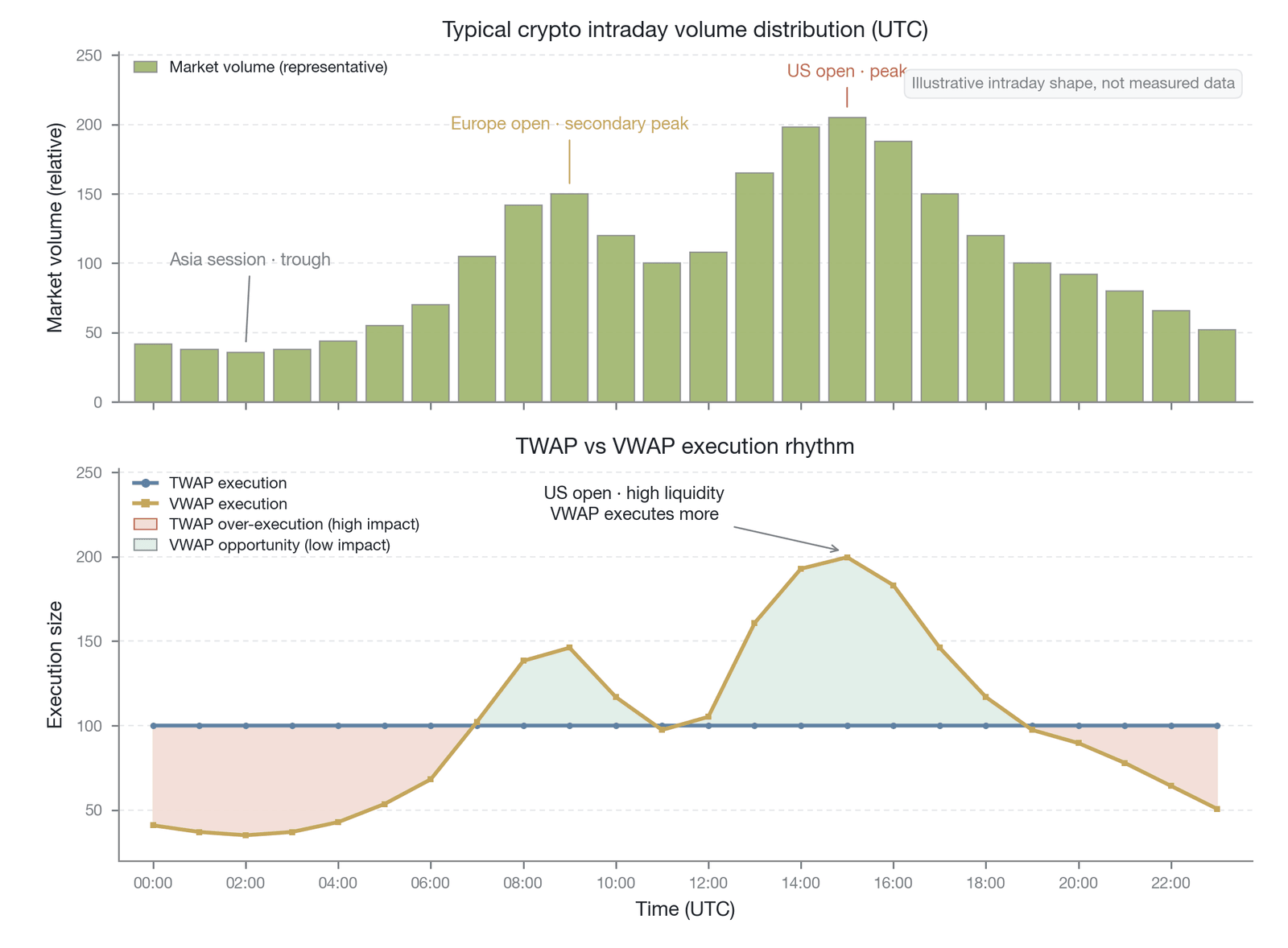
Figure 7-9. A comparison of the typical intraday volume distribution in crypto with the execution cadences of TWAP/VWAP (representative intraday volume-profile illustration: the curves are stylized values, not empirical; the twin peaks are per Talos 2025 [15] and Jasiak & Zhong 2024 [16], and DL-VWAP is per Genet 2025 [17])
Table 7-6 systematically compares TWAP and VWAP along four dimensions: core logic, advantages, disadvantages, and applicable scenario. The core trade-off between the two algorithms is that TWAP trades execution simplicity for a disregard of changes in market structure, whereas VWAP trades reliance on the historical volume pattern for a better execution price.
| Algorithm type | Core logic | Advantages | Disadvantages and risks | Applicable scenario |
|---|---|---|---|---|
| TWAP | Splits the order linearly and evenly over time | Simple logic, no reliance on historical-data prediction; provides some smoothing against extreme "wicks" | Ignores intraday liquidity variation; forced execution during low-liquidity windows leads to costly slippage | Assets lacking a reliable volume-prediction model; tasks with extremely high time-certainty requirements |
| VWAP | Splits the order in proportion to predicted market volume | Execution trajectory tracks market depth, minimizing impact on market microstructure and implementation shortfall | Highly dependent on the accuracy of the volume-curve prediction; prediction fails when the market undergoes a structural break | Mainstream assets with clear cyclical liquidity patterns (such as BTC/ETH); large position-building highly sensitive to slippage |
Table 7-6. A matrix of algorithmic execution strategies for advanced order types (Data source: constructed by the author)
As Table 7-6 shows, TWAP is suited to long-tail assets that lack a reliable volume-prediction model, whereas VWAP performs better in large position-building scenarios for mainstream assets (such as BTC/ETH). In actual execution, institutional traders typically switch between the two algorithms according to the liquidity characteristics of the underlying asset and the execution time window.
7.3.5 Conditional orders
Beyond conventional price triggers (such as stop-loss/take-profit), modern perpetual futures platforms have also spawned conditional orders based on more complex microstructure data. These orders allow traders to push strategy logic directly down to the matching-engine level.
A funding-rate-based conditional order triggers when the funding rate deviates beyond a certain threshold. For example, an algorithmic trader can set: "when the BTC funding rate exceeds 0.05% (longs extremely crowded), automatically trigger a market sell to go short." This allows the trader to capture fleeting rate-arbitrage opportunities. Trading strategies executed automatically on algorithmic conditions may, in several jurisdictions, be classified as algorithmic trading, thereby triggering compliance obligations such as registration, risk-control systems, and trade reporting (for example, the definition of algorithmic trading under the EU's MiFID II and the related rules of the U.S. SEC). A conditional order based on open interest is another option, as OI is a key indicator of market momentum. When open interest (OI) surges in a short period, it often foreshadows imminent violent volatility. A conditional order based on changes in OI can help a trader intervene automatically at the early stage of a trend breakout. There is also the conditional order based on the liquidation heatmap, a highly advanced form of strategy expression. A trader who anticipates that a dense cluster of highly leveraged long liquidation lines exists at a certain price level can set a conditional order to automatically provide liquidity (buy) when that region is triggered, thereby acquiring a position at a lower price amid a large-scale liquidation cascade.
The evolution of advanced order types is, in essence, an escalation of the game between traders and market microstructure. From the market order's direct impact on the order book, to the limit order's passive waiting to fill, to VWAP's adaptation to the market's liquidity cadence, the richer the available order toolkit, the finer the granularity of strategy expression—and the greater the probability of surviving in the zero-sum game of the derivatives market.
7.4 The strategic dimensions of perpetual futures
In traditional spot trading, the order decision is generally a relatively simple two-dimensional optimization problem: the trader mainly weighs price (at what price to execute) against signal leakage (which order type to choose to control information exposure). In perpetual futures, however—the most dominant derivative instrument in the crypto market—the order decision gains three additional strategic dimensions: leverage, liquidation, and time. These three dimensions make the order decision in perpetual futures an order of magnitude more complex than in the spot market, and they also give "a good order strategy" an influence on a perpetual futures trader's profit and loss far exceeding that in the spot market. For ineffective traders who suffer systematic losses in the market over the long run, the losses often stem not from errors in directional judgment but from their unconscious exposure along these three key dimensions. Behavioral-finance research further shows that even when traders understand the three dimensions of leverage, liquidation, and time at a cognitive level, they still make erroneous decisions because of systematic cognitive biases: overconfidence bias causes traders to systematically underestimate liquidation risk ("I won't get liquidated"), the disposition effect causes them to hold losing positions too long and close winning positions too early, and mental accounting causes them to treat each position under cross-margin mode as an independent bet while ignoring portfolio-level risk contagion. Figure 7-10 uses a three-dimensional coordinate system to show how these three dimensions layer onto the traditional price-signal two-dimensional framework: the horizontal axis represents leverage (from 1× to maximum leverage), the vertical axis represents liquidation distance (from safe to dangerous), and the time axis represents the funding-rate settlement cycle. Every order has a definite coordinate in this three-dimensional space, and that coordinate determines the order's overall degree of risk exposure.
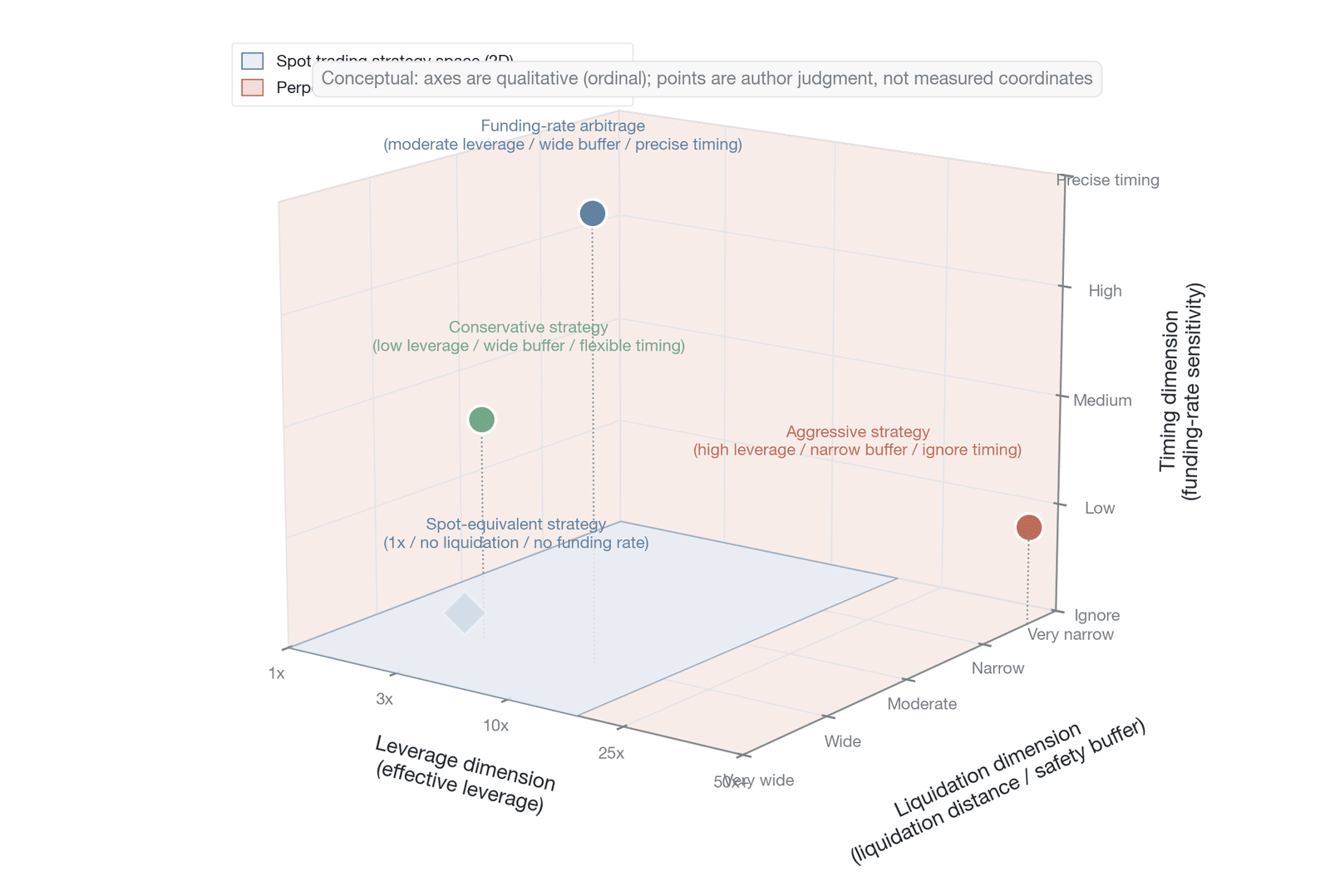
Figure 7-10. The three additional dimensions of perpetual futures order strategy (conceptual three-dimensional strategy-space illustration; the positioning points reflect the author's judgment, not measured coordinates)
7.4.1 The leverage dimension
In the spot market, executing a buy order merely converts cash into an asset, and the risk exposure is linear and bounded. In perpetual futures, however, each order execution not only changes the direction and size of a position but also directly changes the account's effective leverage. Effective leverage is defined as the ratio of notional position value to total account margin (including unrealized profit and loss), computed as:
Effective leverage = total notional position value / total account equity (margin + unrealized P&L)
When a trader submits a new add-on order on top of an existing position, that order in effect "compresses their risk tolerance." Consider a concrete numerical case to illustrate this dynamic. Take an account with $10,000 of margin, initially holding no position. Executing a $50,000 notional Ethereum perpetual long order takes the account's effective leverage from 0× to 5×. At this leverage level, assuming a maintenance margin rate of 0.5% (charged on notional position value; in practice exchanges generally use a tiered, dynamic maintenance margin rate—Binance's, for example, ranges from 0.4% for small positions to 5% for large ones—so the 0.5% here is merely a pedagogical simplification), the liquidation price sits roughly 19.5% below the entry price. If the trader then executes another $50,000 buy order, the total notional value reaches $100,000 and effective leverage jumps to 10×. At this point the liquidation price rises sharply, narrowing to only about 9.5% below the average entry price. A single add-on order has compressed the "risk tolerance" by half.
Core insight: in perpetual futures, every add-on order "compresses your risk tolerance," and every reduce order "expands your risk tolerance." The "next order," therefore, is not merely a trading decision but a profound risk-management decision.
This dynamic variation in the leverage dimension requires traders to implement strict margin-allocation strategies at the order level. Two common strategic patterns embody different risk-management philosophies:
Incremental position-building (the leveraged version of dollar-cost averaging) requires the trader to execute the target total position in tranches. After each add-on order fills, the new effective-leverage level is systematically assessed. Once effective leverage approaches the trader's preset upper limit of risk tolerance, further adding stops. The core advantage of this strategy is that the trader retains, at every step, the option "not to keep adding," rather than exposing all margin to a single entry price at once.
Pyramiding, by contrast, requires the trader to add to the position using a sequence of orders of decreasing size after the market trend is confirmed. For example, the first order is 40% of the target position, the second 30%, the third 20%, and the last 10%. This order strategy can increase profit exposure while preventing the average entry price from converging too quickly toward the current market price, thereby keeping effective leverage within a relatively safe range. Its essence is to trade "decreasing marginal commitment" for "increasing trend confirmation."
7.4.2 The liquidation dimension
The liquidation dimension is the most distinctive part of the perpetual futures order decision. In the traditional spot market, the "worst outcome" an investor faces is that the asset value goes to zero, but never a liability. In the high-leverage environment of perpetual futures, the "worst outcome" is not only complete forfeiture of margin but, under extreme market volatility and liquidity depletion, may even produce a bankruptcy liability (though most platforms absorb this portion of the risk through an insurance-fund mechanism). The liquidation price is precisely the rigid mathematical threshold that triggers this "worst outcome." Taking a long position as an example, the approximate formula for its liquidation price is:
Liquidation price (long) ≈ average entry price × (1 − 1/effective leverage + maintenance margin rate)
Liquidation price (short) ≈ average entry price × (1 + 1/effective leverage − maintenance margin rate)
The approximate formulas above apply to a single position under isolated-margin mode. Under cross-margin mode, the liquidation price is determined by total account equity rather than the margin of a single position, and the formulas above no longer apply. The approximate formulas can also produce large errors under high leverage (50× to 100×), because they ignore the effects of cumulative funding, trading fees, and fluctuations in unrealized P&L. In actual trading, a trader should rely on the exchange's real-time computed liquidation price rather than estimate it from a simplified formula.
Within this dimension, the most critical order decision is the setting of the stop-loss order and its interaction with the liquidation price. When submitting any opening order, a trader must simultaneously compute and plan the spatial relationship between the liquidation price and the stop-loss price. This relationship has three basic states:
If the stop-loss trigger price is set beyond the liquidation price (that is, for a long, the stop-loss price is below the liquidation price), the stop-loss order is logically entirely ineffective. This is because, before the market price reaches the stop-loss price, the exchange's risk engine has already forcibly taken over the position and executed the liquidation procedure. Surprisingly, in actual trading, such "ineffective stop-loss" settings—arising from an insufficient understanding of the liquidation mechanism—are not rare. Viewed from another dimension, if the stop-loss order is set before the liquidation price with an ample buffer, it can provide effective protection under normal market conditions. However, as discussed earlier (Section 7.2.3), in extreme conditions a stop-loss market order may encounter enormous execution slippage due to oracle latency or an instantaneous drain of order-book liquidity, causing the final fill price to be even worse than the theoretical liquidation price. The third state is a stop-loss price set flush against the liquidation price, with an extremely narrow buffer. This configuration pursues extreme capital efficiency, but it essentially outsources the trader's own risk management to the exchange's liquidation engine. In a transparent on-chain environment, such an extremely narrow buffer is prone to becoming the target of deliberate price pushing—a risk Section 7.5 analyzes in detail.
The distance between the "liquidation price and the stop-loss price" constitutes the "safety buffer" that the trader actively chooses. The wider the buffer, the higher the trader's probability of surviving violent volatility; but this also means the trader must accept lower effective leverage or a larger single stop-loss, thereby compressing the potential return on capital. This trade-off has no "correct answer," only "an answer matched to the trader's risk preference."
7.4.3 The time dimension
Perpetual futures can track the spot price closely without expiry delivery because of the funding-rate mechanism. This mechanism typically settles once every 8 hours (on some application chains the frequency is higher: Hyperliquid settles once every hour, while dYdX v4 adopts a continuous-accrual model in which the funding rate accrues proportionally within each block without waiting for a fixed settlement point). (For a detailed analysis of the funding-rate formula, the clamp mechanism, and the game-theoretic structure, see Chapter 10.) At the moment of settlement, funds transfer directly between traders holding positions: when the perpetual futures price is above the spot price, longs pay funding to shorts, and vice versa. This periodic flow of funds creates a strategic dimension entirely absent from the spot market—the choice of order timing around the settlement moment.
In the traditional spot market, the "timing" of order execution mainly affects slippage and market-impact cost, a matter of execution-level optimization. In perpetual futures, however, execution timing directly determines whether the trader pays or receives funding—a source of profit and loss independent of price direction. This gives rise to a series of specific order strategies:
The rate-sniping strategy is the most direct application of the time dimension. When market sentiment is extremely one-sided, causing the expected funding rate to be abnormally high (for example, extremely crowded longs producing an extremely high positive rate), a trader may submit a short market order or an aggressive limit order minutes or even seconds before settlement. After crossing the settlement moment and collecting the high funding rate, they close the position quickly. The core of this strategy is to weigh the net benefit between "the funding collected" and "the slippage and fees generated by the two orders." On platforms that settle hourly, such as Hyperliquid, the frequency and precision with which this strategy can be executed far exceed those of the traditional 8-hour settlement cycle. In practice, however, the strategy faces severe execution constraints. First, the order book during a high-rate settlement window is often extremely thin (other participants are also competing for the same direction), so the adverse-selection cost rises significantly. Second, even within a 1-hour settlement cycle, a 1% adverse move in the underlying asset means a 10% margin loss at 10× leverage, whereas the corresponding rate gain is typically only 0.01%–0.05%—directional risk can be dozens of times the rate gain. Third, some exchanges have adopted time-weighted rate calculations (prorating by the ratio of holding time to the settlement cycle), greatly reducing the effectiveness of last-moment sniping. Consider a simplified numerical case to illustrate the break-even condition: assume the expected funding rate is 0.05% and the trader uses 10× leverage to establish a $1 million notional short position ($100,000 of margin); the single-period rate gain is $500 ($1 million × 0.05%). If the round-trip trade (the two legs of opening and closing) incurs fees of 0.05% × 2 legs = $1,000, plus estimated slippage of 0.02% × 2 legs = $400, then the trading cost alone reaches $1,400 and the strategy makes a net loss of $900. This strategy has positive expected value only when the rate is extremely high (typically above 0.1%) and trading costs are extremely low, and its profitability has a strong dependence on the macro cycle: in a sustained one-directional trend, the funding rate may remain in the same direction for a long time, invalidating the mean-reversion assumption.
The avoidance-reduce strategy exploits the time dimension from a defensive angle. If a trader holds a large trending long position and currently faces an extremely high positive funding rate, they may choose to submit a reduce order before settlement to avoid paying the expensive funding, and re-establish the position after settlement. However, this operation of moving in and out of the order book frequently not only increases trading costs (two sets of fees plus potential slippage) but may also expose the trader's intent, making them a source of signal leakage.
Core insight of the time dimension: the funding-rate mechanism of perpetual futures makes "order timing" an independent strategic variable. An originally perfect trend-following order, if it merely chooses the wrong execution timing and pays a high funding rate for several consecutive days, may have its final profit-and-loss outcome completely reversed. Chapter 10 analyzes the game-theoretic structure of the funding rate in depth.
7.4.4 The choice of margin mode
Beyond the three dynamic dimensions above, perpetual futures order strategy is also profoundly constrained by the underlying account-level institutional framework. Before submitting an order, a trader must choose the margin mode in which the order sits, and this choice determines the boundary of risk contagion and constitutes the institutional framework for all subsequent order behavior (a comparison of the two modes appears in Table 7-7).
Under isolated-margin mode, each position has its own isolated margin. The loss and eventual liquidation of one position will absolutely not affect the other positions in the account or the available balance. The philosophy of this mode is to "isolate the risk exposure of each position," achieving strict risk isolation. For high-risk, high-leverage one-directional speculative orders, isolated mode is the preferred choice, because it strictly confines the "worst outcome" to the margin allocated to that position. Its cost, however, is low capital efficiency: funds cannot be shared across different positions, and even if one position has a large amount of unused margin, it cannot be used to support another position that is taking a loss.
Under cross-margin mode, all positions in the account share a single margin pool. The unrealized profit of a winning position can serve as collateral to "support" a losing position, greatly improving capital efficiency. The philosophy of this mode is to "bring all positions into a unified risk pool to improve capital efficiency." However, cross-margin has strong procyclicality. Ali (2025), in a study of the crypto-market liquidation cascade of October 2025, notes that the event cleared $19 billion of open interest in 36 hours, and that the procyclicality of cross-margin was a key systemic-risk amplifier [9]. Its mechanism is as follows: when a macro shock causes all assets to fall together, the collateral value of all positions in a cross-margin account shrinks simultaneously, systematically lowering the margin health of the entire account and ultimately causing even originally safe positions to be liquidated by association. This chain of intra-account liquidation contagion does not occur under isolated mode (though market-level and liquidity-level contagion still exist).
The risk profile of cross-margin, however, has a pronounced "two-sidedness," and one must avoid simplistically labeling it a "risk amplifier." Under normal market volatility and with asset correlations near their historical means, cross-margin actually acts as a stabilizer: the unrealized profit of winning positions provides a buffer for losing positions, lowering the probability that a single position is liquidated by temporary volatility. Only when the market undergoes a regime switch—when asset correlations suddenly jump from normal levels to near 1 (that is, "all assets fall at once")—does cross-margin flip into an amplifier: the collateral value of all positions shrinks in unison, the profit buffer vanishes, and the liquidation probability jumps nonlinearly. This critical feature of the regime switch is key to understanding the systemic risk of cross-margin.
Looking further, the systemic shock produced by liquidation propagates in turn through three levels: intra-account contagion (under cross-margin mode, the liquidation of a single position consumes shared margin and drags down other positions) → market contagion (the forced market orders produced by liquidation strike the order book, pushing the price further away and triggering the liquidation of more accounts) → liquidity contagion (after observing the signal of a liquidation cascade, market makers withdraw liquidity on a large scale, order-book depth plunges, and the price impact of subsequent liquidations intensifies). This contagion path is not unique to crypto markets. Adrian and Shin (2010), in a study of the traditional financial system, had already revealed the systemic-risk mechanism of procyclical leverage and margin spirals [18]. The cross-margin problem in crypto markets is, in essence, an accelerated version of this known systemic-risk mechanism in a 24/7, high-leverage, digital-native environment.
| Dimension | Isolated margin | Cross margin |
|---|---|---|
| Risk isolation | Strict isolation; liquidating one position does not affect others | No isolation; losses contaminate the entire account |
| Capital efficiency | Low; funds locked in a fragmented way | High; funds shared and utilized |
| Liquidation trigger | Triggered when a single position's margin is insufficient | Triggered when total account equity is insufficient |
| Procyclical risk | Low; risk is isolated | High; risk amplified in a market-wide sell-off |
| Applicable scenario | High-leverage speculation, standalone strategies | Hedged portfolios, low-leverage multi-asset allocation |
| Mental model | "Each trade is an independent bet" | "All trades are one portfolio" |
Table 7-7. A comparison of isolated margin and cross margin (Data source: compiled by the author)
The choice of margin mode, therefore, is by no means a simple technical setting; it is a fundamental risk-management decision that affects all subsequent order behavior. It determines "whether, and how, the loss from one bad order contaminates the entire portfolio."
7.4.5 A unified decision framework
By combining the traditional order-selection dimensions (price, signal) with the three extended dimensions unique to perpetual futures (leverage, liquidation, time) and the margin-mode institutional framework, we can construct a unified order-decision framework. Under this framework, the formation of every perpetual futures order must pass through a multi-objective optimization process comprising seven decision nodes.
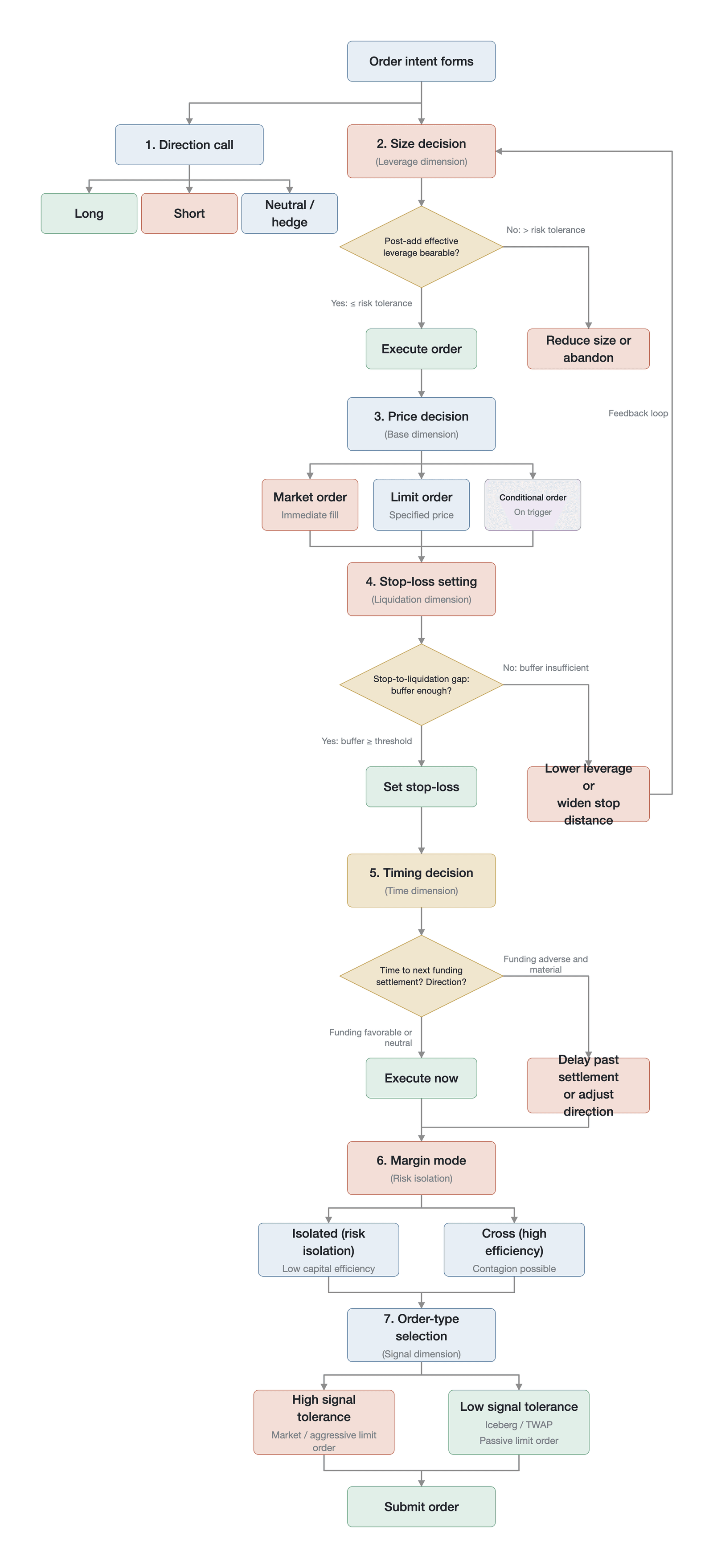
Figure 7-11. A unified decision tree for perpetual futures order strategy (conceptual decision-tree illustration, not empirical data)
As shown in Figure 7-11, after forming a preliminary trading intent, a mature trader must pass in turn through the following seven nodes:
The trader's starting point is directional judgment—deciding, based on fundamental analysis or technical signals, whether to go long, go short, or construct a neutral hedge. This is the step every trader performs, and the only step most ineffective traders perform. Building on this, the trader must convert the directional judgment into a sizing decision, calculating whether effective leverage after adding remains within their risk tolerance. If it exceeds the tolerance, they must reduce the order size or forgo the trade, thereby converting the subjective judgment of "I favor this direction" into the quantified decision of "how much risk I am willing to bear." Next comes the price decision: choosing immediate execution (a market order), waiting at a specified price (a limit order), or a conditional trigger (a stop-loss/take-profit order). This dimension exists in the traditional spot market as well, but in perpetual futures the price decision is tightly coupled with leverage, and different entry prices imply different effective leverage and liquidation distances.
At the same time, the stop-loss setting constitutes a key feedback loop in the decision tree: the trader must assess whether the safety buffer between the stop-loss price and the liquidation price is sufficient to withstand slippage in extreme volatility, and if the buffer is insufficient, they must fall back to lower the leverage or widen the stop-loss distance. Then the timing decision requires the trader to examine the time remaining until the next funding-rate settlement and the expected direction of the rate, and decide whether to execute immediately or defer until after settlement. For a large position, the funding cost may be a non-negligible factor in profit and loss.
Having established the risk framework, the trader must still make two structural choices. The margin mode determines whether this order is placed in the capital-efficiency-seeking cross-margin pool or under the risk-isolation-seeking isolated mode, thereby defining the order's risk-contagion boundary. The choice of order type then requires the trader, based on their own tolerance for information leakage, to make the final trade-off between execution certainty and signal concealment: for a trader with high signal tolerance, a market order or an aggressive limit order is a reasonable choice; for a large trader who needs to hide intent, an iceberg order, TWAP, or a passive limit order is the better strategy.
Every perpetual futures order is a multi-objective optimization across these seven decision nodes. This is precisely the microfoundation of why perpetual futures trading is "simple to operate but complex to decide." Ineffective traders who suffer systematic losses in the market over the long run typically stop at only the first node of the decision tree—"directional judgment"—while entirely neglecting the six critical decision nodes that follow. This insufficient analysis is precisely the microstructural operationalization of the systematic losses of the "ineffective traders" analyzed in Chapter 4.
7.5 The commitment property of on-chain orders
Having understood the essence of the order as a signal and the three-dimensional extension that perpetual futures confer on orders, we must now turn our attention to the execution architecture itself. Traditional financial theory generally treats the execution architecture as a neutral background variable: whether at the New York Stock Exchange or on Nasdaq, the economic meaning of a limit order is assumed to be the same. In decentralized finance, however, the physical constraints of the underlying blockchain reshape the economic semantics of an order.
In the two starkly different environments of the centralized exchange and the on-chain central limit order book, the same order faces different processing flows. The core difference is this: on an on-chain CLOB, an order changes from a "private expression of intent" on a CEX into a public, costly, on-chain commitment observable by everyone. This commitment property is the ultimate concretization, at the order level, of the "transparency paradox" of Chapter 1 and the "transparency-fragility paradox" of Chapter 4, and it changes the trader's strategic choices. Taking a single limit order as an example, Figure 7-12 contrasts the "private expression of intent" on a CEX with the "public commitment" on an on-chain CLOB along three dimensions: visibility, cancellation cost, and confirmation latency (the mechanism of each path is detailed in Sections 7.5.1 and 7.5.2).
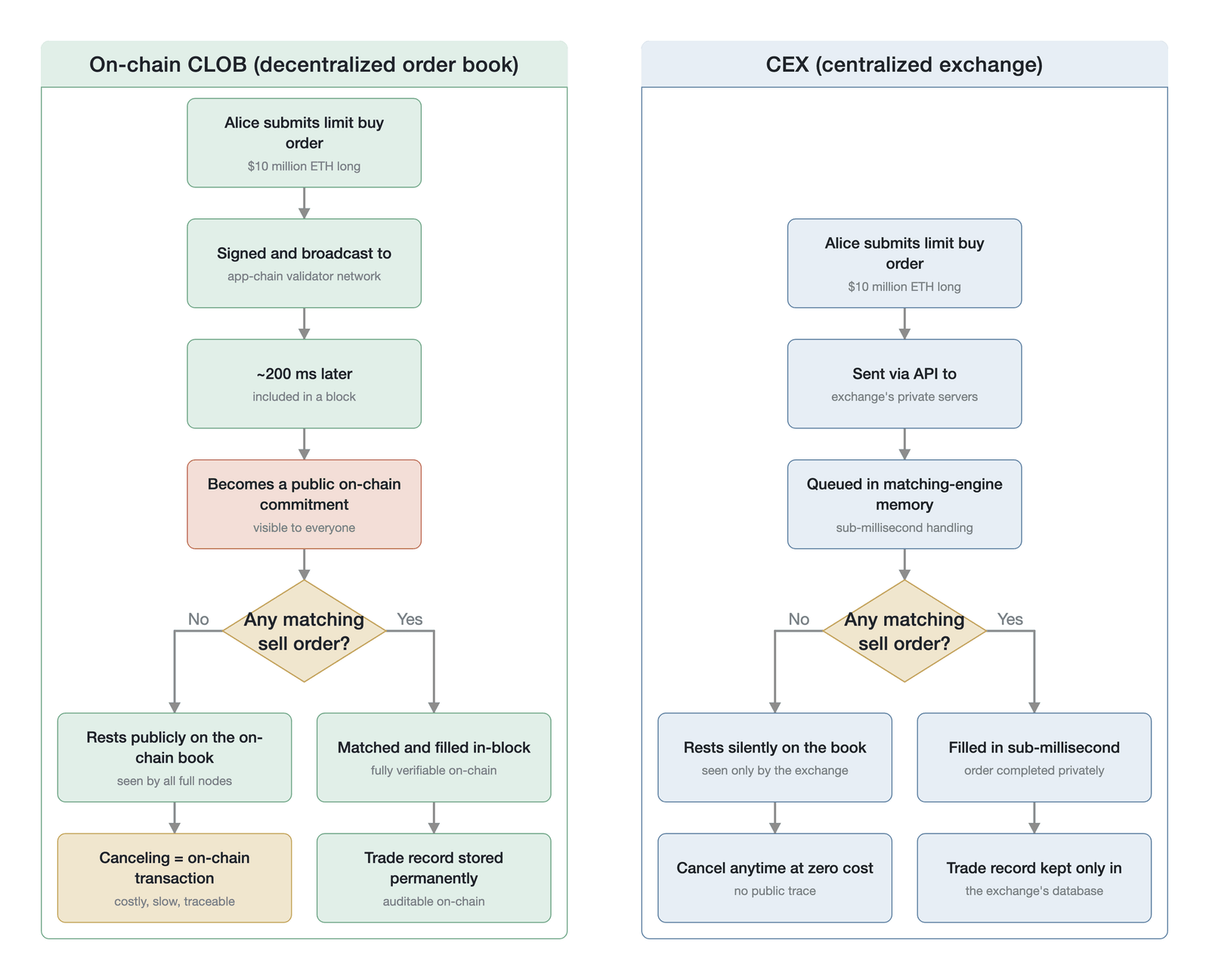
Figure 7-12. The different processing paths of an order on a CEX versus an on-chain CLOB (mechanism-path comparison illustration, not empirical data)
7.5.1 The privacy of CEX orders
In a traditional CEX architecture, when a trader submits a limit order, the order is sent through an API or web front end directly to the exchange's internal private matching engine. Within the matching engine's memory, this order is visible only to the exchange itself and to specific authorized counterparties (such as certain market makers who enjoy a special data feed). If the order is not executed immediately, it rests at a price level on the order book, entirely invisible to the outside world.
For the trader, the CEX environment offers a high degree of strategic flexibility. If market conditions change slightly, the trader can cancel this order at any time, at sub-millisecond speed and zero cost. After the order is canceled, no external observer can prove that the order ever existed; it leaves no public record and no on-chain trace.
Advantage: strategic-privacy protection relative to the public on-chain ledger (though this privacy does not extend to the exchange itself). The trader's intent, capital base, and degree of patience cannot be obtained and exploited in advance by external market participants. This privacy allows large traders to use advanced strategies such as iceberg orders relatively safely to hide their true intent, and allows market makers to instantly withdraw all quotes when unfavorable information appears in order to avoid adverse selection.
Disadvantage: unverifiability and trust cost. The opaque nature of a CEX means that an ordinary trader cannot verify "whether the order book you see is real." The exchange is fully capable of displaying fake market depth, or of using its exclusive visibility into the global order flow to grant itself preferential treatment (such as front-running customer orders). Under this architecture, "the trader's strategic privacy is protected, but at the same time the integrity of the market data cannot be independently verified." This is the structural paradox of the CEX order model.
7.5.2 The public-commitment property of on-chain orders
When the same limit order is submitted to a CLOB protocol built on a general-purpose public chain or an application chain, its nature undergoes an important transformation. The order must be cryptographically signed and broadcast as a transaction to the validator network. From the moment it enters the mempool or is packed into a block, this limit order becomes an on-chain observable public commitment.
Everyone in the world running a full node can clearly see that "someone has committed to buying quantity Q of an asset at price P." More importantly, this commitment cannot be canceled "quietly." Canceling the order likewise requires sending an on-chain transaction, which not only incurs a gas fee (or is constrained by network bandwidth) but also requires waiting at least one block of consensus confirmation. During the time spent waiting for the cancellation to confirm, the original order is still "alive" and can still be filled by anyone.
This "public commitment" property brings mechanism effects that are both positive and negative. The positive meaning: verifiable, genuine liquidity. The on-chain order book achieves verifiability at levels L3 to L4 of the verifiability ladder of Chapter 5. External observers can independently audit every drop of liquidity in the order book, ensuring that no fake depth fabricated by the exchange exists. Everyone sees the same real, fair market state; with respect to the single dimension of fake depth, information asymmetry is significantly reduced at the infrastructure level. This transparency is a structural advantage that current CEX architectures generally cannot provide (without introducing additional cryptographic proofs). The negative meaning: strategy exposure and cancellation cost. Your limit order tells the whole world "I have definite demand at this price." MEV searchers, competing market makers, and other strategic traders can all exploit this public information at no cost to adjust their own strategies. At the same time, because cancellation carries latency and cost, a market maker facing sudden unfavorable information cannot instantly withdraw all quotes as on a CEX, and this significantly increases the adverse-selection risk they face (the transmission by which they widen spreads and pass the cost on to liquidity consumers is detailed in Section 7.6.3).
7.5.3 The MEV exposure surface of orders
In a transparent on-chain environment, an order is no longer merely a number in a matching engine but an object that various algorithms may exploit. Different types of orders, because of the differences in the information they leak to the market and in their execution mechanisms, face starkly different MEV exposure surfaces.
According to data analysis by EigenPhi (2025), the monthly amount extracted by sandwich attacks on the Ethereum mainnet has fallen from nearly $10 million in late 2024 to about $2.5 million by October 2025 [19]. This decline may be partly attributable to the spread of private RPCs and MEV-resistant routing (such as Flashbots Protect and MEV Blocker), as well as to competition among searchers compressing profit margins [20]. For large orders on an on-chain CLOB, however, MEV remains one of the largest implicit execution costs.
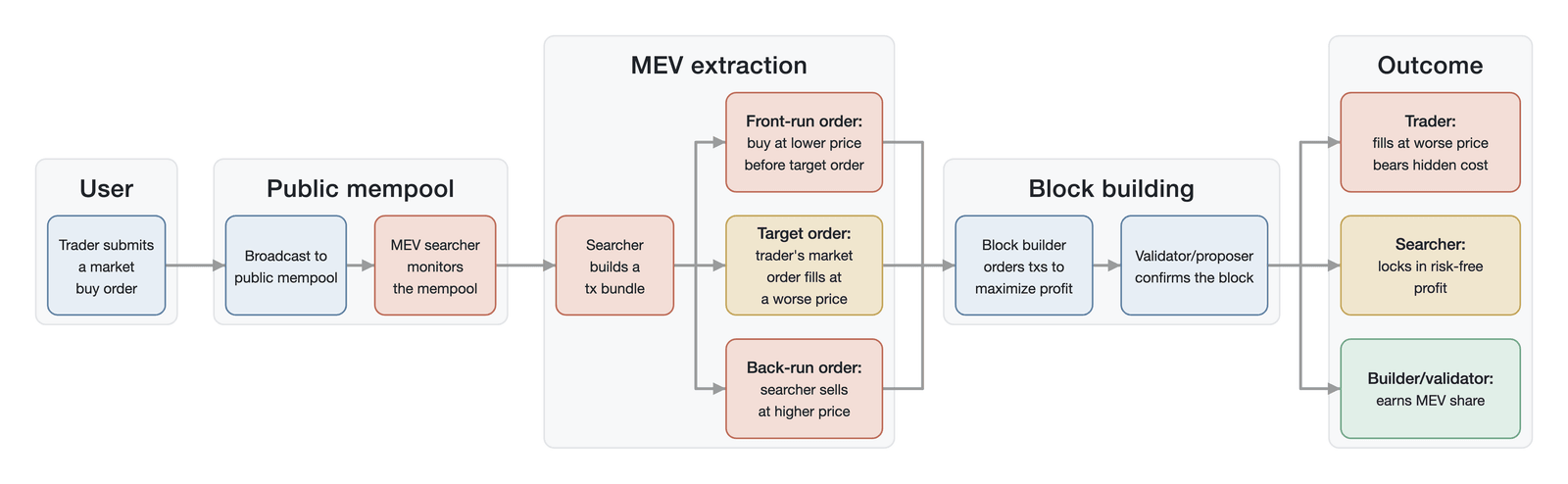
Figure 7-13. The on-chain path of a speculator's market order and MEV intervention (on-chain MEV-intervention mechanism-path illustration, not empirical data; the monthly sandwich extraction of about $10M → about $2.5M is discussed in the text, per EigenPhi [19] and Flashbots [20])
In a perpetual futures environment, the MEV exposure surface of an order is not limited to the traditional sandwich attack; it also includes the deliberate triggering of stop-losses. When a stop-loss order's trigger price is publicly visible on-chain, an attacker can precisely calculate the expected-value relationship between "the capital needed to push the price to the trigger" and "the profit obtainable after triggering." Only when this expected value is positive—as noted at the end of this paragraph, this generally holds only under the narrow conditions of shallow order-book depth at the target level and a high concentration of stop-loss/liquidation positions—does deliberately triggering a stop-loss become a rational attack strategy. Deliberately pushing the price to trigger others' stop-losses, however, is explicitly characterized as market manipulation under the major regulatory frameworks. U.S. SEC Rule 10b-5 renders illegal any fraudulent conduct intended to artificially affect market prices; Article 12 of the EU's Market Abuse Regulation (MAR) defines "manipulative trading" to include trading conduct aimed at creating artificial price levels; and the CFTC's anti-manipulation authority derives mainly from Section 6(c)(1) of the Commodity Exchange Act and Rule 180.1, which is modeled on SEC Rule 10b-5. The CFTC's 2023 enforcement action against Ooki DAO, by contrast, was not based on anti-manipulation grounds but rather established the precedent that a DAO can bear legal liability as an "unincorporated association," as well as the precedent of violations such as operating unregistered illegal leveraged trading; the significance of that case for the legal-personhood status of decentralized protocols is independent of the anti-manipulation rules themselves. As crypto-asset-specific regulations such as the EU's MiCA framework are implemented, the legal risk faced by participants who carry out such strategies—even on decentralized platforms—is steadily increasing. This book's analysis of the stop-loss-hunting strategy here is therefore purely for the academic purpose of understanding market microstructure, and readers should fully recognize the substantial legal risks involved in engaging in such conduct. From the standpoint of economic analysis, the feasibility of deliberately triggering a stop-loss depends on the relationship between the attack cost and the expected return: the attacker must deploy enough capital to push the price into the stop-loss trigger region (the cost depends on the order-book depth at the target level), while the expected return depends on the total volume of stop-loss orders clustered in the trigger region and the size of the reverse position the attacker has established in advance. Only under specific conditions (namely, shallow order-book depth near the target level but a high concentration of stop-loss/liquidation positions) does such an attack have positive expected value.
| Order type | Degree of MEV exposure | Exposure mechanism and attack vector | Mitigation |
|---|---|---|---|
| Large market order (public mempool) | Very high | The trading intent is fully public before filling, making it vulnerable to sandwich attacks and front-running. Searchers can precisely calculate the slippage tolerance and maximize the value extracted. | Use a private transaction pool (such as MEV Blocker); set strict slippage protection. |
| Stop-loss market order (on-chain trigger) | High | The stop-loss trigger price is publicly visible. In a transparent environment, this amounts to telling the attacker, "push the price here and you trigger my forced sell." | Use a "stop-loss + limit order" combination, or split a large stop into multiple small trigger orders. |
| Limit order (on-chain order book) | Medium | A long-resting limit order exposes the trader's strategic intent and may be used by counterparties to infer their liquidation price or overall capital strength. | Shorten the resting time (use GTT orders), or use conditional triggers where the protocol supports them. |
| Iceberg order (on-chain implementation) | Depends on implementation | A simple smart-contract implementation may expose the iceberg order's total size through its state-change pattern, causing the concealment to fail. | Rely on native protocol-level support from the application chain or on zero-knowledge-proof technology. |
Table 7-8. The MEV exposure matrix of different order types (Data source: constructed by the author)
After Table 7-8 summarizes the qualitative risk level of each order type, Figure 7-14 goes further, using a heatmap to quantify the degree of exposure of eight common order types under five MEV attack vectors:
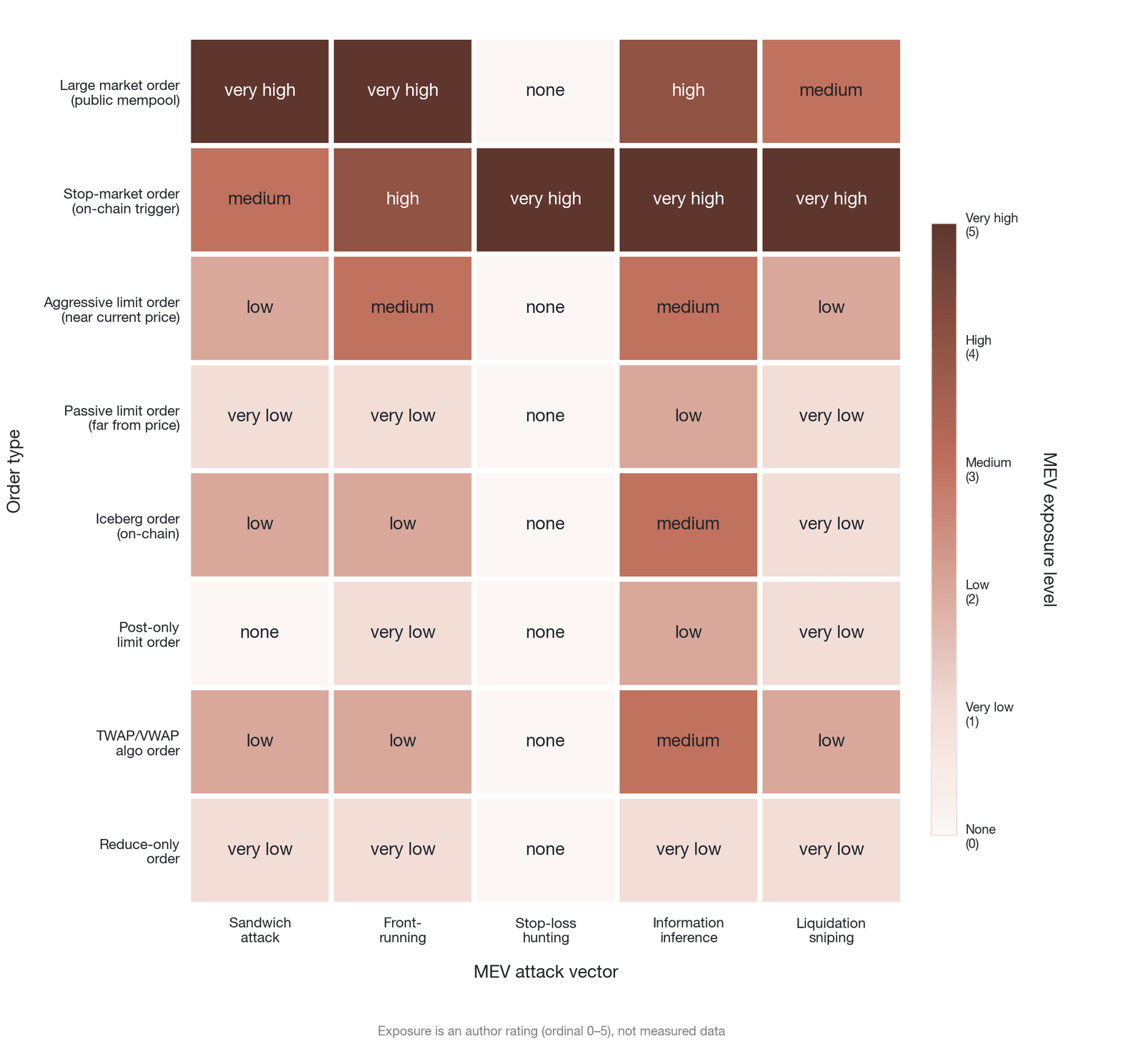
Figure 7-14. The degree of exposure of different order types under five MEV attack vectors (author's qualitative rating matrix; the 0–5 scale reflects the author's judgment, not empirical data; the MEV taxonomy is per Flashbots 2024 [20] and EigenPhi 2025 [19])
Figure 7-14 reveals a key pattern unique to the perpetual environment: although the stop-loss market order has only "medium" exposure on the sandwich-attack dimension, it reaches "very high" on both the deliberate-stop-triggering and information-inference dimensions—a risk-amplification effect unique to the perpetual futures environment. The "very high" exposure of large market orders on the sandwich and front-running dimensions, and the low exposure of Post-Only limit orders and Reduce-Only reduce orders across attack vectors owing to their passive nature, can all be read directly from the heatmap.
Core insight: on an on-chain CLOB, the public visibility of the stop-loss order is directly related to the "transparency-fragility paradox" of Chapter 4. When your stop-loss price is seen by everyone and you use high leverage, "pushing the price to trigger your stop-loss" can become a positive-expected-value attack strategy for a market maker or an MEV bot. This is a systemic risk unique to perpetual futures in the transparent on-chain environment. At the same time, because deliberately triggering a stop-loss constitutes market manipulation under most regulatory frameworks, participants in such conduct also face steadily increasing legal risk.
7.5.4 The order-protection mechanisms of application chains
To address the negative effects of the on-chain order commitment property, a new generation of derivatives application chains (such as Hyperliquid and dYdX v4) has undertaken extensive innovation at the protocol layer, seeking a new balance point between "verifiability" and "strategic privacy." These application chains abandon the global-state model of general-purpose public chains such as Ethereum, opting instead for a highly customized architecture designed for order-book trading, thereby providing three core classes of order-protection mechanism.
The private mempool is the first class of protective measure these application chains adopt. On a general-purpose public chain, a transaction must be broadcast in a public P2P network before it is packed, giving MEV searchers a "submit-to-confirm" time window to observe and exploit pending orders. Many application chains, by contrast, adopt a private mempool or validator-level direct routing, encrypting the user's order or sending it directly to the current block proposer, so that it is not disclosed publicly before it is formally packed into a block and executed. This eliminates the MEV exposure in the "submit-to-confirm" time window and deprives the traditional sandwich attack of its target. The cost of this design, however, is that trust is transferred from the "trustless public network" to the validator nodes, and this transfer of trust introduces a non-negligible centralization risk. Under a private-mempool architecture, validators have complete visibility into and ordering power over the user's order flow, functionally no different from the operator of a CEX matching engine. A malicious or compromised validator can carry out a variety of concrete attacks: selectively delaying a particular user's orders to create an execution environment favorable to itself, front-running high-value orders, censoring (refusing to pack) transactions from particular addresses, and colluding with external parties to leak order-flow information. Take Hyperliquid as an example: its validator set is relatively small (about 4–16 nodes) and its admission mechanism is restricted, so compromising or bribing a single validator suffices to gain an informational advantage over all the order flow that validator processes. Mitigations currently under exploration include: threshold encryption (encrypting an order and distributing it to multiple validators, decryptable only when more than a threshold number of validators cooperate), commit-reveal schemes (the trader first submits a hash commitment of the order and reveals the order contents only after the block is confirmed), and periodic ordering-fairness audits. To assess the current state candidly: mainstream application-chain DEXs are far less decentralized than general-purpose public chains such as Ethereum, and their security model still relies largely on trust in a small number of validators rather than on cryptographic guarantees. From the standpoint of regulatory classification, a private mempool is functionally equivalent to a dark pool or a systematic internalizer in traditional finance, which are subject to extensive transparency and fairness regulation under the SEC and MiFID II frameworks—a regulatory equivalence that has not yet received sufficient attention in the current discussion of DeFi regulation.
Building on this, protocol-level deterministic ordering provides a complementary safeguard. General-purpose public chains typically use a priority-fee auction mechanism: whoever pays more gas has their transaction ordered first, which creates the economic basis for front-running, as an attacker need only pay slightly more gas than the target transaction to ensure their own transaction is executed first. Application chains, by contrast, typically enforce first-in-first-out or other deterministic ordering rules at the consensus level: as long as the order in which orders arrive at the validators is determined, their execution order is locked, thereby eliminating the possibility of prioritizing an order by paying a higher fee. Deterministic ordering, however, cannot fully eliminate the validator's internal ordering advantage; validators can still selectively delay or reorder the transactions they receive.
Going further, an application chain, by virtue of its full-stack control (from the consensus layer to the application layer), can also provide native support at the protocol layer for advanced orders such as iceberg orders and implement selective opacity. For example, it can record on-chain only the currently visible portion of an order while hiding the total size in encrypted state. This "selective opacity" design is precisely a response to the profound recognition that "full transparency is not net-positive in a high-leverage environment." It responds to the "transparency-leverage-safety trilemma" analyzed in Chapter 6: in some scenarios, moderate opacity can actually improve the overall safety and efficiency of the market. Zero-knowledge-proof technology offers a more elegant solution in this direction: "prove compliance without exposing the details" (see the analysis of the prospects for zero-knowledge proofs in order protection in Chapter 30).
The evolution of on-chain orders from "private intent" to "public commitment" is not merely a technological shift but an architectural transformation of market microstructure. It requires traders to relearn the "on-chain dialect" of this language—to enjoy the transparency and fairness that decentralization brings while learning to use the new infrastructure to protect their own strategies from strategy-exposure risk. And the application chains' ongoing exploration between "verifiability" and "strategic privacy" is defining the boundaries of this new architecture.
7.6 The execution-architecture spectrum and the reshaping of order semantics
In traditional financial markets, the lifecycle and execution logic of an order are built on highly centralized, low-latency physical infrastructure. The matching engine runs on dedicated hardware, order submission, matching, and cancellation complete at the sub-millisecond level, and the trader hardly needs to care about the physical characteristics of the underlying infrastructure. When perpetual futures trading migrates to an on-chain environment, however, the physical constraints of the underlying blockchain—the discreteness of block time, the latency of the consensus mechanism, the volatility of gas fees, and the costliness of state storage—reshape the semantics of an order. An order whose semantics are clear and whose behavior is predictable on a centralized exchange may exhibit a starkly different lifecycle, cost structure, and risk profile in an on-chain environment.
This section systematically examines the differences in the core properties of the three main execution architectures (the centralized exchange, the fully on-chain DEX, and the application-chain DEX), and analyzes one by one how the physical constraints of blockchain reshape the economic meaning of an order along five key dimensions: order lifecycle, cancellation mechanism, conditional triggering, matching logic, and state management.
7.6.1 A comparison of the three execution architectures
Three execution architectures currently exist in the crypto derivatives market: the centralized exchange, the fully on-chain decentralized exchange, and the application-chain-based decentralized exchange. These three architectures exhibit a starkly different feature spectrum in latency, throughput, order cost, transparency, and censorship resistance, forming a continuum from "extreme performance but complete opacity" to "complete transparency but limited performance."
On a centralized exchange, the matching engine runs on a single high-performance server or a tightly coupled cluster, and order submission, matching, and cancellation typically complete at the sub-millisecond level. The matching engines of top-tier CEXs such as Binance and Bybit can reach an order-processing throughput on the order of a million orders per second, and order submission and cancellation incur no direct fees. This architecture offers extreme execution efficiency, but at the cost of entirely opaque operation: the trader cannot verify whether the matching engine has fairly executed the price-time priority principle, nor audit whether the exchange engages in improper conduct such as internal front-running or selective execution.
The fully on-chain DEX (such as protocols based on the Ethereum mainnet or a general-purpose Layer 2) goes to the other extreme. The submission, matching, and settlement of every order must, as an on-chain transaction, pass through the consensus confirmation of the entire network. The Ethereum mainnet's block time is about 12 seconds, and even an Optimistic Rollup such as Arbitrum requires a soft-confirmation time of about 250 milliseconds. This brings extremely high transparency and censorship resistance (anyone can independently verify the execution process of every transaction), but it also introduces significant latency and high, volatile gas costs. During periods of network congestion, a simple order submission may require paying tens of dollars in gas fees.
The application-chain DEX (such as dYdX v4 and Hyperliquid) seeks a new balance point between the two. By building a sovereign blockchain purpose-optimized for trading, with a customized consensus mechanism and in-memory order-book state management, this class of architecture can achieve sub-second latency and extremely high throughput. Hyperliquid's block time is about 200 milliseconds, and its official documentation claims it can process about 200,000 order operations per second (about 200,000 OPS) [14] (this figure is self-reported from Hyperliquid's official documentation and represents theoretical peak processing capacity rather than sustained throughput under stress; the JELLY incident of March 2025 exposed the platform's operational constraints under extreme market conditions, indicating that sustained processing capacity under actual stress may be significantly lower than the theoretical peak). dYdX v4, built on the Cosmos SDK, has constructed an independent application chain that maintains the order book in the validators' memory rather than in on-chain state, thereby greatly improving performance while preserving non-custodial and verifiable properties [21]. Figure 7-15 uses a radar chart to compare these three architectures along six dimensions—latency, throughput, order cost, transparency, censorship resistance, and degree of decentralization: the CEX excels on the performance dimensions while its transparency/censorship resistance is nearly zero, the fully on-chain DEX is the reverse, and the application-chain DEX has the most balanced profile.
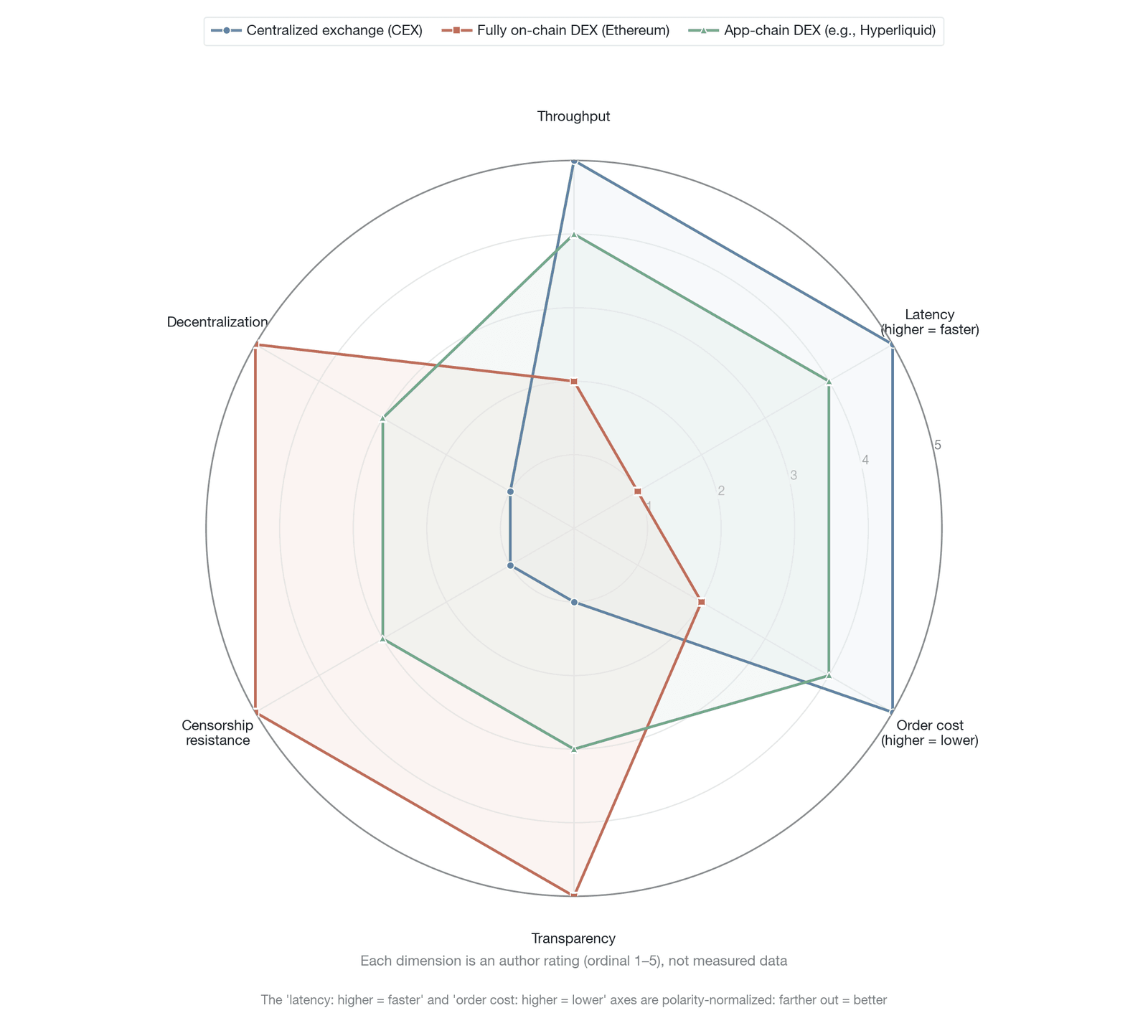
Figure 7-15. A comparison of the core properties of the three execution architectures (author's relative-rating radar; the 1–5 scale reflects the author's judgment, not empirical data; six dimensions, including degree of decentralization, consistent with the text; the latency/order-cost axes have been polarity-normalized so that farther out = better; platforms as of 2025, per Hyperliquid [14] and dYdX [21])
| Property | Centralized exchange | Fully on-chain DEX | Application-chain DEX |
|---|---|---|---|
| Latency | < 1 ms | 100 ms – 12 s | ~200–1,000 ms |
| Throughput | > 1,000,000 TPS | ~15–2,000 TPS | About 200,000 OPS (200,000 operations/second) |
| Order cost | Zero | High and unstable (gas fee) | Zero or extremely low |
| Order visibility | Private (visible only to the exchange) | Public (visible network-wide) | Configurable (short-term private/long-term public) |
| Matching mechanism | Continuous matching | Batch matching | High-frequency batch matching |
| Censorship resistance | Low | High | Medium |
| State-storage location | Centralized database | On-chain global state | Memory (short-term) + on-chain (long-term) |
Table 7-9. A comparison of the key physical metrics of the three execution architectures (Note: "TPS" in the table refers to order-operation processing capacity, including operations such as order submission, cancellation, and matching, which differs from the transaction-level TPS of the underlying blockchain. The data for the application-chain DEX are the theoretical peak self-reported in official documentation, and sustained throughput under stress may be significantly lower than this value. The "censorship resistance: medium" rating is based on the following dimensions: the size of the validator set, the openness of the validator-admission mechanism, and whether users have a feasible alternative submission path when censored.) (Data source: compiled by the author)
Table 7-9 converts the qualitative comparison of the radar chart into concrete quantitative metrics. Most noteworthy is the order-of-magnitude difference: the CEX's latency is under 1 millisecond, whereas the fully on-chain DEX's latency may exceed 12 seconds—a gap spanning four orders of magnitude. This order-of-magnitude difference is not merely a matter of "fast versus slow"; it fundamentally determines the space of feasible order strategies under each architecture: the speed-sensitive high-frequency market-making and latency-arbitrage strategies that can be implemented at sub-millisecond latency lose essentially all economic viability at second-scale latency.
7.6.2 The order lifecycle
In traditional markets and on centralized exchanges, "good-til-canceled" is the most common order-lifecycle type. A trader can submit a GTC order, which will rest on the order book until it fills completely or the trader actively cancels it. The marginal cost of maintaining an order record in a centralized database is nearly zero, so there is no technical obstacle to implementing GTC.
In a blockchain environment, however, maintaining long-term on-chain state consumes costly storage resources. Every unfilled limit order occupies the disk space of full nodes, and if orders were allowed to exist permanently, the blockchain state would expand without limit, ultimately making node operating costs unbearable. Almost all on-chain order-book protocols have therefore abandoned GTC in its true sense, replacing it with order types that have a well-defined lifecycle.
The design of dYdX v4 provides a highly representative example. Its architecture explicitly distinguishes "short-term orders" from "stateful orders," which use starkly different mechanisms for lifecycle management [22]:
Short-term orders are aimed mainly at high-frequency market makers; their lifecycle is measured in block height, with a maximum survival time of only the current block height plus 20 blocks (about 20–30 seconds). Orders of this kind reside only in the validators' memory and are not written to on-chain state. If the network restarts or halts, these ephemeral orders are simply discarded. This feature introduces a noteworthy asymmetric risk in the chain-halt-and-restart scenario: short-term maker orders (a market maker's bid and ask quotes) are cleared on restart, while long-term stateful taker orders (such as stop-loss and take-profit orders) survive. If the external market price moved violently during the halt, the order book after restart will face a situation of severely insufficient depth while conditional orders can still be triggered—which may lead to a "restart flash crash" in which stop-loss orders fill at enormous slippage on an order book with almost no counterparty liquidity. Whether protocol designers should implement a cooling-off period or an auction-style reopening mechanism to mitigate this risk is a design question worth exploring in depth. This design appears "unreliable," but it is in fact a protective mechanism for market makers: after violent market volatility, stale market-making quotes that remain valid would expose the market maker to high adverse-selection risk. By letting orders expire automatically within an extremely short time, market makers can ensure that their quotes always reflect the latest market state.
Stateful orders are aimed at ordinary retail traders and institutional investors; their lifecycle is measured by timestamp (Good-Til-Time), with a maximum validity of up to 95 days. Orders of this kind are formally written to on-chain state and can be restored after a validator restart, ensuring the durability of long-term trading intent. Conditional orders (such as stop-loss and take-profit orders) also fall within the category of stateful orders.
Core insight: the shift from GTC to GTT/GTB means that market makers can no longer "submit an order and then ignore its state" as on a CEX. They must develop dedicated infrastructure to continuously monitor the remaining lifecycle of on-chain orders and refresh them in time before expiry, which significantly increases strategic complexity and infrastructure cost.
Hyperliquid takes a more aggressive route. By virtue of the application chain's high throughput and lower state-management cost, Hyperliquid has once again made GTC viable in an on-chain environment, its design philosophy contrasting sharply with that of dYdX [14]. This difference itself reflects the different trade-offs that application-chain designers make between state-management cost and user experience.
| Time-in-force type | Meaning | CEX support | Fully on-chain DEX | Application-chain DEX | Typical users |
|---|---|---|---|---|---|
| GTC | Valid permanently until filled or canceled | Standard | Generally unsupported | Partially supported | Retail traders, hedgers |
| GTB | Expires after a specified block height | Not applicable | Partially supported | Standard (short-term orders) | Market makers, high-frequency traders |
| GTBT | Expires after a specified timestamp | Not applicable | Partially supported | Standard (stateful orders) | Speculators, hedgers |
| IOC | Immediate-or-cancel | Standard | Complex to implement | Standard | Arbitrageurs |
| FOK | Fill-or-kill | Standard | Complex to implement | Standard | Arbitrageurs |
Table 7-10. A comparison of how the time-in-force types are implemented across the different execution architectures (Data source: compiled by the author)
Table 7-10 reveals a key trend: the application-chain DEX has approached the completeness of the CEX in its support for time-in-force types, and the introduction of GTB and GTBT provides differentiated lifecycle-management tools for market makers and ordinary traders, respectively. The "complex to implement" label on IOC and FOK for the fully on-chain DEX, however, reveals a fundamental constraint: these two order types require immediate feedback (filled or canceled), and the consensus mechanism of a blockchain inherently cannot provide sub-second confirmation feedback—which constitutes a structural bottleneck in the functional completeness of the fully on-chain CLOB.
7.6.3 The order-cancellation mechanism
The semantics of the cancellation operation undergo a significant change in an on-chain environment. On a centralized exchange, cancellation is a free and instantaneous operation. High-frequency market makers frequently use the strategy of "placing large numbers of orders and quickly canceling them before they fill" to probe market liquidity and manage inventory risk. By some estimates, the cancel-to-fill ratio of market makers on top-tier CEXs typically exceeds 95% (this figure is a widely cited industry rule of thumb; the specific ratio varies significantly by trading pair, exchange, and time period—see the SEC's statistics on cancellation rates in the U.S. equity market and the publicly disclosed market-maker-activity reports of various exchanges), meaning that of every 100 orders submitted, more than 95 are ultimately canceled rather than filled.
In a fully on-chain architecture, however, cancellation is no longer free. Every cancellation instruction is an on-chain transaction that must be broadcast, queued, packed, and charged gas. During periods of Ethereum network congestion, the gas cost of canceling an order may be as high as tens or even hundreds of dollars. More seriously, because of the confirmation latency of on-chain transactions, there is a non-negligible time window between the broadcast of a cancellation instruction and its ultimate effect. Within this window, the order the trader intended to cancel is still "active" and may be targeted for a fill by other traders (especially MEV searchers and arbitrage bots).
The asymmetry of latency and cost in cancellation significantly weakens a market maker's ability to respond to adverse selection. This portion of extra risk is ultimately passed on to all liquidity consumers in the form of wider bid-ask spreads, becoming an implicit cost of on-chain trading.
To mitigate this problem, application-chain architectures adopt differentiated approaches. For short-term orders, dYdX v4 propagates cancellation instructions rapidly among validators via a gossip protocol, handling them on a "best-effort" basis [22]. This mechanism does not guarantee the absolute success of a cancellation (under network congestion or in the presence of a malicious validator, the cancellation instruction may fail to take effect in time), but it greatly reduces latency and cost, allowing market makers to adjust their quotes at a frequency close to that of a CEX. For stateful orders, cancellation still requires a formal on-chain transaction, but thanks to the application chain's high-frequency block production (such as Hyperliquid's 200-millisecond block time), the latency is compressed to within 1–2 blocks. Figure 7-16 uses a sequence diagram to compare the complete cancellation flow under the three architectures and the processing steps and time overhead of each stage.
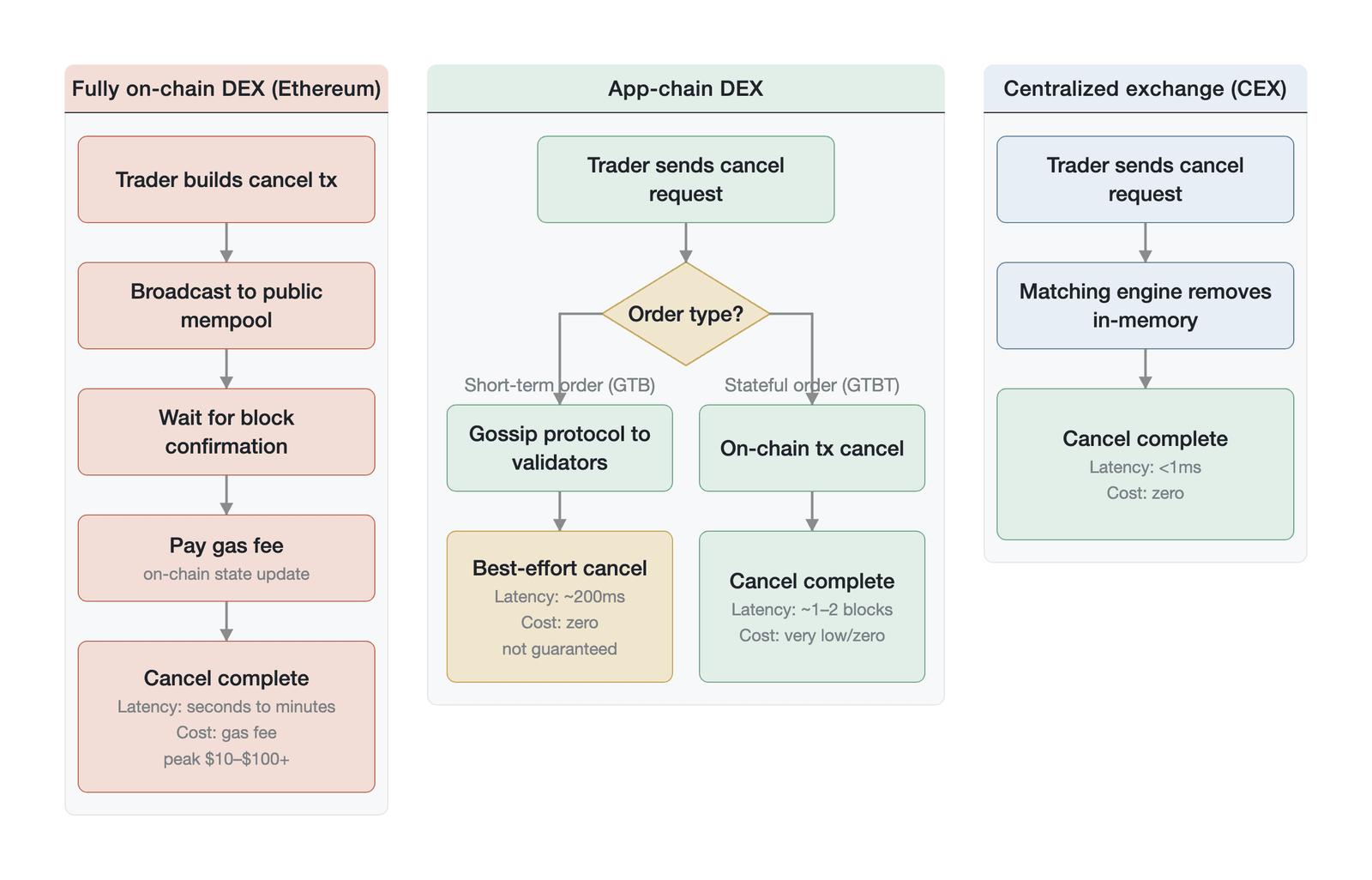
Figure 7-16. The evolution of the order-cancellation flow under the three execution architectures (cancellation-flow mechanism illustration, not empirical; the short-term-order gossip "best-effort" is per dYdX [22], and the fully on-chain gas of $10–$100+ is a peak-period magnitude)
Figure 7-16 shows the qualitative differences in the cancellation flow, and Figure 7-17 quantifies this difference along the two dimensions of latency and cost on a logarithmic scale (see the figure caption for specific magnitudes).
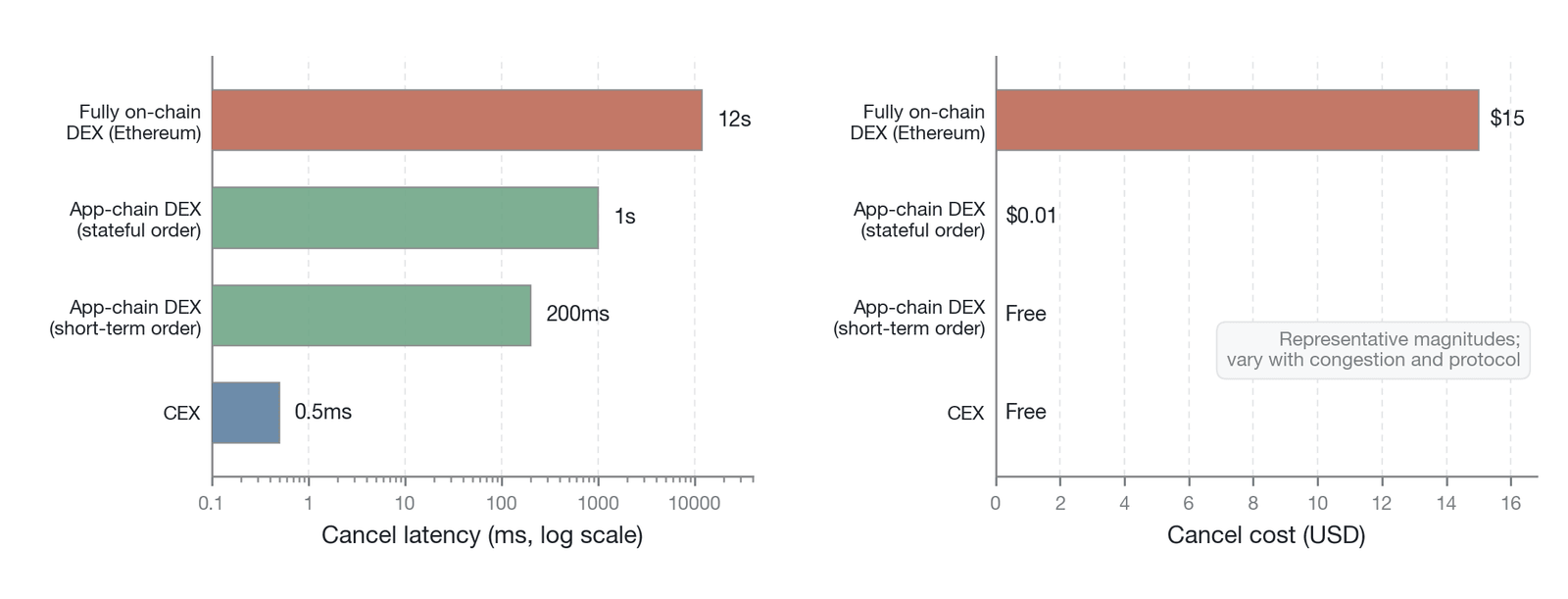
Figure 7-17. A quantitative comparison of cancellation latency and cancellation cost (representative-magnitude comparison illustration: 12s/$15, 1s/$0.01, 200ms/free, 0.5ms/free are order-of-magnitude representative values, not empirical; mapping to the text and to [22][14])
The quantitative comparison in Figure 7-17 reveals a conclusion with profound implications for market makers: on a fully on-chain DEX, the dual pressure of cancellation latency and cancellation cost makes the "place many orders, cancel quickly" style of market making common on a CEX all but infeasible. Although the application-chain DEX achieves a significant improvement on the latency dimension (compressing it from seconds to hundreds of milliseconds), it still lags the CEX's sub-millisecond level by two to three orders of magnitude. This gap directly dictates that on-chain market makers must use wider quote spreads and fewer quote layers to compensate for the structural disadvantage of being unable to cancel quickly.
7.6.4 Conditional-order triggering
The execution logic of conditional orders (such as stop-loss and take-profit orders) undergoes an important change in an on-chain environment. On a CEX, a conditional order is triggered directly by the internal matching engine according to the last traded price generated in real time, and the entire process from the price touching the trigger threshold to the order entering the matching queue completes at the microsecond level. In on-chain derivatives protocols, however, a smart contract cannot directly obtain external market prices, and the triggering of a conditional order generally relies on a price feed provided by an external oracle.
This reliance on the oracle introduces two key physical constraints: discontinuity and inherent latency.
Oracle price updates are discrete rather than continuous, and oracles differ fundamentally across execution architectures in their update frequency and mechanism. In DeFi protocols on general-purpose public chains, conditional orders typically rely on third-party oracle networks such as Chainlink. Chainlink, for example, generally pushes a new price only after the price deviation reaches a certain threshold (such as 0.5%) or a specific time interval elapses (such as the heartbeat period, which varies by feed and chain—for mainstream pairs on the Ethereum mainnet it is often about 1 hour, and for some it can reach 24 hours) [23]. This means that in a general-purpose-public-chain environment, the price changes the on-chain system perceives exhibit a pronounced stair-step character. Mainstream application-chain DEXs, however, adopt a starkly different oracle architecture. dYdX v4 uses a custom oracle module: validator nodes aggregate price data from the APIs of multiple centralized exchanges and reach price consensus during the consensus process of each block, achieving one update per block (about 1–2 seconds). Hyperliquid runs an internal oracle network in which validators publish a price about once every 3 seconds (first taking a cross-exchange weighted median, then aggregating among validators by stake weight); although its update frequency is faster than that of third-party oracles on general-purpose public chains, it is still significantly slower than its roughly 200-millisecond block production. The update frequency of these custom high-frequency oracles is far higher than Chainlink's, so the conditional-order trigger latency of an application-chain DEX is far lower than that of a general-purpose-public-chain DeFi protocol. Chainlink's parameters (a 0.5% deviation threshold and a 1-minute heartbeat) apply only to describing DeFi protocols on general-purpose public chains and should not be generalized as the oracle characteristics of all on-chain derivatives platforms.
Despite the order-of-magnitude difference in oracle update frequency, all on-chain oracles face a more serious security threat: the oracle-manipulation attack. An attacker can use a flash loan to temporarily manipulate the price source on which the oracle relies within a single transaction, artificially creating an extreme price deviation and thereby triggering stop-losses and liquidations en masse. The Mango Markets incident of October 2022 is a representative case of this attack vector: the attacker manipulated the oracle price of Mango Markets, artificially inflating the price of the MNGO token and then using the fake collateral value to borrow protocol assets, causing a loss exceeding $110 million (over $110 million per the CFTC/DOJ figure; about $116 million per the SEC) [24]. In a perpetual futures system that relies on an oracle to trigger stop-losses and liquidations, a manipulated oracle price can trigger thousands of stop-losses and liquidations simultaneously, causing a catastrophic market impact. The main mitigations include: adopting a TWAP (time-weighted average price) oracle to smooth out instantaneous manipulation; aggregating multiple independent price sources and discarding outliers; and activating a circuit breaker when the price deviation exceeds a threshold, suspending liquidation and stop-loss triggering.
When the market swings violently, the compounding effect of discontinuity and latency may produce adverse consequences, but the severity varies by oracle architecture. In general-purpose-public-chain DeFi protocols, oracle update latency can reach seconds or even tens of seconds, and the lag in stop-loss triggering is especially pronounced. On application-chain DEXs, thanks to custom high-frequency oracles, the trigger latency is compressed to about 200 milliseconds to 1 second, but it still cannot be entirely eliminated. Consider a concrete scenario: with ETH at $2,000, a stop-loss order is set with a trigger price of $1,900. If the market plunges to $1,800 in an extremely short time, then on a general-purpose public chain the oracle may update only once, to $1,850, so the stop-loss triggers at $1,850, by which point the actual market price may already be far below $1,850; on an application chain such as Hyperliquid, the oracle updates at a second scale (about 3 seconds), still faster than the tens-of-seconds third-party oracles on general-purpose public chains, so the trigger lag is relatively small but not eliminated. Furthermore, after a conditional order is triggered, it generally must wait for the next block before it can enter the matching engine as a market order or a limit order. On dYdX v4, conditional orders are checked and triggered during the EndBlocker stage of block processing (the final processing step of the current block), and the resulting market/limit order does not participate in matching until the next block—an inherent latency of at least one block from trigger to execution [22].
In extreme conditions, the price may swing more than 5% within 1 second. A 1-second latency is enough to let a stop-loss order intended to cap a loss at 10% ultimately fill at a loss of 20% or more. This is an implicit risk that on-chain traders must understand and manage.
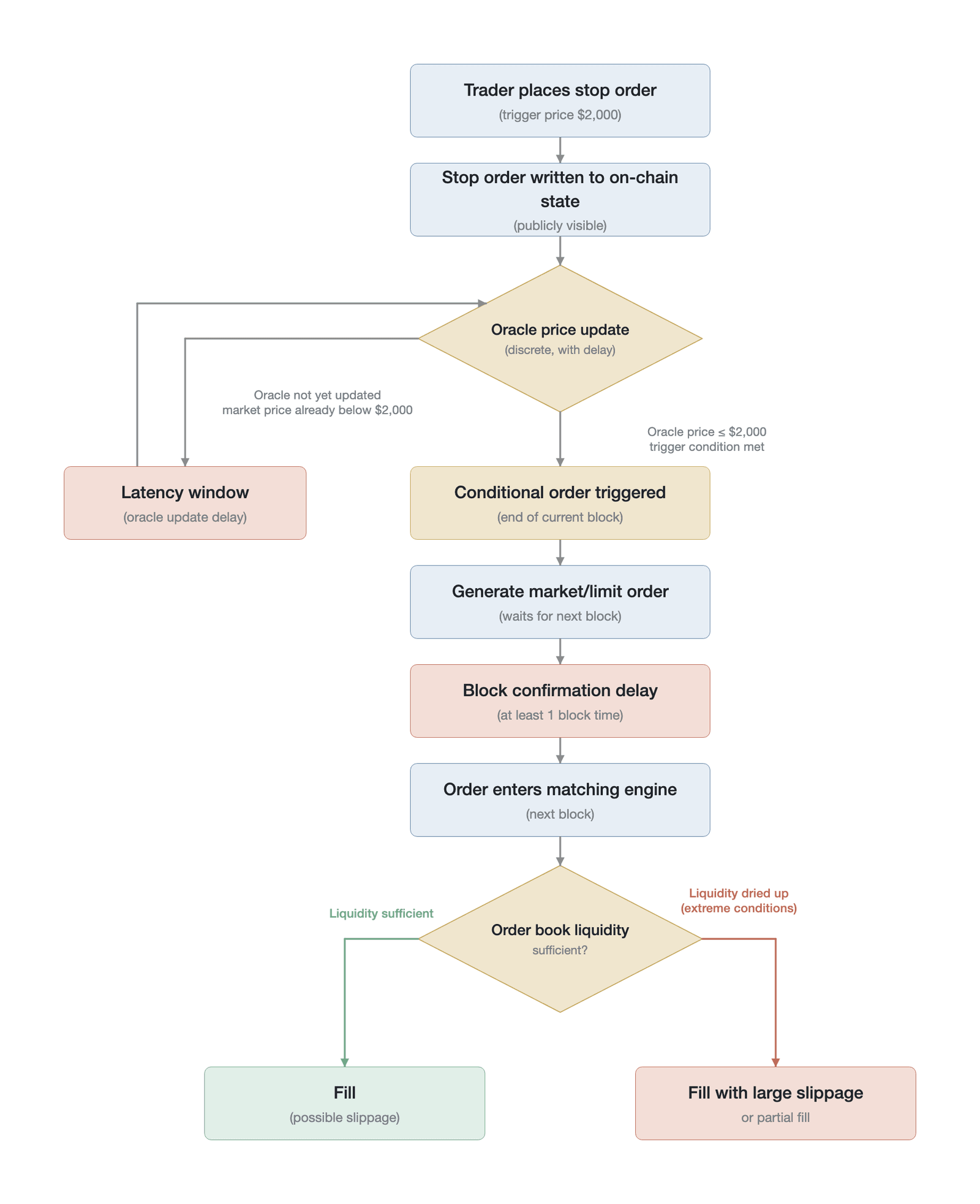
Figure 7-18. The trigger and execution path of an on-chain stop-loss order (on-chain stop-loss trigger-execution mechanism illustration: the $2,000 trigger price is an illustrative value, not empirical; the "at least 1 block" is per the dYdX EndBlocker [22]; the 5%/10%/20% slippage tiers are discussed in the text)
Figure 7-18 uses a timeline to show, in full, all the stages of an on-chain stop-loss order from dormancy to final fill. The time interval between each stage may introduce slippage, and in extreme conditions the compounding of these intervals may cause a deviation of hundreds or even thousands of basis points between the final fill price and the trigger price.
7.6.5 The order-matching mechanism
On a centralized exchange, the matching engine uses a continuous-time limit-order-book model, matching orders at the instant they are received according to the "price priority, time priority" principle. Between two orders at the same price, the one that arrives a fraction of a microsecond earlier gains priority to fill. This continuous-matching mechanism updates the order-book state in real time as each new order arrives, and the price-discovery process appears as a smooth, continuous trajectory.
The discrete-time nature of blockchain fundamentally changes this matching paradigm. Because state updates proceed in units of blocks, the minimum time resolution is no longer the microsecond but the duration of one block. On the Ethereum mainnet this interval is about 12 seconds; on an application chain such as Hyperliquid, about 200 milliseconds. All orders arriving within the same block are treated as "submitted simultaneously" on the time dimension, and priority cannot be established by arrival time. Budish, Cramton, and Shim (2015) note that such discretization can, in theory, transform speed-based competition into price-based competition [25], and the block-time nature of blockchain bears a structural resemblance to that conception.
The matching implementations of current on-chain perpetual futures order books fall mainly into three modes, each representing a different response strategy to the discrete-block constraint.
dYdX v4 adopts a proposer-matching mode: the order-book state is maintained in the validators' memory, the matching process is completed off-chain by the proposer during the block-proposal stage, and the matching result is then submitted as part of the block to the other validators for consensus verification [22]. This design keeps the matching logic itself following the price-time priority principle, but the arrangement order of orders within a block is determined by the proposer rather than strictly fixed by arrival time.
Hyperliquid adopts a validator-embedded-matching mode: its validator nodes simultaneously play the role of the matching engine, orders enter the matching queue at sub-second latency after arriving at a validator, and through high-frequency block production (about 200 ms/block) and a first-in-first-out ordering rule, the matching behavior approaches the CEX's continuous model on the time-granularity dimension [14]. However, "first-in-first-out" is an ill-defined concept in a distributed system: when multiple validators receive orders submitted by different traders at nearly the same time, the definition of "arrived first" depends on the local timestamp of the leader validator (the block proposer) rather than on a globally verifiable objective order. In the absence of a verifiable ordering proof, the credibility of a FIFO claim ultimately depends on trust in the honest behavior of the current leader validator—which is no fundamentally different from the trust model of a CEX matching engine.
Injective adopts a frequent-batch-auction mode, whose design logic is fundamentally different from the previous two. Within each block's time window (about 1 second), all submitted orders are sealed—neither disclosed publicly nor entered into a visible order book. At the end of the block, the protocol performs a uniform clearing of all crossing buy and sell orders within that window: the system computes a single clearing price that maximizes traded volume, and all filled orders execute at that price [26]. When the resting quantities of buyers and sellers at the clearing price are asymmetric, the smaller side fills in full and the larger side fills proportionally in part. This mechanism makes the submission order of orders irrelevant to the fill price, thereby transforming the competitive dimension from "who is faster" to "whose price is better," and eliminating at the protocol layer the economic basis for ordering- and speed-based front-running within a block (though cross-block and cross-venue informational front-running, and the potential peeking at sealed orders by validators, are not covered by this mechanism). The frequent-batch-auction theoretical framework proposed by Budish, Cramton, and Shim (2015) [25] is precisely the academic precursor of this design (a derivatives batch-auction mechanism is functionally equivalent to a traditional exchange's call auction and may, in jurisdictions such as the United States, trigger exchange-registration requirements and related compliance obligations). This theory originally targeted the high-frequency-trading arms race in equity markets, and its core assumptions do not necessarily hold in full in the crypto perpetual futures market; the boundaries of its applicability deserve attention when it is cited across domains. Specifically, the model of Budish et al. assumes the following conditions, all of which face challenges in the on-chain perpetual futures market: (1) homogeneous competition among a large number of market makers, whereas the number of active market makers on an on-chain DEX is in fact far smaller than on a traditional securities exchange; (2) discrete arrival of fundamental information through public news, whereas the information sources of the crypto market are dispersed and include the distinctive dimension of oracle latency; and (3) arbitrage activity occurring mainly among different trading venues for a homogeneous asset, whereas cross-chain arbitrage in the crypto market involves additional complexities such as bridging latency and settlement finality.
The three modes exhibit a gradient of difference in matching fairness. In the dYdX v4 architecture, because the block proposer has discretion over the ordering of transactions within a block, the execution order of orders within the same block is not fully deterministic, which affords the proposer a certain ordering advantage. Hyperliquid, by embedding the matching logic in the consensus-protocol layer and adopting a first-in-first-out rule, narrows this ordering-discretion space, but validators still have the ability to fine-tune the orders they receive. Injective's frequent batch auction, through its uniform clearing price and sealed-order mechanism, provides the strongest guarantee of ordering neutrality among the three, and the economic value of ordering power approaches zero under the uniform-clearing mechanism. The cost of this design is a sacrifice of matching time-granularity: traders cannot obtain immediate fill feedback within the auction window, and all orders must wait until the window closes to be processed uniformly.
Another layer of impact that discrete block time has on the matching mechanism is reflected in the order book's update frequency. On a CEX, every minute change in the order book can be observed in real time, and market makers can adjust their quotes at the microsecond level. In an on-chain environment, however, the order-book state updates only at block boundaries, and between two blocks the order book is "frozen." This means on-chain market makers cannot precisely manage inventory risk and spreads through high-frequency fine-tuning as on a CEX, but must submit their quoting strategy all at once within each block window. This constraint directly affects the depth structure and spread levels of the on-chain order book, which the next chapter analyzes further from the perspective of order-book microstructure.
7.6.6 State-management constraints
The costly state-storage resource of blockchain imposes strict physical constraints on order-book design. On a CEX, a trader can maintain thousands of active limit orders simultaneously at no extra cost. In an on-chain environment, however, every active order occupies precious state space, and the scarcity of storage resources gives rise to a series of design limitations absent on a CEX.
The most direct constraint is a limit on the number of orders. To prevent state bloat and denial-of-service attacks, on-chain protocols must set clear boundaries on trader behavior. Paradex, for example, explicitly stipulates that each trader can maintain at most 100 unfilled resting orders in a single market [27]. On platforms with a higher market share, Hyperliquid sets an upper limit on the number of active orders per address in a single market (the specific value is dynamically adjusted by market and account tier), and dYdX v4 likewise sets an upper limit on the number of active orders per subaccount (typically on the order of hundreds). This hard limit forces market makers to manage their order flow more precisely, abandoning the strategy—common on a CEX—of densely posting orders across dozens of price levels, in favor of a more concentrated and efficient quoting approach.
In addition, the on-chain order book faces a distinctive "dust attack" threat. Usman (2025), in Hacken's security research, describes this attack vector in detail [28]: an attacker uses transactions of an extremely small amount (such as 1 wei, the smallest divisible unit) to partially fill a target order. Because the smart contract must perform complex rounding and state updates when handling a partial fill, this tiny fill may cause a variety of problems: loss of computational precision, invalidation of the remaining order amount when it falls below the minimum trade unit, or even—in a poorly designed protocol—the state of the original large order being erroneously marked as "completed," nullifying the limit-order provider's liquidity. The dust attack is merely the tip of the iceberg of the smart-contract security surface facing on-chain order books. Broader attack vectors also include: reentrancy attacks (repeatedly triggering state updates within an order-fill callback), integer overflow/underflow (producing unexpected results in high-precision price and quantity computations), and state-bloat denial-of-service (creating large numbers of tiny orders to push the contract's storage and computation costs beyond the gas limit). Protocol developers should consult the on-chain-order-book audit reports published by professional security-audit firms (such as Trail of Bits, OpenZeppelin, and Hacken) to systematically assess and defend against these attack surfaces.
To defend against attacks that exploit state-management vulnerabilities, protocol developers must introduce additional defensive mechanisms: mandating a minimum order size (such as $10 equivalent in tokens), setting a minimum fill ratio (such as at least 1% of the order's remaining amount), automatically zeroing out an order when its remaining amount falls below a specific threshold, or charging an extra processing fee for partial fills of extremely small amounts. This logic, added to adapt to the on-chain physical environment, further increases the complexity and audit difficulty of the smart contract.
State bloat is the core challenge of the on-chain order book. All mitigations (order expiry, quantity caps, minimum size) weaken, to varying degrees, the competitiveness of the on-chain order book relative to the CEX. Application chains mitigate this problem through higher throughput and lower state cost, but cannot eliminate it entirely.
The table below summarizes the behavioral differences of the core order types across the three execution architectures, providing traders with an intuitive reference framework for choosing order strategies in different environments:
| Order type/property | Centralized exchange | Fully on-chain DEX | Application-chain DEX |
|---|---|---|---|
| Limit-order lifecycle | GTC, valid permanently | Must use GTT/GTD | Short-term GTB / long-term GTBT or GTC |
| Limit-order cancellation | Instant and free | Requires sending a transaction, paying gas, awaiting confirmation | Short-term best-effort free / long-term requires an on-chain transaction |
| Market order | Instant fill, low slippage | High slippage + MEV sandwich risk | Medium slippage, lower MEV risk |
| Post-Only | Standard support | Requires smart-contract logic checks | Standard support |
| IOC | Standard support | Complex to implement, high gas cost | Standard support |
| FOK | Standard support | Complex to implement | Standard support |
| Stop-loss market order | Based on internal fill price, instant trigger | Based on oracle, at least 1-block latency | Based on oracle, at least 1-block latency |
| Trailing stop | Standard support | Extremely complex to implement, generally unsupported | Partially supported |
| TWAP | Via API or third-party tools | Generally unsupported | Some native support |
| Iceberg order | Standard support | On-chain transparency renders it ineffective | Possibly supported (depends on the order-visibility design) |
| Maximum active orders | No practical limit | Constrained by gas and state storage | Clear upper limit (such as 100 per market) |
Table 7-11. The behavioral differences of the core order types across the three execution architectures (Data source: compiled by the author)
The core conclusion of Table 7-11 is that the application-chain DEX has approached the functional completeness of the CEX for the vast majority of order types, but a gap remains in advanced functions such as trailing stops, TWAP, and iceberg orders. Constrained by gas cost and state-storage limits, the fully on-chain DEX has difficulty implementing order types that require immediate feedback, such as IOC and FOK. This functional difference directly affects the platform choices of different types of traders: high-frequency market makers tend toward the application-chain DEX, whereas traders with a strict need for censorship resistance may still have to choose a fully on-chain protocol.
7.7 The order strategies of market participants
Orders do not exist as isolated technical instructions; they are the tools with which different market participants express intent, compete for advantage, and manage risk within a shared trading grammar. In the ecosystem of the decentralized perpetual futures market, market makers, arbitrageurs, speculators, hedgers, and liquidators each play a key role, bear different risks, and pursue different return objectives. The impact of an order radiates outward along four dimensions: funding-rate transmission, the liquidation chain, microstructure signals, and on-chain MEV risk exposure. Understanding the order preferences of different participants not only helps illuminate the operating mechanics of market microstructure but also makes it possible to infer, in reverse, the current market state and the dominant forces.
This section analyzes the characteristics of five core classes of market participant, examines how they use different order types and strategies to achieve their business objectives, and finally shows how the dominant participants in a market can be identified through order-flow analysis.
7.7.1 The order strategies of market makers
Market makers are the primary providers of liquidity on decentralized exchanges and a core component of order-book depth and market continuity. Their core business model is to earn the bid-ask spread and the liquidity incentives provided by the exchange (such as maker-fee rebates or token rewards) by simultaneously providing quotes on both the bid and ask sides. Because market makers generally remain market-neutral and do not actively take directional risk, their order strategies depend heavily on low latency and the ability to adjust at high frequency.
In an on-chain environment, a market maker's most core tools are the limit order (especially with the Post-Only attribute) and the short-term order. The Post-Only attribute (see Section 7.3.3) is decisive for market makers: it not only guarantees that they always enjoy the maker-side fee benefit (on many DEXs the maker fee is zero or even negative) but also avoids the unexpected slippage that arises when a rapid market price movement causes a limit order to "cross" and become a market order.
Market makers densely place limit orders at multiple price levels on the order book, forming a multilayered quote structure to build market depth. When the net position deviates from neutral, a market maker widens the spread on one side, thickens the resting orders on the other side, or uses small aggressive orders to return quickly to neutral. To cope with rapid market-price fluctuations, market makers need to cancel old orders and place new ones frequently. As discussed in the previous section, on DEXs with an application-chain architecture (such as dYdX v4), market makers make heavy use of short-term orders that expire based on block height [22]. Such orders exist only in memory and expire automatically within tens of seconds, significantly reducing the risk of "stale orders being targeted for attack" due to network latency or congestion.
In the perpetual futures market, market makers also face a distinctive dual inventory risk: not only the directional risk from movements in the underlying asset's price but also the position-carrying-cost risk from the funding rate. If a market maker holds a large long position and the current funding rate is negative (longs pay shorts), the continuously paid funding will erode market-making profit. A more common practice, therefore, is "perpetual market-making + spot hedging"—providing liquidity in the perpetual futures market while establishing an opposite-direction position in the spot market, thereby isolating directional risk. This hedging strategy, however, faces several non-negligible execution risks in practice. The first is basis risk: the basis between the perpetual futures price and the spot price fluctuates continuously, so the hedge is not perfect. The second is cross-platform margin lock-up: when the perpetual leg is in profit while the spot leg is at a loss (or vice versa), the funds on the profitable leg cannot be reallocated in real time to the losing leg to top up margin, potentially causing one leg's position to be liquidated while the "hedge" on the other leg fails. Most serious is the operational risk during a crisis: an exchange outage, a withdrawal delay, or a cross-chain-bridge failure may prevent the spot-leg position from being adjusted in time, leaving the perpetual position unprotected at precisely the moment hedging protection is most needed. In addition, market makers make wide use of algorithmic strategies such as time-weighted average price or iceberg orders, splitting large liquidity into multiple small orders to hide their true position intent.
7.7.2 The order strategies of arbitrageurs
Arbitrageurs are a key force maintaining cross-market price consistency, playing the role of "price calibrator" in market microstructure. By capturing minute price differences of the same asset across different exchanges (such as between a CEX and a DEX, or between different DEXs), they buy low and sell high to obtain risk-free or low-risk profit. Arbitrage opportunities are typically fleeting, so speed and execution certainty are the arbitrageur's core requirements.
An arbitrageur's preferred tools are the market order and limit orders with the immediate-or-cancel or fill-or-kill attribute. The market order offers the strongest fill certainty: regardless of the current order-book state, a market order immediately takes the available liquidity. An IOC order takes the liquidity within the fillable depth and then automatically cancels the unfilled remainder, avoiding the one-sided-exposure risk the arbitrageur would face if one leg fills while the other does not. An FOK order is stricter, requiring the order to fill in full or else cancel entirely, guaranteeing the atomicity of the arbitrage strategy.
In the perpetual futures market, arbitrageurs enjoy a rich variety of opportunity sources: basis arbitrage between perpetual futures and spot, cross-exchange price-difference arbitrage, and a cross-chain combination of price-difference and funding-rate-difference arbitrage. When an arbitrage bot detects that the price on an on-chain DEX lags that on a CEX, it immediately sends an IOC order to the DEX. If network latency means the price has already moved unfavorably by the time the order arrives, the IOC attribute ensures that the portion unable to fill immediately is automatically canceled, preventing a failed arbitrage from turning into one-sided exposure.
The on-chain environment, however, has rewritten the arbitrageur's profit model. Gas cost becomes a non-negligible fixed cost: every arbitrage transaction incurs a gas fee, which means only arbitrage opportunities whose price gap exceeds the gas cost are worth executing. More seriously, MEV front-running may cause an arbitrageur to pay gas yet fail to fill, or to fill after the price has already been pushed to a worse level. On-chain arbitrageurs are therefore increasingly turning to private transaction channels to protect their arbitrage intent. The two must be distinguished. MEV-protection infrastructure on Ethereum (such as Flashbots Protect and MEV-Share) applies only to Ethereum and its Layer 2 ecosystem, and its trust model is built on the competitive mechanism of the block-builder market. On application-chain DEXs (such as Hyperliquid and dYdX v4), the relevant MEV-protection mechanisms are the validator private mempool and protocol-level deterministic ordering, whose trust model is entirely different, relying on trust in the honest behavior of a small number of validators rather than on market competition (see the detailed analysis in Section 7.5.4). Conflating the two would mislead practitioners.
7.7.3 The order strategies of speculators
Speculators, often called directional traders or retail traders, are the primary contributors of market volatility and trading volume. Based on analysis of market fundamentals, technicals, or macroeconomic events, they actively take directional risk in the hope of obtaining leveraged gains from a price rise or fall. Speculators are the most active and diverse group of participants, and their core constraints include not only structural factors (informational disadvantage, slippage cost, the chain effect of stop-loss triggering, and on-chain MEV exposure) but also behavioral factors: revenge trading (rushing to "win it back" after a loss by increasing position size and leverage), FOMO-driven chasing (buying in with a market order during a sharp price surge for fear of missing out), and the endowment-effect-driven refusal to close losing positions (treating an "unrealized loss" as a "loss not yet confirmed" rather than an economic loss that has already occurred). These behavioral biases systematically undermine the speculator's risk-management discipline.
The order strategies of speculators are the most varied, but their core demands can be summarized in two keywords: "entry" and "risk control." To capture market trends quickly, speculators frequently use market orders to take liquidity directly (as takers). Mature speculators, however, are more inclined to use conditional orders—especially stop-loss and take-profit orders—to achieve automated risk management.
In on-chain perpetual futures trading, because they cannot monitor the market 24 hours a day, speculators rely heavily on stateful conditional orders to protect their leveraged positions. For example, when going long on Ethereum, a speculator simultaneously sets a stop-loss order with a trigger price below the current market price. Once the oracle price falls below that threshold, the stop-loss order is activated and converts into a market order, forcibly closing the position to prevent losses from widening. This "set-and-forget" strategy is generally implemented on an application-chain DEX through a months-long GTBT stateful order.
The special risks speculators face in an on-chain environment cannot be ignored. They are the primary source of MEV's "extractable-value order flow": their market orders and trigger orders are visible on-chain and more easily fall prey to sandwich attacks. The final fill price of an on-chain market order depends not only on order-book depth but also on the outcome of the game among MEV bots in the same block. Typical countermeasures include: using MEV-resistant routing (such as submitting transactions through a private mempool), setting reasonable slippage-protection parameters, and choosing an application-chain DEX with a protocol-level MEV-protection mechanism.
7.7.4 The order strategies of hedgers
Hedgers participate in the perpetual futures market not to obtain absolute returns but to transfer or hedge their risk exposure in the spot market or other lines of business. Typical hedgers include miners (hedging the price risk of mining revenue), token project teams (hedging the value volatility of treasury assets), cross-chain-bridge operators (hedging the exchange-rate risk of liquidity pools), and institutional investors holding large spot positions.
Hedgers typically trade in large sizes and are highly sensitive to the execution price but have relatively low requirements for execution speed. Hedgers therefore rarely use market orders to strike the order book directly, because a large market order would produce considerable market impact and slippage. Instead, they are more inclined to use limit orders (GTC or GTBT) and algorithmic orders (such as TWAP and VWAP).
By splitting a large hedging need into smaller child orders and executing them gradually over a longer time window, a hedger can minimize the impact of their trading on the market price. The splitting logic of TWAP and VWAP was detailed in Section 7.3.4 (the former splits evenly by time, the latter weights by the historical volume distribution) and is not repeated here.
In the perpetual futures market, the two most common structures for hedgers are: spot long + perpetual short (the standard hedging structure for miners and institutions) and the funding-rate trade (when the funding rate is high, shorting perpetual futures while going long spot to earn the rate differential). In addition, the Reduce-Only attribute is especially important for hedgers: it ensures that an order can only reduce an existing position and will not accidentally increase speculative exposure, preventing the creation of new risk exposure due to an operational error when adjusting the hedge ratio.
7.7.5 The order strategies of liquidators
Liquidators (or the liquidation mechanism) are key participants in the decentralized leveraged-trading ecosystem and the core executor of the solvency-safeguard mechanism. When a trader's margin ratio falls below the maintenance-margin requirement, the liquidation mechanism forcibly takes over and closes the defaulting position, thereby protecting the protocol from bad-debt risk. The liquidation architecture of current on-chain derivatives protocols, however, comes in two starkly different modes that must be distinguished.
The first is the external-liquidator-competition mode, seen mainly in DeFi lending protocols (such as Aave and Compound) and early derivatives protocols (such as dYdX v3). In this mode, liquidators are independent third-party participants who must monitor the health factor of all on-chain accounts in real time and, the moment they find an account whose margin ratio has fallen below the liquidation threshold, call the protocol's liquidation function as fast as possible. This liquidation operation is, in effect, equivalent to a forced market order. In return, the liquidator generally receives a portion of the liquidation penalty as a profit incentive. The behavioral pattern of liquidators closely resembles that of arbitrageurs: both are highly time-sensitive participants who pursue execution certainty.
The second is the protocol-built-in-liquidation-engine mode, adopted by current mainstream application-chain DEXs. Hyperliquid uses an internal liquidation engine: when an account's margin ratio falls below the threshold, the protocol automatically assigns the defaulting position to a backstop liquidity pool for handling, without the participation of external liquidators bidding. dYdX v4's liquidation is likewise executed automatically by the protocol during block processing: validators check the margin status of all accounts during each block's EndBlocker stage and automatically initiate liquidation for accounts that fail to meet the maintenance-margin requirement. In this mode, the concept of the "liquidator" is internalized as the protocol's automated risk-management module rather than an external competitor.
Among protocols on general-purpose public chains that use the external-liquidator-competition mode (such as Ethereum-based DeFi lending protocols), competition among liquidators is especially fierce during violent volatility. Large numbers of accounts hit their liquidation lines simultaneously, and liquidation opportunities emerge and vanish within an extremely short time. To be the first to complete a liquidation, liquidators participate in MEV bidding, raising the gas fee to ensure their liquidation instruction is packed first. On Ethereum, the competition mainly takes the form of fierce gas bidding; on high-throughput chains such as Solana, it takes the form more of a latency race and infrastructure competition. On application-chain DEXs that use a protocol-built-in liquidation engine, the liquidation process is executed automatically by the protocol, eliminating competition and gas bidding among external liquidators; but its processing capacity may face a throughput bottleneck in extreme conditions: when the number of accounts that need liquidation within a single block exceeds the engine's processing limit, some liquidations may be deferred to subsequent blocks.
Whatever liquidation architecture is used, forced liquidation raises several unresolved legal issues. Under the consumer-protection framework of traditional finance, forced position closure generally requires specific contractual authorization, prior notice, and a grace period. The automated liquidation of on-chain protocols lacks a notice mechanism and a grace period, and the fairness of the liquidation penalty likewise lacks regulatory review. As frameworks such as MiCA gradually bring crypto-asset service providers within the scope of consumer-protection obligations, the legal status of forced liquidation (including the boundary of the protocol's fiduciary duty to users and the reasonableness of the liquidation penalty) is becoming a frontier topic in regulatory discussion.
7.7.6 Participant identification based on order flow
In a fully transparent on-chain order book, the behavioral patterns of different participants leave clear and traceable digital footprints. Unlike the opaque environment of a CEX, the on-chain environment allows anyone to infer the current market's dominant participants and their intent by analyzing the characteristics of the order flow. This analytical capability is a distinctive advantage brought by the transparency of on-chain finance.
Through a combined analysis of the type, survival time, cancellation frequency, and fill pattern of orders, as well as their correlation with market-price movements, the following typical behavioral patterns can be identified:
- Market-maker activity signal: a dense, symmetric distribution of limit orders paired with an extremely high cancellation rate and frequent two-sided quoting generally means that market makers are actively providing liquidity and that the market is in a relatively stable state.
- Arbitrageur execution signal: a large order sweeping through multiple price levels at once, appearing simultaneously in opposite directions across two markets, is generally the signal of an arbitrageur executing a two-leg hedge strategy.
- Retail activity signal: a continuous inflow of small market orders suggests that the activity of retail speculators is rising.
- Event-driven shock: the sudden appearance of a large market order eating through several price levels is generally related to a major news event or a large on-chain liquidation.
- Stop-loss cascade signal: successive market impacts as stops are triggered reflect the coupling effect between the speculators' stop-loss chain and the liquidation engine.
- Risk-perception signal: a sudden widening of the bid-ask spread means that market makers have perceived an increase in risk and adjusted their quotes accordingly.
- Institutional execution signal: slow, tranched filling over a long period is a typical feature of a hedger or institution using an algorithm such as TWAP to execute a large order.
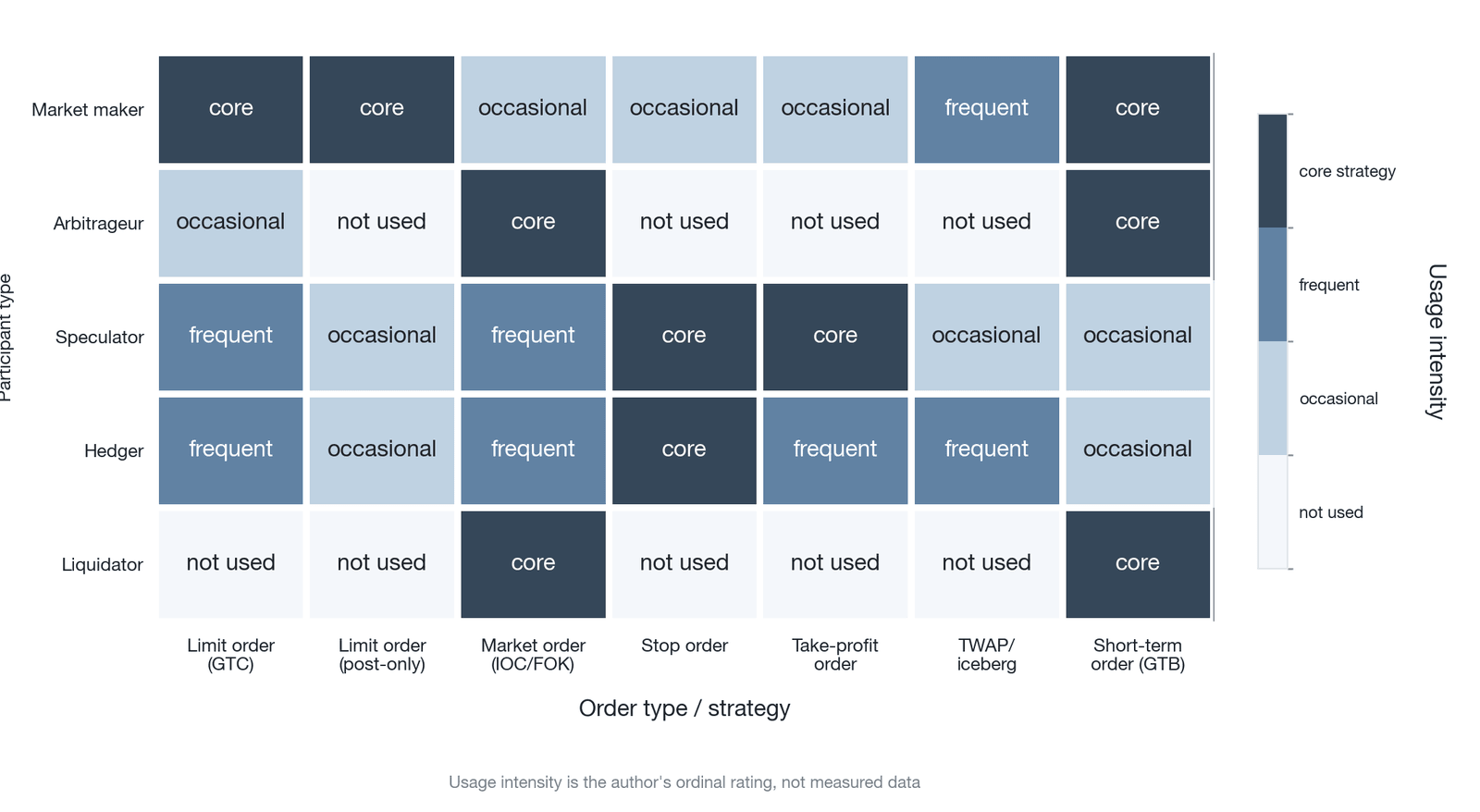
Figure 7-19. A heatmap of the order-strategy usage of different market participants (author's qualitative rating heatmap; "not used/occasionally/frequently/core" reflect the author's judgment, not empirical data; consistent with Table 7-12)
As Figure 7-19 shows: market makers' orders are highly concentrated in Post-Only limit orders and short-term orders; arbitrageurs concentrate on IOC and FOK (reflecting a need for execution atomicity); speculators' tool usage is the most dispersed (covering market orders, stop-loss orders, take-profit orders, and more, reflecting both strategic diversity and an emphasis on risk management); and liquidators concentrate on the equivalent of market orders and short-term trigger orders, reflecting their passive execution mode driven by protocol rules.
Table 7-12 systematically summarizes the order strategies of the five classes of participant along five dimensions: core objective, typical order types, reason for preference, main risks, and on-chain-specific countermeasures:
| Participant | Core objective | Typical order types | Reason for preference | Main risks and costs | On-chain-specific countermeasures |
|---|---|---|---|---|---|
| Market maker | Earn the spread and maker rebates | Post-Only limit orders, layered quoting, short-term orders | Ensure maker status, build multilayered depth | Adverse selection, inventory skew, cancellation-latency cost | Widen spreads, shorten order lifespan, perpetual + spot hedging |
| Arbitrageur | Capture risk-free spreads | Market orders, IOC, FOK | Ensure fill certainty and two-leg consistency | Slippage, naked single leg from an unfilled order | Account for gas and MEV costs, use private transaction channels |
| Speculator | Directional leveraged returns | Market orders, stop-loss orders, take-profit orders, trailing stops | Quickly express a directional view and manage risk | Sandwich attacks, stop-loss cascades, slippage amplification | MEV-resistant routing, reasonable slippage protection, choose application-chain DEXs |
| Hedger | Reduce portfolio risk exposure | Limit orders, TWAP, VWAP, Reduce-Only | Reduce market impact and prevent operational errors | Long execution cycle, missing the optimal timing | Tranched execution, cross-market hedging, funding-rate trades |
| Liquidator | Obtain liquidation rewards | Liquidation-function calls (equivalent to market orders), IOC | Driven by system rules, seizing execution priority | Gas cost of losing the competition, on-chain congestion | Gas bidding, latency racing, private liquidation channels |
Table 7-12. A comparison matrix of the order strategies of the five classes of market participant (Data source: constructed by the author)
By understanding "who says what with which tool," we can better understand the microstructure behind the decentralized perpetual futures market. Each class of participant's order choice is not random but a rational trade-off around cost, certainty, and risk exposure under their specific constraints. In the decentralized derivatives market, every order instruction is not only a carrier of value transfer but also a direct expression of each party's interests and strategic maneuvering. A systematic analysis of order flow not only helps traders devise more targeted counter-strategies but also provides important data support for DEX protocols to optimize their fee structures, improve their matching mechanisms, and guard against malicious attacks.
7.8 A three-dimensional framework for risk analysis
In the crypto derivatives market, the risk and cost of an order are not static attributes but dynamic variables determined by the execution environment. As discussed earlier, the slippage of a simple market order may differ by hundreds of times between a normal market and an extreme crisis, and the MEV risk it faces differs starkly between a centralized exchange and a fully on-chain decentralized exchange. To comprehensively assess the potential risks in trade execution, we need to go beyond single-dimensional consideration. This section integrates the three dimensions of order type, market state, and execution architecture into a unified analytical framework, providing traders with a practical tool for decision-making in complex market environments.
7.8.1 Defining the three dimensions
The formation of trading risk is a multivariable, interactive process. In this three-dimensional analytical framework, each dimension represents a major driver of risk, and the cross-combination of the three determines the ultimate risk level.
Dimension one: order type (microstructure role). The order type determines the role the trader plays in market microstructure: the limit order, as a liquidity provider, has as its core risks adverse selection and execution uncertainty—just as Copeland and Galai (1983) argued that "a limit order is equivalent to giving the market a free option" [4] (the full mechanism of this causality appears in Section 7.1.3); the market order, as a consumer, mainly bears market-impact cost and slippage risk; and the stop-loss market order is the most distinctive, as it may encounter a liquidity vacuum when triggered and even become a catalyst for a liquidation cascade (see Section 7.2).
Dimension two: market state (macro liquidity environment). The market state reflects the macro liquidity environment and is generally divided into three types—normal, high-volatility, and extreme-crisis: under a normal state, order-book depth is ample and spreads are tight; as the state evolves toward high volatility and then extreme crisis, liquidity becomes thin and fragile, and risk exhibits nonlinear, more-than-proportional amplification. As cited in Section 7.1.4, Kaiko Research (2025) measured that under extreme conditions order-book depth plunged by more than 90% and market-order slippage spiked from a few basis points to 5% or even 10% [10].
Dimension three: execution architecture (underlying infrastructure). The differences in execution architecture determine the transmission path and ultimate impact of risk: the CEX has extremely low latency (sub-millisecond) and zero order cost, but its opacity may conceal counterparty risk; the fully on-chain protocol has the highest transparency and censorship resistance, yet faces significant MEV risk due to high gas costs, slow block confirmation, and a public mempool; and the application-chain DEX (such as Hyperliquid and dYdX v4) seeks a balance between the two through a sovereign, customized blockchain [21] (the full comparison of the three architectures appears in Section 7.6.1).
These three dimensions together constitute a three-dimensional risk space, as shown in Figure 7-20. In this three-dimensional coordinate system, the X-axis is the order type, the Y-axis is the market state, and the Z-axis is the execution architecture, and any order can be located by its three-axis coordinate to determine its risk level. The color gradient in the figure indicates that risk does not grow linearly as the coordinate moves, but may exhibit a more-than-proportional amplification effect when all three dimensions trend toward the extreme simultaneously. Two caveats apply. First, the "more-than-proportional" pattern rests mainly on the slippage-depth pairing observed in a few extreme events such as October 2025; it still lacks a linear-superposition baseline rigorously defined within the framework, so it should be treated as an empirical observation awaiting testing against more cross-event evidence rather than a proven law. Second, the three dimensions are not fully orthogonal—the execution architecture already endogenizes most of the risk drivers of order type and market state, so the framework more closely resembles a hierarchical structure of "architecture as the main factor, with order type and market state as moderating factors," and the three-dimensional coordinate system is merely an approximation for ease of visualization. For example, the risk level of a stop-loss market order executed through a fully on-chain DEX in an extreme crisis far exceeds the simple sum of the three single-dimensional risks.
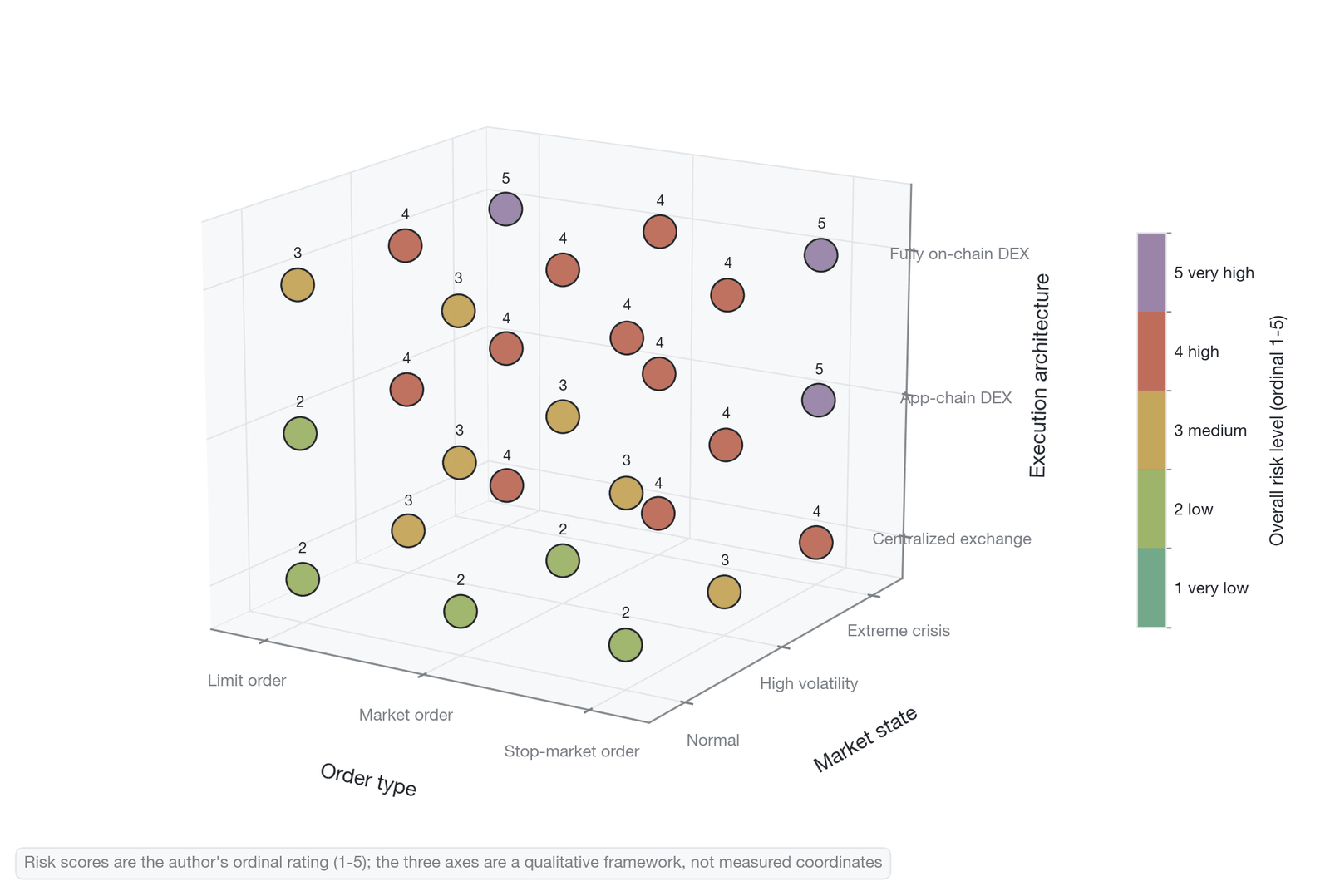
Figure 7-20. A three-dimensional analytical framework for trading risk (author's composite risk-rating 3D scatter; the ordinal 1–5 reflects the author's composite judgment, not empirical data; sources: Ali 2025 [9], Copeland & Galai 1983 [4], EigenPhi [19], dYdX Foundation [21][22])
7.8.2 Applying the three-dimensional risk matrix
To show more intuitively how these three dimensions interact and affect the ultimate execution risk, we can map the three-dimensional space onto a concrete risk matrix. Table 7-13 details the specific risk characteristics that different order types face under various market states and execution architectures.
| Order type | Market state | Centralized exchange | Fully on-chain DEX | Application-chain DEX |
|---|---|---|---|---|
| Limit order | Normal | Low adverse-selection risk | Medium adverse-selection risk | Low-to-medium adverse-selection risk |
| High volatility | High adverse-selection risk | Very high adverse selection + costly cancellation | High adverse selection + cancellation latency | |
| Extreme crisis | Order may fail to fill | Fails to fill + cancellation fails due to network congestion | May fail to fill | |
| Market order | Normal | Low slippage | Medium slippage + potential MEV risk | Low-to-medium slippage, lower MEV risk |
| High volatility | Medium slippage | High slippage + high MEV exposure | Medium slippage | |
| Extreme crisis | Very high slippage | Extreme slippage | High slippage | |
| Stop-loss market order | Normal | Low trigger slippage | Medium trigger slippage + oracle latency | Low-to-medium + oracle latency |
| High volatility | Medium trigger slippage | High trigger slippage + oracle latency | Medium + oracle latency | |
| Extreme crisis | High trigger slippage + may cause a cascade | Extreme slippage + risk of trigger failure | High trigger slippage + may cause a cascade |
Table 7-13. The three-dimensional risk matrix from the user's perspective (Note: order-of-magnitude reference for the qualitative risk levels in the table: "low slippage": <10 bps; "medium slippage": 10–50 bps; "high slippage": 50–200 bps; "very high/extreme slippage": >200 bps. "Low adverse-selection risk": market-maker spread <5 bps; "high adverse-selection risk": spread widening to >20 bps. These values are the typical order of magnitude for mainstream trading pairs under the corresponding market state; the specific values vary by underlying, time period, and platform.) (Data source: compiled by the author)
Analyzing this matrix, we can identify several key regularities.
Under a normal market state, the CEX has a clear advantage in execution efficiency and cost, especially for market orders and stop-loss orders, whose low slippage and instant triggering are difficult for on-chain protocols to match. On a fully on-chain DEX, however, even in the normal state, a market order must bear medium slippage and potential MEV risk, and a limit order must pay a gas fee when canceled. The application-chain DEX performs close to the CEX in the normal state, but oracle latency remains an inherent constraint on conditional-order triggering.
When the market enters a high-volatility state, the risk exposure of on-chain protocols increases sharply. High cancellation costs and network congestion make it difficult for market makers to adjust their quotes quickly, resulting in very high adverse-selection risk. At the same time, MEV searchers are more active in this environment, and market orders face a very high probability of being sandwich-attacked. The application-chain DEX shows a degree of resilience in this state: its lower cancellation cost and faster confirmation speed mitigate these risks to some extent, but it still cannot entirely eliminate the stop-loss-triggering lag caused by oracle latency.
Most noteworthy is the performance under an extreme-crisis state. At this point, all execution architectures face challenges, but the form the risk takes differs. On a CEX, the slippage of a market order may reach a very high level, and the mass triggering of stop-loss orders may become a catalyst for a liquidation cascade—precisely the concrete manifestation of the procyclicality of cross-margin in the October 2025 liquidation cascade described by Ali (2025) [9]. On a fully on-chain DEX, the situation can become extremely severe: a market order may face enormous slippage, and a stop-loss order, owing to oracle-update latency and network congestion, may even face the risk of trigger failure. This nonlinear widening of the "intent-execution gap" during a crisis is a systemic risk that traders must fully recognize. Especially worth guarding against is the correlated failure mode in which all protective layers fail simultaneously: in an extreme crisis, a stop-loss order fails to fill at an acceptable price because of a liquidity vacuum, the liquidation engine is delayed because its processing queue is overloaded, and the oracle price feed lags the actual market price because of latency in the underlying data source itself. When these three lines of defense fail at once, a trader's position can persist at a level far beyond the liquidation price, producing bad debt that exceeds the margin. At this point the insurance fund is called upon to absorb the bad debt; and if the insurance fund is exhausted, the protocol generally activates the auto-deleveraging (ADL) mechanism, forcibly closing the corresponding positions of the profitable side to digest the loss. This comprehensive failure of defense-in-depth is rare, but it is precisely the extreme tail scenario that systemic-risk assessment must consider.
7.8.3 Practical implications for risk management
The three-dimensional risk framework is not merely a theoretical model; it can also provide concrete guidance for a trader's actual operations. Based on the analysis above, we can draw the following practical implications for risk management.
There is no universally "optimal" execution architecture, only the architecture "best suited" to a specific scenario. Traders should choose an execution platform according to their own strategic needs, order size, and tolerance for different types of risk. Under a normal market environment, a high-frequency trader pursuing extremely low slippage may lean toward a CEX; whereas for a trader who highly values self-custody of funds and censorship resistance, a fully on-chain protocol is the preferred choice. The application-chain DEX offers a highly attractive option for those traders who wish to find a compromise among speed, cost, and decentralization. This judgment echoes the core argument of Chapter 5 regarding the "impossible trinity": every architecture choice is a specific trade-off among performance, decentralization, and security.
One must recognize the nonlinear character of risk growth. As discussed in Section 7.8.1, from a normal market to high volatility and then to extreme crisis, slippage and adverse-selection risk amplify nonlinearly and more than proportionally, rather than increasing proportionally. When devising a strategy, therefore, a trader cannot backtest based only on normal-market parameters but must incorporate the nonlinear risk under extreme conditions. As discussed in Chapter 1 with the concept of "risk-surface transformation," high-frequency variable shocks are the theoretical basis for the nonlinear amplification of risk.
At the operational level, the following principles deserve special attention. For large trades, whatever platform they are executed on, it is strongly recommended to use algorithmic orders such as time-weighted average price or volume-weighted average price for splitting, so as to effectively reduce market impact and signal leakage. Stop-loss orders must be used with extreme care; never "set and forget." When using stop-loss orders in an on-chain environment, one must fully understand the inherent lag brought by oracle latency and block confirmation. Traders should treat MEV loss as an implicit trading cost and include it when assessing a strategy's profit and loss. By diversifying asset allocation across the CEX and on-chain protocols, one can simultaneously hedge the trust risk of centralized platforms and the technical risk of decentralized protocols, achieving more robust overall risk management. However, the diversification strategy itself also introduces new risks: cross-platform rebalancing operations carry latency (especially during a crisis, when cross-chain transfers and exchange withdrawals may lag severely), capital efficiency declines because funds are dispersed, and in extreme conditions multiple platforms may experience liquidity depletion or technical failure simultaneously, weakening the expected protective effect of diversification.
The three-dimensional framework above analyzes the static risk characteristics of a single order in a specific environment. In an actual market, however, risk evolves dynamically: thousands upon thousands of orders pour into the market as a continuous flow, and the orders of different participants intertwine, superimpose, and hedge one another. To understand this dynamic process, one must rise from the static analysis of a single order to the dynamic examination of order flow.
7.9 Order-flow analysis
If a single order is a "word" in the language of trading, then a continuous order flow is a sequence composed of these orders. The information content of order flow and its compositional structure fundamentally determine a market's price-discovery efficiency, the quality of its liquidity, and the distribution of profit among different participants. This section transitions from the static analysis of a single order to the dynamic examination of order flow, establishing a conceptual bridge to understanding the market's information ecosystem and laying the groundwork for the next chapter's discussion of the order book that order flow aggregates into.
7.9.1 The composition of order flow
The order flow in a market is not a homogeneous whole but a composite structure formed by the confluence of different sources. Each source represents the trading intent of a specific participant, carries a different type of information, and produces a distinctive impact on market microstructure. We can classify these order flows into four main types, as shown in Figure 7-21.
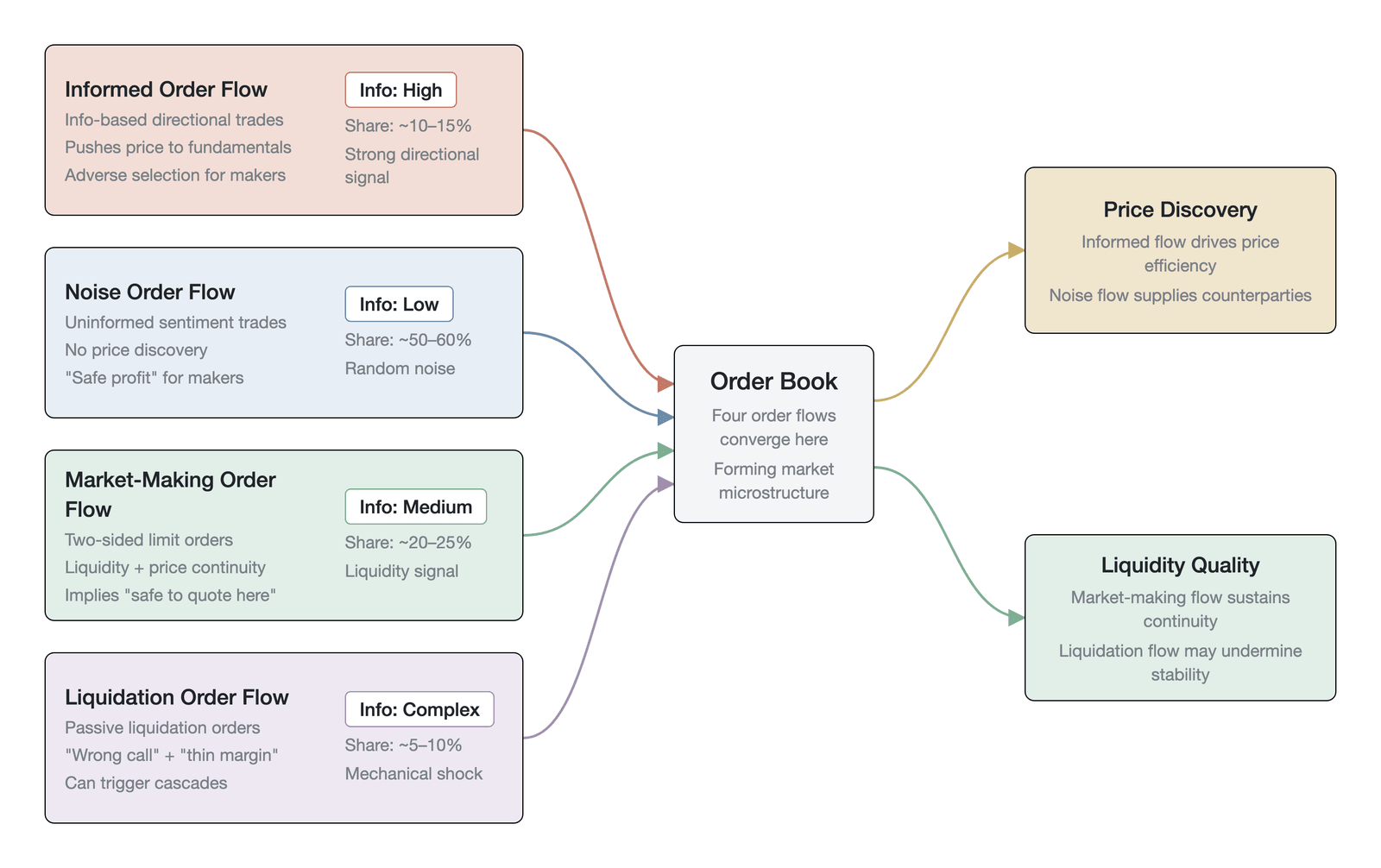
Figure 7-21. The four sources of order flow and their information content (illustration of the information content of the four classes of order flow: the shares of about 10–15% / 50–60% / 20–25% / 5–10% are the author's order-of-magnitude estimates, not empirical, and are affected by the macro cycle; per Easley et al. 2012 VPIN [29], Copeland & Galai 1983 [4], Ali 2025 [9])
Figure 7-21 divides order flow into four classes—informed, noise, market-making, and liquidation—in descending order of information content; the characteristics of each are analyzed in turn below.
Informed order flow is initiated by traders who possess information not yet fully priced into the market. These traders make directional bets based on their informational advantage, and their order flow has extremely high information content. The PIN/VPIN literature of market microstructure (Easley et al.) estimates that in a typical mature market, informed order flow accounts for about 10% to 15% of total order flow, but its influence on price far exceeds its share by count [29]. Informed order flow is the core force driving price toward fundamental value, promoting the market's price-discovery efficiency. For the market makers who provide liquidity, however, informed order flow is the direct source of adverse-selection risk (the mechanism by which market makers accordingly widen the bid-ask spread to compensate for potential losses appears in Section 7.1.3).
Noise order flow comes from participants who lack an informational advantage and trade on the basis of emotion, liquidity needs, or mistaken beliefs. This class of order flow has extremely low information content, generally manifesting as random buying and selling that does not exert a long-term directional push on price. Yet noise order flow plays an important role in the market ecosystem: it provides market makers with a relatively safe counterparty and is the primary source of their spread profit, thereby indirectly supporting the market's overall liquidity. In the crypto derivatives market, because of the heavy participation of retail speculators, the share of noise order flow is generally higher than in traditional equity markets; the author's preliminary order-of-magnitude estimate, based on public data, is about 50% to 60% of total order flow. This ratio, however, carries a high degree of methodological uncertainty and depends heavily on the macro cycle: in a bull market, retail speculative activity surges and the noise-flow share may rise significantly; in a bear market, retail participation ebbs and the share contracts sharply. In addition, the original study of the PIN model by Easley et al. (2012) [29] targeted the U.S. equity market, and directly transplanting its informed-flow ratio to the crypto perpetual futures market requires caution, because the two markets differ fundamentally in participant composition, information-propagation speed, and regulatory environment. Although the precise figure is hard to determine, the higher share of noise flow remains an important reason for the relatively high market-making profit margin in this market.
Market-making order flow consists mainly of the two-sided limit orders submitted by market makers, estimated to account for about 20% to 25% of total order flow in mainstream trading pairs (based on the publicly disclosed market-share data of market makers on top exchanges). This class of order flow does not itself contain strong directional information; its core function is to provide liquidity and maintain price continuity. If market-making order flow conveys any information, it is that "market makers regard providing liquidity at the current price level as relatively safe." When market makers perceive an increase in market risk (for example, anticipating an imminent surge of informed order flow), they quickly withdraw or adjust their quotes, and the sudden widening of the bid-ask spread and the sharp drop in order-book depth themselves constitute a strong signal of a change in market state.
Liquidation order flow is a class distinctive to, and extremely important in, the crypto derivatives market. It consists of passive orders forcibly triggered by the protocol's risk engine when a trader's margin is insufficient, generally entering the market in the form of market orders. The information content of liquidation order flow is quite complex: it may merely reflect a single trader's poor leverage management (a purely mechanical trigger, with no directional information), or it may hint at a reversal of the market trend that has caught large numbers of traders on the wrong side. A liquidation cascade, moreover, is generally not confined to a single market: the forced selling pressure produced by a large-scale liquidation of BTC perpetual futures spills over to related assets such as ETH and SOL, triggering a cross-asset "correlation spike" and in turn setting off liquidation cascades in those assets themselves, forming a cross-market systemic contagion. More critically, large-scale liquidation order flow produces a strong mechanical price impact and may even trigger a chain of liquidations (a liquidation cascade), undermining the stability of market liquidity [9]. During the normal operation of a typical perpetual futures market, liquidation order flow is estimated to account for about 5% to 10% of total order flow (extrapolated from the frequency of on-chain-observable liquidation events), but in extreme conditions this ratio may spike sharply, becoming the core force dominating the market's short-term movement [9].
7.9.2 Order-flow toxicity and VPIN
Having understood the composition of order flow, the core challenge facing market makers and quantitative traders is how to assess in real time the information content of incoming order flow—the so-called "order-flow toxicity." Highly toxic order flow means that informed traders are actively entering, and if market makers do not adjust their strategy in time, they will face serious adverse-selection losses.
VPIN is a classic indicator for measuring order-flow toxicity, proposed by Easley, Lopez de Prado, and O'Hara (2012). Its core intuition is that when buyer-initiated volume and seller-initiated volume exhibit a significant and sustained imbalance over a short period, it very likely means that informed traders are actively building positions using their informational advantage [29].
VPIN is computed as follows: total volume is divided equally into volume buckets, each containing a fixed volume . For the -th bucket, a bulk-classification algorithm divides the volume into buyer-initiated volume and seller-initiated volume . VPIN is defined as:
where is the total volume within the window, so VPIN falls in the interval . This volume-based rather than time-based sampling method can capture microstructural anomalies that are hard to detect with traditional time-period-based data. When VPIN approaches 1, it indicates that the order flow is almost entirely one-directional and toxicity is extremely high; when it approaches 0, it indicates that buying and selling are roughly balanced and toxicity is low. In practice, a sharp rise in VPIN often precedes large market swings, so it is widely used as an early-warning indicator.
However, one must be especially cautious when applying VPIN or similar indicators in the perpetual futures market. This is because order-flow imbalance in the perpetual futures market may arise not only from informed traders' directional bets but also from a liquidation cascade. When large numbers of long positions are forcibly closed, an enormous volume of sell market orders suddenly emerges, which appears in the data as a significant seller imbalance—highly similar in feature to "informed traders shorting heavily." In reality, however, these liquidation orders are "forced to sell" and contain no predictive information about future prices; they are mechanical, not informational.
Accurately distinguishing information-based toxic flow from mechanism-based liquidation flow is key to high-frequency trading strategies and market-making strategies in perpetual futures. Research by Bieganowski and Ślepaczuk (2026) further shows that by analyzing the microstructural features of order-flow imbalance (such as the duration of the impact and the accompanying pattern of OI changes), one can distinguish these two different kinds of order flow to some extent [7]. Later chapters further explore how market makers quantify and manage the information content of order flow (see the "toxic-flow spectrum" framework in Chapter 19); this section only establishes the basic recognition.
7.9.3 The distinctive signals of perpetual futures order flow
Compared with the traditional spot market, the order flow of perpetual futures carries some distinctive signals derived from its derivative mechanisms. These signals offer the keen observer valuable clues for predicting short-term price dynamics.
Because perpetual futures allow high-leverage trading, traders' liquidation prices tend to cluster in specific price ranges, forming so-called liquidation-price clusters. In an on-chain environment, these liquidation prices are even publicly visible. When the liquidation prices of large numbers of positions cluster near the current price, a potential zone of concentrated risk forms, as shown in Figure 7-22.
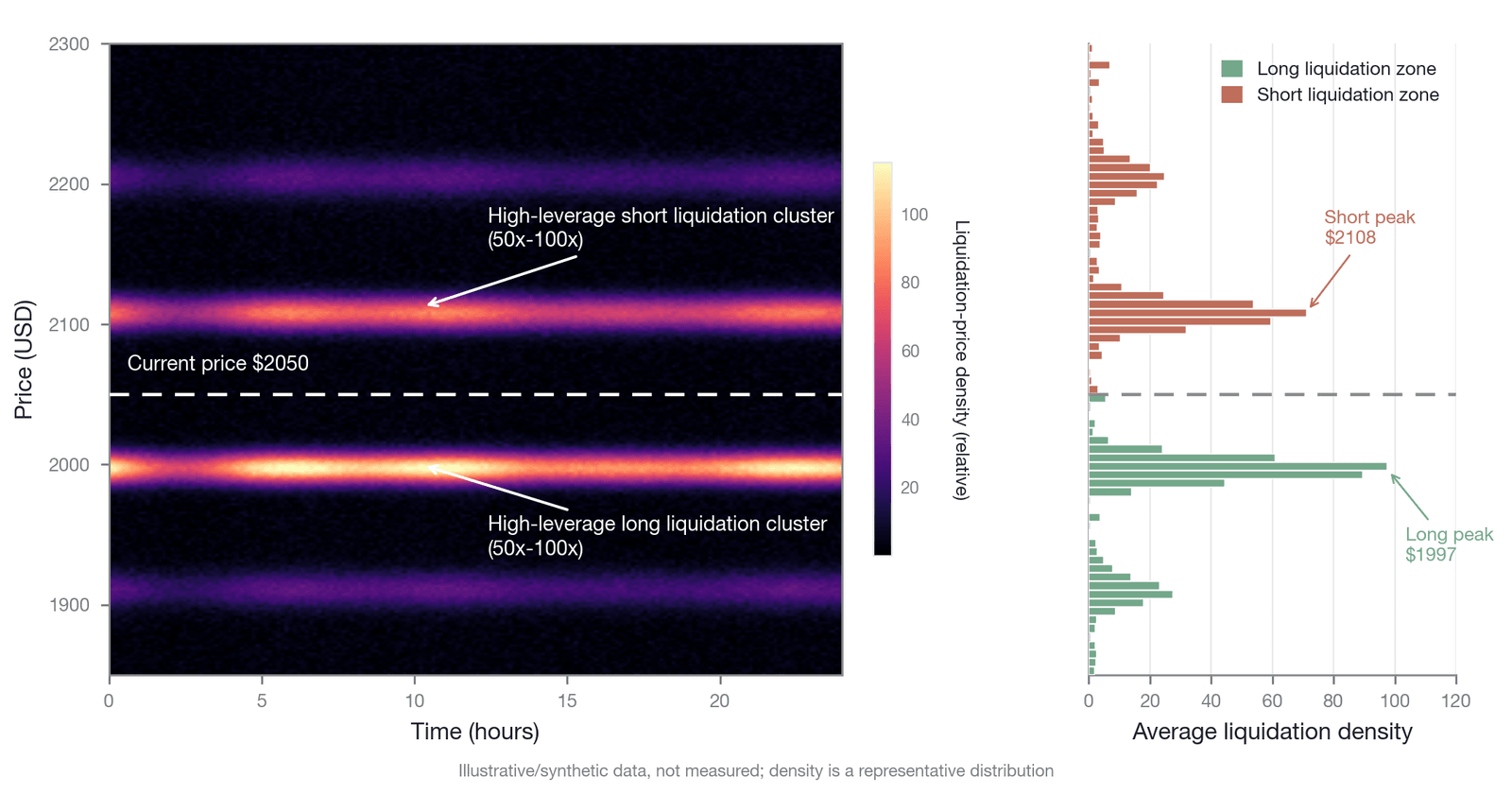
Figure 7-22. A heatmap of liquidation-price clusters (conceptual illustration: $2,050/$1,997/$2,108 and the like are synthetic representative values, not empirical; the distribution pattern is per Ali 2025 [9] and public statistics from CoinGlass/Bybit/Binance)
A liquidation-price cluster is a signal with a strong self-reinforcing property. It signals to the market: "if the price reaches this level, it will trigger a large number of forced market orders." When enough participants observe this signal, speculative capital may strategically push the price toward the cluster (the so-called deliberate triggering of stop-losses or deliberate triggering of liquidations), in the hope of setting off a liquidation cascade and profiting from it. The triggering of a liquidation cascade, however, does not depend solely on deliberate manipulation by large players: as the price approaches a publicly visible liquidation cluster, panic-driven early exits (traders proactively selling to avoid being liquidated) accelerate the price's move toward the liquidation zone, forming a self-fulfilling prophecy. The real-time spread of social media further amplifies this effect—the wide dissemination of liquidation heatmaps makes the liquidation zone common knowledge, accelerating herd behavior and increasingly blurring the boundary between deliberate hunting and the spontaneous cascade caused by collective panic. Methodological clues for distinguishing a deliberately manipulated trigger from a natural swing touching a liquidation cluster include: anomalous order-flow patterns (whether large one-directional orders inconsistent with normal trading activity appear before the trigger), the price-recovery shape (deliberate manipulation is generally accompanied by a rapid V-shaped reversal after the trigger, whereas a trend-driven trigger shows a sustained decline), and the pattern of change in open interest (a deliberate manipulator has generally established a reverse position before the trigger, so the change in OI exhibits a special temporal relationship with the price direction). This fragility, brought by the transparency of the mechanism design, significantly affects the short-term microstructure of the perpetual futures market and is a concrete manifestation, at the order-flow level, of the "transparency-fragility paradox" discussed in Chapter 4.
The anticipatory trading behavior around funding-rate settlement (whose mechanisms of anchoring to spot and settling every 8 hours appear in Section 7.4.3 and Chapter 10) constitutes another class of distinctive signal. Around the moment of funding-rate settlement, order flow often exhibits an observable systematic pattern, reflecting traders' expectations of the direction and magnitude of the rate. For example, if large amounts of short-position-building order flow suddenly appear just before a funding-rate settlement, this may mean that the market broadly expects the next period's funding rate to be positive (longs pay shorts), so speculators are "positioning in advance" to collect the rate. By analyzing the order-flow dynamics before and after settlement, one can infer the trade-off strategies market participants are making between directional gains and rate gains.
The direction of order flow, paired with changes in open interest, can provide a richer signal than a bare price rise or fall—this is precisely the informational value embedded in changes in open interest. An increase in open interest means new capital is entering the market to establish positions; a decrease means existing positions are being closed. Cross-analyzing the price direction with the change in open interest can distinguish four combination patterns with different market implications.
| Price direction | OI change | Market implication | Signal strength |
|---|---|---|---|
| Up | Increase | New long capital actively building positions | Strongly bullish |
| Up | Decrease | Short covering (shorts closing) driving the rise | Weakly bullish |
| Down | Increase | New short capital actively building positions | Strongly bearish |
| Down | Decrease | Longs closing (long stop-losses) driving the decline | Weakly bearish |
Table 7-14. Interpreting the signals of price direction and changes in open interest (Data source: compiled by the author)
The most noteworthy contrast in Table 7-14 is the difference between "up + OI increase" and "up + OI decrease": the former indicates that new long capital is actively entering, constituting a strongly bullish signal; the latter merely reflects short covering, with weak upward momentum. Likewise, "down + OI increase" indicates that new short capital is entering and is a strongly bearish signal, whereas "down + OI decrease" merely reflects long stop-losses, with limited downward pressure. This distinction has practical value for judging the persistence of a price movement.
In the 24/7, high-leverage perpetual futures market, this interaction between OI and order flow changes more rapidly and violently. Especially during a liquidation cascade, a sharp drop in OI accompanying a one-directional price plunge is a typical feature of "mechanical volatility" (rather than "informational volatility") (see the detailed analysis in Chapter 22).
7.9.4 From orders to the order book
In this chapter, we have deconstructed the "words" of the trading language—the order—in detail. We have explored the dual function of an order (trading and signaling), the strategic implications of different order types, the three-dimensional extension that perpetual futures confer on orders, and how the underlying execution architecture reshapes the physical properties of orders. We have seen that even the simplest market order or limit order conceals complex maneuvering and trade-offs behind it.
A market, however, is not composed of isolated orders. As this section has shown, thousands upon thousands of orders carrying different intents from different participants converge to form a continuous order flow. These order flows interact, match, or rest within the matching engine, ultimately aggregating into a real-time-updated data structure—the order book.
The order book is "the real-time record of the market's conversation." Its state at every microsecond is the cumulative result of all prior order submissions, cancellations, fills, and liquidations. The shape, depth, and buy-sell asymmetry of the order book, and its resilience when struck by new orders, embed rich information about the market's current liquidity conditions and future price direction. The next chapter raises the line of sight from the level of "words" and "sentences" to that of "discourse," dissecting the structural dynamics of the order book and establishing a complete analytical framework for understanding the evolution of market microstructure.
7.10 Chapter summary
The order is the most basic building block of market microstructure and the only interface through which a trader interacts with the market. In the highly complex, round-the-clock, and strategically charged environment of the crypto derivatives market, understanding the meaning of an order is a precondition for every participant seeking to build an effective strategy. This chapter has systematically deconstructed the concept of the "order," establishing for the reader—from several core perspectives—an analytical framework for mastering this fundamental toolkit of trading.
The foundation of understanding microstructure lies in recognizing that the order is a signal. While every order performs its surface "trading function," it inevitably also exercises a "signaling function," leaking to the market clues about the submitter's urgency, capital base, and information content. The choice of order type is, in essence, the process by which a trader finds the optimal trade-off position between "execution certainty" and "information leakage"; and it is precisely by reading these signals that market makers manage adverse-selection risk, which constitutes the microfoundation of bid-ask spread formation [4].
The emission of a signal, however, is only the starting point. Between a trader's original intent and the final fill outcome lies an intent-execution gap composed jointly of slippage, latency, MEV, information leakage, and liquidation risk. The width and composition of this gap differ fundamentally across execution architectures: on a centralized exchange, the gap is generally narrower but contains a hard-to-quantify implicit risk of information exploitation; on an on-chain protocol, the gap may be wider, but every component of it is transparent and auditable. Especially worth guarding against is that, under an extreme-crisis state, this gap undergoes a sharp nonlinear widening [10]—a tail event that risk management must guard against.
Building on this, the distinctive mechanisms of perpetual futures further intensify the complexity of order decisions. Order decisions in the traditional spot market revolve mainly around price, quantity, and time, whereas perpetual futures add three important dimensions: leverage (every order changes the effective leverage and liquidation distance), liquidation (the complex interaction between the stop-loss order and the forced-closure mechanism), and time (the funding-rate settlement cycle creates new strategic timing). This multidimensional complexity is the microfoundation of the perpetual futures market being "simple to operate but complex to decide," and it is an important reason for the systematic losses of many ineffective traders [9].
At the same time, when these orders are submitted to an on-chain environment, their nature undergoes a fundamental transformation: on a centralized exchange, an order is a private expression of intent that can be canceled at any time at zero cost, but on an on-chain central limit order book, every order becomes a "public commitment" observable by the entire world. This transparency is a mechanism with both positive and negative effects: on the one hand it provides verifiable, trustless liquidity; on the other, it fully exposes the trader's strategic intent, making key levels such as the stop-loss order easy targets for sniping [20].
More fundamentally, the physical constraints of blockchain reshape the economic semantics of orders from the ground up: state-storage cost forces permanently valid orders to be replaced by orders with a lifecycle; the consensus mechanism turns cancellation from free and instant into costly and latent; oracle dependence introduces an inherent lag into the triggering of conditional orders; and discrete block time transforms continuous matching into a batch auction. Understanding how these underlying architectures change the behavioral characteristics of orders is the key entry point for understanding the distinctiveness of on-chain finance.
It is thus clear that an order is by no means merely a button on a software interface or a string of code in an API, but a complex carrier of intent, risk, and information. This chapter has completed a systematic dissection of the "words" of the trading language; the next chapter raises the perspective to the level of "sentences" and "narrative," analyzing the core data structure that order flow aggregates into—the order book—and revealing its structural dynamics, its information content, and how it drives the evolution of the entire microstructure ecosystem as the real-time record of the market's conversation.
References
[1] CoinGlass. (2025). 2025 annual crypto derivatives market report. CoinGlass. https://www.coinglass.com/learn/2025-annual-report-en
[2] CoinGecko. (2025). 2025 annual crypto industry report. CoinGecko Research. https://www.coingecko.com/research/publications/2025-annual-crypto-report
[3] Harris, L. (2003). Trading and exchanges: Market microstructure for practitioners. Oxford University Press.
[4] Copeland, T. E., & Galai, D. (1983). Information effects on the bid-ask spread. The Journal of Finance, 38(5), 1457–1469. https://doi.org/10.2307/2327580
[5] Glosten, L. R., & Milgrom, P. R. (1985). Bid, ask and transaction prices in a specialist market with heterogeneously informed traders. Journal of Financial Economics, 14(1), 71–100. https://doi.org/10.1016/0304-405x(85)90044-3
[6] Kyle, A. S. (1985). Continuous auctions and insider trading. Econometrica, 53(6), 1315–1335. https://doi.org/10.2307/1913210
[7] Bieganowski, B., & Ślepaczuk, R. (2026). Explainable patterns in cryptocurrency microstructure. arXiv preprint, arXiv:2602.00776. https://arxiv.org/abs/2602.00776 https://doi.org/10.48550/arXiv.2602.00776
[8] Ruan, Q., & Streltsov, A. (2022). Perpetual futures contracts and cryptocurrency market quality. SSRN Electronic Journal. https://papers.ssrn.com/sol3/papers.cfm?abstract_id=4218907 https://doi.org/10.2139/ssrn.4218907
[9] Ali, Z. (2025). Anatomy of the Oct 10-11, 2025 crypto liquidation cascade: Macroeconomic triggers, market microstructure, and systemic risk lessons. SSRN Electronic Journal. https://papers.ssrn.com/sol3/papers.cfm?abstract_id=5611392 https://doi.org/10.2139/ssrn.5611392
[10] Kaiko Research. (2025, October). When October surprise meets crypto liquidity drought. Kaiko Research. https://research.kaiko.com/insights/when-october-surprise-meets-crypto-liquidity-drought
[11] Perold, A. F. (1988). The implementation shortfall: Paper versus reality. The Journal of Portfolio Management, 14(3), 4–9.
[12] Brunnermeier, M. K., & Pedersen, L. H. (2009). Market liquidity and funding liquidity. The Review of Financial Studies, 22(6), 2201–2238. https://doi.org/10.1093/rfs/hhn098
[13] Langer, E. J. (1975). The illusion of control. Journal of Personality and Social Psychology, 32(2), 311–328. https://doi.org/10.1037/0022-3514.32.2.311
[14] Hyperliquid. (n.d.). Overview — The Hyperliquid L1. Hyperliquid Documentation. https://hyperliquid.gitbook.io/hyperliquid-docs
[15] Talos. (2025). VWAP or TWAP for crypto execution? A market impact perspective. Talos Insights. https://www.talos.com/insights/vwap-or-twap-for-crypto-execution-a-market-impact-perspective
[16] Jasiak, J., & Zhong, A. (2024). Intraday and daily dynamics of cryptocurrency. International Review of Economics & Finance, 96(Part B), 103658. https://doi.org/10.1016/j.iref.2024.103658 https://www.sciencedirect.com/science/article/pii/S1059056024006506
[17] Genet, R. (2025). Deep learning for VWAP execution in crypto markets: Beyond the volume curve. arXiv preprint, arXiv:2502.13722. https://arxiv.org/abs/2502.13722 https://doi.org/10.48550/arXiv.2502.13722
[18] Adrian, T., & Shin, H. S. (2010). Liquidity and leverage. Journal of Financial Intermediation, 19(3), 418–437. https://doi.org/10.1016/j.jfi.2008.12.002
[19] EigenPhi. (2025). Exclusive data reveals that sandwich attacks on Ethereum have waned. Cointelegraph Research. https://www.tradingview.com/news/cointelegraph:fa12ba092094b:0-exclusive-data-from-eigenphi-reveals-that-sandwich-attacks-on-ethereum-have-waned/
[20] Flashbots. (2024). Publishing Flashbots Protect and MEV-share data. Flashbots Collective. https://collective.flashbots.net/t/publishing-flashbots-protect-and-mev-share-data/3087
[21] dYdX Foundation. (n.d.). Intro to dYdX Chain architecture. dYdX Documentation. https://docs.dydx.exchange
[22] dYdX Foundation. (n.d.). Short-term vs stateful orders. dYdX API Integration Trading Documentation. https://docs.dydx.exchange/api_integration-trading/short_term_vs_stateful
[23] Chainlink. (n.d.). Data feeds — Using data feeds. Chainlink Documentation. https://docs.chain.link/data-feeds
[24] Commodity Futures Trading Commission. (2023, January 9). CFTC charges Avraham Eisenberg with manipulative and deceptive scheme to misappropriate over \$110 million from the Mango Markets exchange [Press Release No. 8647-23]. https://www.cftc.gov/PressRoom/PressReleases/8647-23
[25] Budish, E., Cramton, P., & Shim, J. (2015). The high-frequency trading arms race: Frequent batch auctions as a market design response. The Quarterly Journal of Economics, 130(4), 1547–1621. https://doi.org/10.1093/qje/qjv027
[26] Injective Labs. (n.d.). Injective exchange upgrade: A novel order matching mechanism. Injective Blog. https://injective.com/blog/injective-exchange-upgrade-a-novel-order-matching-mechanism
[27] Paradex. (n.d.). Contract specifications — Maximum number of open orders. Paradex Documentation. https://docs.paradex.trade
[28] Usman, A. (2025). 19 security pitfalls in on-chain order books. Hacken Insights. https://hacken.io/insights/order-book-security-vulnerabilities/
[29] Easley, D., Lopez de Prado, M., & O'Hara, M. (2012). Flow toxicity and liquidity in a high-frequency world. The Review of Financial Studies, 25(5), 1457–1493. https://doi.org/10.1093/rfs/hhs053