177 years ago, the birth of the standardized delivery futures contract shifted pricing power over agricultural commodities from a fragmented network of spot markets to a centralized exchange. 177 years later, perpetual futures — synthetic derivatives with no expiration date — have become the highest-volume financial product in crypto markets, with average daily notional turnover reaching the scale of hundreds of billions of dollars. For the major crypto assets, perpetual futures are already the dominant force in price discovery. Now consider a counterfactual history: what if, in 1848, the Chicago Board of Trade had launched not delivery futures but perpetual futures on grain? How would history have differed? With no expiration date, farmers and buyers would no longer be troubled by the roll costs of quarterly contracts; with around-the-clock trading, participants across the world's time zones could trade at any moment; with a funding rate mechanism, the perpetual price would be automatically anchored to spot without the complex logistics of physical delivery; and with global access, anyone in the world with a communications connection could take part. In 1848 there was no internet, no blockchain, and no global communications network, so perpetual futures were technically impossible. Today, however, all of these technological preconditions are in place [1].
The previous two chapters diagnosed the current state of the perpetual futures market. Chapter 25 used a five-dimensional model of market quality to characterize its asymmetric profile — strong on offense but weak on defense — and Chapter 26 analyzed the extent to which regulation can repair these defensive deficiencies. The central question of this chapter is the following: if we set these constraints aside for the moment, and if the defensive deficiencies are progressively repaired while the offensive advantages are fully released, where does the ultimate potential of perpetual futures as a financial instrument lie? Can it transcend crypto-native assets to become a general-purpose global pricing infrastructure? When perpetual futures on any asset can be traded by anyone, anywhere, at any moment, what happens to global asset pricing? The core mechanism of perpetual futures, funding rate anchoring, does not depend on any special properties of the underlying asset; it is a general-purpose mechanism for generating synthetic exposure [2]. In his theory of macro markets, Robert Shiller argued that derivatives markets should be created for all important economic variables so that risk can be shared more efficiently [3]. Perpetual futures may be precisely the suitable mechanism for realizing this vision, because they are a low-friction instrument for synthetic exposure. When a faster, more continuous, and more accessible pricing venue emerges, the pricing power of incumbent venues comes under structural pressure to migrate. The speed and limits of this migration depend on the new venue's ability to close the trust gap and on the progress of institutional recognition.
This chapter explores the possibilities and boundaries of perpetual futures as a general-purpose pricing layer through three progressively more ambitious thought experiments. The first examines the world's largest market, foreign exchange, and considers how foreign exchange perpetual futures could address structural inefficiencies such as fragmented trading sessions, settlement delays, and access barriers, while confronting the ultimate obstacles of central bank monetary policy transmission and anti-money-laundering compliance. The second turns to equity indices, analyzing the potential of index perpetual futures as a permissionless alternative to exchange-traded funds, and building a scenario-analysis framework to examine the price-transmission thresholds at which single-stock perpetual futures move from insignificance to systemic influence. The third examines the technical feasibility and institutional obstacles of turning commodities and emerging assets into perpetual futures — from crude oil and gold to carbon credits and real estate indices, and ultimately to prediction markets as the limiting form. Through these thought experiments, we sketch four stages in the migration of pricing power: from the establishment of pricing power over crypto-native assets, to shadow pricing of traditional assets, to institutional recognition, and finally to the integration of infrastructure.
After reading this chapter, the reader will understand that funding rate anchoring, as a general-purpose mechanism for generating synthetic exposure, applies in principle to any underlying asset; will grasp the "faster, cheaper, more accessible" logic of pricing-power migration; and will see clearly the feasibility, advantages, and obstacles of an Everything Perpetual, along with the real-world boundaries drawn by its three-fold technical, institutional, and fundamental constraints. This provides the analytical foundation for the subsequent parts of the book, which take up decentralized engineering and autonomous finance.
27.1 The universality of the perpetual futures mechanism
Before developing the analysis, a methodological note about this chapter's framework is in order. There are two parallel paths for extending perpetual futures to traditional assets. The first is the centralized exchange (CEX) path: regulated centralized order-book exchanges extend the range of underlyings for perpetual futures from crypto assets to traditional assets. Examples include the tokenized equity spot products (xStocks) listed on Kraken and the tokenized equity perpetual futures that some platforms are now launching. The second is the decentralized exchange (DEX) path: permissionless on-chain protocols offer perpetual futures trading on synthetic assets through automated market makers or on-chain order books, as Hyperliquid does. The two paths share the same core principles of mechanism design — funding rate anchoring, margin management, and liquidation logic — but their execution-layer trade-offs differ sharply. The CEX path sacrifices open access in exchange for regulatory compliance, high execution speed, and deep liquidity; the DEX path sacrifices execution efficiency in exchange for permissionless global access and censorship resistance. This chapter uses the CEX order book as its primary analytical framework, because the overwhelming majority of current perpetual futures volume occurs on centralized exchanges (for the specific share, see Section 27.1.5), and because the CEX path is the more likely near-term form for turning traditional assets into perpetual futures. The DEX path is discussed throughout as a point of comparison and complement, especially in the analysis of access barriers and regulatory constraints.
In the evolution of financial infrastructure, a tool built for one narrow purpose can end up reshaping the structure of an entire market. Perpetual futures are just such an instrument, one with systemic potential. This section steps outside the specific context of crypto assets and returns to first principles to examine the core mechanism of perpetual futures: funding rate anchoring. Through this abstraction, we can see that the funding rate is essentially a general-purpose mechanism for generating synthetic exposure, one that does not depend on any special properties of the underlying asset. In principle, so long as a reliable price oracle for the underlying asset exists, this mechanism can create perpetual futures for any asset, thereby building a general-purpose pricing infrastructure that spans everything.
27.1.1 The funding rate anchoring mechanism
When we return to first principles to examine the funding rate mechanism, we must set aside for the moment the specific context of crypto assets such as Bitcoin. The core function of the funding rate is to anchor the contract price firmly to some reference price in the absence of an expiration date and without physical delivery. This anchoring is achieved through periodic funding payments between longs and shorts: when the contract price exceeds the reference price, longs pay shorts; in the opposite case, shorts pay longs. This arbitrage incentive forces the contract price back toward the reference price [1].
In practice, the funding rate typically consists of two components. The standard formula can be expressed as F = clamp(Premium, −d, d) + clamp(Interest Rate, −d, d), where the interest rate component reflects the lending spread between the quote currency and the base currency, the premium component measures the deviation between the perpetual futures' mark price and the spot index price, and the clamp function restricts the rate to within upper and lower bounds of ±d to prevent extreme swings. Centralized exchanges differ in how they implement this framework. Binance uses a volume-weighted average price method to compute the index price and settles the funding rate every 8 hours; Bybit uses a fair mark price method, smoothing the mark price through a moving-average basis; and some exchanges have raised the settlement frequency to every hour or even to continuous settlement. The theoretical analysis of Ackerer, Hugonnier, and Jermann (2025) shows that, under no-arbitrage conditions, the perpetual futures price equals the risk-neutral expectation of the spot price sampled at a random time that reflects the strength of funding rate anchoring; as the anchoring strength approaches infinity, the perpetual price converges monotonically to the spot price, and under a particular funding rate specification the two are identical [1].
This reference price is not limited to the spot price of a crypto asset. It can be any price indicator that is observable and verifiable in public markets — the euro-dollar exchange rate, the level of the S&P 500 index, or the spot price of West Texas Intermediate crude oil, for example. So long as this reference price can be reliably obtained and transmitted to the trading system, the funding rate mechanism can operate effectively. The physical properties, trading conventions, and storage costs of the underlying asset have no material bearing on the intrinsic logic of the mechanism.
The funding rate is to perpetual futures what the interest rate is to a currency swap. In both cases it is a general-purpose tool for anchoring prices, and its effectiveness does not depend on the specific object being anchored. Just as a currency swap can be applied to any two liquid fiat currencies, the funding rate mechanism of perpetual futures can be applied to any underlying asset with reliable price discovery. The simplicity and mathematical generality of this mechanism give it the potential for universality across asset classes.
27.1.2 Applicability across asset classes
If the funding rate mechanism is so broadly applicable, why are perpetual futures today confined almost entirely to crypto-asset markets? The answer lies not in any technical limitation of the mechanism itself but in a combination of historical path dependence and the prevailing regulatory environment.
Historically, the perpetual futures instrument was launched for Bitcoin by the crypto derivatives platform BitMEX in May 2016 and rapidly scaled into widespread use [2]. The crypto community was the first to adopt this convenient, roll-free instrument, and over the following years developed it into the highest-volume product in the ecosystem. This history has created a strong cognitive inertia, so that market participants often equate perpetual futures with crypto-native products.
From the standpoint of the regulatory environment, traditional asset classes such as equities, foreign exchange, and commodities all sit within highly mature and stringent regulatory frameworks. Introducing a new kind of derivative — one with no expiration date, high leverage, and no guarantee from a central counterparty — into these traditional markets faces high compliance barriers. Crypto markets, by contrast, occupied a regulatory gray zone in their early years, and this relatively permissive environment supplied the conditions necessary for the rapid iteration and development of perpetual futures.
From a pure mechanism-design perspective, however, no economic or engineering reason restricts perpetual futures to serving crypto assets alone. Indeed, some cutting-edge decentralized exchanges have begun to offer perpetual futures on foreign exchange, equities, and commodities. Although trading in these non-crypto perpetual futures remains small in scale, their existence already demonstrates the technical feasibility of extending the funding rate mechanism to traditional asset classes. This indicates that, once the regulatory environment evolves or the technical architecture can satisfy compliance requirements, no fundamental technical obstacle stands in the way of perpetual futures expanding across asset classes.
27.1.3 The economics of synthetic exposure
Another key dimension for understanding the universality of perpetual futures is the economics of synthetic exposure. In financial markets, capturing the return from an asset's price movements does not always require holding the asset physically. Owning the asset and owning a contract — that is, obtaining synthetic exposure — differ markedly in their economic consequences and in their trading friction.
Holding a physical asset typically requires purchase, custody, and safekeeping, a complex chain that necessarily involves settlement delays, delivery logistics, and possible restrictions on cross-border capital flows. Holding a contract, by contrast, requires the trader only to post a certain proportion of margin to obtain price exposure identical to that of holding the underlying asset. The advantages of this synthetic exposure are systemic: it achieves zero settlement delay and zero delivery cost, removes the geographic barriers to cross-border transactions, builds in leverage, and makes shorting as simple and direct as going long.
Among all instruments that provide synthetic exposure, perpetual futures represent the lowest-friction form. Traditional futures also provide synthetic exposure, but their inherent expiration date requires traders to roll their contracts periodically, and this roll cost constitutes a persistent trading friction. Exchange-traded funds (ETFs) likewise provide exposure, but they rely on an in-kind or cash creation-and-redemption mechanism, involve a complex system of authorized participants, and are confined to specific trading sessions. Perpetual futures eliminate these frictions: no expiration date means no roll cost, no delivery means no logistical friction, and the automatic anchoring of the funding rate ensures effective price tracking.
Within the spectrum of synthetic-exposure instruments, the contract for difference (CFD) closely resembles perpetual futures in functional terms: both have no expiration date, and both support leveraged, two-way trading. The two differ in one important respect at the level of market microstructure, however. A CFD is made by a broker acting as the sole counterparty, so that a trader's gain is the broker's loss; this concentrates counterparty risk in a single entity and gives the broker a structural incentive to manipulate quotes. Perpetual futures, by contrast, are traded through order-book matching on a centralized exchange or through an automated market maker on a decentralized exchange, so that counterparty risk is dispersed across the liquidation engine and the insurance fund system. In regulatory terms, CFDs are constrained by the retail-derivatives rules of particular jurisdictions — the United States prohibits retail CFD trading outright, and the European Union imposes strict leverage caps through MiFID II — whereas crypto perpetual futures have in practice achieved global access through on-chain protocols. The marginal innovation of perpetual futures relative to CFDs lies in two dimensions: the funding rate mechanism provides transparent, verifiable price anchoring (a CFD's quotes are determined entirely within the broker), and the decentralized implementation path removes the concentration of credit risk in a single counterparty.
In a 1993 book, the economist Robert Shiller set out a grand vision of macro markets. He argued that liquid derivatives markets should be created for all important economic variables — gross domestic product, real estate prices, and national income among them — so that these major risks bearing on human welfare could be diversified and managed more effectively [3]. Given the financial technology of the time, this vision faced enormous implementation costs. Yet perpetual futures, a synthetic-exposure instrument superior to traditional alternatives in both flexibility and friction cost, fit Shiller's macro-markets vision more closely than any other existing synthetic-exposure mechanism.
27.1.4 The concept of an Everything Perpetual
Building on the preceding analysis of the universality of the funding rate mechanism and the economics of synthetic exposure, we can construct a thought experiment about a general-purpose pricing layer. At the heart of this thought experiment is a construct that we call the "Everything Perpetual" (a term coined by the author).
Imagine a unified global trading infrastructure on which perpetual futures on Bitcoin against the dollar, the euro against the dollar, the S&P 500 index, gold, and even carbon-emission metrics all trade simultaneously. All of these contracts, spanning different asset classes, share the same stablecoin margin system, the same unified clearing mechanism, and the same governance framework. On a single seamless interface, a trader can switch in an instant from long gold to short euro to long an equity index. All of this trading proceeds continuously, around the clock, is open without distinction to every participant worldwide, and settles instantly.
This construct qualifies as a pricing infrastructure, rather than merely an efficient trading platform, because once enough participants trade on the system, the prices it generates are positioned to become one of the important reference prices for global markets. Just as the futures prices of the Chicago Mercantile Exchange have long been regarded as benchmark prices for global commodities, this Everything Perpetual platform would establish pricing power across asset classes.
There is a fundamental difference from a traditional commodity exchange, however: this perpetual-futures-based general-purpose pricing layer is permissionless. Anyone, anywhere, with an internet connection and a digital wallet can take part in this global pricing process. This means that the billions of unbanked people excluded from the traditional financial system would, for the first time, gain a channel to participate in the pricing of core global assets and to manage their own economic risks. This is the central proposition of the chapter's thought experiment, and it concerns not only gains in financial efficiency but also the reconstruction of financial power.
27.1.5 The order-book microstructure of centralized exchanges
In practice, the principal vehicle for perpetual futures is the order-book matching system of centralized exchanges. Understanding this microstructure is essential for assessing the pricing efficiency of perpetual futures.
At the level of fee structure, mainstream centralized exchanges generally adopt a maker-taker fee model. The maker, who provides liquidity to the order book, typically enjoys a lower fee or even a negative rate as an incentive, while the taker, who consumes liquidity, bears a higher fee. The economic logic of this asymmetric pricing structure is to use differentiated incentives to elicit a continuous supply of limit orders, thereby maintaining the depth of the order book and the tightness of the spread.
At the level of risk management, centralized exchanges build a multi-layered defense system to preserve the solvency of the system. The insurance fund, accumulated from liquidation gains and platform revenue, absorbs the shortfall when a liquidated position cannot be filled at the bankruptcy price or better. When the insurance fund is insufficient to cover the losses, the auto-deleveraging (ADL) mechanism ranks counterparties by profit and forcibly closes out the most profitable counterparty positions against the bankrupt position. Some exchanges also retain a socialized-loss fallback, allocating the residual loss pro rata across all profitable accounts. Together, these mechanisms form the solvency-assurance chain for perpetual futures on centralized exchanges.
Centralized exchanges also maintain a multi-tiered price system to balance different risk-management needs. The last traded price reflects the actual price of the most recent match in the order book. The mark price, typically computed as a weighted combination of the spot index price and a decaying basis, is used for profit-and-loss calculation and for triggering liquidations; its purpose is to filter out the price spikes caused by short-term manipulation. The index price aggregates a weighted average across multiple spot exchanges and serves as the anchoring benchmark for the funding rate calculation. Binance uses a volume-weighted average price method to compute the index price, whereas Bybit uses a fair mark price method, and the two methods perform differently under extreme market conditions. These design choices give the perpetual futures of centralized exchanges a marked competitive advantage in liquidity depth, execution speed, and risk-control maturity, making them the dominant form in the current perpetual futures market. As of 2025, centralized exchanges accounted for more than 90% of total perpetual futures volume (by notional turnover) [4].
27.2 The historical logic of pricing-power migration
The migration of pricing power is not a theoretical hypothesis but an objective phenomenon that recurs throughout financial history. In every major shift in market structure, pricing power moves from the old trading venue to the new one. This migration typically follows a similar logical pattern, and understanding this historical regularity is important for assessing whether perpetual futures have the potential to take over global asset pricing.
27.2.1 Three migrations of pricing power
Looking back over the development of modern financial markets, we can clearly identify three consequential migrations of pricing power.
The first migration occurred in the mid-to-late nineteenth century and marked the movement of pricing power from fragmented spot markets to a centralized futures exchange. The Chicago Board of Trade was founded in 1848 and initially traded forward (or "to-arrive") contracts; its truly landmark innovation came around 1865, when it transformed forward contracts into standardized delivery futures — unifying quantity, quality, delivery location, and delivery date, and introducing margin and formal settlement rules [5]. Before this, pricing power over agricultural commodities was dispersed across countless local spot-trading networks, and information asymmetry produced violent price swings. The advent of the Chicago Board of Trade allowed farmers and buyers to lock in future buying and selling prices in advance, giving them certainty. This standardized and centralized trading model sharply reduced information costs and price uncertainty, so that the exchange's futures prices quickly became the reference prices for the global grain market, completing the first major migration of pricing power.
The second migration took place between the 1990s and the 2010s and was characterized by the movement of pricing power from traditional open-outcry floor trading to electronic trading systems. As computing technology and communications networks spread, electronic matching platforms — exemplified by the Chicago Mercantile Exchange's Globex system and Nasdaq — gradually displaced the traditional trading floor [6]. This migration greatly increased trading speed, compressing execution time from seconds to milliseconds; it also sharply reduced the high costs of manual matching and broke the constraints of physical space, allowing investors worldwide to participate more easily in market pricing.
The third migration occurred mainly from the early 2000s into the 2020s and manifested as the movement of pricing power from traditional delivery futures to exchange-traded funds. For certain assets, particularly equity indices and gold, the trading volume of exchange-traded funds gradually surpassed that of the corresponding futures contracts (such as the Chicago Mercantile Exchange's E-mini futures on the S&P 500), making ETFs the primary tool through which retail investors and some institutional investors obtain market exposure [7][8]. The success of exchange-traded funds rests on their minimalist user experience: investors need not manage complex futures accounts and margin, and can participate simply through an ordinary securities account. Moreover, the total holding cost of an exchange-traded fund is typically lower than the roll cost of a futures contract, which further accelerated this migration.
27.2.2 The drivers of migration
The three migrations of pricing power follow a common driving logic that can be distilled into four core elements: faster (lower trading latency and higher-frequency information processing), cheaper (lower total transaction and access costs), more accessible (a broader range of participants and a lower barrier to entry), and more trustworthy (regulatory protection, depth of institutional participation, and legal certainty). In all three historical migrations, the new venue was no weaker than the old on the trustworthiness dimension, so that dimension did not become a constraint; yet it is precisely the principal weakness of perpetual futures relative to traditional markets. From standardized futures lowering search costs, to electronic matching compressing execution time to milliseconds, to exchange-traded funds turning complex exposure into a product accessible through an ordinary securities account, each migration was the result of the new venue accumulating sufficient advantage along these three dimensions. Throughout this process, resistance from incumbents delayed but could not reverse the migration; once the efficiency advantage of the new venue is sufficiently pronounced, the migration of pricing power tends ultimately to occur. Section 27.7 further analyzes how this driving logic acts specifically on the extension of perpetual futures to traditional assets.
27.2.3 The candidacy of perpetual futures
Assessed against this framework, perpetual futures hold a structural advantage on two dimensions: faster (around-the-clock continuous trading, which eliminates the price vacuum of non-trading hours) and more accessible (permissionless global access with a very low barrier to entry). On the cheaper dimension, they hold an advantage in some asset classes because they eliminate roll costs and delivery logistics. Their principal weakness lies in the trustworthy dimension: the institutional accumulation of traditional markets in regulatory protection, depth of institutional participation, and legal certainty constitutes a trust gap that perpetual futures must close. The speed at which this gap narrows will directly determine the course of pricing-power migration, and Section 27.7 develops a detailed analysis through a four-stage model.
27.3 Thought experiment I: foreign exchange perpetual futures
Foreign exchange is the largest financial market in the world, and its depth of liquidity and breadth of trading form a cornerstone of the modern international financial system. According to the Bank for International Settlements (BIS), average daily turnover in the global foreign exchange market reached about $9.6 trillion in April 2025, roughly 28% higher than in the same period of 2022 [9]. Despite its vast scale, however, this market still exhibits pronounced structural inefficiencies. This section takes foreign exchange perpetual futures as the starting point for a thought experiment, examining which problems the perpetual futures mechanism can solve when applied to the world's largest financial market, and which insurmountable institutional obstacles it would face.
27.3.1 Structural inefficiencies of the foreign exchange market
The foreign exchange market is nominally a market that operates around the clock, yet its internal structure is markedly fragmented. The first issue is the uneven distribution of liquidity across trading sessions. Liquidity is heavily concentrated in the overlapping London and New York sessions, while the Asian session is relatively thin. More critical still, during the non-trading hours of the weekend the market loses its price-discovery function entirely. When a geopolitical event or major macroeconomic data release occurs over the weekend, participants must wait for the "open" on Sunday evening or Monday morning before they can trade. This "weekend gap" constitutes a serious information-transmission delay and a structural inefficiency.
The second issue is the systemic risk created by settlement delay. The standard settlement cycle for traditional foreign exchange transactions is typically 2 days, which means that after reaching an agreement the two parties must bear 2 days of settlement risk exposure. In a market with daily volume in the trillions of dollars, this delay accumulates enormous systemic risk. Although some traditional financial markets have recently begun to shorten their settlement cycles — the U.S. equity market, for example, has shortened its cycle from 2 days to 1 day [10] — the complex network of the global foreign exchange market makes universal instant settlement a formidable challenge.
The final issue is access barriers and execution costs. For retail investors and small and medium-sized enterprises, the barrier to direct participation in the core foreign exchange market is extremely high. They can generally trade only through brokers or commercial banks, and in this "last mile" they face wide bid-ask spreads and suboptimal execution quality, bearing a disproportionate share of transaction costs.
27.3.2 The design of foreign exchange perpetual futures
If we introduce the perpetual futures mechanism into the foreign exchange market — designing, say, a euro-dollar perpetual futures contract — its core architecture would display characteristics quite different from those of traditional foreign exchange derivatives. The contract could be denominated and settled in a stablecoin, with its price anchored to the spot euro-dollar exchange rate through the funding rate mechanism. An oracle network would obtain and transmit the spot price in real time, while the funding rate could settle at an hourly or even continuous frequency.
Compared with the traditional foreign exchange futures offered by the Chicago Mercantile Exchange, foreign exchange perpetual futures eliminate the constraint of an expiration date and thus dispense with the roll operations traders must perform at expiry and the costs that accompany them. More importantly, they achieve genuine around-the-clock continuous trading and eliminate the weekend gap. At the same time, a stablecoin settlement mechanism built on a blockchain network achieves instant delivery, replacing the 2-day settlement delay of traditional markets.
From the standpoint of pricing theory, the pricing of traditional foreign exchange forwards rests on covered interest rate parity. Within the perpetual futures framework, the funding rate should, in long-run equilibrium, converge toward the risk-free interest rate differential between the two underlying currencies. This prediction is empirically testable, and it shows that the funding rate mechanism does more than anchor prices: it intrinsically reflects differences in macroeconomic variables.
27.3.3 Potential advantages
The core structural advantage of foreign exchange perpetual futures lies in their capacity for around-the-clock continuous pricing. In today's highly interconnected world, geopolitical risks and sudden events are not confined to the business hours of a traditional exchange. If foreign exchange perpetual futures achieved around-the-clock trading, a sudden event on a Friday evening could be absorbed by the market and reflected in prices within minutes, rather than waiting for an open more than 40 hours later. Such a mechanism would produce a structural leap in informational efficiency.
The instant settlement mechanism likewise has significant practical value. Instant settlement via stablecoins eliminates the 2-day settlement risk exposure, which matters greatly for the risk management of multinational corporations and large financial institutions. It reduces counterparty risk and substantially improves capital efficiency.
Moreover, undifferentiated global access gives foreign exchange perpetual futures an important dimension of financial inclusion. Around the world, billions of people live in countries or regions with strict foreign exchange controls, and they cannot freely convert into strong currencies through legal channels to protect their assets. Foreign exchange perpetual futures running on a decentralized network can provide these populations with a tool for obtaining synthetic foreign exchange exposure. The core value of such a tool lies not in speculation but in giving ordinary people a way to hedge against depreciation of their home currency, which carries considerable social value.
27.3.4 Core obstacles
Although foreign exchange perpetual futures hold clear advantages in mechanism design, their broad adoption faces powerful resistance from sovereign states and the existing financial system. The foremost obstacle is the monetary policy transmission mechanism of central banks. Central banks rely on their intervention in, and influence over, the foreign exchange market to implement monetary policy and safeguard domestic economic stability [11]. A globally mobile perpetual futures market controlled by no single jurisdiction could weaken the transmission of central bank monetary policy. Sovereign states will not lightly relinquish control over the pricing power of their currencies or over the foreign exchange market.
Anti-money-laundering compliance is another formidable obstacle. The foreign exchange market has always been a high-risk arena for cross-border capital flows and money laundering. A permissionless, decentralized foreign exchange perpetual futures platform faces enormous technical and institutional challenges in implementing adequate know-your-customer (KYC) and anti-money-laundering (AML) procedures. Regulators take a cautious stance toward financial infrastructure that cannot trace the source of funds or the identity of traders [12].
The settlement needs of the real economy also mean that perpetual futures cannot fully replace the spot market. Multinational enterprises making international trade payments require genuine transfers of currency, whereas perpetual futures can offer only a synthetic derivative of price exposure and cannot meet the need for physical delivery. The contract market and the spot market are therefore bound to coexist over the long run, with the former relying on the latter for its price anchor.
Finally, the reliability of the oracle constitutes a single point of risk at the technical level. Trading volume in the foreign exchange market is extremely large, and even a tiny deviation in an oracle's quote could be exploited by high-frequency traders, producing large arbitrage losses. Whether current oracle infrastructure possesses the stability and manipulation resistance required to support a foreign exchange derivatives market on the order of trillions of dollars remains an open question in urgent need of verification.
27.3.5 Feasibility assessment
Taking the preceding analysis together, foreign exchange perpetual futures are more likely in the near term to serve as a complement to the existing traditional foreign exchange market than as its replacement. They can play a distinctive role in filling the weekend pricing vacuum and lowering the barrier to entry for retail investors. For ordinary people in emerging markets, they offer a practical tool for hedging the risk of home-currency depreciation.
Over the longer term, if oracle technology achieves a fundamental breakthrough and the regulatory framework for decentralized finance becomes progressively clearer and widely accepted, foreign exchange perpetual futures could divert a portion of the speculative trading volume of traditional markets. Yet because the central position of central banks and sovereign governments in the monetary system is a cornerstone of the modern state, foreign exchange perpetual futures cannot fully replace the traditional foreign exchange market. The migration of pricing power will be a gradual and constrained process, finding its ultimate equilibrium in the interplay between technological innovation and institutional constraint.
27.4 Thought experiment II: equity index perpetual futures
The success of exchange-traded funds demonstrates substantial latent demand for simplified ways of obtaining asset exposure. Along this trajectory, equity index perpetual futures can reasonably be understood as the ETF's next evolutionary form. They build an around-the-clock, global, and permissionless trading environment. Inevitably, however, this innovative mechanism must confront the institutional advantages that ETFs have accumulated over time, as well as the challenge of winning regulators' acceptance.
27.4.1 The success and limits of the ETF
Since the first ETF tracking the S&P 500 index (SPY) appeared in 1993, ETFs have become one of the most successful products in the democratization of finance. By the end of 2025, global ETF assets under management approached $20 trillion (of which U.S.-listed ETFs accounted for about $13 trillion), and U.S.-listed ETFs attracted about $1.5 trillion of net inflows in 2025 alone, a record high [7]. This product structure allows ordinary investors to obtain broad market exposure at very low cost.
Despite this enormous success, the ETF mechanism retains inherent structural limits. The first is the rigidity of the trading session. SPY, for example, trades mainly during New York's regular session, from 9:30 a.m. to 4:00 p.m. Eastern Time. Participants in other time zones must passively adapt to this window, and Asian investors cannot directly participate in the pricing and trading of SPY during their own regular working hours [13]. The second is geographic and institutional barriers. Non-U.S. residents who wish to buy U.S.-listed ETFs generally must open a securities account across borders, facing burdensome compliance review and obstacles to moving funds internationally.
A more fundamental limit lies in the ETF's liquidity-creation mechanism. The arbitrage anchoring of an ETF depends heavily on the creation-and-redemption mechanism operated by authorized participants. In the primary market, these large financial institutions swap a basket of underlying securities for ETF shares, keeping the ETF's market price closely aligned with its net asset value [14]. During extreme market volatility, however, authorized participants may withdraw from market-making because of evaporating liquidity or risk considerations, causing the ETF to trade at a large premium or discount — a phenomenon analyzed in detail in Chapter 18 of this book.
27.4.2 The design of index perpetual futures
To break through these limits, on-chain equity index perpetual futures offer a wholly new mechanism design. Consider the SPX perpetual futures tracking the S&P 500 index: their core architecture typically uses a stablecoin (such as USDC) as the unit of denomination and settlement. The contract involves no actual delivery of the underlying stocks; instead, an oracle system continuously obtains the latest level of the S&P 500 index as the reference benchmark. On this basis, the funding rate mechanism substitutes for the arbitrage behavior of authorized participants, automatically anchoring the perpetual futures' trading price to the spot index price through funding exchanges between longs and shorts [15].
To display the structural differences of this design more clearly, Table 27-1 systematically compares the traditional SPY ETF with an idealized SPX perpetual futures contract across 10 core dimensions. This multidimensional comparison helps identify the dimensions on which perpetual futures hold a structural advantage and those on which they carry an inherent institutional weakness.
| Comparison dimension | SPY ETF (traditional finance) | SPX perpetual futures (on-chain finance) |
|---|---|---|
| Trading session | New York regular session (6.5 hours per day) | Around the clock, uninterrupted (24/7) |
| Global access | Geographic barriers; requires a U.S. securities account | Permissionless; requires only a crypto wallet (decentralized version) |
| Access to leverage | Depends on broker financing; constrained by regulatory margin requirements | Built into the protocol; typically 1x to 20x or higher |
| Shorting mechanism | Requires borrowing shares, with high costs and limited supply | Open a short directly, with no additional friction cost |
| Settlement cycle | Delayed settlement (T+1) | Instant settlement via smart contract |
| Holding cost | Fixed annual management fee (about 0.09%) | Dynamic funding rate (potentially much higher than the management fee) |
| Price anchoring | In-kind creation and redemption by authorized participants | Algorithmically driven funding rate arbitrage |
| Regulatory protection | Strictly regulated by the U.S. Securities and Exchange Commission (SEC) | Regulation absent or in a gray zone |
| Oracle dependence | No external price feed required | Core mechanism; highly dependent on oracle accuracy |
| Ownership attributes | Includes voting and dividend rights of the constituent stocks | Pure price exposure, with no corporate governance rights |
Table 27-1. Comparison of the core mechanisms of the SPY ETF and SPX perpetual futures (Data source: CoinDesk reporting on Kraken's tokenized equity perpetuals [15]; Schwab Asset Management report on the ETF creation-and-redemption mechanism [14]). Note: the comparison of 6.5 hours with 24/7 is a coarse-grained contrast along the trading-session dimension; assessing the actual execution cost of arbitrage across U.S. cash equities, futures, and ETFs would also require incorporating the pre-market and after-hours sessions, the CME's near-around-the-clock trading, and the authorized-participant creation-and-redemption mechanism discussed in Chapter 18
As shown in Table 27-1, SPX perpetual futures hold a structural advantage over the SPY ETF on five dimensions: trading session, global access, access to leverage, ease of shorting, and settlement speed. These advantages are not marginal improvements but stem from a fundamental difference in the underlying architecture: the synthetic-exposure mechanism eliminates the frictions of physical delivery and intermediary institutions. Yet the table also clearly reveals the institutional weaknesses of perpetual futures: the absence of regulatory protection means that investors lack legal recourse in a dispute; the loss of ownership attributes means that they cannot replace the ETF's function as a tool for long-term value investing; and the uncertainty of holding cost (a dynamic funding rate can, under extreme market conditions, far exceed an ETF's fixed management fee) adds further unpredictability to long-term holding strategies. This asymmetric profile of "strong on offense, weak on defense" runs throughout the comparison between perpetual futures and traditional financial products.
27.4.3 Potential advantages
The clearest near-term value of index perpetual futures is filling the Asian-session pricing vacuum. In the current market structure, after the U.S. equity market closes, for more than 10 hours global investors have no effective venue to price their views on changes in the U.S. macroeconomy or in corporate fundamentals. If a major geopolitical event or an emergency statement by the Federal Reserve (Fed) occurs during this window, traditional markets must wait for the New York open to release the accumulated pricing pressure. The around-the-clock nature of SPX perpetual futures can effectively fill this vacuum, so that information enters the price-discovery process the instant it arises [16].
Moreover, this mechanism greatly extends the boundaries of financial inclusion. Billions of people worldwide are constrained by local financial infrastructure and cannot easily buy U.S. ETFs. Through the SPX perpetual futures of a decentralized exchange, these groups need only an internet connection and a digital wallet to gain exposure to the world's most important equity market, which democratizes global capital allocation to a degree.
At the level of market microstructure, perpetual futures markedly reduce the friction cost of expressing a bearish view. In the traditional equity market, shorting requires locating a supply of shares and paying high borrowing fees, and this asymmetric transaction cost means that negative information often fails to be reflected promptly and fully in asset prices. The symmetric design of perpetual futures makes shorting as convenient as going long, which helps improve the price-discovery efficiency of the market as a whole.
27.4.4 Core obstacles
For all the ingenuity of their mechanism design, index perpetual futures still face insurmountable obstacles in real-world adoption. The first is the regulatory challenge. The core duties of securities regulators are investor protection and the maintenance of orderly markets, and they are highly unlikely to embrace, in the near term, an S&P 500 derivative that sits outside the traditional compliance framework. Although a decentralized exchange can, through its technical architecture, evade some direct jurisdiction, doing so also means transferring all compliance risk and counterparty risk entirely onto ordinary users [15].
The reliability of the oracle system constitutes another key technical bottleneck. During the regular U.S. equity session, perpetual futures can easily obtain real-time index quotes from data sources such as Bloomberg or Reuters. But during the long non-trading hours, the spot market ceases to operate, and the oracle can rely only on the relatively thin after-hours session or on E-mini futures prices as a reference [17]. This fragility of the data source makes perpetual futures highly susceptible to malicious manipulation during non-trading hours, and a tiny oracle deviation, amplified by leverage, could trigger a catastrophic liquidation cascade.
Another core tension is that index perpetual futures are, in essence, decoupled to some degree from the real economy. They provide pure synthetic price exposure and confer no ownership whatsoever in the underlying listed companies. This means that a holder of perpetual futures can neither exercise shareholder voting rights nor participate directly in corporate dividends. In terms of financial function, they are not fully equivalent to an ETF that represents ownership of real assets, and this limits their potential to become the preferred tool for long-term value investing.
27.4.5 Near-term value
Weighing their advantages and obstacles together, we can reach a relatively conservative judgment: even if index perpetual futures cannot fully replace the traditional ETF in the foreseeable future, the single function of filling the Asian-session pricing vacuum is enough to establish their distinctive value in the modern financial ecosystem. They can be positioned precisely as an extension of, and complement to, the traditional ETF in trading session and geographic reach.
This convergence and complementarity has in fact already begun to take place in the market. In early 2026, leading platforms including Kraken began launching regulated tokenized equity perpetual futures, supporting 24/7 trading of major indices including the S&P 500 [15]. At the same time, oracle infrastructure such as Chainlink launched U.S. equity data streams covering the full trading day on weekdays (24/5, including the pre-market, after-hours, and overnight sessions), providing continuous pricing support for on-chain derivatives — though continuous pricing over the weekend remains an unresolved gap [17]. Although overall trading volume still appears negligible compared with traditional markets, the completion of this proof of concept marks a key step in the penetration of crypto-native mechanisms into the pricing power of traditional financial assets.
27.5 Scenario analysis: price transmission in TSLA perpetual futures
In the evolution of financial infrastructure, the process by which a new market moves from the periphery to the core is not a linear, gradual progression but often exhibits pronounced phase-transition characteristics. When a new derivatives market attempts to contest pricing power over an asset, it must cross a series of thresholds in liquidity and informational efficiency. This section builds a conceptual scenario-analysis framework, taking Tesla, Inc. (ticker: TSLA) as the benchmark asset, to examine how a hypothetical "TSLA perpetual futures" market might, under varying conditions, progressively acquire and even come to dominate global pricing power over the asset. This thought experiment is not only a test of the theoretical framework developed above but also an attempt to answer a central question: what scale must permissionless on-chain perpetual futures reach before they materially affect the price-discovery process of traditional financial markets, forcing institutional traders to incorporate on-chain price signals into their decision-making framework?
27.5.1 The traditional pricing ecosystem of TSLA
The subjects of the previous two thought experiments — the foreign exchange market and equity indices — are macro-level asset classes whose pricing is dominated by the aggregation of many constituents. This section shifts the analytical granularity down from the index level to the level of a single stock. We choose an individual stock rather than an index because individual stocks have higher volatility, more pronounced information asymmetry, and fiercer contests between institutions and retail investors, which makes for a more extreme test of pricing-power migration. If perpetual futures can capture a material contribution to price discovery in the demanding case of a single stock, their prospects at the index level become more certain.
The choice of Tesla as the subject of the scenario analysis is not random. In contemporary financial markets, TSLA has a set of distinctive microstructure characteristics that make it a suitable subject for testing the pricing-power-migration hypothesis. As the world's most valuable automaker, TSLA has a highly complex and active pricing ecosystem. As of March 2026, Tesla's market capitalization stood at around $1.48 trillion, and its stock exhibited very high liquidity, with average daily volume steady at around 65 million shares and average daily turnover exceeding $25 billion [18]. Such a vast liquidity pool means that any new market seeking to challenge its pricing power must possess extremely deep market thickness.
More critically, in traditional markets TSLA displays a dual character of high volatility and high information sensitivity. Its 5-year monthly beta is as high as 1.93, and its implied volatility has long held at around 45% [18]. In the options market, TSLA is one of the most actively traded single-stock options in the world, with open interest in call options alone remaining above 3.9 million contracts year-round [18]. This microstructure, driven jointly by a vast retail base and high-frequency quantitative institutions, makes TSLA's price-discovery process highly dependent on the capacity to process information instantly.
Yet although TSLA enjoys near-perfect pricing efficiency during the regular session (9:30 a.m. to 4:00 p.m. Eastern Time), the after-hours and weekend periods expose the inherent flaws of the traditional market structure. During the after-hours session, TSLA's volume typically plunges to around 1.5 million shares, less than 3% of the regular session [19]. This evaporation of liquidity causes the after-hours spread to widen markedly, and the price's response to information becomes extremely fragile and prone to overshooting. When a major event — such as an Elon Musk tweet or a sudden geopolitical event — occurs during non-trading hours, traditional markets can absorb the information only through the extremely thin after-hours session or by waiting for the open on the next trading day, producing a large "time gap" and arbitrage opportunity. It is precisely this session-based pricing vacuum that offers around-the-clock (24/7) perpetual futures a structural opening into the global pricing system.
Before constructing the TSLA scenario analysis, empirical data from the Bitcoin perpetual futures market provide a useful reference anchor. Using the information-share method of Hasbrouck (1995), the empirical study of Alexander and Heck (2020) shows that unregulated crypto derivatives markets (perpetual futures and futures) already command about half of the information share in Bitcoin price discovery and dominate the price-discovery process [20][21]; the study by De Blasis and Webb (2022) of arbitrage and spillover effects between quarterly and perpetual contracts on crypto exchanges likewise confirms the dominant role of derivatives markets in pricing [22]. As of 2025, according to CoinGlass data, the average daily volume of Bitcoin perpetual futures accounted for more than 60% of Bitcoin's total market volume (spot and derivatives combined), making perpetual futures the dominant venue for pricing crypto assets [4]. This "already-realized first stage" provides an empirical reference for the TSLA scenario analysis that follows: the trajectory by which Bitcoin perpetual futures grew from a marginal tool into the dominant force in price discovery can serve as a lower-bound estimate of the potential development path for perpetual futures on traditional assets. Bitcoin, however, as a digitally native asset, owes the success of its perpetual futures to special conditions — no need for physical delivery, and little competition from traditional alternatives — so extrapolating directly to traditional equities such as TSLA still calls for caution.
27.5.2 The price-transmission model
To assess systematically the potential influence of TSLA perpetual futures on the spot market, we construct a conceptual price-transmission framework. A caveat is essential here: the functional forms, thresholds, and PTI values given in the following model and in the subsequent figures are all illustrative estimates intended to organize thinking and to display orders of magnitude and nonlinear shapes; they are neither a directly runnable quantitative model nor to be read as precise forecasts or statistical estimates. In market microstructure theory, the contribution to price discovery of two parallel markets is usually measured through the information-share model proposed by Hasbrouck (1995) or the Gonzalo-Granger component-share model [21]. Drawing on this methodological framework, we define the "price transmission intensity" (PTI) as the weight of the perpetual futures market in the total price-discovery process, ranging from zero (completely passive acceptance of the spot price) to one (complete dominance of the spot price); intuitively, PTI measures the "share of voice" the new venue holds in price movements.
Price transmission intensity is not determined by a single variable but is a nonlinear function of the interaction of several market-microstructure parameters. In our model, the core variables that determine PTI span four dimensions. The first is relative liquidity depth — the ratio of the bid-ask depth of the perpetual futures market to that of the traditional spot and options markets. Only when the depth of the perpetual market is sufficient to absorb institutional-sized orders without producing a destructive price impact will market makers in traditional markets have an incentive to arbitrage across markets. The second is the difference in information-processing speed, which reflects the time lag between the two markets in completing a price update after receiving new information. The block-confirmation time and oracle latency of on-chain perpetual futures must be low enough to gain an edge in the competition over information.
The third determinant is the sensitivity of the funding rate. The funding rate is the sole mechanism by which perpetual futures anchor to the spot price, and its speed of response to price deviations and the severity of its penalty directly determine the direction in which arbitrage capital flows. If the funding rate adjusts too sluggishly, the perpetual futures will devolve into a freestanding speculative casino; if it adjusts too violently, it will trigger frequent liquidation cascades. The last determinant is cross-market arbitrage friction, which includes trading fees, delays in transferring funds, compliance costs, and the friction of on-chain and off-chain fiat channels. This friction coefficient constitutes the physical resistance to price transmission, and only when the price difference between the perpetual futures and spot exceeds this friction threshold is the price-transmission mechanism truly activated.
By feeding these four variables into a nonlinear dynamical system, we can simulate how, as the perpetual futures market grows in scale, its pricing power penetrates the traditional TSLA spot market. This process is not a smooth linear rise but undergoes abrupt shifts at particular parameter thresholds, displaying clear stage-wise leaps.
27.5.3 A five-stage scenario simulation
Building on the model framework above, we simulate the development trajectory of TSLA perpetual futures as five progressive stages, each representing a paradigm shift in the transmission of pricing power.
The first stage is the "shadow market" stage. Here, TSLA perpetual futures have a daily volume of less than 1% of the spot market (about $250 million). The perpetual market is at this point entirely a dependency of the traditional market, its price passively supplied by an oracle. Because liquidity is thin, any medium-sized order pushes the perpetual price sharply away from the spot price, after which a high funding rate forcibly pulls it back. At this stage, price transmission intensity is close to zero; the market lies outside the monitoring field of traditional financial institutions and has not yet drawn the attention of institutional traders. It exists only as a marginal tool for high-leverage speculation by crypto-native users.
The second stage is the "extreme-conditions buffer" stage. When the daily volume of perpetual futures reaches 5% to 10% of spot (about $1.2 billion to $2.5 billion), the market structure begins to change subtly. During the regular session, the perpetual market remains a price taker. When the market experiences extreme volatility, however — say, an earnings shock that drives the spot price limit-down — some of the panicked selling that cannot be closed out in the traditional market spills over into the perpetual market. The depth of the perpetual futures is not yet sufficient to reverse the spot trend, but the additional liquidity pool it provides begins to serve as a buffer. Market makers start to run algorithms for rough statistical arbitrage between the two markets, and under extreme conditions PTI leaps briefly to around 10%.
The third stage is the "non-trading-hours dominator" stage, and it marks the first critical threshold in pricing-power migration. As perpetual futures volume reaches 20% of spot (about $5 billion), their around-the-clock trading advantage begins to show. If a major sudden event involving TSLA occurs over the weekend or after hours, the traditional market cannot respond because it is closed, while the perpetual market immediately begins price discovery. Because the perpetual market now has considerable depth, the price it forms is no longer noise but embodies a genuine market consensus. When Nasdaq opens on Monday, the spot price gaps up or down directly to meet the price the perpetual market formed over the weekend. At this stage, the perpetual market's PTI during non-trading hours is as high as 80% or more, though during the regular session it still takes second place.
The fourth stage is the "arbitrage engine" stage. When the perpetual market reaches 50% of spot (about $12.5 billion), it has grown too large for the traditional market to ignore. Large quantitative funds and high-frequency trading firms begin to make it part of their core strategies. At this stage, the funding rate of the perpetual futures is no longer merely an anchoring mechanism but becomes a leading indicator for predicting the short-term direction of spot. If the perpetual price stays persistently above spot, large arbitrage capital buys TSLA in the spot market while shorting in the perpetual market, and this arbitrage transmits the perpetual market's long sentiment directly to the spot market, pushing the spot price up. At this point, PTI during the regular session holds steady at 30% to 40%, and the perpetual market has become an indispensable engine in TSLA's global pricing system.
The fifth stage is the "pricing-power reversal" stage. In the limiting scenario of the simulation, TSLA perpetual futures volume exceeds the combined total of the spot and traditional options markets (what follows is an extrapolation of the model's limiting scenario, not a forecast about TSLA). This typically occurs after compliance channels are fully opened and traditional institutional capital connects seamlessly to on-chain infrastructure. At this stage, the perpetual market — by virtue of zero settlement delay, no physical-delivery friction, and undifferentiated global access — becomes the venue with the deepest liquidity and the fastest response to information. The traditional spot market is instead reduced to a "derivative," its price passively following the movements of the perpetual market. Market makers set their spot-market quotes primarily by reference to the real-time order book of the on-chain perpetual futures. At this point, PTI exceeds 60%, and pricing power reverses in the sense of the model, just as delivery futures once wrested pricing power over agricultural commodities from fragmented spot markets.
Figure 27-1 plots the PTI trajectory of these five stages as an S-shaped curve against the perpetual futures' share of trading volume. Its core message is that pricing-power migration is not a linear, quantitative process but exhibits phase-transition behavior at two critical thresholds, 20% and 50%: before a threshold, the marginal contribution of incremental liquidity is extremely limited, but once it is crossed, a positive feedback loop drives PTI to leap rapidly toward saturation.
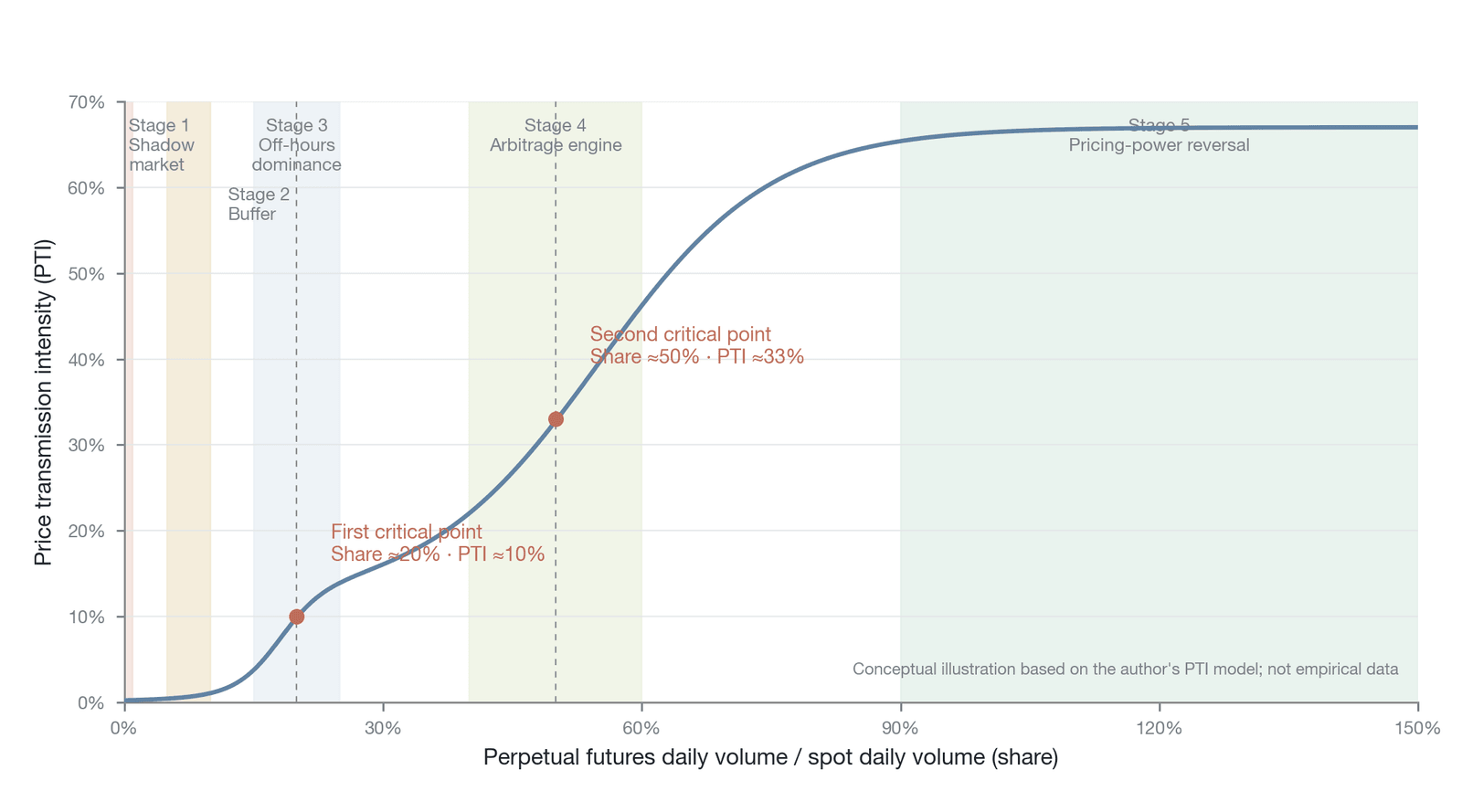
Figure 27-1. The five-stage evolution of PTI as a function of the perpetual futures' share of trading volume (conceptual illustration, not a forecast and not empirical: the curve is an extrapolation of the author's PTI model, using the double-logistic function PTI(x) = 0.12·σ(40(x − 0.18)) + 0.55·σ(10(x − 0.55)), where σ is the logistic function; the horizontal axis is the model's independent variable, namely the perpetual-to-spot daily volume ratio, not a time axis; the two critical points at 20% and 50% and the individual PTI values are illustrative parameter choices, not statistical estimates; the PTI concept draws on the information-share method of Hasbrouck 1995 [21], which provides the measurement framework but is not the calibration source for this figure's thresholds)
27.5.4 Sensitivity analysis
In the evolution across these five stages, the weight of each variable is not constant. A sensitivity analysis reveals the key bottlenecks that determine whether a threshold can be crossed.
The first is sensitivity to oracle latency. The model shows that when the perpetual futures' oracle update frequency is slower than one second, its PTI ceiling during the regular session is locked at 15%, because on Nasdaq the reaction time of high-frequency trading firms is measured in microseconds. If an on-chain oracle needs several seconds to reflect a change in the spot price, the perpetual market will remain at a disadvantage in passive arbitrage and become a venue from which high-frequency traders systematically extract value [23]. Only when oracle latency falls to the hundred-millisecond level, with very high manipulation resistance, does the perpetual market gain the physical basis to contest pricing power during the regular session.
The second is the nonlinear effect of the friction coefficient. The simulation finds a clear convex relationship between cross-market arbitrage friction and price transmission intensity. When the all-in cost of moving funds across the on-chain and off-chain boundary — including slippage, gas fees, and losses on fiat on- and off-ramps — exceeds 0.5%, price transmission is significantly suppressed. When this friction coefficient falls below 0.1% through improvements in infrastructure (such as the spread of stablecoin settlement and the establishment of institutional-grade clearing networks), however, PTI grows rapidly. This shows that pricing-power migration is not a linear quantitative change but depends on a threshold effect that takes hold once infrastructural resistance falls below a particular level.
The last is sensitivity to the funding rate cycle. The traditional funding rate mechanism, which settles once every 8 hours, proves too sluggish for a high-volatility asset. The model indicates that shortening the funding rate settlement cycle of TSLA perpetual futures to hourly or even continuous settlement would improve its price-anchoring efficiency by more than 40%. Tighter anchoring means smaller price deviations, which attracts more slippage-sensitive institutional capital and forms a virtuous circle of rising liquidity and improving pricing efficiency.
Figure 27-2 presents, in two panels, the sensitivity of PTI to two bottleneck variables: (a) before oracle latency falls to the hundred-millisecond level, the regular-session PTI ceiling is locked at 15%; and (b) once cross-market friction falls below 0.1%, PTI grows rapidly. Together, the two panels reveal the same regularity: the bottleneck in pricing-power migration is not liquidity itself but the quality of the infrastructure connecting the two markets.
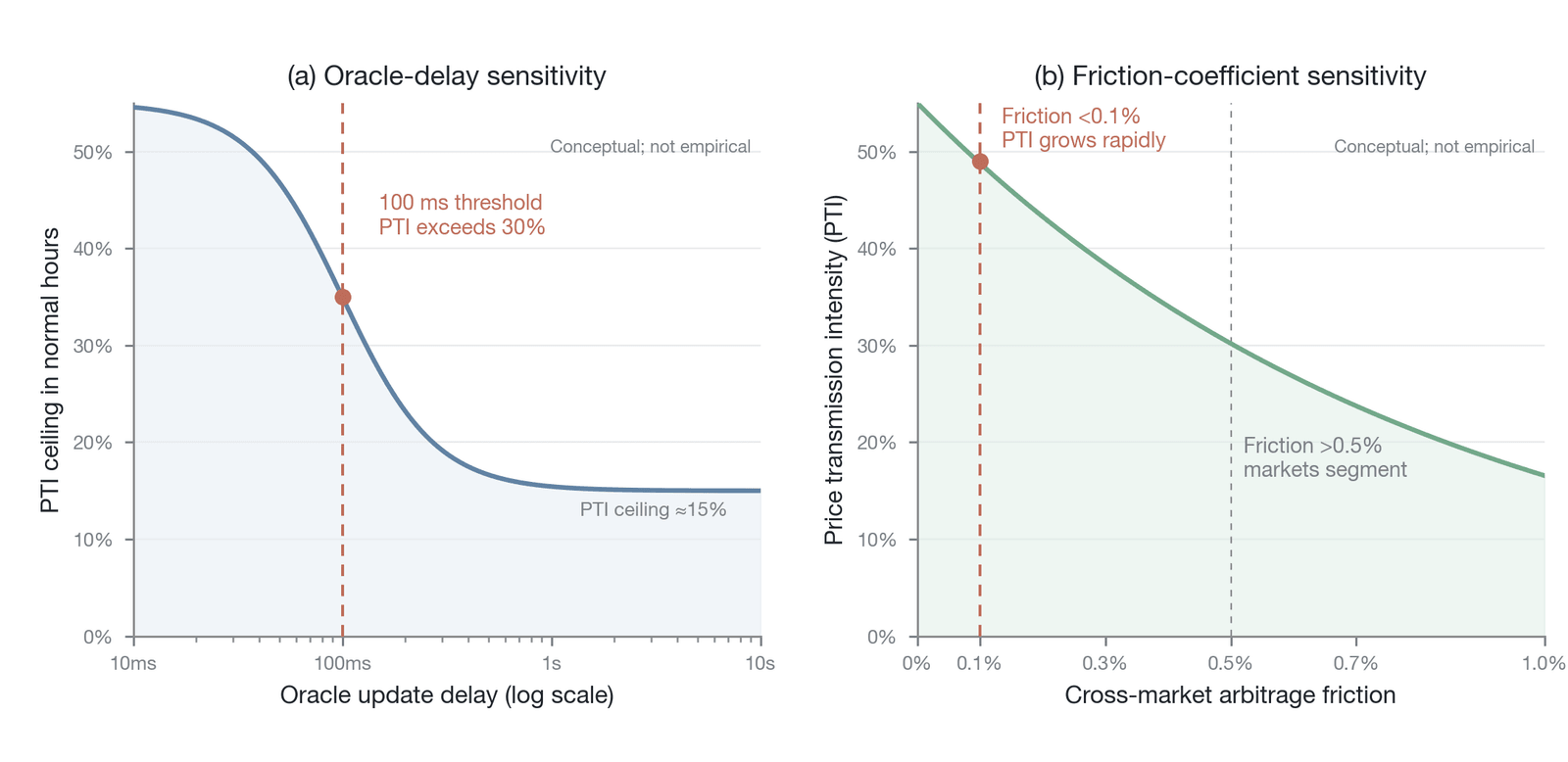
Figure 27-2. Sensitivity curves of PTI to oracle latency and the friction coefficient (conceptual and parameter-sensitivity modeling illustration, not empirical: all are extrapolations of the author's model; (a) oracle-latency model: PTI = 0.15 + 0.40·σ(4.5(2 − log₁₀(latency))); (b) friction-coefficient model: PTI = 0.55·exp(−120 · friction coefficient), with the friction coefficient entered as a decimal and calibrated to the thresholds in the text as 0.1% → 0.49, 0.3% → 0.38, 0.5% → 0.30, 1% → 0.16)
27.5.5 Summary of the thresholds
Combining the scenario simulation with the sensitivity analysis, we can clearly delineate the quantitative thresholds at which TSLA perpetual futures acquire pricing power. The first threshold is the "non-trading-hours dominance threshold": the perpetual market's daily volume reaches 20% of spot (about $5 billion), and cross-market friction is below 0.3%. Crossing this threshold means that perpetual futures have formally filled a structural gap in the traditional financial market and begin to demonstrate irreplaceable informational value.
The second threshold is the "regular-session competition threshold," which requires the perpetual market's daily volume to reach 50% of spot and oracle latency to fall below 100 milliseconds. Crossing this threshold means that perpetual futures have gained the ability to compete with Nasdaq in price discovery during the regular session and have become a central hub for global arbitrage capital.
The third threshold is the "pricing-power reversal threshold," which requires not only that perpetual volume surpass spot but also that a widely accepted institutional trust be established, so that traditional asset managers can lawfully use the on-chain perpetual price as a benchmark reference.
These quantitative thresholds reveal an important economic implication: for permissionless financial infrastructure to reshape global asset pricing, it cannot rely on the sophistication of its ideas alone but must meet extremely high engineering standards on the hard metrics of microstructure — liquidity thickness, latency, and friction cost. The migration of pricing power is a strict competition on efficiency, and only when the new system is superior to the old on every dimension can it complete the final substitution.
27.5.6 Case simulation: price transmission of an after-hours event
To make the abstract model above more concrete, we simulate a specific scenario. At 9:00 p.m. on a Friday (Nasdaq has closed, and the after-hours session has ended as well), Elon Musk posts on social media a major tweet announcing a breakthrough in Tesla's autonomous-driving technology. Empirical research shows that Musk's tweets tend to produce measurable abnormal returns in TSLA's stock price within minutes to hours of posting, often accompanied by increased trading activity and volatility [24][25].
Under the traditional market structure, the weekend closure means this major positive news cannot be translated into price immediately. Millions of retail and institutional investors can only crowd in together at the Monday morning open, causing the opening price to show a violent upward gap. This pricing vacuum not only reduces the market's informational efficiency but also forces investors to bear a full 2 days of overnight risk.
Now introduce a TSLA perpetual futures market in the "third stage" (non-trading-hours dominator). After the tweet is posted, algorithmic trading bots instantly detect the shift in sentiment, and a flood of buy orders pours within milliseconds into the around-the-clock on-chain perpetual futures order book. Because the spot market is closed and the oracle price is frozen at Friday's close, the perpetual price rapidly unmoors to the upside, standing about 5% above the spot close within the first 10 minutes. The large basis forces longs to pay shorts an extremely high funding rate, while shorts, tempted by that funding rate, supply liquidity. Over the roughly 60 hours of the weekend that follow, the perpetual market, through ample turnover, independently completes the pricing of this information without a spot anchor, ultimately reaching a new equilibrium at a level 8% above the original close.
When Nasdaq opens at 9:30 a.m. on Monday, market makers in the traditional market no longer need to guess blindly at the opening price. They refer directly to the equilibrium price the on-chain perpetual futures formed over the weekend and use it as the benchmark for setting the spot open. In this specific event, TSLA perpetual futures took on the function of price discovery during non-trading hours; they did not replace the spot market but performed the spot market's work of absorbing information during the closure. This price-transmission path clearly demonstrates how, when the mechanistic advantages of perpetual futures are fully released, they can seamlessly embed in and optimize the pricing network for global assets.
Figure 27-3 uses three liquidity conditions — shadow market, non-trading-hours dominator, and pricing-power reversal — to simulate the evolution of the TSLA perpetual futures price from Friday's close to Monday's open (a 72-hour window) in the scenario above, along with the corresponding implied funding rate dynamics. Its core regularity is that the deeper the liquidity, the faster weekend price discovery converges: the first stage barely responds to the event, whereas the fifth stage converges to a new equilibrium within hours of the event.
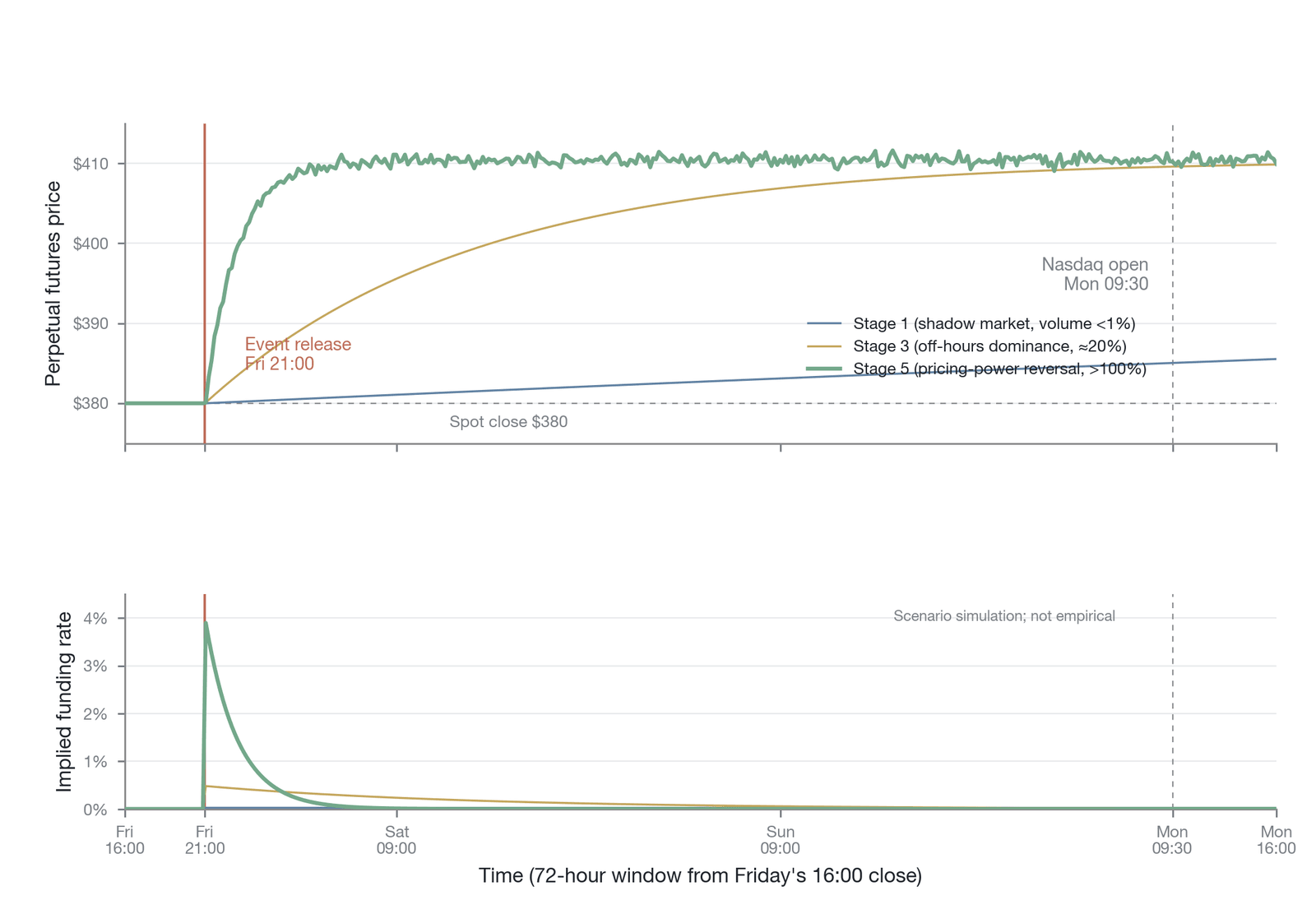
Figure 27-3. TSLA weekend-event simulation: the price-transmission trajectories and funding rate dynamics of perpetual futures at different stages (scenario simulation, not empirical: built by the author on the exponential-convergence model P(t) = P₀ + ΔP·(1 − exp(−λ·t)), with price convergence timed from the event at 9:00 p.m. on Friday; the total shock magnitude of +8% is a scenario shock assumption set by the author, not a point estimate from any study; Dam 2023 [24] supports only the directional conclusion that Musk's Tesla-related tweets produce measurable abnormal returns, not the +8% magnitude; the calibration parameters are TSLA's average daily volume of about $25 billion, a representative magnitude as of March 2026 [18], and an after-hours volume share of about 3% [19])
Figure 27-4 uses a stacked bar chart to quantify the information-incorporation efficiency of the five stages: the green bars represent the price gain already absorbed over the weekend, and the red bars represent the residual gap remaining at Monday's open. Efficiency rises from 17% in the first stage to 97% in the third, exhibiting the same nonlinear leap as Figure 27-1. This shows that when perpetual futures volume reaches 20% of spot (the third-stage threshold), the problem of the weekend pricing vacuum has, in substance, been solved.
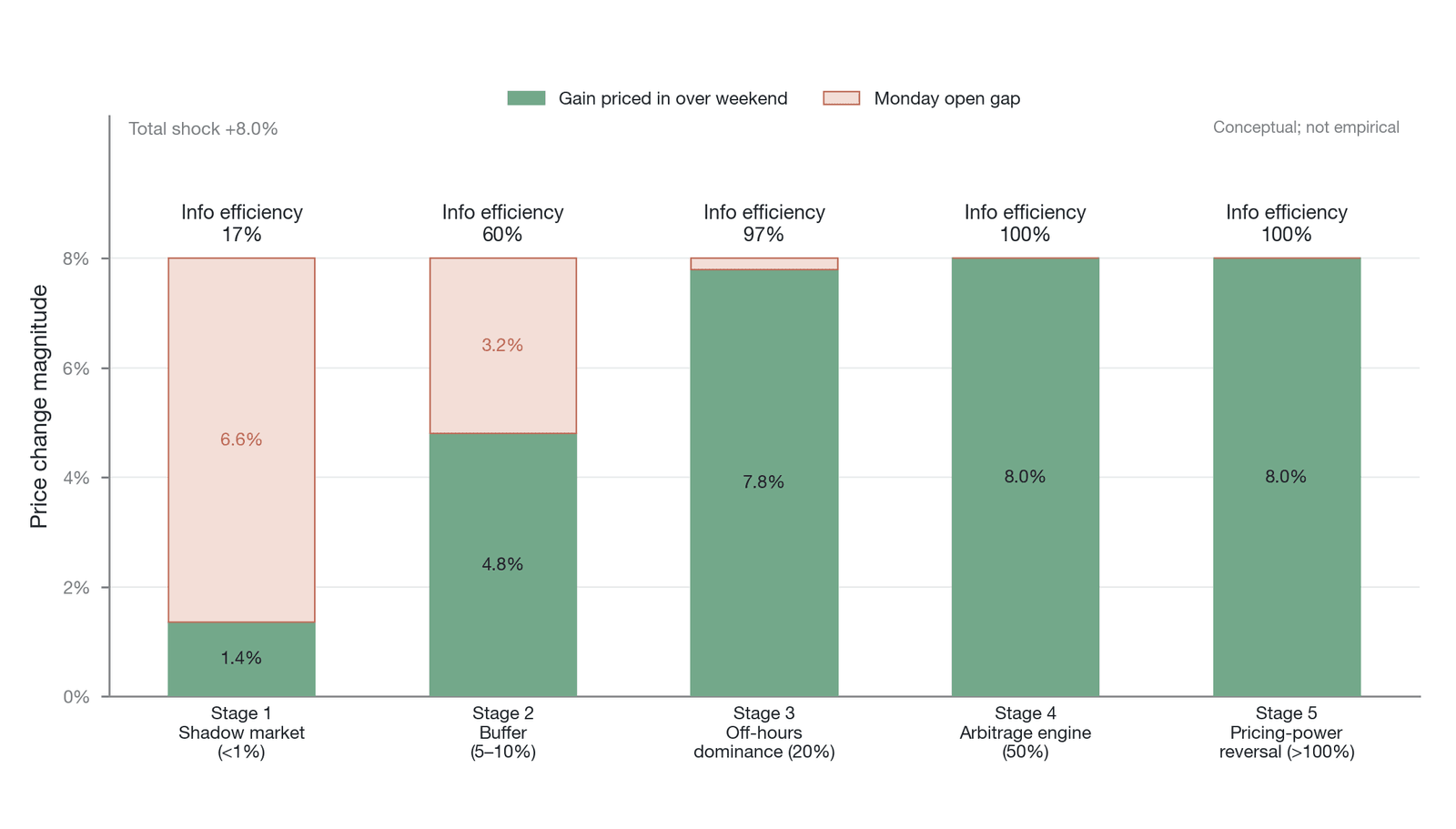
Figure 27-4. The five-stage information-incorporation efficiency of TSLA perpetual futures and the Monday-open gap (conceptual illustration, not empirical: built by the author on the exponential-convergence model η = 1 − exp(−λ·T), with five-stage information efficiency of 17% → 60% → 97% → 100% → 100%, derived from the share of the total shock already incorporated at each stage and internally consistent, with an effective convergence window of T = 60.5 hours timed from the event at 9:00 p.m. on Friday to the Monday open; the total shock magnitude of +8% is the author's scenario assumption; the λ values are illustrative choices reflecting the liquidity depth of each stage; Dam 2023 [24] supports only the direction and not the 8% magnitude, and Hasbrouck 1995 [21] is the conceptual anchor for the information-share method — neither is a source of point estimates)
27.6 Thought experiment III: commodities and emerging assets
The pricing mechanism of perpetual futures shows potential not only in crypto assets, foreign exchange, and equity indices; its properties of no expiration date and synthetic exposure also offer a wholly new pricing perspective for commodities and emerging asset classes. This section extends the boundaries of the thought experiment further, examining how perpetual futures could reshape the pricing logic of non-traditional underlying assets — from crude oil and gold to carbon credits, real estate indices, and even prediction markets. The traditional derivatives markets in these areas often suffer from fragmented liquidity, an excessively high barrier to entry, or the outright absence of any effective pricing mechanism, and the introduction of perpetual futures may be not only a complement to existing markets but also a creator of entirely new liquidity.
27.6.1 Crude oil, gold, and agricultural commodities
In the traditional financial system, commodity futures markets are the central hub of price discovery. Take crude oil: the West Texas Intermediate crude oil futures and options of the Chicago Mercantile Exchange together have average daily volume exceeding 1 million contracts and combined open interest of about 4 million contracts, forming the benchmark for global energy pricing [26]. The gold market is likewise vast: open interest in the gold futures of the New York Mercantile Exchange has long held at roughly 400,000 to 550,000 contracts (with a peak of about 900,000 contracts on a combined-options basis and an all-time record of about 800,000 contracts) [27]. For these highly mature markets, the incremental value of perpetual futures is not to replace the existing liquidity pool but to eliminate the friction costs inherent in traditional delivery futures.
The principal drawback of traditional commodity futures is the roll cost. Because a futures contract has a fixed expiration date, an investor who does not wish to take physical delivery — a commodity index fund or a retail speculator, for instance — must close the position before expiry and buy a forward contract. This periodic roll not only incurs high trading fees but also exposes the investor to the implicit losses of the term structure (such as contango or backwardation). Perpetual futures anchor automatically to the spot price through the funding rate mechanism, eliminating the explicit roll operation and its trading friction (the holding cost is instead expressed as the funding rate). A trader can hold synthetic exposure to crude oil or gold indefinitely, without attending to a complex delivery calendar. Decentralized derivatives platforms such as Hyperliquid have recently reported record-high open interest in their crude oil and gold perpetual futures, providing preliminary confirmation of genuine demand for roll-free commodity exposure [28].
Commodity perpetual futures nonetheless face an insurmountable physical constraint: the need for physical delivery (this is one of the four ultimate constraints on the "Everything Perpetual," discussed in full in Section 27.8.2). Although synthetic exposure holds advantages for price speculation and risk hedging, it can never replace the movement of supply chains in the physical world. In crude oil and gold, therefore, perpetual futures are more likely to evolve into a parallel, "purely financialized" pricing layer that coexists over the long run with the traditional futures markets that bear the function of physical delivery.
Unlike crude oil and gold, the traditional futures markets for agricultural commodities and metals are often characterized by insufficient liquidity. Research shows significant differences in liquidity cost across agricultural futures contracts, with trading volume and the delivery period the key factors affecting liquidity [29]. For many farmers in developing countries, participating in the agricultural futures markets of Chicago or Dalian entails extremely high barriers to opening an account, moving funds across borders, and managing margin. Here, the global access and very low barrier of perpetual futures reveal enormous potential for financial inclusion. Through a smartphone and a crypto wallet, a coffee farmer in South America or a cocoa grower in Africa could use agricultural perpetual futures directly to lock in a future selling price and hedge the risk of price fluctuations. This is the closest realization of the vision Robert Shiller depicted in Macro Markets: enabling groups once excluded from the modern financial system to effectively manage the economic risks they face.
27.6.2 Carbon credits and real estate indices
As the thought experiment extends outward, we enter areas where traditional derivatives markets are weaker still. The carbon-credit market is an important global mechanism for addressing climate change, but the liquidity of the current voluntary carbon market is highly fragmented. Although trading volume in compliance carbon markets continues to grow, the voluntary carbon market still faces problems such as opaque pricing and high transaction costs, with significant price differences between different types of carbon credits (such as forestry carbon sinks and industrial emissions reduction) [30]. The introduction of carbon-credit perpetual futures could provide this fragmented market with a unified global pricing venue. By indexing carbon credits of a particular standard and issuing perpetual futures on that index as the underlying asset, global capital could participate seamlessly in the pricing of carbon emissions, substantially improving the liquidity and price-discovery efficiency of the carbon market.
Real estate is another quintessential "non-traditional" underlying asset. Housing is not only the principal store of wealth for most households but also one of the most broadly influential variables in the macroeconomy. Real estate, however, is extremely illiquid and difficult to short. The Chicago Mercantile Exchange once launched futures based on the S&P CoreLogic Case-Shiller Home Price Index, but because of the high barrier to entry and insufficient willingness among market makers, its volume has always remained extremely low [31]. Although the Real Estate Index of the Shenzhen Stock Exchange in China reflects the performance of the relevant listed companies, it cannot directly hedge the risk of fluctuations in physical home prices [32].
Real estate index perpetual futures could break this deadlock. Because they require no complex traditional brokerage account and support very fine-grained trade sizes, home-price perpetual futures could attract large numbers of ordinary residents seeking to hedge the risk of home purchases, as well as global capital seeking diversified investment. Once the participant base crosses a critical point, liquidity would reinforce itself, ultimately forming a continuous pricing curve that reflects expectations of future home prices. The common feature of these non-traditional assets is that the liquidity of their traditional derivatives markets is weak or even nonexistent. Perpetual futures need not compete with entrenched incumbents; instead, by lowering the barrier to entry, they create an entirely new liquidity pool "from scratch."
27.6.3 Prediction markets
If the logic of the funding rate anchoring mechanism is pushed to its limit, the underlying asset of perpetual futures need no longer be confined to the price of a financial asset but can extend to any quantifiable variable or discrete event. Prediction markets are the direct application of this generalized logic. In a prediction market, the value of a contract depends on whether a particular event — an election result, an economic data release, or a geopolitical conflict, for example — occurs.
Decentralized prediction markets, exemplified by Polymarket, have grown rapidly. During the 2024 U.S. presidential election, Polymarket's trading volume far surpassed that of the traditional regulated prediction platform Kalshi, and it maintained strong momentum thereafter. Recent data show that Polymarket's single-day notional volume once exceeded $478 million (March 2026) [33]. Academic research on prediction markets indicates that they are highly efficient in price discovery and that in some settings their accuracy can match or even exceed that of traditional opinion polls [34].
From the standpoint of mechanism design, an event contract in a prediction market is essentially a binary perpetual futures contract. Traders continuously price "whether an event will occur," and the price fluctuates between zero and one, reflecting the market's consensus on the probability of the event. So long as a reliable oracle can adjudicate the event's outcome without dispute, any uncertainty in the real world can be turned into a tradable financial instrument. This trend of financializing temperature changes, macroeconomic indicators, and even the course of geopolitics has provoked a profound controversy over "the financialization of everything." Supporters hold that it greatly extends the boundaries of risk sharing, drawing more latent information into the price system, while critics worry that it may lead to excessive speculation, degrading serious social issues into a global gambling game. This tension constitutes the core challenge of permissionless finance at the level of social ethics.
27.6.4 Technical feasibility and institutional obstacles
In sum, as a general-purpose pricing infrastructure, the trajectory by which perpetual futures extend their coverage from crypto assets to everything displays a clear gradient of technical feasibility and an increasing set of institutional obstacles. Table 27-2 systematically assesses the prospects for turning six categories of underlying asset into perpetual futures across four dimensions: oracle reliability, the strength of traditional-market substitutes, the core incremental value of perpetual futures, and near-term feasibility. This assessment framework will help the reader understand why the speed at which perpetual futures penetrate different asset classes varies so markedly.
| Underlying asset class | Oracle reliability | Traditional-market substitute | Core incremental value of perpetual futures | Near-term feasibility assessment |
|---|---|---|---|---|
| Crypto-native assets | Very high (on-chain native data) | None (perpetual futures already dominate) | Mechanism fully validated and implemented | Fully realized |
| Major foreign exchange pairs | High (deep liquidity, stable data sources) | Interbank spot market and CME foreign exchange futures | Around-the-clock (24/7) continuous pricing and inclusive global access | Relatively high |
| Equity indices (such as the S&P 500) | Moderate (limited by the data vacuum during non-trading hours) | ETFs and CME equity index futures | Filling the Asian-session pricing vacuum and providing permissionless global access | Moderate |
| Commodities (gold/crude oil) | Moderate (dependent on traditional exchange quotes) | Mature commodity futures such as those of the CME and LME | Eliminating roll costs and lowering the barrier to entry | Moderate |
| Non-traditional assets (carbon credits/home prices) | Relatively low (low data-collection frequency, difficult to standardize) | Market liquidity weak or nonexistent | Creating an entirely new, unified global pricing market for illiquid assets | Relatively low |
| Prediction markets (events of every kind) | Very low (heavily dependent on manual adjudication and complex fact-checking) | Traditional betting, or no substitute | Realizing the highest-potential risk sharing, while facing the greatest oracle challenge | Very low |
Table 27-2. Feasibility assessment of turning different underlying assets into perpetual futures (Data source: constructed by the author on the basis of the three preceding thought experiments)
As shown in Table 27-2, from crypto-native assets to prediction markets, the feasibility of turning assets into perpetual futures displays a clear declining gradient. This gradient is determined mainly by two variables. The first is oracle reliability: as the underlying asset extends from highly standardized financial instruments toward non-standardized physical entities and real-world events, oracle reliability declines exponentially. An oracle must transmit off-chain information to an on-chain contract accurately, with low latency, and tamper-resistantly. For crude oil or an equity index, the oracle need only relay quotes from a traditional exchange; but for a home-price index or a complex political event, the design of the oracle faces enormous game-theoretic challenges. Moreover, when perpetual futures attempt to price carbon credits or macroeconomic indicators, they inevitably touch the regulatory boundaries of sovereign states. Technology can build a permissionless trading layer, but it cannot eliminate the physical world's need for delivery, nor can it bypass the deeply rooted trust structures and institutional constraints of human society. Together, these ultimate constraints draw the real-world boundary of the "Everything Perpetual" thought experiment.
27.7 The dynamics of pricing-power migration
The migration of pricing power requires several preconditions: liquidity reaching critical mass, institutional recognition, and, for non-crypto-native assets, oracle reliability (the preconditions and timeline of each stage are developed one by one in Section 27.7.5). The speed of migration depends on the overall performance of perpetual futures across several dimensions: efficiency, cost, access, resilience, and fairness.
Given these preconditions, the migration of pricing power is not a sudden event in the financial system but an evolutionary process that advances gradually along liquidity, informational efficiency, and institutional acceptance. If the perpetual futures mechanism does have the potential to take over global asset pricing, this process will not be completed overnight but will follow a clear four-stage dynamic model. Each stage marks a structural reorganization of the relationship between on-chain pricing infrastructure and the traditional financial system, and crossing each stage requires a particular level of technical maturity and specific institutional preconditions as support.
27.7.1 Stage one: crypto-native assets
The first stage of pricing-power migration is not a theoretical extrapolation but an empirical fact that has already occurred. In this stage, perpetual futures successfully established their status as the core pricing venue for a particular asset class. For crypto-native assets such as Bitcoin and Ethereum, the perpetual futures market has already surpassed both the spot market and the traditional delivery futures market to become the dominant venue for price discovery.
According to data on the crypto derivatives market in 2025, total volume in this space reached about $85.7 trillion, with average daily volume exceeding $260 billion, and perpetual futures occupied the dominant position [4]. In the quantitative analysis of price discovery, as cited in Section 27.5.1, crypto derivatives markets already command about half of the information share in Bitcoin price discovery [20][21][22]. Given that perpetual futures surpass quarterly futures in both volume and continuity, their share in price discovery may be higher still; but there is at present no direct point estimate of the information share of perpetual futures specifically, so this judgment is a qualitative inference based on volume and continuity. The microfoundation of this phenomenon is that the built-in leverage, seamless shorting mechanism, and around-the-clock continuous trading of perpetual futures make informed traders more inclined to express their informational advantage in such venues.
The completion of the first stage proves the effectiveness of the funding rate anchoring mechanism. It shows that, absent the constraint of physical delivery, pure synthetic exposure can still bear enormous sums and sustain an efficient price-discovery function. Yet the success of this stage owes much to the characteristics of crypto assets themselves: they are digitally native, have no hard binding to physical-world delivery, and, in their early development, faced little competition from strong traditional-finance substitutes.
27.7.2 Stage two: shadow pricing
When the underlying assets of perpetual futures extend from crypto-native assets to traditional financial assets — foreign exchange, equity indices, or commodities — pricing-power migration enters its second stage. In this stage, on-chain perpetual futures begin to provide price signals for traditional assets, but these prices have not yet won the institutional recognition of the traditional financial system. They play the role of a "shadow price" in the system, analogous to the shadow-pricing role that offshore currency markets play relative to the onshore official exchange rate.
The core value of shadow pricing lies in filling the structural gaps of traditional markets, especially gaps in time coverage. Consider the Asian-session pricing vacuum of SPY, the core ETF product on the S&P 500 index (its causes are discussed in Section 27.4) [35]: if a major macroeconomic event or geopolitical shock occurs during this period, the traditional market can offer no venue for immediate price discovery, and the around-the-clock on-chain perpetual futures become the only active pricing source.
Although in this stage the trading volume of on-chain perpetual futures may account for only a very small proportion of total traditional-market volume — 0.1% to 1%, say — its monopoly on information gives it a disproportionate influence over pricing. When the traditional market reopens after a closure, market makers and algorithmic trading systems refer to the perpetual futures' price movements during the closure to set the opening quote. This information-transmission mechanism allows the shadow price to materially influence the price formation of the traditional market, even before it is officially recognized as a benchmark price.
27.7.3 Stage three: institutional recognition
The third stage of pricing-power migration marks the initial narrowing of the trust gap between the on-chain pricing system and the traditional financial system. In this stage, the liquidity depth and oracle reliability of the perpetual futures market reach critical mass, prompting regulators, asset managers, and traditional market makers to begin formally citing or relying on on-chain price data, thereby granting it institutional recognition.
A precedent for this recognition has already appeared in the 2024 approval of the Bitcoin ETF. The fund was the first institutional bridge between traditional finance and crypto finance, and its pricing mechanism relies indirectly on the liquidity and information flow of the perpetual futures market (the microstructure of this triangular-arbitrage price transmission, intermediated by the Chicago Mercantile Exchange futures market, is detailed in Section 27.9.2).
For non-crypto assets, reaching the stage of institutional recognition requires overcoming more complex obstacles. First, traditional market makers must participate in on-chain market-making across the boundary at scale, to ensure that prices in the two markets are tightly coupled. Second, oracle infrastructure must demonstrate its absolute reliability under extreme market conditions, particularly how it provides a manipulation-resistant reference price while the traditional market is closed. When these conditions are met, the information share of perpetual futures will rise significantly, possibly reaching the 20% to 35% range, making them a major pricing venue on a par with traditional exchanges.
27.7.4 Stage four: infrastructure integration
The ultimate form of the four-stage model is the deep integration of infrastructure. In this stage, the binary opposition between "traditional finance" and "on-chain finance" is broken down, and the two merge into different execution layers of a single unified global pricing system. Perpetual futures are no longer a challenger to, or a complement of, the traditional market but become a core component of the underlying infrastructure.
Under this integrated architecture, traditional exchanges might directly operate a clearing layer based on distributed ledger technology (DLT), or introduce the perpetual futures mechanism into their core product lines. A trader could switch seamlessly on a single interface among traditional spot, regulated futures, and permissionless perpetual futures, with all risk exposures net-settled within a single unified global liquidity pool. Such a convergence would not only resolve the settlement-delay risk that has long existed in the traditional foreign exchange market but also greatly widen the access boundary for global capital [36].
Realizing the infrastructure-integration stage would mean a fundamental reconstruction of the underlying logic of financial markets. It would require the regulatory framework to shift from territorial oversight based on institutional entities to global coordination based on code function and protocol logic. In this stage, the vision of perpetual futures as a general-purpose pricing layer would be fully realized, and any asset could be turned, through the funding rate mechanism, into synthetic exposure that is globally accessible, tradable around the clock, and instantly settled.
Figure 27-5 visualizes the four-stage model with the qualitative stages of evolution (from early to distant) on the horizontal axis: stage one, "crypto-native assets," is essentially complete (the information share for BTC and ETH has reached about 50%); stage two, "shadow pricing," is now taking place; and stage three, "institutional recognition," and stage four, "infrastructure integration," are anticipated extrapolations, with the key preconditions for crossing each stage marked at the junctions. The core lesson of this evolutionary path is that the speed of pricing-power migration is determined not by technological progress alone but by the slower of technical maturity and institutional acceptance.
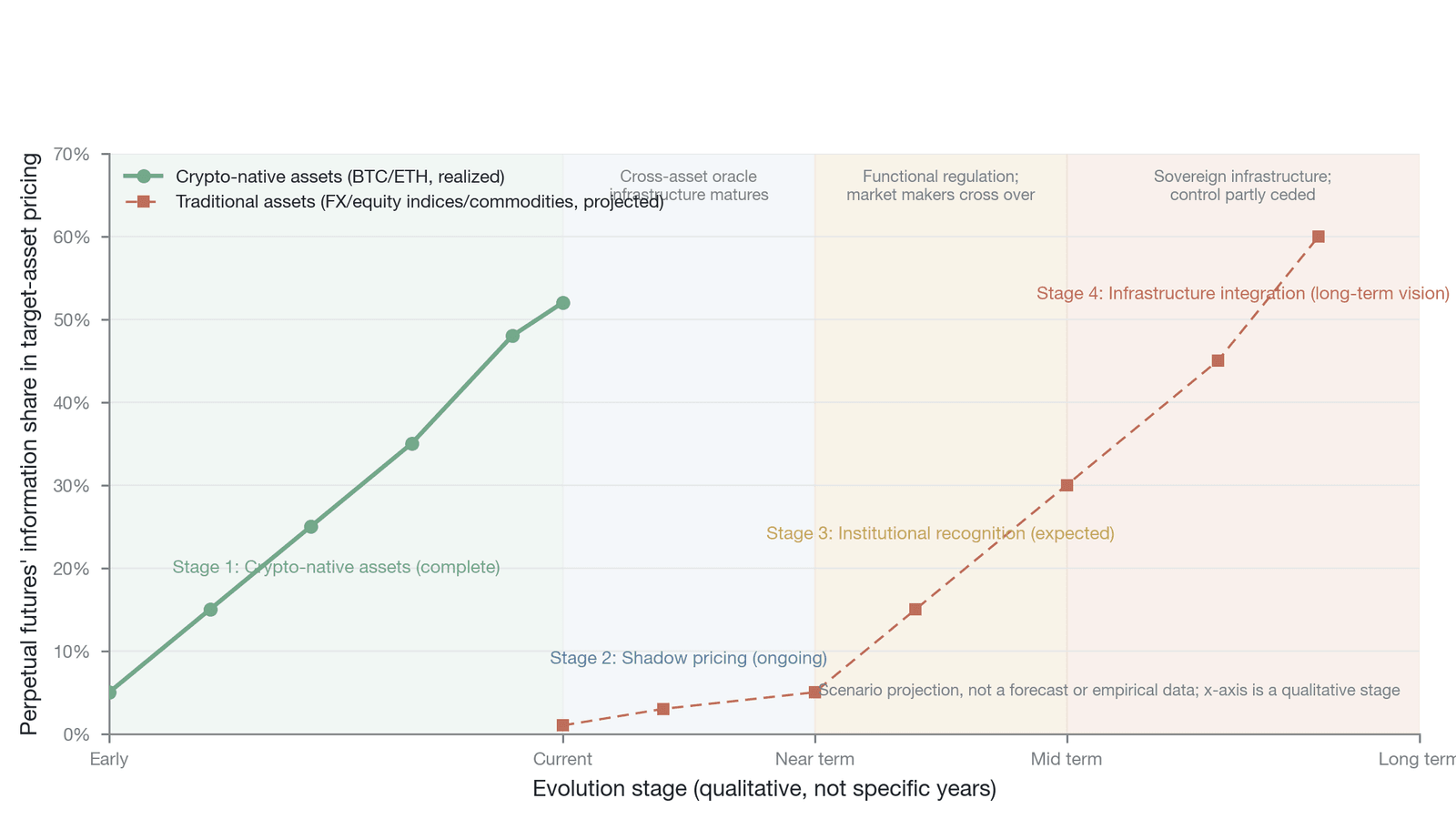
Figure 27-5. The four-stage model of pricing-power migration: stages of evolution and key preconditions (scenario extrapolation, not a forecast and not empirical: built by the author on the four-stage model, with the horizontal axis showing qualitative stages of evolution from early to distant rather than specific years; the stage-one figure "BTC/ETH information share ≈ 50%" draws on Alexander & Heck 2020 [20], which uses the Hasbrouck 1995 information-share method [21], and the figure that "perpetuals account for about 60% of BTC's total market volume" draws on the CoinGlass crypto derivatives report [4]; De Blasis & Webb 2022 [22] is corroborating evidence of derivatives dominance and spillover effects, does not itself provide an information-share estimate, and is not on its own a source for the 50% information share; stages two through four are framework-based scenario projections)
27.7.5 Preconditions and timeline
Each stage of pricing-power migration is subject to particular technical and institutional constraints, and these constraints determine the speed and boundaries of the evolution. The first stage (crypto-native assets) is complete, having taken nearly a decade (2016–2025). The second stage (shadow pricing of traditional assets) is now taking place: several decentralized exchanges have launched perpetual futures on foreign exchange, equity indices, and commodities, completing the proof of concept and the early accumulation of liquidity.
The leap from the second stage to the third (institutional recognition) is the most difficult transition in the entire dynamic model, because it goes beyond engineering and enters the reconstruction of social trust and institutional design. The preconditions for this leap include building a decentralized oracle network capable of withstanding state-level attacks, forming a functional regulatory framework interoperable with traditional finance, and establishing deep trust in smart contract code among institutional investors. Based on the historical pace at which financial infrastructure evolves, realizing this stage may take 5 to 10 years.
As for the fourth stage (infrastructure integration), its timeline is more distant and fraught with uncertainty, and it may take 10 to 20 years to unfold. It depends not only on the full maturation of the technical and regulatory conditions described above but also on a fundamental cession of sovereign states' control over financial markets. The rigid demands of sovereign states regarding capital flows, monetary policy transmission, and anti-money-laundering compliance constitute the fundamental constraint on this ultimate picture. The complete migration of pricing power may therefore forever be an asymptote — infinitely approached but never fully reached — and it is along this asymptote that perpetual futures will continue to reshape the boundaries of global asset pricing.
27.8 The ultimate constraints
A thought experiment must confront its insurmountable boundaries honestly. In examining the potential of perpetual futures as a general-purpose pricing layer, we must distinguish which constraints are technical, which are institutional, and which are fundamental. Technical constraints can be solved through engineering innovation, and institutional constraints may loosen as regulation evolves, but fundamental constraints reflect the deep structure of human society and the objective laws of the physical world; they will not vanish with technological progress. This section defines the ultimate picture of this thought experiment and analyzes in depth the four ultimate constraints that limit its unbounded expansion.
27.8.1 The ultimate picture
In the limiting case where all technical and institutional constraints are perfectly resolved, perpetual futures could constitute a fully comprehensive global pricing layer. In this picture, anyone, anywhere, at any moment can trade and price any asset. All financial exposure is turned into synthetic products that settle instantly, are globally accessible, and operate continuously around the clock. This eliminates not only the geographic and temporal fragmentation of traditional financial markets but also the access barriers between different asset classes.
The value of this ultimate picture lies not in offering a definite forecast but in revealing the theoretical limit of financial-market evolution. It shows how high the efficiency of price discovery could rise if friction costs fell to zero. In this ideal state, the funding rate mechanism anchors synthetic assets to their underlying perfectly, the oracle network transmits information with no latency and absolute reliability, and smart contracts execute all clearing and settlement logic with a zero failure rate. Yet this perfect state is merely a theoretical asymptote. The physical properties, political structures, and human psychology of the real world constitute insurmountable boundaries, so that this ultimate picture can only be approached infinitely and never fully realized.
27.8.2 The settlement needs of the physical world
There is an essential economic difference between synthetic exposure and physical delivery, and this is the first ultimate constraint that prevents perpetual futures from fully replacing traditional markets. Synthetic products can provide perfect price exposure, but they cannot meet the physical needs of the real economy. A refinery needs real crude oil to keep running, a flour mill needs real wheat to make bread, and a multinational enterprise needs real foreign currency to pay overseas suppliers. However deep the liquidity of a crude oil perpetual futures contract, and however efficient its price discovery, it cannot be refined into gasoline.
In traditional futures markets, although the overwhelming majority of contracts are ultimately closed through cash settlement rather than physical delivery, the possibility of delivery is the ultimate guarantee that the futures price anchors to the spot price. This delivery mechanism builds a solid bridge connecting financial derivatives to physical reality [37]. Perpetual futures attempt to substitute the funding rate mechanism for this anchoring function of physical delivery. For crypto-native assets, the substitution is successful, because crypto assets are themselves digital and have no logistical friction of physical delivery. But when we extend perpetual futures to commodities or agricultural products, whether the funding rate can fully substitute for the anchoring force of physical delivery under extreme market stress remains an unverified assumption.
Perpetual futures may therefore come to dominate pricing power over many assets in the future and become the primary venue for price discovery, but the physical need for settlement and delivery means that physical markets and traditional delivery futures markets must coexist with them. The two would form a division of labor: perpetual futures provide the most efficient information processing and price discovery, while traditional markets handle the logistics and settlement of the physical world. This dual structure is the inherent constraint that the physical world imposes on purely digital finance.
27.8.3 The financial power of sovereign states
The second ultimate constraint arises from the political-economy foundations of the modern nation-state system. The power to issue currency, to control foreign exchange, and to regulate financial markets constitutes the core power of a sovereign state. A fully permissionless global financial market that crosses national borders is, in essence, a direct challenge to a state's financial sovereignty. History shows that sovereign states will not lightly surrender these powers, nor will they remain indifferent to a technology that could weaken the transmission of their monetary policy [38].
The stability of money depends not only on technical architecture but also, and more importantly, on credible public support and the enforcement of par value. In successive financial crises, stability was restored not by the public's access to a particular payment technology but by the ability of the central bank's balance sheet to absorb systemic risk [39]. A permissionless financial network, for all the efficiency it displays in day-to-day operation, lacks a lender of last resort capable of creating liquidity without limit when faced with a systemic collapse.
Faced with the expansion of permissionless finance, the response of sovereign states need not be a simple prohibition; it is more likely to be adaptation and discipline. A state might upgrade its own monetary infrastructure by introducing a central bank digital currency (CBDC), or exert control by bringing decentralized protocols into a new regulatory framework. This means that the globalizing vision of perpetual futures will always operate within the space constrained by national sovereignty. Different jurisdictions will inevitably differ in the degree to which they accept these financial instruments and in the regulatory requirements they impose, leading to a degree of fragmentation in global liquidity. The utopia of fully eliminating national borders and regulatory arbitrage is unattainable so long as the system of sovereign states exists.
27.8.4 The oracle problem
At the technical level, the oracle problem is the foremost obstacle to extending perpetual futures to non-crypto assets. The oracle is the key infrastructure connecting isolated blockchain networks to data from the external world [40]. For crypto-native assets, an oracle can obtain the price directly from the on-chain transactions of a decentralized exchange, and the data source is itself trustless. But for traditional assets such as equities, foreign exchange, and commodities, the oracle must rely on off-chain data sources, such as the market feeds of Bloomberg, Reuters, or a traditional exchange.
This gives rise to a fundamental trust paradox: the goal of the entire decentralized finance system is to build a trustless architecture, yet its acquisition of the underlying asset's price requires absolute trust in these centralized off-chain data sources. The degree to which a system is trustless can never exceed the degree to which its oracle is trustworthy. Even if a decentralized oracle network is used to reduce single-point-of-failure risk through multi-node aggregation, that decentralization is merely superficial if all nodes ultimately depend on the same data interface from Nasdaq [41].
Moreover, during the non-trading hours when the traditional market is closed, the oracle faces the predicament of having no real-time price to report. It can then rely only on alternative data sources or historical data, which greatly weakens the pricing quality and anchoring efficiency of perpetual futures during these periods. Although cryptography and mechanism design can mitigate these problems, so long as the external world's data-generation process is not decentralized, the oracle problem will forever be a technical and trust bottleneck that cannot be entirely eliminated.
27.8.5 Human trust structures
The final ultimate constraint is rooted in the very nature of human cognition and social structure. Technology can shift the object of trust and reduce dependence on particular intermediaries, but it can never fully eliminate the need for trust itself. In traditional finance, participants trust banks, exchanges, and the legal and regulatory systems behind them. In a permissionless financial system, this trust is displaced onto the code logic of smart contracts, the security of cryptographic primitives, the honesty of the oracle network, and the governance mechanisms of DAOs [42].
Although this displacement of trust increases the transparency and verifiability of the system, it does not achieve genuine "trustlessness." For the overwhelming majority of market participants, verifying complex smart contract code or assessing the game-theoretic security of an oracle network far exceeds their cognitive capacity. They are in fact trusting the reputation of code-audit firms, the expertise of core developers, or simply the system's past record of stable operation.
The ultimate constraints of the thought experiment are therefore not only physical, political, and technical but also sociological and psychological. A fully trustless global financial market is a theoretical ideal that points the way toward lower friction and higher efficiency, but the inherent complexity of human society and its psychological need for certainty mean that some form of institutional trust will always be an indispensable foundation of the financial system.
27.9 Anchoring in reality
The value of a thought experiment lies not only in exploring the boundaries of theory but also in providing an analytical framework for observing reality. The foregoing extrapolation of perpetual futures as a universal global pricing infrastructure is not pure logical fantasy; its core elements have already begun to appear in the real world. This section anchors the theoretical extrapolation of the thought experiment to the current reality of financial markets, showing which transformations have already occurred, which infrastructure is being built, and which obstacles the path to the future vision must cross.
27.9.1 Early practice of the Everything Perpetual
Extending the underlying logic of perpetual futures from crypto-native assets to a broader range of financial instruments has already been validated on decentralized exchanges. The decentralized exchange Hyperliquid, for example, offers preliminary empirical evidence for the concept of the Everything Perpetual through its all-asset strategy. The platform not only lists perpetual futures on crypto assets but has also introduced exposure to traditional financial assets through its permissionless builder-deployed market framework (HIP-3).
In implementation, the platform has successfully launched perpetual futures products covering foreign exchange, equity indices, and commodities. Using the same margin system in a fully permissionless environment, a trader can obtain synthetic exposure to the stocks of traditional technology companies such as Nvidia and Tesla, as well as to macro commodities such as gold and crude oil. This aggregation of liquidity across asset classes proves the universality of the funding rate anchoring mechanism: it does not, in fact, depend on the specific physical properties of the underlying asset but requires only a reliable price feed from an oracle.
The evolution of market data further confirms that this cross-boundary demand genuinely exists. Measured by share of average daily volume, from the fourth quarter of 2025 to the first quarter of 2026 the share of traditional assets in Hyperliquid's total volume underwent a marked structural leap, climbing from less than 5% to more than 30% (about 31.6% by the end of January 2026, according to Delphi Digital data) [43]. The structural advantage of the around-the-clock trading of perpetual futures is especially evident in the face of sudden geopolitical events. In late February 2026, for instance, during tensions in the Middle East, the traditional commodity markets were closed for the weekend, and capital seeking to hedge risk poured into the decentralized perpetual futures market, driving a surge in the trading volume of synthetic crude oil and gold assets [44]. This episode bears out the expectation about the advantage of continuous pricing set out in the thought experiment above.
27.9.2 The bridging role of the Bitcoin ETF
Even as the permissionless on-chain financial system extends into the domain of traditional assets, the traditional financial system is actively building channels toward crypto-native assets. The approval of the spot Bitcoin ETF in 2024 marked the establishment of the first key institutional bridge between traditional finance and crypto finance. The significance of this event lies not only in providing traditional capital with a compliant investment channel but also in connecting two very different pricing ecosystems at the level of microstructure.
From the perspective of pricing-power migration, the introduction of the ETF significantly changed the market's information-transmission mechanism. The influx of traditional institutional capital caused the assets under management of the spot ETF to swell rapidly, and more than 2,000 U.S. investment advisory firms began incorporating such assets into their allocation portfolios [45]. Yet the ETF's own pricing mechanism depends heavily on the arbitrage activity of market makers and authorized participants. In executing their arbitrage strategies, these institutional participants inevitably need to hedge risk using the standardized futures contracts of the Chicago Mercantile Exchange and the more deeply liquid offshore perpetual futures market.
This cross-market arbitrage forms a hidden but efficient chain of price transmission. When large-scale inflows or outflows occur in the traditional market during the regular session, this information is reflected first in the ETF's premium or discount, then transmitted through market makers' hedging operations to the futures market of the Chicago Mercantile Exchange, and finally resonates in price with the perpetual futures market. Although this connection remains indirect at the current stage and is constrained by the trading hours of the traditional market, it establishes an ever-deepening interconnection of liquidity between the two worlds, laying the institutional foundation for fuller infrastructural integration in the future.
27.9.3 The evolutionary roadmap
A significant gap separates today's nascent all-asset perpetual futures from the ultimate vision of genuinely taking over pricing power for core global assets. Closing this gap requires not only technical breakthroughs at the engineering level but also a systematic evolution of institutional and trust structures.
At the level of technical infrastructure, oracle reliability remains the core bottleneck constraining the scaling of perpetual futures on non-crypto assets. When the traded underlying shifts from crypto assets with native on-chain prices to traditional assets that depend on external data sources, the oracle network must be able to provide accurate, latency-free, manipulation-resistant price feeds under extreme market volatility. Moreover, to bear the enormous transaction throughput of traditional financial markets, the clearing efficiency and concurrent processing capacity of the underlying blockchain must still improve by orders of magnitude.
At the level of institutions and social consensus, establishing a functional regulatory framework is unavoidable. The bottom-line demands of sovereign states regarding monetary policy transmission and anti-money-laundering compliance mean that a shadow-pricing system entirely detached from regulation can hardly win broad adoption by mainstream financial institutions. The more likely evolutionary path is a gradual convergence: preserving the core advantages of perpetual futures — continuous trading and efficient settlement — while achieving selective compliance verification at the application layer through cryptographic techniques such as zero-knowledge proofs. The timeline of this process is fraught with uncertainty, but the direction of technological evolution and the market's intrinsic demand for a more efficient pricing mechanism have already pointed the way for this potentially transformative change to financial infrastructure.
27.10 Chapter summary
The universality of the funding rate anchoring mechanism is the logical starting point of this chapter's thought experiment. This mechanism does not depend on the physical or financial properties of the underlying asset and can, in principle, turn any continuously priceable asset into perpetual futures that trade around the clock, are globally accessible, and settle instantly [1]. The "faster, cheaper, more accessible" driving logic of financial history was confirmed repeatedly across three migrations — from spot to futures, from the trading floor to the electronic screen, and from delivery futures to ETFs [46]. Perpetual futures hold a structural advantage on the first two of these dimensions but still face a significant gap on the "more trustworthy" dimension.
The three thought experiments in this chapter reveal a consistent pattern: perpetual futures offer distinctive structural incremental value in each asset class — around-the-clock pricing in foreign exchange, Asian-session coverage for equity indices, and zero roll cost for commodities — but each also faces the hard constraints of oracle reliability, regulatory compliance, and the need for physical delivery. The ultimate picture of the "Everything Perpetual" is bounded by four insurmountable limits: the settlement needs of the physical world, the financial power of sovereign states, the trust paradox of the oracle, and the trust structures inherent in human society [47].
Returning to the counterfactual with which the chapter opened: if the Chicago Board of Trade had launched perpetual futures rather than delivery futures in 1848, the globalization of pricing power might have arrived earlier, but the constraints of physical delivery and sovereign control would not have vanished as a result. What perpetual futures can do is push the efficiency frontier of financial markets as far as possible toward its limit, within these irremovable constraints. The next part of the book, Part 10, "Trustless Engineering," examines how, through decentralized architectural design, one might build an on-chain financial system that preserves the offensive advantages of perpetual futures while repairing their defensive deficiencies.
References
[1] Ackerer, D., Hugonnier, J., & Jermann, U. (2025). Perpetual futures pricing. Mathematical Finance. https://doi.org/10.1111/mafi.70018
[2] Chainalysis. (2026). An introduction to perpetual futures. https://www.chainalysis.com/blog/perpetual-futures/
[3] Shiller, R. J. (1993). Macro markets: Creating institutions for managing society's largest economic risks. Oxford University Press.
[4] CoinGlass. (2025). 2025 Crypto Derivatives Market Annual Report. https://www.coinglass.com/learn/2025-annual-report-en
[5] CME Group. (n.d.). History of the Chicago Board of Trade. https://www.cmegroup.com/company/history/
[6] CME Group. (n.d.). CME Globex overview. https://www.cmegroup.com/globex.html
[7] BlackRock / iShares. (2025). 2025 ETF & ETP Market Trends: Flow and Tell Year in Review. https://www.ishares.com (global and U.S. ETF industry totals additionally per ETFGI 2025 annual data)
[8] CME Group. (2026). E-mini S&P 500 futures overview. https://www.cmegroup.com
[9] Bank for International Settlements. (2025). Triennial central bank survey of foreign exchange and OTC derivatives markets. https://www.bis.org/statistics/rpfx25.htm
[10] U.S. Securities and Exchange Commission. (2023). Shortening the Securities Transaction Settlement Cycle (Final Rule, Release No. 34-96930; T+1 effective May 28, 2024). https://www.sec.gov/rules/final/2023/34-96930.pdf
[11] Mohanty, M. S. (n.d.). Central bank views on foreign exchange intervention. BIS Papers. https://www.bis.org/publ/bppdf/bispap73e_rh.pdf
[12] U.S. Department of the Treasury. (2023). Illicit finance risk assessment of decentralized finance. https://home.treasury.gov/system/files/136/DeFi-Risk-Full-Review.pdf
[13] MacroMicro. (2026). US - SPDR S&P 500 ETF Trust trading volume. https://en.macromicro.me
[14] Schwab Asset Management. (2024). Understanding the ETF creation and redemption mechanism. https://www.schwabassetmanagement.com
[15] CoinDesk. (2026). Kraken rolls out crypto-style, 24/7 perpetuals trading for tokenized U.S. stocks. https://www.coindesk.com
[16] RootData. (2026). The next trillion-dollar battlefield for on-chain derivatives. http://www.rootdata.com
[17] Chainlink Blog. (2026). Chainlink launches 24/5 U.S. equities streams. https://blog.chain.link
[18] Yahoo Finance. (2026). Tesla, Inc. (TSLA) stock price, news, quote & history. Retrieved March 7, 2026, from https://finance.yahoo.com/quote/TSLA/
[19] CNBC. (2026). TSLA: Tesla Inc - stock price, quote and news. Retrieved March 7, 2026, from https://www.cnbc.com/quotes/TSLA
[20] Alexander, C., & Heck, D. F. (2020). Price discovery in Bitcoin: The impact of unregulated markets. Journal of Financial Stability, 50, 100776. https://doi.org/10.2139/ssrn.3583843
[21] Hasbrouck, J. (1995). One security, many markets: Determining the contributions to price discovery. The Journal of Finance, 50(4), 1175-1199.
[22] De Blasis, R., & Webb, A. (2022). Arbitrage, contract design, and market structure in bitcoin futures markets. Journal of Futures Markets, 42(3), 492-524. https://doi.org/10.1002/fut.22305
[23] Biais, B., Foucault, T., & Moinas, S. (2015). Equilibrium fast trading. Journal of Financial Economics, 116(2), 292-313. https://doi.org/10.1016/j.jfineco.2015.03.004
[24] Dam, J. G. (2023). CEO's tweets and firm stock returns: A case study of Elon Musk and Tesla (Honors College Theses No. 850). Georgia Southern University.
[25] VeriDelisi. (2025). How Elon's tweets affect Tesla stock price. https://veridelisi.substack.com/p/elon-talks-tesla-falls-the-more-elon
[26] CME Group. (2025). WTI crude oil futures volume. https://www.cmegroup.com/markets/energy/crude-oil/light-sweet-crude.volume.html
[27] MacroMicro. (2025). Global gold futures open interest by exchanges. https://sc.macromicro.me/charts/110916/global-gold-futures-open-interest-by-exchanges-stacked-bar-chart
[28] LiquidityFinder. (2026). Hyperliquid achieves record open interest in perpetual contracts for real-world assets. https://liquidityfinder.com/news/hyperliquid-achieves-record-open-interest-in-perpetual-contracts-for-real-world-assets-6a09e
[29] Wang, H. H., & Ke, B. (2005). Efficiency tests of agricultural commodity futures markets in China. Australian Journal of Agricultural and Resource Economics, 49(2), 125-141. https://doi.org/10.1111/j.1467-8489.2005.00283.x
[30] KAPSARC. (2025). Voluntary carbon market (VCM) total value, volume, price. https://datasource.kapsarc.org/explore/assets/voluntary-carbon-market-transaction-value-volume-and-price/
[31] CME Group. (n.d.). S&P CoreLogic Case-Shiller home price index futures. https://www.cmegroup.com/markets/real-estate/residential/SandP-702702case-shiller-702702home-702702price-index.html
[32] Investing.com. (2025). SZSE Real Estate Index (SZREI). https://www.investing.com/indices/szse-real-estate
[33] Yahoo Finance. (2026). Polymarket breaks \$478 million record as Kalshi Khamenei market faces backlash. https://finance.yahoo.com/news/polymarket-breaks-478-million-record-193853484.html
[34] Bossaerts, P., et al. (2024). Price formation in field prediction markets: The wisdom in the crowd. Journal of Financial Markets, 68. https://www.sciencedirect.com/science/article/pii/S1386418123000794 https://doi.org/10.1016/j.finmar.2023.100881
[35] Market Chameleon. (2024). SPY best hour/worst hour State Street SPDR S&P 500 ETF Trust. https://marketchameleon.com/Overview/SPY/Stock-Price-Action/Best-and-Worst-Hour-of-Trading
[36] Bank for International Settlements. (2023). Supervisory guidance for managing settlement risk in foreign exchange transactions. https://www.bis.org/publ/bcbsc1310.pdf
[37] Loader, D. (2005). Clearing and settlement of derivatives. Butterworth-Heinemann.
[38] Buchan, J., & Ungor, M. (2026). Monetary sovereignty in the digital age: The role of central bank digital currencies. International Journal of Political Economy. https://doi.org/10.1080/08911916.2026.2624900
[39] Reichlin, L. (2026). Central bank digital currency and monetary sovereignty. VoxEU, CEPR. https://cepr.org/voxeu/columns/central-bank-digital-currency-and-monetary-sovereignty
[40] Chainlink. (2025). The blockchain oracle problem. https://chain.link/education-hub/oracle-problem
[41] Caldarelli, G. (2020). Understanding the blockchain oracle problem: A call for action. Information, 11(11), 509.
[42] Bangui, H., & Buhnova, P. (2024). When trustless meets trust: Blockchain consensus review and reconsideration. Procedia Computer Science.
[43] Yahoo Finance. (2026). How Hyperliquid's TradFi edge could lift HYPE price 90%. https://finance.yahoo.com/news/hyperliquid-tradfi-edge-could-lift-200000961.html
[44] Bloomberg. (2026). Crypto traders hedge Iran war risks with 24/7 oil, gold perpetuals. https://www.bloomberg.com/news/articles/2026-02-28/oil-gold-rally-on-hyperliquid-as-24-7-crypto-prices-iran-risk
[45] TRM Labs. (2026). The rise of crypto ETPs: How a fringe idea became a pillar of institutional adoption. https://www.trmlabs.com/resources/blog/the-rise-of-crypto-etps-how-a-fringe-idea-became-a-pillar-of-institutional-adoption
[46] Working, H. (1953). Futures trading and hedging. The American Economic Review, 43(3), 314-343.
[47] Cong, L. W., & He, Z. (2019). Blockchain disruption and smart contracts. The Review of Financial Studies, 32(5), 1754-1797. https://doi.org/10.1093/rfs/hhz007