According to a report published by CoinGecko in February 2026, the world's top 10 centralized exchanges (CEXs) and decentralized exchanges (DEXs) processed $92.9 trillion in notional (leveraged) perpetual futures trading volume across full-year 2025, a 64.6% increase over the prior year; decentralized perpetual futures exchanges reached an all-time high of $6.7 trillion in trading volume, up 346% year over year (this figure is notional volume, and because the source does not disclose its wash-trading filtering method, it should be read as an order-of-magnitude scale rather than as precise net demand) [1]. In stark contrast, the 2025 edition of the World Bank's Global Findex Database reports that roughly 1.3 billion adults worldwide remain unbanked [2][3], and the average cost of cross-border remittances has long held at around 6% (recent World Bank data put it at approximately 6.2% to 6.65%, still more than twice the Sustainable Development Goals' 3% target) [4]. The contrast between these two sets of figures reveals the central contradiction confronting autonomous finance: on-chain financial infrastructure has demonstrated the engineering capacity to substitute for traditional intermediaries, yet the scale of global financial exclusion shows that this capacity has not translated into universally accessible services. The central question of this chapter is whether the three-layer stack composed of perpetual futures, on-chain clearing and settlement, and artificial intelligence (AI) agents can address the genuine needs of financial inclusion while improving the efficiency of global capital allocation, and how its inherent tensions delimit the boundaries of this process.
The architectural logic of the three-layer stack is the starting point of the analysis. The asset layer converts underlying assets into on-chain perpetual futures; the infrastructure layer provides decentralized clearing and settlement together with embedded compliance; and the intelligence layer, through AI agents, sharply compresses the marginal cost of professional financial services. The synergy among the three layers within a permissionless network far exceeds the simple sum of each layer's functions (elaborated in Section 32.1), and its value can be understood only through systematic analysis.
On this basis, the discussion of financial inclusion shifts from an abstract vision to a concrete analysis of engineering feasibility. The core pain points faced by the roughly 1.7 billion to 4 billion people in emerging markets who lack basic financial services (a broader measure than the unbanked) [5][6]—namely foreign-exchange hedging, inflation-resistant savings, and low-cost cross-border payments—correspond directly to the engineering properties of the three-layer stack in lowering friction costs and barriers to entry. Yet the real constraints on inclusion cannot be ignored. A lack of financial literacy means that low barriers may expose users without risk-management capacity to highly leveraged markets, and a large share of the world's population still has no internet access (approximately 2.2 billion people are entirely offline, and more than 3 billion others fall within mobile-network coverage yet do not use mobile internet—the so-called usage gap [7][8]; the full accounting is detailed in Section 32.2.5), so the digital divide constitutes a more fundamental barrier to access than financial exclusion itself. As the three-layer stack sharply compresses friction costs, the efficiency of global capital allocation also changes structurally: around-the-clock continuous pricing eliminates the opening gaps caused by information backlogs; synthetic exposure decouples the economic allocation of capital from the cross-border transfer of physical ownership; and cross-margining raises capital-utilization efficiency to a level unattainable under the traditional isolated-account system. But a highly interconnected network simultaneously breeds new forms of systemic risk, including liquidation cascades under global cross-margining, global flash crashes triggered by the homogenization of AI-agent strategies, and the system-wide propagation of an oracle single point of failure. These risks propagate on the order of milliseconds, compressing the window for human intervention to the extreme.
This analysis ultimately converges on three irreducible structural tensions. The trade-off between efficiency and stability is amplified to a global scale by the introduction of leverage and continuous trading; a fundamental conflict exists between permissionless access and the demand for consumer protection; and an enduring contest arises between a borderless liquidity network and the control that sovereign states exercise over monetary policy and capital flows. These tensions are not engineering defects awaiting repair but fundamental trade-offs that any financial system must make among competing value objectives. After reading this chapter, readers will be able to systematically understand the architectural logic and synergies of the three-layer stack, assess its real potential and constraints in financial inclusion and global capital allocation, and recognize that the mark of maturity for autonomous finance lies not in eliminating its inherent contradictions but in establishing governance mechanisms that seek a dynamic equilibrium within these long-term tensions.
32.1 The three-layer stack of autonomous finance
As defined in this chapter, autonomous finance refers to a paradigm of financial services whose defining feature is the autonomous decision-making capacity of AI agents and which runs on permissionless on-chain infrastructure. This concept has clear boundaries with adjacent terms: DeFi emphasizes the decentralization of governance structures, open finance emphasizes the openness of interfaces and data, and programmable finance emphasizes the ability of smart contracts to encode financial logic, whereas autonomous finance is distinctively positioned by the capacity of AI agents to complete the full closed loop of risk assessment, liquidity provision, and strategy execution without continuous human intervention.
The architecture of an autonomous finance network can be decomposed into three functional layers: the asset layer, the infrastructure layer, and the intelligence layer. This three-layer analytical framework corresponds to the BIS Committee on Payments and Market Infrastructures (CPMI) layering of financial market infrastructures and to the DeFi composability stack proposed by Schär (2021) [9], but the distinctive contribution of this chapter's framework is to incorporate the AI intelligence layer as an independent functional layer, reflecting the fundamental impact of autonomous agents on the structure of the financial system. Each layer has made varying degrees of technical progress, but their value lies not in their individual functions but in the emergent effects produced when the three layers operate in concert within a single permissionless network. This section analyzes in turn the current maturity and core challenges of each layer, and on that basis argues why the synergy of the three-layer stack far exceeds the simple sum of each layer's functions.
The three functional layers are not simply stacked one atop another; rather, they form tight interdependencies along three dimensions—data flow, the transmission of trust, and the supply of liquidity (Figure 32-1).
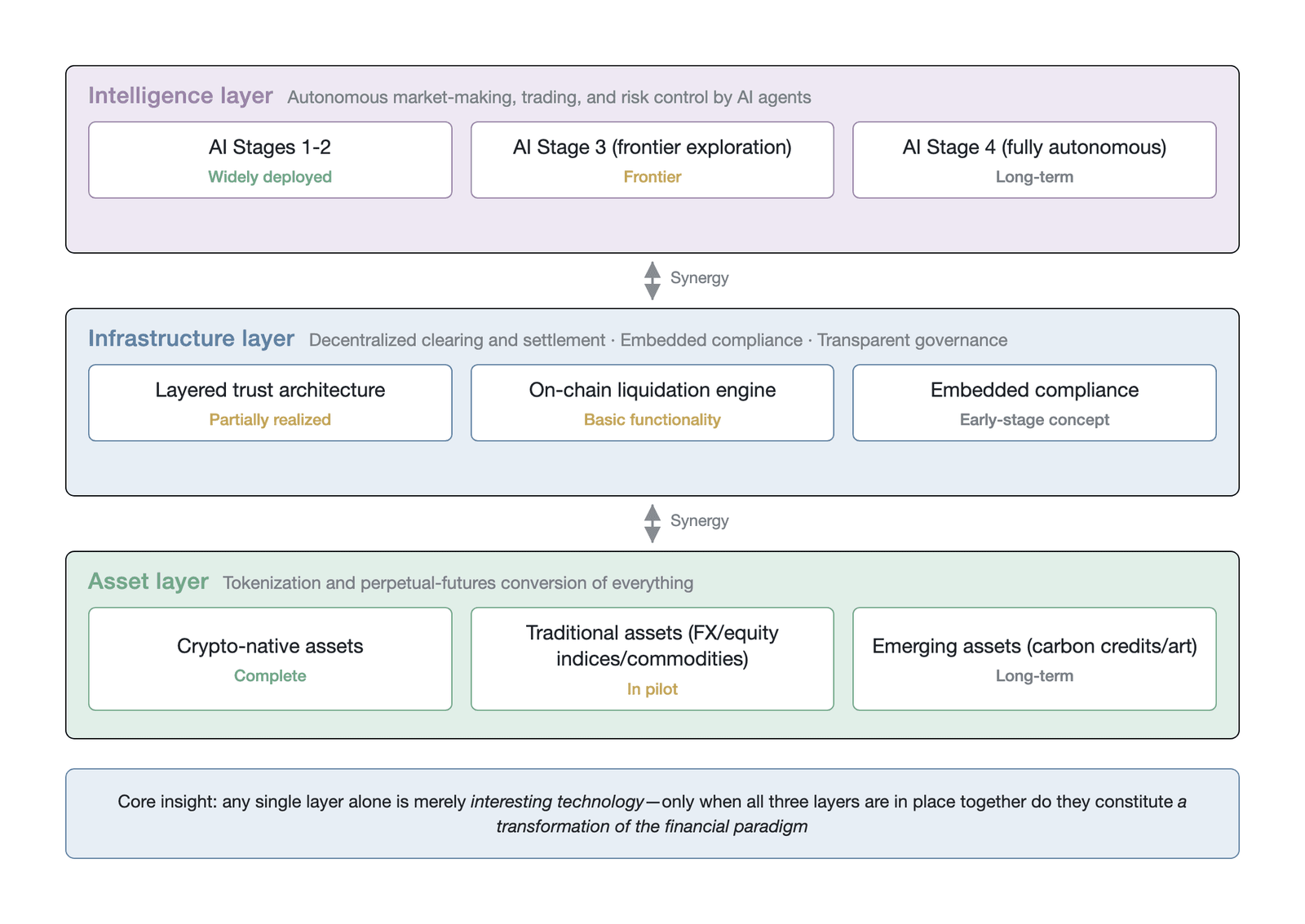
Figure 32-1. The three-layer stack architecture of autonomous finance (Data source: theoretical derivation in this chapter)
32.1.1 The asset layer
The asset layer is the cornerstone of the autonomous finance stack. In Chapter 27, we introduced the thought experiment of perpetual futures on everything, noting that the funding-rate anchoring mechanism is highly general: as long as a reliable external price source exists, any asset can be wrapped as a perpetual futures contract and traded. This mechanism substantially weakens the physical-delivery constraint of traditional finance (though it does not eliminate the constraint of geographic jurisdiction—that is, of regulation; see Section 32.5.3), allowing global investors to gain exposure to a given underlying through synthetic assets. In essence, the asset layer is a value-mapping layer that converts diverse forms of real-world value—from crypto assets to commodities, from equity indices to exchange rates—into digital forms tradable on-chain. This conversion appears simple, but it involves complex problems of pricing, risk management, and liquidity aggregation.
At present, the development of the asset layer shows a marked phased character. The conversion of crypto-native assets into perpetual futures has largely matured at the product level, but the design of the underlying mechanisms is still evolving: the sharp divergence of funding rates under extreme conditions, the inconsistency of mark prices across exchanges, and the sustainability of insurance funds over a complete market cycle have yet to be fully tested. According to the report published by CoinGecko in February 2026, the world's top 10 centralized and decentralized exchanges processed as much as $92.9 trillion in notional (leveraged) perpetual futures trading volume across full-year 2025, an increase of 64.6% over 2024 [1]. For some crypto assets, perpetual futures volume has already surpassed spot volume, making them an important venue for price discovery and liquidity aggregation. Decentralized perpetual futures exchanges achieved explosive growth of 346%, reaching an all-time high of $6.7 trillion in volume [1]. The DEX perpetual futures volume should be interpreted with caution: token incentives and airdrop-points programs may have driven substantial wash trading, so the figure represents notional volume, and actual organic volume may be substantially lower. These data show that on-chain derivatives markets have evolved from a niche field into an important component of global financial trading. This growth is driven by several factors. First, perpetual futures offer greater capital efficiency than spot trading, allowing traders to obtain larger exposure with less capital. Second, 24-hour uninterrupted trading meets the needs of global investors, particularly those in different time zones. Third, the permissionless nature of decentralized platforms attracts users who are excluded from traditional exchanges.
Extending this model to traditional assets, however, remains at the pilot stage. Some frontier decentralized platforms have begun to experiment with perpetual futures on foreign exchange, equity indices, and commodities. For example, in discussing Hyperliquid's HIP-3 permissionless deployment mechanism, the same CoinGecko report notes that the platform can create a perpetual market for any asset with a reliable price feed, spanning commodities and even underlyings such as SpaceX and OpenAI [1]. These experiments demonstrate technical feasibility, but their trading scale and market depth remain far below those of crypto-native assets. This asymmetry reflects a deeper reality: although the technology is ready, the confidence of market participants, the clarity of regulatory frameworks, and the accumulation of liquidity still require time. The core challenges facing the conversion of traditional assets into perpetual futures include oracle reliability (equity prices require real-time, accurate feeds), regulatory uncertainty (attitudes toward derivatives trading differ widely across countries), and the cold-start problem for liquidity (a new trading pair needs enough participants before an effective market can form). Despite these challenges, we have already seen preliminary successes, which lay a foundation for the further expansion of the asset layer.
As for the everything vision of fully tokenizing or converting into perpetual futures such non-standard assets as carbon credits, real estate, or art, this remains a long-term goal. Such assets face not only more complex oracle-feed difficulties but also the constraints of legal title and physical enforcement that arise when real-world assets are brought on-chain. A real-estate perpetual futures contract, for example, requires a reliable house-price oracle, yet global house-price data are far less standardized than equity or commodity prices. Moreover, if settlement of the perpetual futures involves physical delivery, then cross-border legal and logistical costs rise sharply. The challenge for carbon-credit perpetual futures lies in the fact that carbon markets themselves are still in an early stage of development, with pricing mechanisms differing widely across countries and regions, which makes it difficult to build a unified on-chain carbon-credit market. Perpetual futures on art and collectibles, in turn, face the problems of authentication and the subjectivity of valuation. The evolutionary path of the asset layer is therefore a gradual one—from highly digitized native assets, gradually penetrating standardized traditional financial assets, and ultimately perhaps reaching non-standard physical assets. This process may take a decade or longer, but its direction is clear.
32.1.2 The infrastructure layer
If the asset layer defines what is traded, the infrastructure layer defines how to trade safely. In Chapters 28 through 30, we examined the decentralized clearing engine, the layered trust architecture, and embedded compliance mechanisms. Under the traditional system, clearinghouses and custodian banks rely on sovereign credit and vast legal-compliance apparatus to guarantee the finality of transactions. In the autonomous finance stack, these functions are hard-coded into immutable smart contracts and consensus protocols.
The on-chain clearing engine is the core component of this layer. Modern decentralized exchanges have already implemented cross-margining and cross-clearing functions similar to those of a traditional central counterparty (CCP), but in a permissionless environment these engines must cope with higher volatility and more extreme market conditions. In 2025, the open interest on decentralized exchanges surged by 229.6% (over the same period, open interest on centralized exchanges fell by 20.8%, reflecting a rotation of capital from CEXs to DEXs; note that 229.6% is a growth rate rather than a level), indicating that market participants' trust in on-chain infrastructure is rising substantially—they are not merely engaging in short-term speculation but also building long-term, substantive capital positions [1]. From a risk perspective, however, the rapid growth of open interest is at the same time a signal of accumulating systemic leverage, and readers should cross-reference the corresponding risk analysis in Section 32.4. This trust is built gradually: each time the system successfully weathers extreme conditions without failing, participants' confidence is further reinforced. Even so, under stress testing for capital efficiency and extreme tail risk, current on-chain clearing mechanisms remain functionally basic and not yet fully optimized.
The layered trust architecture seeks a balance between decentralization and performance. By building application chains (app-chains) optimized specifically for derivatives trading, platforms can achieve sub-second trade confirmation and high throughput while anchoring the final settlement layer to a more decentralized underlying network. This architecture has already been validated on some leading platforms, but cross-chain liquidity fragmentation and cross-domain interoperability remain pressing problems. Imagine an investor who holds margin on chain A but wishes to trade an asset on chain B: this requires support from cross-chain bridges and liquidity protocols, which still carry technical and economic friction. Moreover, it is necessary to distinguish between architectural decentralization and operational decentralization. Most current derivatives app-chains anchor settlement architecturally to a decentralized base layer, yet remain highly centralized operationally: the sequencer is typically controlled by a single entity that orders transactions, the validator set is highly concentrated, and the platform retains emergency-intervention capabilities. Hyperliquid's 2025 JELLY incident—in which validators voted to freeze specific positions—shows that under extreme conditions the actual operating model of these platforms more closely resembles a centralized exchange with on-chain settlement than a genuinely decentralized protocol.
The least mature link in the infrastructure layer is embedded compliance. As Chapter 30 noted, for decentralized finance to enter the mainstream it must encode its responses to regulatory requirements. Technologies such as zero-knowledge proofs (ZKPs) and digital identity credentials provide a theoretical foundation for a system architecture in which lawbreaking is rendered impossible, but in actual deployment, how to establish a unified on-chain compliance standard across globally fragmented regulatory regimes remains at a very early, conceptual stage. The deeper obstacle is not only technical immaturity but also the fundamental incompatibility between zero-knowledge-proof compliance and existing legal frameworks: the U.S. Bank Secrecy Act requires financial institutions to be able to produce actual customer records, not merely to supply a cryptographic proof of compliance, while the EU's Anti-Money Laundering Directive requires transparent disclosure of beneficial ownership. A zero-knowledge proof can demonstrate that an address is not on a sanctions list, but it cannot satisfy regulators' record production obligations. U.S. anti-money-laundering rules, for example, conflict fundamentally with EU data-privacy rules, and there is as yet no clear answer to how a globalized on-chain system could satisfy both simultaneously.
32.1.3 The intelligence layer
The intelligence layer sits at the top of the autonomous finance stack. In Chapter 31, we analyzed the four stages of AI's penetration into on-chain finance. Although traditional quantitative trading has long been widespread, an autonomous finance network requires autonomous agents that can continuously assess risk, provide quotes, and execute complex strategies without human intervention.
At present, the use of AI in market making and algorithmic trading (that is, the first and second stages) is already widespread. In both centralized and decentralized markets, the overwhelming majority of liquidity is algorithm-driven. According to McKinsey's 2025 State of AI global survey, 62% of firms report at least experimenting with AI agents (about 23% have deployed them at scale in certain functions and 39% are at the experimental stage), indicating that the underlying technical foundation for the intelligence layer is accumulating at an accelerating pace [10]. On decentralized exchanges, because interfaces are fully open and smart contracts are composable, AI agents can conduct cross-market arbitrage and liquidity management more freely than in traditional financial systems. An AI market-making bot can provide liquidity simultaneously on multiple DEXs and automatically execute arbitrage when it detects a price inconsistency—all on a millisecond timescale.
Entering the third stage, however—highly autonomous AI conducting complex capital allocation and dynamic risk control within decentralized finance protocols—remains a frontier exploration. Such agents must handle risks specific to on-chain environments, including maximal extractable value (MEV) attacks, smart-contract vulnerabilities, and oracle latency. An AI risk-control system, for instance, must predict not only market risk but also the behavior of other AI agents and the possible failure modes of smart contracts. This is a far more complex problem than traditional risk control. As for the fourth stage—a fully autonomous market of AI versus AI, in which market microstructure is entirely dominated by machine logic—it remains a theoretical conception.
The core value of the intelligence layer lies in the way it substantially lowers the threshold and cost of liquidity provision. Most of what is currently called AI market making on-chain remains rule-based automated market making—adjusting automated market maker (AMM) parameters, running grid strategies, and the like—together with machine-learning-assisted parameter optimization, rather than end-to-end autonomous AI decision-making. Genuine autonomous market making is constrained by on-chain latency (approximately 200 milliseconds, compared with the microsecond-level response of centralized exchanges) and by pre-trade transparency (mempool visibility and the risk of sequencer front-running); these structural constraints make on-chain AI market making, at the current stage, closer to intelligent automation than to AI autonomy. In the incumbent financial architecture, market making is a capital- and technology-intensive privileged business in which only a few large institutions can participate. In the autonomous finance stack, open-source AI market-making bots combined with on-chain liquidity pools allow ordinary investors to participate in liquidity provision as well, thereby democratizing financial infrastructure. An individual holding a small amount of stablecoins can deploy a simple market-making bot to provide liquidity on a given trading pair and earn income from trading fees.
32.1.4 Synergies
Taken separately, each of the asset layer, the infrastructure layer, and the intelligence layer represents progress in a specific technology. Perpetual futures are an innovative financial derivative; on-chain clearing is an efficient piece of distributed-systems engineering; and AI trading agents are a successful application of machine learning. Developed in isolation, they would at most be interesting technologies. But when the three layers interweave and fall into place at once within a single permissionless network, they constitute a paradigm shift in finance.
This synergy is manifested first in the mutual reinforcement of liquidity and trust. The asset layer's perpetual futures on everything substantially expands the boundary of tradable underlyings, but without the decentralized clearing and immutable ledger provided by the infrastructure layer, traders would be unable to establish trust in a global network that lacks traditional legal protection. Conversely, without the around-the-clock, deep liquidity provided by the intelligence layer's AI agents, perpetual futures on long-tail or emerging assets would become unattractive because of excessively wide bid-ask spreads. A perpetual futures contract on an emerging-market currency pair, for example, would have prohibitively high trading costs without sufficient liquidity, losing its value as a hedging instrument. This positive reinforcing cycle also operates in reverse: when liquidity declines, trust erodes with it, triggering capital withdrawal that further depletes liquidity, forming the liquidity-spiral mechanism described by Brunnermeier and Pedersen (2009) [11]. The key question is what conditions trigger the system to switch from the positive cycle to the negative one—an issue developed further in the systemic-risk analysis of Section 32.4.
Second, the synergy is manifested in the reconciliation of compliance and innovation. The embedded compliance being explored in the infrastructure layer allows the asset layer to satisfy the regulatory requirements of a given jurisdiction while preserving permissionless access. The intelligence layer's risk-control agents can read these compliance parameters in real time and automatically adjust trading strategies, ensuring that capital is allocated globally without crossing regulatory red lines. This hard-wiring of compliance and trading logic at the code level is unimaginable in traditional systems built from human compliance officers and cumbersome paper documents. A zero-knowledge proof can demonstrate that a trader satisfies a specific compliance condition (for example, that the trader is not a U.S. person) without revealing the trader's true identity.
Finally, the combination of the three layers unlocks capital efficiency. In traditional finance, an investor who wants to hedge foreign-exchange risk, invest in U.S. technology stocks, and short a commodity all at once must cross multiple time zones, open different brokerage accounts, and endure lengthy settlement cycles. In the autonomous finance stack, through the composability of smart contracts, an AI agent can, within milliseconds and using the same stablecoin margin, establish all three positions simultaneously with the support of a decentralized clearing engine. All friction is abstracted away, and capital flows freely, without borders and without time-zone lag.
This synergy also appears along the risk-management dimension: when the three-layer stack is fully in place, risk is no longer isolated but understood and managed by the entire system—the diversification of the asset layer lowers single-asset risk, the transparency of the infrastructure layer supports real-time monitoring, and the automation of the intelligence layer enables rapid response.
Although the components of the autonomous finance stack differ in maturity, its core skeleton is already in place. The success of crypto-native assets has proven the feasibility of the underlying logic, while the evolution of infrastructure and the spread of AI agents are accelerating the network's expansion into the broader field of traditional finance. This is not merely an upgrade of trading tools; it is a fresh answer to the fundamental question of who should build financial systems, who should run them, and whom they should serve.
From a systems-theory perspective, the core value of the three-layer stack lies in its emergence. When the asset layer provides sufficiently diverse underlyings, the infrastructure layer provides sufficiently reliable clearing mechanisms, and the intelligence layer provides sufficiently efficient liquidity, the system as a whole spontaneously evolves new functions and possibilities. These new functions are not preplanned by any single layer's designers but emerge naturally from the interaction of the three layers. Cross-asset automatic hedging strategies, dynamic risk management, and even new forms of financial products, for example, may all arise spontaneously within this system. The magnitude of the synergy can be illustrated with a conceptual example. In a three-asset portfolio of BTC, the S&P 500, and gold, because the correlation matrix among the three exhibits a substantial negative-correlation component in most market environments, the aggregate margin requirement under cross-margining can be 30% to 50% lower than under the isolated-account model. This estimate, however, requires three important qualifications: (1) the 30% to 50% margin saving assumes that the correlation structure remains stable under normal market conditions; (2) under stress scenarios, cross-asset correlations tend toward 1 (systematically demonstrated by Forbes and Rigobon (2002) [12]), at which point the margin saving may narrow to as little as 5% to 15%; and (3) no on-chain DEX currently offers perpetual futures on BTC, the S&P 500, and gold simultaneously, so this portfolio serves only as a conceptual example rather than a currently realizable trading strategy. This means that the same amount of principal can support greater risk exposure within the three-layer stack, but this gain in capital efficiency also implies greater system fragility to extreme jumps in correlation. When cross-asset correlations tend toward 1 under stress, the margin buffer contracts far faster than under the isolated-account system (see Section 32.4.1 for a dedicated analysis of cross-margining risk under stress scenarios).
As the foregoing analysis shows, the components of the three-layer stack differ significantly in maturity, and this difference means that the pace of the whole system's evolution will be constrained by how quickly its weakest link can be overcome. Table 32-1 summarizes the core functions, current maturity, and key bottlenecks of each layer of the three-layer stack, providing a baseline reference for the later sections' analysis of the real-world constraints on the three-layer synergy.
| Layer | Core function | Current maturity | Key bottleneck |
|---|---|---|---|
| Asset layer | Converts underlyings into on-chain perpetual futures | Crypto-native assets mature; traditional assets at the pilot stage; non-standard assets a long-term prospect | Oracle reliability, regulatory clarity, liquidity cold start |
| Infrastructure layer | Decentralized clearing and settlement, and embedded compliance | Clearing engine functionally largely complete; cross-chain interoperability fragile; embedded compliance at the concept stage | Cross-chain liquidity fragmentation, unification of global compliance standards |
| Intelligence layer | Autonomous market making, risk control, and strategy execution by AI agents | Market making and arbitrage widely deployed (stages one and two); autonomous capital allocation at the frontier (stage three) | Perception of on-chain-specific risks, explainability, strategy homogenization |
Table 32-1. Maturity comparison across the three-layer stack (Data source: based on the analysis in Sections 32.1.1–32.1.3)
The engineering properties of the three-layer stack—permissionless access, extremely low barriers to participation, and globally accessible infrastructure—correspond directly to the scale of global financial exclusion. Translating this technical potential into financial inclusion, however, requires distinguishing the essential difference between lowering barriers to entry and effective empowerment.
32.2 The structural constraints on financial inclusion
The existence of billions of unbanked people worldwide makes financial inclusion not merely a moral appeal but a systemic problem with clear engineering constraints. The technical properties of the three-layer stack in lowering friction costs and barriers to entry correspond directly to the core pain points these populations face—foreign-exchange hedging, inflation-resistant savings, and low-cost cross-border payments. Beginning from the genuineness of the demand, this section examines the inclusive potential of perpetual futures, on-chain infrastructure, and AI agents, then confronts the unavoidable structural constraints of financial-literacy gaps, the digital divide, and the inclusion trap.
32.2.1 Genuine demand
When we speak of financial inclusion, we must first establish the genuineness and urgency of these needs. According to the 2025 edition of the World Bank's Global Findex Database, roughly 1.3 billion adults worldwide remain unbanked (account ownership has risen to about 79%; the earlier literature's range of 1.3 billion to 1.7 billion reflects differences across survey years such as 2017, 2021, and 2025), a group concentrated primarily in developing countries in Asia, Africa, and Latin America [2] [3]. Behind these numbers lie genuine economic hardship and the erosion of wealth. Small-business owners in emerging markets face the daily risk of local-currency depreciation, yet no effective foreign-exchange hedging instrument is available to them. Traditional commercial banks typically do not offer forward FX contracts or options to small customers, and even when they do, the high fees and margin requirements deter micro and small enterprises. This scarcity of financial instruments leaves such firms defenseless against global macroeconomic fluctuations, and their profits may shrink sharply because of exchange-rate movements.
Beyond exchange-rate risk, savers in developing countries also face persistent erosion from inflation. In many emerging-market economies, inflation has long held at elevated levels; average inflation in emerging markets and developing economies in 2024, for example, was about 8% (approximately 8.1% per the International Monetary Fund (IMF) World Economic Outlook), while the 2025 forecast is about 5.3% (on the basis of the IMF's October 2025 World Economic Outlook) [13]. In this environment, if savers can only hold their money in local currency at home or in local bank accounts with extremely low yields, the real purchasing power of their wealth will inevitably shrink. Yet because of capital controls, high account-opening thresholds, and complex cross-border compliance requirements, these savers can almost never obtain exposure to international assets. Unlike investors in developed countries, they cannot hedge local inflation risk by buying an S&P 500 index fund or U.S. Treasuries. This absence of investment channels is, in essence, a structural form of wealth deprivation.
In addition, the world's tens of millions of cross-border remittance workers likewise bear the heavy costs of an inefficient financial system. These workers leave their hometowns to labor in foreign lands and remit their savings home to support their families. According to World Bank and IMF data, however, the average cost of personal cross-border remittances has long held at around 6% (recent World Bank data put it at approximately 6.2% to 6.65%, still more than twice the Sustainable Development Goals' 3% target), and in some regions it is even higher [14] [15]. This means that tens of billions of dollars each year are consumed by financial intermediaries in the friction of cross-border transfers—money that could otherwise have improved the lives, education, and health of poor families. These needs—foreign-exchange hedging, inflation-resistant savings, and low-cost cross-border payments—are not false demand created by financial engineering but genuine pain points that billions of people worldwide face every day.
32.2.2 The inclusive functions of perpetual futures
Confronted with these genuine financial needs, the traditional financial system—because of its high operating costs, complex compliance requirements, and path dependence on high-net-worth clients—has consistently failed to provide effective solutions. The perpetual futures examined in Chapter 27, once combined with decentralized infrastructure, show the potential to become a powerful instrument of inclusion. Foreign-exchange perpetual futures give small-business owners in emerging markets a hedge against local-currency depreciation at a cost significantly below that of traditional solutions. Unlike a traditional bank's forward contract, participating in on-chain FX perpetual futures requires no complex credit review or high account-opening threshold. A small-business owner needs only a smartphone wallet and a small amount of stablecoins to establish, on a decentralized exchange, a perpetual futures position opposite to the firm's actual exposure. Because perpetual futures are tightly anchored to the spot price through the funding-rate mechanism, this hedge can precisely offset the losses caused by local-currency depreciation; and on liquid major trading pairs, the empirical analysis of on-chain stablecoin foreign exchange by Adams et al. (2023) [16]—using EUROC/USDC as a proxy for EUR/USD—shows that the on-chain trading price deviates from the traditional-market exchange rate by an average of about 5 basis points during normal trading hours. For a $500 on-chain cross-border transfer, the cost in the best case is about $4.80, roughly 83% lower than the $28 charged through traditional banking channels. Liquidity-provider fees for on-chain AMM spot swaps are typically about 1 to 5 basis points (0.01% to 0.05%), far below the spreads and credit-review costs embedded in traditional bank forward contracts, substantially lowering the economic threshold for small conversions. The cost-advantage figures above, however, derive primarily from empirical analysis of major currency pairs such as USDC/EUROC; for the small-currency pairs of emerging markets, on-chain FX liquidity remains limited and spreads may reach 50 to 200 basis points. Moreover, the full-stack cost must also include the on-ramp and off-ramp costs between fiat and stablecoins (typically 2% to 5% in emerging markets), which substantially narrows the cost advantage of on-chain solutions for end users who still need fiat conversion.
For savers in developing countries facing inflationary erosion, equity-index perpetual futures and commodity perpetual futures offer a channel across geographic and institutional barriers. In the traditional financial world, an ordinary saver in India or Nigeria who wishes to invest in the U.S. stock market must overcome layer upon layer of obstacles—foreign-exchange controls, opening an overseas securities account, and meeting minimum-capital requirements—which is entirely impossible for the great majority of people. Through synthetic-exposure perpetual futures (whose frictionless mechanism for decoupling an asset's economic attributes from physical ownership is detailed in Section 32.3.3), with only $100 worth of stablecoins this saver can gain precise on-chain exposure to the S&P 500 or gold, fundamentally breaking the monopoly under which high-quality assets are reserved for the rich and for residents of developed countries.
Going further, the combination of stablecoins and perpetual futures can, in a sense, substitute for—or even surpass—the function of a traditional savings account. In a country with high inflation and an unstable local currency, holding a dollar-pegged stablecoin is itself a defensive strategy. If the user further uses these stablecoins as margin to provide liquidity or adopt a particular hedging strategy in the perpetual futures market, the user can also earn a continuous stream of funding-rate income. In a market environment of strong long demand, this funding-rate-based yield is often far higher than the deposit rates of traditional banks. This combination not only protects the purchasing power of the principal but also creates positive cash flow, providing the unbanked with a fully functional synthetic yield strategy. Yet the risk profile of this strategy differs fundamentally from that of traditional savings: the funding rate can remain negative for extended periods, at which point the yield turns into a continuous cost outflow; even under low leverage, extreme conditions can still trigger margin calls or forced liquidation; and stablecoins themselves carry depegging risk, as the 2022 collapse of UST to zero and the temporary fall of USDC to $0.87 in March 2023 both illustrate. A user who understands such a strategy as savings without fully recognizing these risks is a textbook case of the inclusion trap discussed in Section 32.2.5. In addition, Rajan (2006) [17] argued that an inherent tension exists between the proliferation of financial instruments and the diffusion of systemic risk: as more participants gain access to complex instruments, the total quantity of risk-taking and the pathways of its transmission expand in tandem. The democratization of perpetual futures faces the same dilemma, and its potential negative effects are discussed in detail in Section 32.2.5.
32.2.3 The inclusive properties of the infrastructure
The reason perpetual futures can be transformed from a high-risk speculative instrument into a vehicle for financial inclusion is fundamentally that the on-chain infrastructure on which they run possesses three core properties absent from the traditional financial system: permissionlessness, extremely low barriers, and global accessibility. First, permissionlessness is the most powerful force for breaking down financial exclusion. In traditional finance, know-your-customer (KYC) and anti-money-laundering (AML) requirements—though motivated by the reasonable goal of preventing financial crime—in effect exclude enormous numbers of people. Hundreds of millions worldwide are permanently locked out of the formal financial system because they lack official identification, have no fixed address, or have a blank credit history. The execution logic of smart contracts on decentralized exchanges contains no conditional test of a user's identity attributes; they verify only cryptographic signatures and margin adequacy. This architecture, which executes undifferentiated logic for every participant meeting the verification conditions, gives those abandoned by traditional systems an equal right to participate. Under the current legal framework, however, permissionlessly offering leveraged derivatives to the public constitutes a violation in multiple jurisdictions. The Commodity Futures Trading Commission (CFTC) has brought enforcement actions against offshore decentralized protocols such as Ooki DAO, alleging that they offered unregistered derivatives products to U.S. users. This tension between inclusive value and compliance obligation is precisely the concrete mapping of the trilemma analyzed in Section 32.5.2.
Second, on-chain infrastructure lowers the barrier to participation in financial instruments to a level the traditional system cannot reach. On traditional derivatives markets such as the Chicago Mercantile Exchange, participating in futures trading typically requires thousands or even tens of thousands of dollars of initial margin, which necessarily confines the market to institutional investors and high-net-worth individuals. By contrast, because the automated liquidation mechanism of smart contracts eliminates the fixed costs of human intervention and intermediaries, the minimum margin requirement for on-chain perpetual futures can be as low as $1 to $10 (Hyperliquid and other decentralized platforms, for example, allow positions to be opened with single-digit dollar amounts). This micro-level divisibility lets financial instruments precisely fit the actual capital scale of low-income populations in developing countries. A small vendor with only a few dollars of surplus a day can use the most advanced financial derivatives to manage micro-level risk. But the technical minimum threshold does not equal economic accessibility. Take a position with $10 of margin and 10x leverage ($100 notional): a single open-and-close round trip of taker fees plus spread may consume 0.5% to 1% of the margin, and once funding rates are added, the cost efficiency of a very small position is significantly lower than that of a larger one. The gap between technical reachability and economic viability must be assessed with care.
Finally, the global accessibility of on-chain systems eliminates the financial-island effect created by geographic borders. Traditional financial markets are highly fragmented, and the regulatory pricing islands discussed in Chapter 18 are commonplace in reality. Residents of different countries can access only the limited products that local financial institutions are willing or permitted to offer. Financial infrastructure deployed on a public blockchain, by contrast, is a single global state machine. As long as there is an internet connection, a farmer in a remote African village and a hedge fund manager on Wall Street access exactly the same liquidity pool and face exactly the same execution logic and transaction costs. This globally unified infrastructure substantially narrows the geographic disparity in the supply of financial services.
32.2.4 The democratization of AI financial advisers
If perpetual futures and on-chain infrastructure solve the problems of the supply and reach of financial instruments, the introduction of AI agents addresses the core cognition and execution bottlenecks of financial inclusion. In the traditional wealth-management industry, professional financial-advisory service is an expensive luxury. A qualified private banker able to provide asset allocation, dynamic hedging, tax optimization, and risk management typically serves only high-net-worth individuals with investable assets exceeding $1 million and charges thousands to tens of thousands of dollars a year in advisory and management fees [18]. For the vast majority of ordinary people worldwide, professional financial advice at this level is entirely inaccessible. They can only rely on their own intuition, limited common sense, or unreliable recommendations from social networks to make financial decisions, which often leads to serious consequences.
The intelligence layer of the autonomous finance network is democratizing this expensive professional service through large language models (LLMs) and specialized reinforcement-learning algorithms. An AI financial agent can be regarded as a tireless, emotionless around-the-clock private banker with extremely low marginal cost. Consider a small-business owner in Jakarta. She need not understand complex funding-rate mechanisms or implied volatility; she need only state her need to her AI agent in natural language: "Please protect the rupiah I've set aside for next month's inventory purchases from losses caused by dollar appreciation." The AI agent automatically converts these funds into stablecoins, seeks the deepest-liquidity rupiah-to-dollar perpetual futures on the optimal decentralized exchange, computes the precise hedge ratio, executes the trade automatically, and, when market conditions change or the Federal Reserve (Fed) issues an unexpected statement, automatically adjusts the position within the limits allowed by block-confirmation time.
This AI-as-a-service model not only lowers the operational threshold; more importantly, it bridges the vast gap in ordinary users' financial literacy. An AI agent can monitor a portfolio's risk exposure in real time and set strict stop-loss logic, preventing users from taking on devastating losses through cognitive bias or emotional loss of control. In traditional finance, risk control is imposed by institutions to protect their own interests; in an autonomous finance network, the AI agent is the user's personal fiduciary, whose sole objective is to maximize the user's utility and control downside risk. By encapsulating complex financial-engineering logic beneath a friendly natural-language interface, AI agents allow the most advanced derivatives instruments to serve safely those with the least financial knowledge—and this is the essence of what technology contributes to financial inclusion. However, behavioral-finance research shows that lowering transaction friction may actually intensify overtrading and erode retail returns (Barber and Odean, 2001 [19]). While a natural-language interface lowers the operational threshold, it may also mask the complexity of the underlying derivatives position: when a user issues a simple hedging instruction, the user may not understand that they are opening a leveraged perpetual futures position that carries liquidation risk. Moreover, AI agents at present bear no fiduciary duty and are subject to no regulatory accountability, and when a strategy recommended by an AI leads to a margin call or blow-up, how responsibility is allocated among the user, the developer, and the protocol remains an unresolved legal question.
The foregoing analysis shows that the path to realizing financial inclusion involves three progressive layers—identifying genuine demand, matching technical tools, and responding to structural constraints (Figure 32-2).
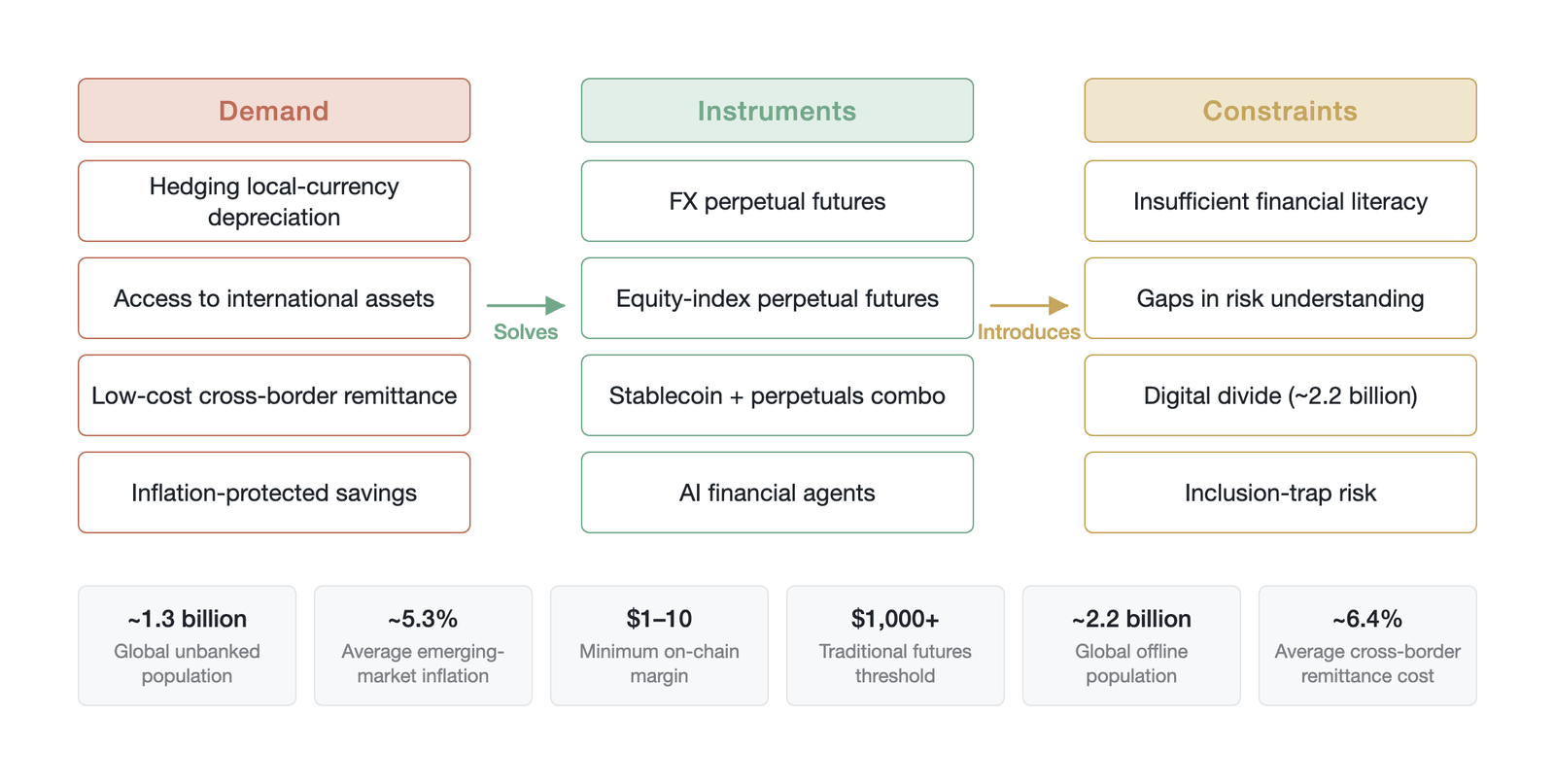
Figure 32-2. An analytical framework for financial inclusion: demand, tools, and constraints (The figure is organized in three columns—demand, tools, and constraints; the left column lists three categories of core pain points, namely foreign-exchange risk, inflation erosion, and cross-border remittance costs, each broken down into specific items that map respectively to the tool solutions in the middle column and the structural constraints in the right column; the framework structure is a theoretical derivation of this chapter; the empirical anchors at the bottom of the figure have been updated to the latest verifiable values: the global unbanked population is approximately 1.3 billion, per the 2025 edition of the World Bank's Global Findex Database, survey year 2024 [2][3]; average inflation in emerging markets and developing economies is approximately 5.3%, per the IMF's October 2025 World Economic Outlook projection, whereas the approximately 8% cited in the main text is the 2024 realized value, the two being different measures; the global offline population is approximately 2.2 billion, per the International Telecommunication Union's Facts and Figures 2025 [7]; the average cost of cross-border remittances is approximately 6.4%, per the World Bank's Remittance Prices Worldwide for the third quarter of 2025, with a global mean of 6.36%; the on-chain minimum margin of approximately $1 to $10 and the traditional-futures threshold of more than $1,000 are product facts, detailed in Section 32.2.3; empirical data as of June 2026)
32.2.5 Real constraints
Yet the analysis of the preceding 31 chapters has repeatedly shown that any leap in technological paradigm comes with irreducible costs. As we celebrate the inclusive vision that the three-layer stack brings, we must remain soberly realistic and confront the real constraints that impede this vision. These constraints are not temporary technical problems but structural features of inclusive finance itself.
The first is the fundamental deficiency of financial literacy and risk understanding. Although AI agents can assist decision-making to a large degree, the ultimate bearer of risk is still the user. Perpetual futures are in essence a leveraged derivative; while they can effectively hedge foreign-exchange or inflation risk, they also introduce entirely new liquidation risk, smart-contract-vulnerability risk, and oracle-failure risk. For the user, the nature of the risk has shifted, but the total quantity of risk has not necessarily decreased. This is the concrete manifestation, within inclusive finance, of the distinction between risk transfer and risk elimination discussed in Chapter 25. If a user who wholly lacks financial common sense blindly participates in highly leveraged trading merely because the barrier to entry has fallen, then this inclusion is in essence the exposure of users who lack risk-management capacity to higher leverage risk. In fact, the constraint lies not only in the absence of financial literacy. Behavioral-finance research shows that even sophisticated investors with professional knowledge systematically exhibit overconfidence and loss aversion, which makes derivatives products fundamentally at odds with the human cognitive architecture rather than merely a knowledge gap that education can bridge. Not only does it fail to improve users' economic circumstances; it can accelerate the destruction of their wealth. This phenomenon has many precedents in financial history. In the 2008 subprime mortgage crisis, many low-income American households were encouraged to enter complex mortgage products they did not understand, ultimately leading to mass loss of housing. Similar tragedies have played out repeatedly in microfinance, where many products billed as inclusive, but usurious in nature, ultimately drove poor populations into deeper debt traps.
Second, we must confront the harsh digital divide. On-chain finance's permissionlessness rests on the implicit premise of possessing the capacity for digital access. In the real world, however, technology itself is a powerful barrier to entry. According to data from the International Telecommunication Union (ITU) and the GSMA, a large share of the world's population still lacks access to mobile internet (the ITU estimates that about 2.6 billion people are entirely offline—a 2023 figure since revised down to about 2.2 billion for 2025 [7]; the GSMA estimates that a further 3 billion-plus people fall within mobile-network coverage yet do not use mobile internet, the so-called usage gap [8]); they either lack a smartphone or cannot obtain a stable, reliable internet connection. This number even exceeds the size of the world's unbanked population. For those in conditions of extreme poverty and infrastructural scarcity, the most advanced on-chain perpetual futures and AI agents are meaningless. They cannot participate in the autonomous finance network—not for lack of permission, but for lack of the most basic means of technical access. The existence of this digital divide makes the inclusive promise of autonomous finance inherently limited. If the expansion of the autonomous finance network merely gives better investment tools to a middle class that already owns digital devices and internet access, while further marginalizing the bottom 3 billion, then this technological evolution will aggravate rather than alleviate global inequality. This is a disquieting reality but one that must be faced.
Finally, we must be wary of the so-called inclusion trap. In financial history, cases of predation in the name of inclusion are common, from subprime mortgages to certain usurious forms of microfinance, all of which drove vulnerable groups deeper into debt. If the actual operating result of the autonomous finance network is to draw more retail investors who lack risk tolerance into a complex market they do not understand at all, making them the liquidity counterparties of institutional market makers and high-frequency trading algorithms, then it degenerates into a mechanism for democratizing risk—pushing risk downward. This democratization of risk is fundamentally different from financial inclusion. The former spreads the burden of risk evenly across everyone, including those least able to bear it; the latter helps people manage risk better through education, protection, and empowerment. Financial inclusion is by no means simply lowering barriers to entry; it must combine effective tools, systematic education, and embedded risk control. The three-layer stack provides powerful tools, but how to build a supporting system of social education, how to design ethical norms that prevent the technology from being abused, and how to ensure that the most vulnerable groups do not become the system's sacrifice will be the key constraints determining where this vision ultimately leads. These questions cannot be answered by technology itself; they require the deep involvement of society, policymakers, and ethicists.
The real constraints on inclusion show that the accessibility of financial instruments is only half the equation; the other half is whether users can wield these instruments effectively while fully understanding the risks. Even as the three-layer stack lowers barriers to entry, it is also reshaping the way global capital is allocated.
32.3 The globalization of capital-allocation efficiency
Global capital markets are nominally highly interconnected, but at the microstructural level they remain deeply divided by geographic barriers, session limits, and unequal access. Through mechanisms such as synthetic exposure, around-the-clock continuous pricing, and cross-margining, the three-layer stack fundamentally changes how capital crosses these barriers. This section analyzes the concrete manifestations of the current fragmentation of global capital allocation, assesses the efficiency gains of the three-layer stack in eliminating temporal and spatial friction, and asks about the distributional effects of this efficiency dividend: who are the main beneficiaries, and who will bear the costs of creative destruction.
32.3.1 The current fragmentation of capital allocation
The fragmentation of global capital markets is manifested first in entrenched geographic barriers. The financial markets of different countries are strictly separated by legal jurisdictions, clearing systems, and monetary boundaries. An ordinary investor in Jakarta who wishes to buy U.S. technology stocks must clear numerous obstacles, including opening an offshore securities account, converting currency, and paying steep cross-border remittance fees. Conversely, capital in New York seeking to invest in high-yield Indian bonds likewise faces complex qualified-foreign-investor quotas and capital controls. This geographic segregation produces pronounced market segmentation, so that assets with identical risk characteristics may be priced very differently across markets [20].
Beyond geographic barriers, session limits are another important factor behind market fragmentation. Modern economic activity proceeds around the clock, and information is generated continuously in every corner of the globe, yet the trading hours of core capital markets still adhere to an industrial-age timetable. The core trading session of the New York Stock Exchange, for example, is limited to 9:30 a.m. to 4:00 p.m. Eastern Time. Major geopolitical events, corporate earnings releases, or macroeconomic data published outside these 6.5 hours cannot be immediately reflected in prices. This session limit artificially severs the immediate transmission between information and price, producing sharp price gaps at the open [21]. Information not priced in time not only increases market uncertainty but also leaves investors across time zones in a passive position when managing risk.
In terms of access mechanisms, the traditional financial system embeds a deep inequality between institutions and retail investors. Large multinational institutional investors can obtain exposure to almost any market and any asset through global custodian-bank networks, prime brokerage services, and complex derivatives instruments. They enjoy privileged channels that cross geographic and temporal barriers. For the vast majority of retail investors worldwide, however, this capacity for global allocation is out of reach. They are confined to local markets and can only passively accept the inflation risk of their own currency and the systemic risk of a single market. This inequality of access, in essence, reserves the world's best investment opportunities and hedging instruments for groups that already possess a capital advantage [22].
The cost of this fragmentation is high: it directly produces enormous losses in the efficiency of global capital allocation. When capital cannot flow freely and frictionlessly, funds cannot reach the places with the highest expected returns in time. In some emerging markets there may be highly promising innovative firms and high-yield projects whose development is constrained by the absence of channels for global capital injection; meanwhile, in developed economies, large amounts of surplus capital may be able to circulate only among low- or even negative-yielding assets. The fragmentation of global capital allocation not only lowers overall economic productivity but also aggravates the imbalance in wealth distribution.
These three forms of fragmentation—geographic barriers, session limits, and unequal access—together constitute the microstructural basis of the current losses in global capital-allocation efficiency; Figure 32-3 contrasts the current state of fragmentation with the target state after integration by the three-layer stack.
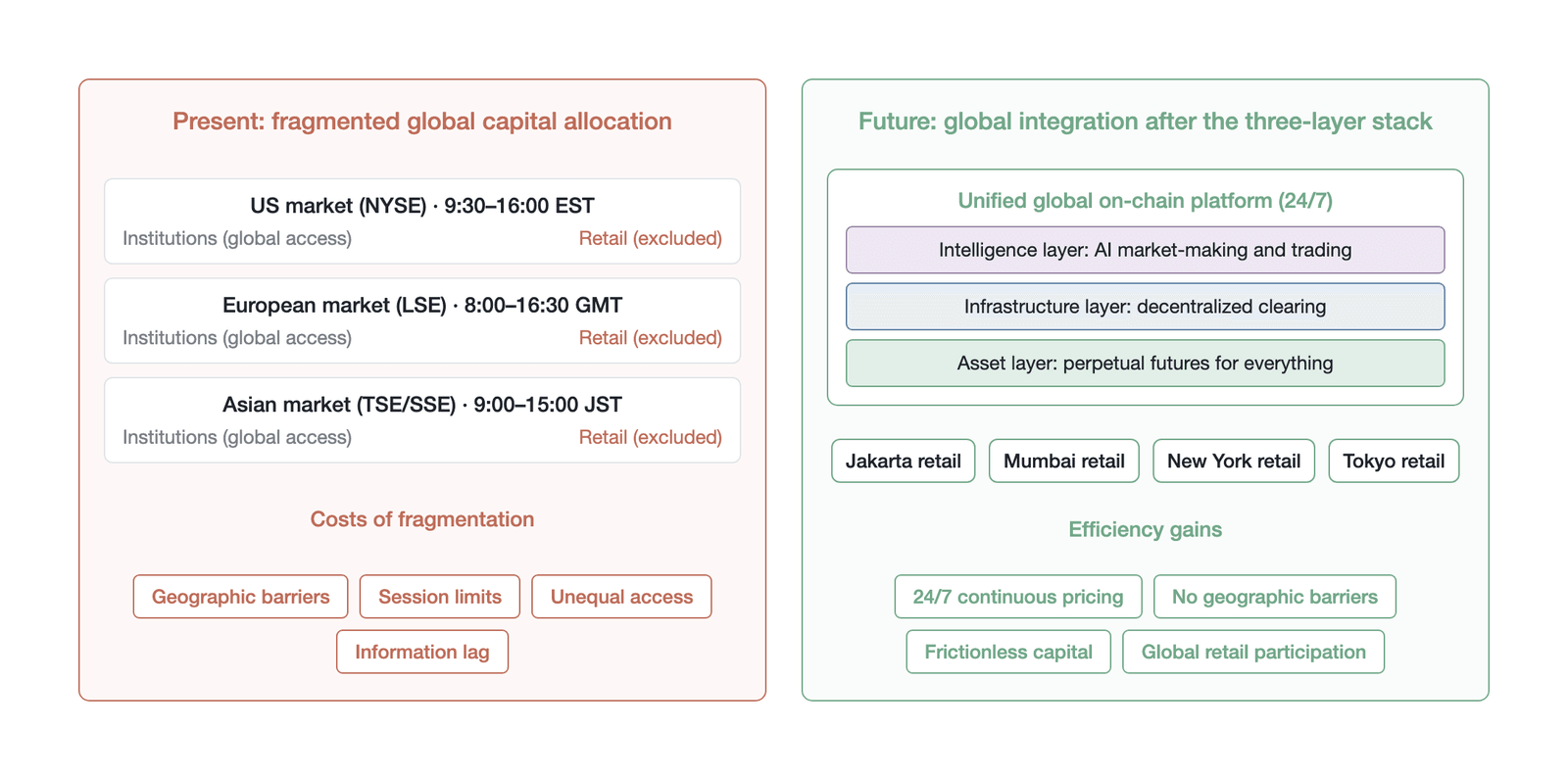
Figure 32-3. Fragmented global capital allocation versus integration by the three-layer stack (Data source: theoretical derivation in this chapter)
32.3.2 Around-the-clock continuous pricing
In an autonomous finance network, session limits are eliminated and replaced by an around-the-clock global continuous-pricing mechanism. As the Tesla-stock simulation in Chapter 27 showed, around-the-clock pricing substantially reduces the magnitude of opening gaps caused by weekend information backlogs. In that thought experiment, a sudden event occurring over the weekend no longer had to wait for the Monday-morning opening bell; market participants could trade and hedge promptly once information was generated. Existing crypto-market data show, however, that around-the-clock operation does not mean an even distribution of liquidity. Public data show that order-book depth for major trading pairs exhibits a strong diurnal cycle, falling by about 40% during the low-activity hours after the U.S. market close relative to the intraday peak (estimated from public data on single trading-pair samples such as those on Binance); what declines over the weekend, however, is chiefly trading-volume share and the spread, while order-book depth itself does not fall in step. Low-liquidity windows can transform gap risk into thin-market abnormal-volatility risk, and the slippage a stop-loss order experiences in a liquidity vacuum can far exceed expectations. This effect especially threatens retail users in emerging markets, who may trade during the windows of lowest liquidity in the global cycle.
When this mechanism extends from a single asset to all major global assets, the resulting efficiency gain is structural. From U.S. equities to European sovereign bonds to Asian agricultural commodities, all assets trade continuously on a single global platform with no concept of a close. Because trading hours cover all geographic time zones with no market-closed window, the price-discovery process is no longer disturbed by artificially set trading periods. New information generated at any moment—whether macro data from Tokyo, a central-bank decision from London, or a technological breakthrough from Silicon Valley—can be translated into movements in global asset prices with extremely low latency.
This continuous-pricing mechanism reduces the excess volatility that arises in traditional markets from information backlogs. In fragmented markets, unpriced information accumulated during market closures is often released all at once at the instant of the open, causing liquidity to dry up and prices to swing violently. In an around-the-clock market, by contrast, information is digested smoothly and continuously. Investors in different time zones can participate in the market according to their own schedules: Asian investors digest Asian information during their day, and European and American investors take up the relay during their respective active hours. This relay not only provides continuous liquidity but also allows prices to reflect an asset's true fundamentals more accurately [21].
More importantly, continuous pricing eliminates the timing-mismatch risk of cross-market arbitrage. In the traditional system, because different markets' trading hours do not overlap, cross-market hedging often faces enormous execution risk. Attempting to hedge a spot exposure in the U.S. market with a derivative in the Asian market, for example, requires bearing the price-movement risk created by the gap between the two markets' opening times. On a unified around-the-clock platform, by contrast, the prices of all related assets update synchronously, so complex cross-market, cross-asset-class arbitrage and hedging strategies can be executed precisely, further improving the pricing efficiency of global markets.
32.3.3 Frictionless capital flows
Beyond temporal barriers, innovations in the asset and infrastructure layers let the autonomous finance network achieve frictionless global capital flow. The core of this shift lies in the mechanism of synthetic exposure, and in particular the widespread use of perpetual futures. In the traditional model, by contrast, obtaining the economic return of an asset generally requires physical settlement—that is, actually buying and holding the asset. This transfer of physical ownership comes with cumbersome legal procedures, cross-border settlement delays, custody fees, and foreign-exchange conversion costs [23].
Perpetual futures largely decouple an asset's economic attributes from its physical ownership. An investor in Mumbai who is bullish on the long-term prospects of the U.S. technology sector no longer needs to go through a complex account-opening and currency-purchase process to buy a real Nasdaq index fund. Through perpetual futures built on on-chain infrastructure, the investor need only use stablecoins as margin to obtain price-movement returns identical to those of holding the real stock. In this process, no real stock crosses a border and no cross-border capital flow occurs in the traditional sense, yet the purpose of capital allocation is perfectly achieved. All friction costs—from clearinghouse fees to custodian-bank cuts to the spreads of foreign-exchange market makers—are sharply compressed. This decoupling conceals an extreme-scenario risk not yet fully examined: when the underlying asset's liquidity dries up or the protocol suspends trading in a specific asset, holders of synthetic exposure may find their exit channel closed, trapped in a state of phantom liquidity in which a position is nominally liquid but in fact cannot be closed. The 2008 synthetic CDO crisis already demonstrated that the liquidity illusion of synthetic instruments can shatter in an instant under stress.
The cross-margining mechanism of on-chain infrastructure pushes this frictionless flow further still. In a traditional fragmented account system, capital is used very inefficiently. An investor's funds may be scattered across a stock account, a foreign-exchange account, and a commodity-futures account, each of which must independently maintain high margin. Even if the investor holds a large unrealized gain in one account, it cannot be used directly to meet a margin call in another. This siloing of funds forces investors to hold large idle cash buffers. In the unified clearing network built by the three-layer stack, by contrast, the same stablecoin margin can support cross-asset positions at the same account level and, by exploiting negative correlations among assets, lower the overall margin requirement (the mechanism and its quantitative range are detailed in Section 32.1.4), giving the same principal far greater risk exposure and allocation flexibility than an isolated-account system. A structural vulnerability of this unified-margin architecture is single-collateral concentration risk. When all cross-asset positions are denominated in a single stablecoin, collateral value and margin adequacy become perfectly positively correlated. During the March 2023 episode in which USDC depegged to $0.87, a cross-margining system denominated purely in USDC would face an approximately 13% decline in the margin adequacy ratio across all positions, triggering cascading liquidations unrelated to the performance of any underlying asset. It is precisely to avoid this concentration risk that traditional prime brokers accept a diversified basket of collateral.
32.3.4 Welfare analysis and distributional effects
When the friction of global capital allocation is minimized and efficiency rises sharply, we must ask: who exactly enjoys this efficiency dividend? Traditional financial innovation has often benefited Wall Street's large institutions first, but the welfare distribution brought by the autonomous finance network presents a strikingly different picture.
The greatest beneficiaries are not the multinational institutions that already occupy the top of the global financial system. For these institutions, complex legal structures, vast compliance teams, and expensive financial infrastructure have long since established dedicated channels for global capital allocation. For them, the three-layer stack merely lowers marginal transaction costs rather than providing a capability from scratch. Those who gain an enormous welfare improvement are the groups long excluded from global capital markets, especially retail investors and small and medium-sized enterprises in emerging markets [24]—as noted in Section 32.2.1, the roughly 1.3 billion unbanked people worldwide are concentrated primarily in developing countries.
For these groups, the autonomous finance network provides global access previously unavailable. In the past, they were trapped in their countries' fragile financial systems, forced to bear the twin blows of hyperinflation and currency depreciation yet unable to hedge effectively. Now, with only an internet-connected smartphone, they can obtain exposure to the world's best assets at an extremely low threshold, or use foreign-exchange hedging instruments once affordable only to multinational corporations. This equalization of access not only protects their wealth from the erosion of a local economic crisis but also, for the first time, gives them a chance to share in the dividends of global economic growth. This shift—from a privilege of the rich to a tool for everyone—is the core embodiment of financial inclusion at the level of capital allocation (the optimistic assessment in this section remains subject to the threefold constraints of financial literacy, the digital divide, and regulatory adaptation discussed in Section 32.7; the greatest beneficiaries are more likely to be middle-income groups that already possess digital access and financial awareness, rather than the most financially excluded at the very bottom).
Any major technological and institutional change, however, comes with creative destruction, and the rise of the autonomous finance network is no exception. The rise in efficiency and the elimination of friction will inevitably deal a heavy blow to the intermediaries of the traditional financial system. In a fragmented global market, vast profits arise precisely from these frictions. Cross-border remittance companies survive on steep fees, global custodian banks extract rents through complex settlement networks, and foreign-exchange market makers earn rich spreads in opaque quotes. Once the three-layer stack automates and makes transparent these functions through code and algorithms, the business models of these traditional intermediaries will face an existential challenge. Moreover, synthetic exposure that functionally bypasses capital controls may provoke a defensive reaction at the sovereign level. Countries that maintain capital-account controls may respond by banning stablecoin transactions or blocking on-chain financial infrastructure, which would nullify the inclusive gains their citizens should in theory receive. Welfare analysis must therefore incorporate a key variable: the very efficiency gains described in this chapter are highly likely to provoke offsetting regulatory countermeasures.
This distributional effect reveals an inherent tension in the development of the autonomous finance network. On one hand, by raising the efficiency of global capital allocation, it creates enormous consumer surplus for the broad population of emerging-market users; on the other, it ruthlessly eliminates the rents earned by traditional financial intermediaries. The transition to this new paradigm is therefore bound to be far from smooth and will face fierce resistance from vested interests. Over a longer horizon, however, the tendency of technological progress to drive down transaction costs and raise capital-allocation efficiency has powerful momentum. When capital is no longer constrained by geographic and institutional barriers and can move to where expected returns are highest, the way the global economy operates will change profoundly.
Frictionless capital flow, however, means that panic, error, and liquidation can likewise propagate across borders with extremely low latency. Systemic risk has not disappeared; it has shifted from the balance sheets of centralized institutions into the topology and algorithmic logic of a decentralized network.
32.4 New systemic risks
Even as the three-layer stack eliminates traditional financial friction, it also removes the function of that friction as a risk buffer, thereby giving rise to entirely new forms of systemic risk. When all assets are interlinked through cross-margining, millions of AI agents share homogeneous strategies, and the oracle becomes the single data interface for the entire system, the global propagation of a local shock is measured in milliseconds. Starting from a globalized version of the reflexivity triangle, this section examines the global flash-crash risk induced by AI-strategy homogenization, the fragility of the oracle as a critical single point of failure, and the challenge that the new paradigm of too interconnected to fail poses to the theory of financial stability.
32.4.1 The globalization of the reflexivity triangle
In Chapter 20 we examined the reflexivity triangle operating within a single exchange or a single asset: a price decline raises volatility, higher volatility forces market makers and traders to reduce leverage, and the forced liquidations of the deleveraging process further depress the price. This positive-feedback loop is the microstructural basis of the extreme conditions that occur frequently in crypto markets. When all assets are interlinked through on-chain infrastructure, however, the transmission range of this reflexivity triangle undergoes a qualitative jump, expanding from a single exchange to all markets worldwide.
In the traditional financial system, natural firewalls exist between asset classes and geographic markets. Although sharp volatility in the U.S. stock market affects global sentiment, the isolation of settlement systems, differences in time zones, and the constraints of capital controls mean this effect typically takes several days to transmit fully to emerging-market foreign-exchange or commodity markets. In the three-layer stack of autonomous world finance, these physical and institutional frictions are wholly eliminated. More critically, if the on-chain system implements the global cross-margining mechanism described in Chapter 29, the liquidation of one asset propagates instantly to all others through margin linkages.
Imagine a scenario: the local currency of an emerging-market country suffers a sudden depreciation, leaving many small-business owners who use foreign-exchange perpetual futures to hedge facing margin calls. Because these users hold global cross-margin accounts, the system automatically liquidates the other assets they hold to cover the losses on the FX position. This cross-asset passive selling drives down the prices of U.S. equity indices and gold, in turn triggering liquidations for other investors who hold only those assets. In this process, the surge in volatility prompts AI market makers worldwide to widen spreads or withdraw liquidity simultaneously, so that an originally tiny sell order inflicts an enormous price impact. The funding-rate mechanism unique to perpetual futures further amplifies this cascade: when crowded longs push the funding rate to an extreme level, the holding cost for longs rises sharply, forcing more longs to close out and exit, thereby forming a positive-feedback loop of funding rate → holding cost → forced liquidation—an amplification channel unique to perpetual futures that does not exist in traditional margin cascades. This is the ultimate, amplified version of the cross-dimensional contagion of Chapter 20: a global liquidation cascade. In such a state, no asset is a safe harbor, because the liquidity pools of all assets are interconnected on the same underlying infrastructure. This interconnection amplifies a minor tremor in a local market into a global systemic crisis whose destructive power far exceeds the contagion effects of traditional financial crises [25]. The equilibrium model for clearing obligations in networked financial systems established by Eisenberg and Noe (2001) [26] provides a starting framework for understanding this contagion mechanism, but its core assumptions (a known, fixed network topology and synchronous clearing) differ fundamentally from the on-chain perpetual futures ecosystem. On-chain systems have a dynamic, permissionless topology (new interconnections can appear at any time without central visibility), block-by-block asynchronous clearing (the clearing order is determined dynamically by MEV auctions), and a first-come-first-served rather than pro-rata loss-allocation mechanism. The E&N model therefore requires substantial theoretical extension along three dimensions—topological dynamism, asynchronous clearing, and loss-allocation rules—before it can apply to contagion analysis in a DeFi environment.
The pioneers of reflexivity theory long ago warned that financial markets do not always tend toward equilibrium but often fall into self-reinforcing states of disequilibrium. In traditional isolated markets, such a state of disequilibrium eventually ends when funds are exhausted or external intervention arrives. But in a globally interconnected autonomous finance network, although the depth and breadth of the capital pool increase, the paths of contagion also become infinitely many. The collapse of one asset is no longer an isolated event but becomes the starting node that triggers a chain of liquidations. This networked reflexivity makes the system appear highly resilient and efficient in normal times, yet under stress it may exhibit systemic fragility.
The foregoing scenario analysis shows that the contagion path of the reflexivity triangle in a globally interconnected environment is far more complex than in a single market: the three links of price decline, volatility surge, and liquidity withdrawal are no longer confined to a single asset or a single exchange but unfold synchronously across all asset classes and geographic markets through the multilateral linkages of cross-margining (Figure 32-4).
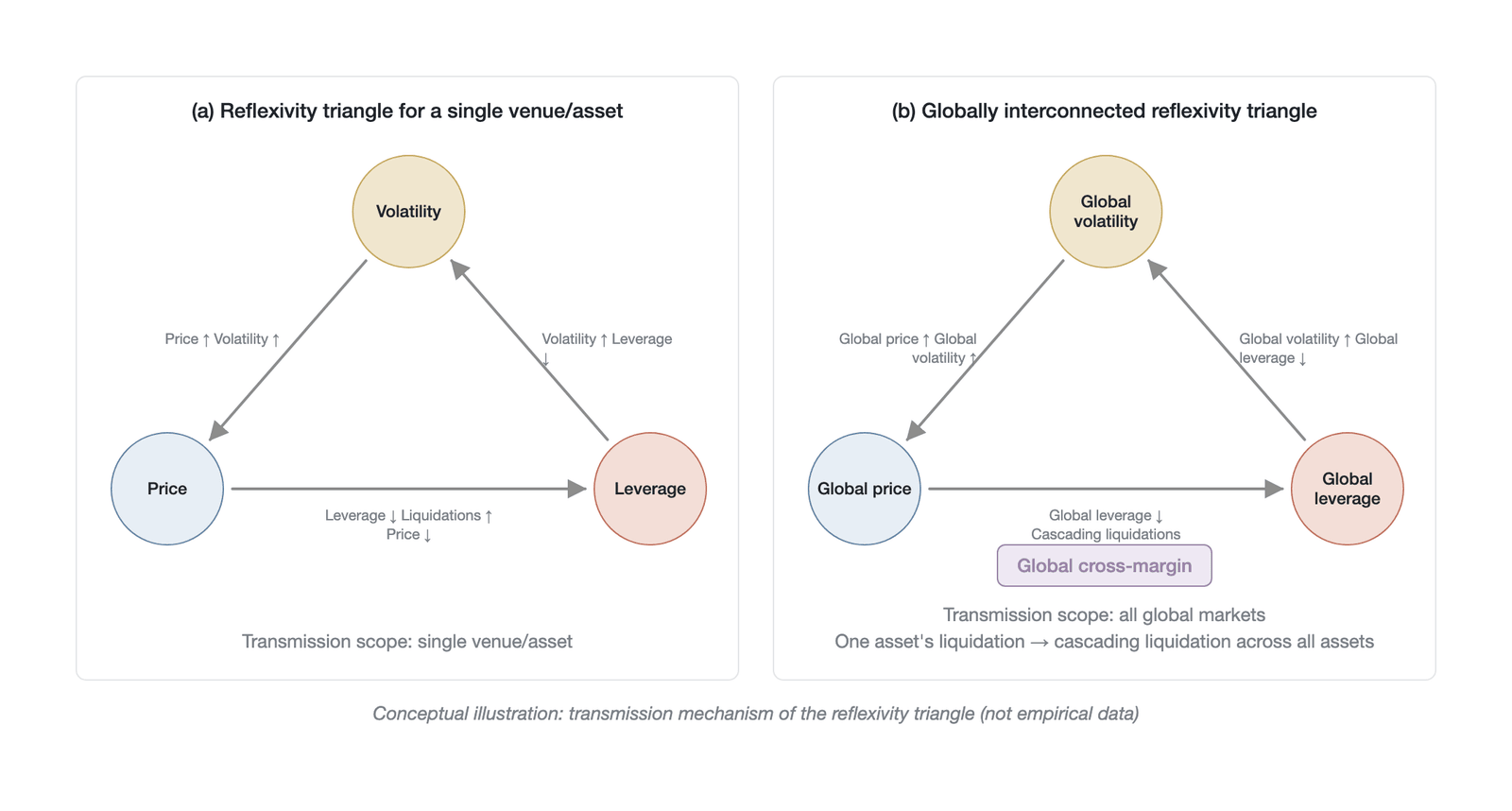
Figure 32-4. The globalized transmission mechanism of the reflexivity triangle (Data source: theoretical derivation in this chapter)
32.4.2 A global AI flash crash
Chapter 31 discussed the strategy-homogenization risk that arises when AI acts as a market participant. In a globally interconnected financial network, this risk will be amplified exponentially. As large language models and reinforcement-learning algorithms become widespread in finance, we can foresee that the overwhelming majority of autonomous trading agents worldwide will be driven by base models supplied by a few top technology companies. This means that although these agents serve different clients and have different risk preferences, the underlying logic by which they process information, assess risk, and execute trades will be highly similar.
If AI market-making agents worldwide use similar strategies, anomalous data or an extreme event in one region could trigger the synchronized reaction of AI agents worldwide within milliseconds. Consider the U.S. stock market flash crash of May 6, 2010, when high-frequency trading algorithms collectively withdrew liquidity in the face of uncertainty: the Dow Jones Industrial Average plunged 998.5 points (approximately 9%) intraday, of which, within about five minutes (2:42 to 2:47 p.m.), it fell nearly 600 additional points on top of the earlier decline, bringing the cumulative peak-to-trough drop for the day close to 1,000 points, before recovering most of that decline within about 20 minutes (by 3:07 p.m.) [27]. That event was confined to the U.S. stock market alone and was caused mainly by simple rule engines rather than advanced AI. The fundamental driver of the 2010 flash crash, however, was microstructure fragility—a single large sell order triggering a liquidity vacuum—rather than strategy homogenization. For the risk of an AI-driven synchronized crash, a more apt historical precedent is the 2007 quant factor crisis, in which strategy crowding among quantitative hedge funds produced synchronized position reversals and a liquidity spiral. Even imposing a mandatory algorithmic diversity requirement cannot fundamentally eliminate the herding effect, because all AI agents are trained on the same historical data, observe the same on-chain signals (which are transparent by design), and optimize the same objective function. Herding is an emergent property of a shared information environment, not merely a technical flaw stemming from a shared code base. In autonomous world finance, the destructive power of a global AI flash crash would far exceed that of 2010.
In an extreme scenario, when a piece of breaking news is fed into the global agent network, a large number of AI agents may reach the conclusion reduce risk exposure within the same millisecond. They would simultaneously cancel buy orders and issue sell orders, driving the liquidity of all major global assets to zero in an instant. Because the matching speed of on-chain transactions is limited only by the blockchain's block-generation time and network latency, such a flash crash might last only seconds. Yet within those few seconds, the liquidity vacuum could cause prices to deviate sharply, triggering the liquidation logic hard-coded into smart contracts. Human traders would not even have time to understand what was happening, let alone intervene. By the time the system finally returns to equilibrium, the transfer and destruction of wealth are often already irreversible.
This machine-driven panic lays bare the fragility of market microstructure. The high-frequency trading arms race analyzed by Budish et al. (2015) [28] takes on a new dimension in the era of AI agents: when competition shifts from a millisecond-level speed advantage to the homogenization of model architecture and training data, the source of systemic risk shifts from the technical failure of an individual institution to the collective behavior pattern of the entire agent population. More worrying still, modern AI models are typically black boxes whose decision processes are hard for humans to understand fully. After a global AI flash crash, post-hoc analysis might take months, and identifying the exact trigger might become impossible. This lack of explainability further undermines the confidence of market participants, making the system's post-crisis recovery even more difficult. To address this risk, future autonomous finance systems may need to introduce algorithmic diversity requirements or distributed circuit-breaker mechanisms—but these would inevitably sacrifice a portion of efficiency.
32.4.3 Oracle single-point-of-failure risk
When we examined perpetual futures on everything in Chapter 27, we noted that the oracle is the sole bridge connecting off-chain real-world data to on-chain smart contracts. In a globally interconnected financial network, this oracle problem will evolve from a local technical challenge into a critical single point of failure for the entire system. The traditional financial system relies on distributed price-discovery and settlement networks: if the New York Stock Exchange's data feed fails, the Chicago Mercantile Exchange or the London Metal Exchange can continue to operate. In an on-chain perpetual futures system, however, if a widely used oracle network is attacked or fails, the consequences will be severe.
Suppose an oracle network that provides price feeds for trillions of dollars of assets worldwide broadcasts an erroneous price to the chain because of a software bug or a failure of its economic-incentive mechanism. In a traditional market, such an obviously erroneous trade would be caught and canceled by the exchange's human monitoring team. But in the on-chain world where code is law, smart contracts trust the oracle's data unconditionally. This erroneous price would immediately trigger erroneous liquidations of all perpetual futures that depend on the oracle. Because of the global cross-margining mechanism described earlier, these erroneous liquidations would set off real chains of blow-ups, turning a data error into a genuine systemic collapse.
Although the industry is working to reduce this risk through multi-source oracles, decentralized oracle networks, and cryptographic-verification techniques based on zero-knowledge proofs, these measures can only mitigate the problem, not eliminate it [29]. Multi-source oracles may provide false redundancy: if most price sources share upstream dependencies (the majority of feeds ultimately derive from the same three or four centralized exchanges), then multi-source aggregation does not genuinely diversify risk. Moreover, oracle extractable value (OEV) creates a structural economic incentive for validators or MEV searchers to profit from liquidation events by manipulating the timing of oracle updates. As long as an on-chain system must rely on external data to execute financial contracts, the oracle will always be the weak link that can trigger a system-wide catastrophe. The potential payoff from hacking an oracle grows geometrically as the on-chain financial network expands in scale, which will attract the world's most capable malicious actors to search for every tiny vulnerability in the system. This asymmetric attack-defense game makes oracle security a persistent structural risk facing autonomous finance systems.
At a deeper level, oracles are not merely conduits that relay data; they in fact perform a function of adjudicating truth. When a dispute arises in the real world (for example, when the definition of an asset diverges or an exchange suspends trading under extreme conditions), the oracle must decide what data to broadcast to the chain. This adjudicative power often lacks sufficient transparency and accountability in decentralized systems. If the governance of an oracle network is controlled by a few interest groups, they could manipulate price feeds to reap enormous profits in on-chain derivatives markets. Oracle risk is therefore not merely technical but also political and economic.
32.4.4 Too interconnected to fail
Network effects are deeply double-edged. A globally interconnected autonomous finance network creates extremely high efficiency by eliminating intermediaries and geographic barriers, but it also creates the systemic fragility of too interconnected to fail. In the 2008 global financial crisis, the core dilemma regulators faced was too big to fail: the balance sheets of a few giant financial institutions were so large that their collapse would destroy the entire credit system. In autonomous world finance, the form of risk has shifted: an individual node may not be large, but because of the system's high interconnection, the failure of any single node may propagate instantly to all others.
This interconnection is manifested at multiple levels: cross-margining at the asset level, shared liquidity pools at the infrastructure level, and strategy homogenization at the intelligence level. When these levels interweave, the system's complexity exceeds the comprehension of any single participant or regulator. The immediacy and around-the-clock continuity of on-chain systems further worsen this problem. Traditional financial markets provide cooling-off periods through market closures and weekends, giving participants time to digest information, raise capital, and coordinate rescues. A global network that never closes strips away this precious buffer.
When a crisis occurs, transmission speed is measured in milliseconds and seconds, and the window for human intervention is extremely compressed or eliminated altogether. We have built a financial machine more efficient and more inclusive than ever before, but it is also a machine that by design lacks the traditional physical damping. How to establish a new shock-absorption mechanism in a global network with no centralized intervener, no market closures, and driven entirely by code and algorithms will be a core challenge of the autonomous finance era. This shift in systemic risk requires us to rethink the definition of financial stability, moving from a focus on the health of a single institution to a focus on the resilience of the entire network topology.
Under the too interconnected to fail paradigm, traditional regulatory tools (such as capital-adequacy requirements or stress tests) may no longer apply, because these tools are typically based on static balance-sheet snapshots and cannot capture the complex nonlinear interactions of a high-frequency dynamic network. In the on-chain perpetual futures ecosystem, the risk nodes with high centrality are already clearly identifiable: core oracle networks (such as a few Chainlink/Pyth data sources), cross-chain-bridge liquidity hubs, and shared market-maker infrastructure. The failure of any one of these high-centrality nodes satisfies the contagion condition of too interconnected to fail, and its impact will spread along the network topology to all dependent nodes. Future financial-stability frameworks may need to draw on epidemiology or complex-systems theory, focusing on monitoring the density of connections among network nodes, identifying potential super-spreader nodes, and designing smart-contract circuit breakers that can automatically sever contagion chains when a local crisis erupts. Yet on-chain circuit breakers face a fundamental paradox: when one protocol halts trading while interconnected protocols keep running, the result is not orderly market stabilization but arbitrage dislocations and trapped positions. The governance of circuit-breaker parameters is itself an unresolved problem: DAO governance votes are too slow for millisecond-scale cascades, while protocol admin keys reintroduce the very centralization risk that permissionless design is meant to eliminate. This is an underexplored field, but it is vital to the long-term survival of autonomous finance.
One systemic-risk channel the foregoing analysis has not adequately addressed is the funding monoculture of dollar stablecoins. The three-layer stack is denominated in dollar stablecoins throughout, and so it natively inherits the transmission effects of Federal Reserve monetary policy. A rate-hiking cycle raises the opportunity cost of stablecoin capital while compressing the total value locked (TVL) and liquidity across all on-chain venues. Empirically, the most likely trigger of a systemic shock is not a cascade of emerging-market currency crises but a dollar-liquidity squeeze that hits all on-chain markets at once, because they share a single base quote currency. This stablecoin monoculture stands in deep tension with the sovereign plurality narrative of Section 32.5.3: a financial system that claims to serve a diverse set of global sovereigns nonetheless depends, at the funding layer, entirely on the monetary policy of a single central bank.
The three risk dimensions analyzed in Sections 32.4.1 through 32.4.3—cross-margining cascades, AI flash crashes, and oracle failures—are not mutually independent events. If an oracle price deviation triggers a cross-margining cascade while AI market makers synchronously withdraw liquidity upon detecting the price anomaly, the joint activation of the three risk vectors will produce a shock-amplification effect far exceeding the sum of each analyzed independently. This risk resonance scenario represents the system's true worst case and is also the extreme scenario a stress-testing framework must cover.
The foregoing analysis of systemic risk reveals a deeper structural problem: the three-layer stack contains three irreducible tensions that must be continuously managed rather than eliminated once and for all by technical means.
Figure 32-5 visualizes these three tensions as three pairs of mutually constraining forces—efficiency versus stability, permissionlessness versus consumer protection, and global integration versus sovereign plurality—and indicates the direction in which each can be addressed: gains in efficiency inevitably bring new fragilities; ZKP credentials can partly reconcile the conflict between permissionlessness and consumer protection but cannot fully eliminate the tension; and in the contest between global integration and sovereign plurality, states choose among embracing, restricting, and vacillating. Section 32.5 develops each of these three trade-offs in turn.
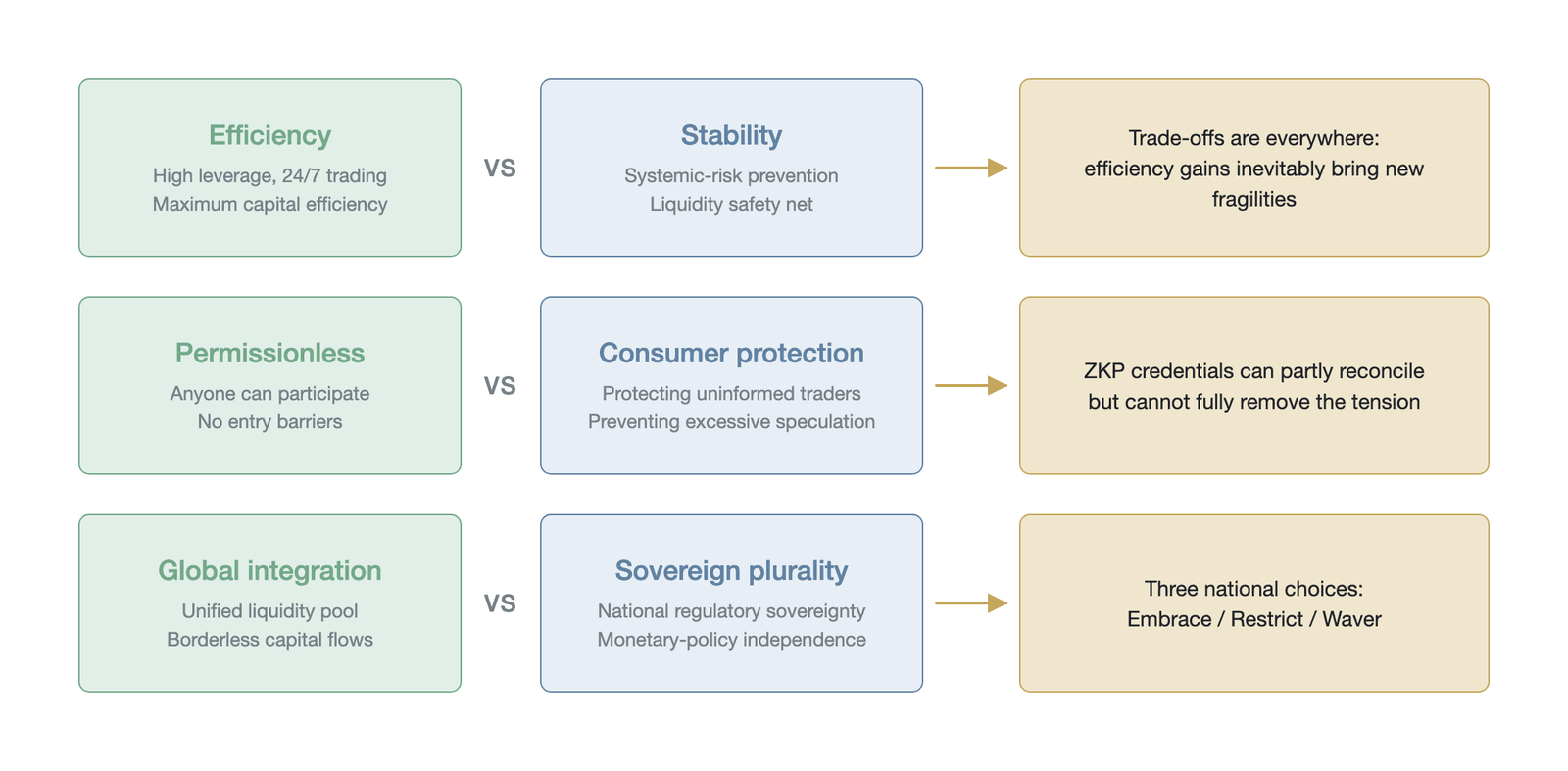
Figure 32-5. The three irreducible tensions in an autonomous finance network (Data source: theoretical derivation in this chapter)
32.5 Three irreducible tensions
The analysis of the two preceding sections shows that the efficiency gains and the systemic risks of the three-layer stack are not independent variables but the two faces of the same set of design choices. This inherent tension can be summarized as three irreducible structural trade-offs: efficiency versus stability, permissionlessness versus consumer protection, and global integration versus sovereign plurality. This section works through the concrete manifestations and amplification mechanisms of each tension in an autonomous finance network, and argues that treating these tensions as fundamental trade-offs requiring continuous management—rather than as engineering defects awaiting repair—is the epistemological premise for understanding autonomous finance.
32.5.1 Efficiency versus stability
The core function of a financial system is capital allocation, and the efficiency of capital allocation is often negatively correlated with the system's stability. In an autonomous finance network, this trade-off can be measured conceptually through two sets of indicators: efficiency indicators (capital-utilization efficiency and price-discovery latency) and stability indicators (tail-risk probability and liquidation-cascade depth), between which a structural negative correlation exists. This chapter offers a conceptual framework for identifying the structure of the trade-off rather than a formal mathematical model; a full formal treatment—such as a constrained optimization linking capital-utilization efficiency to the probability of systemic tail risk—awaits future research. An increase in leverage raises capital-utilization efficiency but necessarily entails a higher probability of liquidation cascades [30]; around-the-clock continuous pricing shortens price-discovery latency but removes the physical circuit-breaking window that traditional markets use to relieve panic. As the global liquidation-cascade mechanism analyzed in Section 32.4.1 shows, cross-asset cross-margining transmits the volatility of a single asset to the entire network. The crypto-market liquidation storm of October 2025—in which more than $19 billion in leveraged positions were forcibly liquidated within roughly 24 hours, the largest single-day liquidation on record (this is measured as liquidation volume, distinct from the contraction in open interest over the same period)—validated this transmission path [31]. The AI-strategy-homogenization risk analyzed in Section 32.4.2 further intensifies this tension: when large numbers of agents adopt homogeneous strategies, their synchronized reaction patterns amplify market volatility to the scale of a millisecond-level flash crash [32][33]. Every gain in efficiency accumulates deeper fragility in the system's foundations; this trade-off is a structural constraint of financial systems that cannot be circumvented by a more advanced technical architecture.
32.5.2 Permissionlessness versus consumer protection
Permissionless participation is the cornerstone of decentralized finance, but an irreconcilable tension exists between full permissionlessness and adequate consumer protection. This tension can be formalized as a trilemma: fully permissionless access, adequate consumer protection, and a deep liquidity network—at most two of which can be satisfied simultaneously. Abandoning access restrictions exposes participants who lack financial literacy to risks they cannot assess (the structural constraint analyzed in Section 32.2.5) [34][35]; imposing access screening reintroduces centralized gatekeepers and excludes the very marginalized populations who need these tools; and abandoning the first two in pursuit of liquidity alone produces an unregulated, highly leveraged casino. This structure is isomorphic to the Mundell-Fleming trilemma in international finance [36]: just as a country cannot simultaneously achieve free capital flows, an independent monetary policy, and a fixed exchange rate, an autonomous finance network cannot simultaneously maximize openness of access, user protection, and market depth. Zero-knowledge-proof compliance credentials mitigate this conflict to some degree by lowering the cost of compliance enforcement [37], but proving that one meets the conditions is itself a permissioning mechanism. As long as the system needs to distinguish participants' eligibility, this structural tension will not disappear.
32.5.3 Global integration versus sovereign plurality
A fundamental conflict exists between the borderlessness of the autonomous finance network and the territoriality of sovereign states. At the network level, protocol standards on public blockchains and decentralized clearing and settlement connect global capital pools into a single liquidity network [38]; at the sovereign level, states rely on exclusive control over domestic currency issuance, capital flows, and financial institutions to implement monetary policy [39]. When citizens can freely convert their local currency into global stablecoins through the autonomous finance network and participate in on-chain trading, the effectiveness of traditional capital-control tools is substantially weakened. This conflict is driving a divergence of national strategies: some countries choose to embrace, obtaining the dividends of innovation by offering a friendly regulatory environment and exploring central bank digital currencies (CBDCs); some choose to isolate, seeking to exclude on-chain finance from the national economic system; and more countries seek a conditional balance between access to global liquidity and the preservation of policy independence. This divergence is not a temporary policy disagreement but the inevitable projection of the structural conflict between the network's global integration and the territorial exclusivity of sovereignty, and it will continue to shape the evolution of the international financial system. The dominance of USD stablecoins, moreover, grants the United States de facto extraterritorial regulatory authority over the entire on-chain financial system. Binance's $4.3 billion settlement and the sanctions against Tornado Cash show that even citizens of countries pursuing an embrace strategy remain subject to major-power enforcement jurisdiction when their transactions involve USD stablecoins, which makes the independence of all three strategies far more limited than it appears.
32.5.4 The epistemology of tension management
A mature theory of financial microstructure requires the recognition that the three tensions above represent fundamental trade-offs, not system bugs awaiting repair. Efficiency versus stability, permissionlessness versus consumer protection, and global integration versus sovereign plurality—these three pairs of opposites constitute the boundary conditions of the autonomous finance network. Different jurisdictions and groups of market participants will position themselves differently within these trade-offs according to their own value orientations: developed economies tend to sacrifice some efficiency in exchange for systemic stability, while emerging markets are more willing to bear volatility risk in exchange for access to global capital and the inclusiveness of financial instruments. This diversity is the inevitable projection of pluralistic values within a complex system. Recognizing that these trade-offs are irreducible marks a cognitive shift from techno-utopianism to realist financial engineering.
The maturity of the three-layer stack lies not in eliminating these contradictions but in establishing mechanisms with sufficient resilience to maintain a dynamic equilibrium within these long-term structural tensions. This equilibrium is continually recalibrated as technology evolves, market cycles turn, and the geopolitical environment shifts.
Under the constraint of the three tensions, the future of autonomous finance is not a fixed endgame but a complex adaptive system that requires continuous design and adjustment.
32.6 From vision to roadmap
Granting the premise of three irreducible tensions, the evolutionary path of autonomous finance is not unpredictable. Depending on different combinations of regulatory attitude, technological maturity, and the speed of market adoption, one can sketch three sharply different scenarios: gradual convergence, dual-track coexistence, and disruptive substitution. This section analyzes the driving conditions and possible outcomes of each path, identifies the key uncertainty variables that will determine the ultimate direction, and proposes responsible optimism as a basic stance for coping with these uncertainties.
32.6.1 Evolutionary paths
In examining the future of autonomous finance, we cannot give a deterministic timetable or a single endgame form. These three paths are not mutually exclusive; they may play out simultaneously in different jurisdictions or across different asset classes.
Path one is gradual convergence. Along this path, the boundary between traditional finance and on-chain finance gradually blurs, ultimately forming a hybrid global financial ecosystem. Large traditional financial institutions begin to recognize the enormous advantages of on-chain infrastructure in clearing-and-settlement efficiency, capital allocation, and around-the-clock trading, and progressively adopt these technologies. They may first pilot on-chain clearing engines in internal operations or specific B2B scenarios, then extend them to customer-facing businesses. At the same time, the regulatory framework gradually adapts, introducing privacy-preserving technologies such as zero-knowledge proofs to preserve a degree of permissionlessness while satisfying anti-money-laundering and know-your-customer requirements. In this scenario, the three-layer stack of autonomous finance (the asset layer, the infrastructure layer, and the intelligence layer) is absorbed and reshaped by the traditional financial system, becoming a new engine for raising global financial efficiency. The winners along this path include both large institutions that actively embrace innovation and emerging-market retail investors who receive better service through financial inclusion.
Path two is dual-track coexistence. In this scenario, on-chain finance and traditional finance coexist over the long term but remain relatively independent, serving different user groups and needs. Because of divergent regulatory policies and the difficulty of unifying technical standards, a clear barrier forms between the two financial systems. The traditional financial system continues to dominate mortgages, corporate financing, and large-scale asset management, while on-chain finance dominates crypto-native assets, high-frequency trading, and parts of emerging markets. This dual-track state produces a degree of market segmentation, and capital-allocation efficiency fails to reach its maximum. It also, however, provides a parallel financial network for the users excluded by the traditional system (such as the billions of unbanked people worldwide). In this parallel world, AI agents autonomously make markets and trade, and permissionless smart contracts manage perpetual futures on a variety of synthetic assets. This state may persist for decades, until one side achieves a decisive breakthrough in technology or regulation.
Path three is disruptive substitution. In certain specific niche markets, on-chain finance, by virtue of its overwhelming advantages in efficiency and cost, achieves disruptive substitution of traditional finance. In derivatives trading, for example, on-chain perpetual futures—by virtue of around-the-clock continuous pricing, frictionless global capital flow, and cross-margining—rapidly absorb global liquidity, forcing traditional derivatives exchanges to the margins. In cross-border payments and remittances, solutions based on stablecoins and on-chain clearing sharply compress transaction costs, disrupting traditional correspondent-banking networks and remittance companies. In fields such as mortgages and large corporate financing, however—which depend heavily on offline credit assessment and complex legal enforcement—traditional finance retains an unshakable position. The evolution of this path is often accompanied by violent market turbulence and regulatory conflict; traditional financial institutions and vested interests may resist fiercely, but ultimately they must accept the reality that part of the market has been disrupted.
Each of these three paths corresponds to a different regulation-technology-market combination, and its ultimate direction is not predetermined but depends on how key variables actually evolve. Table 32-2 offers a structured comparison of the driving conditions, primary beneficiaries, and core risk of the three paths, providing a reference for assessing investment strategies and policy choices under different scenarios.
| Path | Driving conditions | Primary beneficiaries | Core risk |
|---|---|---|---|
| Gradual convergence | Strong regulatory adaptability, active institutional adoption | Large institutions that embrace innovation, and emerging-market retail investors | Pace of innovation constrained by the pace of regulation |
| Dual-track coexistence | Regulatory divergence, difficulty unifying technical standards | The unbanked excluded by the traditional system | Market fragmentation leaves capital-allocation efficiency below its maximum |
| Disruptive substitution | Overwhelming on-chain efficiency advantage, breakthroughs in specific niche markets | Derivatives and cross-border-payment users | Severe market turbulence and resistance from incumbents |
Table 32-2. Comparison of the three evolutionary paths (Data source: based on the analysis in Section 32.6.1)
Figure 32-6 shows the relative changes in the market share of traditional finance and on-chain finance under different scenarios from 2025 to 2040, as well as the evolution of a regulatory-adaptation-or-conflict index.
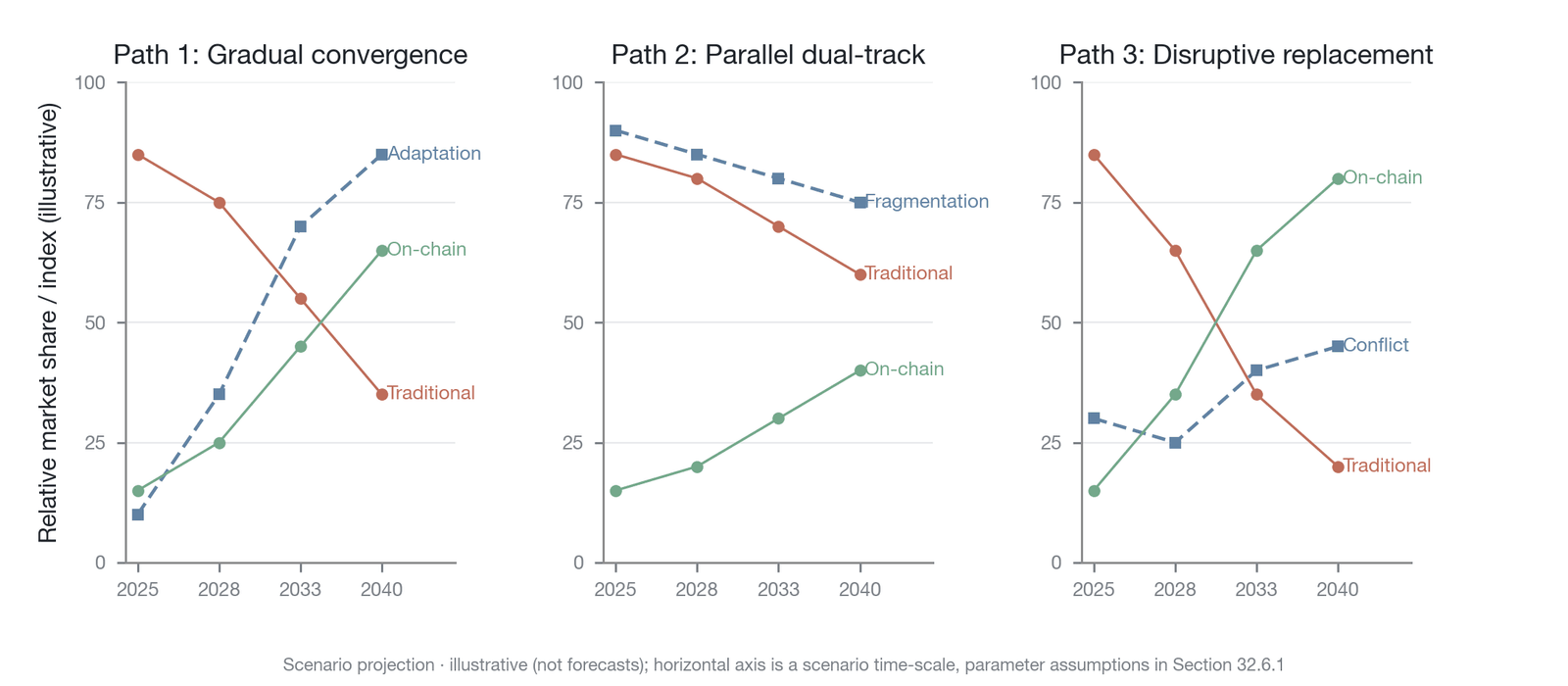
Figure 32-6. Scenario analysis of the three evolutionary paths of autonomous finance, 2025–2040 (Data source: scenario projection based on three variables—regulatory attitude, technological maturity, and market adoption speed; parameter assumptions detailed in the main text of Section 32.6.1)
32.6.2 Key uncertainties
Whichever path autonomous finance ultimately follows, its progress is deeply affected by several key uncertainties. These uncertainties constitute the blind spots in our predictions of the future and are also the variables we must focus on when building autonomous finance systems.
Regulation is among the most decisive of these uncertainties. A fundamental conflict exists between the global, borderless nature of autonomous finance and the sovereignty-based regulatory frameworks of traditional finance. The attitudes of different countries and regions toward on-chain finance will determine its room for development. Some countries may adopt an innovation-embracing attitude, seeking to attract capital and technology by establishing adaptive regulatory sandboxes; others may, out of concern for safeguarding financial sovereignty and preventing systemic risk, adopt severe restrictions or even outright bans. The vacillation or sudden reversal of regulatory policy can change the liquidity distribution and market structure of on-chain finance in an instant. How to find a balance point within the tensions of permissionlessness versus consumer protection and global integration versus sovereign plurality is an enormous challenge facing regulators.
Technological maturity is a second decisive variable. Although the three-layer stack of autonomous finance is conceptually relatively complete, in actual engineering it still faces many technical bottlenecks. The application of zero-knowledge-proof technology in embedded compliance remains at an early stage, and its computational efficiency and cost have not yet reached the requirements for large-scale commercial use. Cross-chain interoperability is still a fragile link; security vulnerabilities in cross-chain bridges have repeatedly caused enormous losses of funds, severely damaging market confidence. In addition, the widespread application of AI in finance brings the challenge of explainability. When millions of AI agents autonomously conduct high-frequency trading in a global network, the logic of their behavior is often a black box. Once a global AI flash crash occurs, it is difficult to trace its root cause quickly and take effective intervention measures. The pace at which these technical problems are solved will directly determine the speed at which autonomous finance matures.
The speed of market adoption and the tipping point of network effects are another key factor. The core value of a financial network lies in its liquidity, and liquidity in turn depends heavily on network effects. If on-chain finance cannot cross the adoption tipping point within a reasonable time and attract enough institutional capital and retail participation, it may remain forever at the margin of a niche market. Conversely, once this tipping point is crossed, network effects amplify exponentially, accelerating its substitution for or convergence with traditional finance. This adoption speed is not linear, however; it may be constrained by user habits, education costs, and switching costs. As noted earlier, pushing users who lack risk-management capacity into highly leveraged markets is not inclusion but a transfer of risk. If users lack the financial literacy needed to understand the risks of on-chain finance, then an overly rapid pace of adoption may instead cause large-scale wealth losses, provoking a social backlash and forceful regulatory intervention.
Finally, black swan events may become catalysts that either accelerate or impede the development of autonomous finance. The next major global financial crisis could expose the fragility of the traditional financial system, prompting a turn toward a more transparent, decentralized on-chain financial system; but by the same token, if the crisis is triggered by the systemic risks of on-chain finance (such as a global liquidation cascade caused by an oracle failure), it could destroy public trust in the new paradigm and set its development back by decades. The unpredictability of black swan events requires that, when designing autonomous finance systems, we treat antifragility as one of the core principles.
32.6.3 Responsible optimism
In the face of the evolutionary paths and key uncertainties above, this chapter takes the stance of responsible optimism. The three-layer stack provides new engineering possibilities, but technology itself does not determine outcomes; the same tools can become either an inclusive network or an instrument of regulatory arbitrage. The ultimate direction depends on choices of institutional design: whether education, risk control, and compliance can be embedded in the system's underlying logic determines whether autonomous finance empowers or preys.
Acknowledging systemic risk and irreducible tensions does not mean denying the potential value of autonomous finance. The builders of autonomous finance must seek a conditionally optimal path under the constraint of the three tensions, which requires combining the interdisciplinary wisdom of cryptography, financial engineering, economics, and law. More importantly, the evolutionary details of this complex adaptive system cannot be precisely predicted by anyone, so mechanisms for continuous iteration and agile adjustment are more valuable than a one-time perfect design.
32.7 Chapter summary
Starting from the architectural logic of the three-layer stack, this chapter analyzed the impact of autonomous finance along three dimensions—financial inclusion, global capital allocation, and systemic risk—and identified three irreducible structural tensions: efficiency versus stability, permissionlessness versus consumer protection, and global integration versus sovereign plurality. Among the three possible evolutionary paths—gradual convergence, dual-track coexistence, and disruptive substitution—the ultimate form realized will depend on the interplay of regulatory attitude, technological maturity, and the speed of market adoption. The core conclusion of this chapter is that the three-layer stack possesses the engineering capacity to raise capital-allocation efficiency and expand the accessibility of financial instruments at the same time, but translating this capacity into genuine inclusion is limited by three constraints: financial literacy, the digital divide, and regulatory adaptation. Until these constraints are adequately addressed, the main beneficiaries of the three-layer stack will be middle-income groups that already possess digital access and basic financial awareness, rather than the most financially excluded at the very bottom. The value of autonomous finance lies not in building a perfect, contradiction-free system but in creating a governance mechanism capable of dynamically seeking the optimum within long-term tensions.
The next chapter turns from this chapter's forward-looking analysis to the theoretical level, systematically drawing together the analysis of the whole book—distilling its core propositions and a spectrum of confidence levels, clarifying unresolved questions and a research agenda, and offering the book's recommended courses of action for different groups of readers.
References
[1] CoinGecko. (2026). Is the Future of Crypto Perpetual? The Meteoric Rise of Perp DEXs. https://www.coingecko.com/learn/rise-of-perpetuals-and-perp-dexs
[2] World Bank. (2025). The Global Findex Database 2025. https://www.worldbank.org/en/publication/globalfindex
[3] World Bank. (2025). Financial Inclusion Overview. https://www.worldbank.org/en/topic/financialinclusion/overview
[4] World Bank. (2022). Remittance Prices Worldwide (Issue 44, December 2022). https://remittanceprices.worldbank.org/
[5] United Nations Development Programme. (2024). UNDP annual report 2023. https://www.undp.org/publications/undp-annual-report-2023
[6] World Bank. (2024, July 1). World Bank country classifications by income level for 2024-2025. World Bank Blogs. https://blogs.worldbank.org/en/opendata/world-bank-country-classifications-by-income-level-for-2024-2025
[7] International Telecommunication Union. (2025). Facts and figures 2025: Measuring digital development. https://www.itu.int/itu-d/reports/statistics/facts-figures-2025/
[8] GSMA. (2025). GSMA calls for renewed focus on closing the Usage Gap as more than 3 billion people remain offline. https://www.gsma.com/newsroom/press-release/gsma-calls-for-renewed-focus-on-closing-the-usage-gap/
[9] Schär, F. (2021). Decentralized finance: On blockchain- and smart contract-based financial markets. Federal Reserve Bank of St. Louis Review, 103(2), 153-174.
[10] McKinsey & Company. (2025). The State of AI: Global Survey 2025. https://www.mckinsey.com/capabilities/quantumblack/our-insights/the-state-of-ai
[11] Brunnermeier, M. K., & Pedersen, L. H. (2009). Market liquidity and funding liquidity. The Review of Financial Studies, 22(6), 2201-2238.
[12] Forbes, K. J., & Rigobon, R. (2002). No contagion, only interdependence: Measuring stock market comovements. The Journal of Finance, 57(5), 2223-2261. https://doi.org/10.1111/0022-1082.00494
[13] Statista. (2024). Annual inflation rate of the Consumer Price Index in emerging markets and developing economies from 1980 to 2030.
[14] World Bank. (2024). Remittance Prices Worldwide, Issue 49. https://remittanceprices.worldbank.org/
[15] International Monetary Fund. (2021). A Smorgasbord of Factors Drive Remittance Costs. https://www.elibrary.imf.org/view/journals/001/2021/199/article-A001-en.xml
[16] Adams, A., Lader, M-C., Liao, G., Puth, D., & Wan, X. (2023). On-chain foreign exchange and cross-border payments. SSRN Working Paper No. 4328948. https://ssrn.com/abstract=4328948 https://doi.org/10.2139/ssrn.4328948
[17] Rajan, R. G. (2006). Has finance made the world riskier? European Financial Management, 12(4), 499-533.
[18] NerdWallet. (2026). How Much Does a Financial Advisor Cost in 2026? https://www.nerdwallet.com/financial-advisors/learn/how-much-does-a-financial-advisor-cost
[19] Barber, B. M., & Odean, T. (2001). Boys will be boys: Gender, overconfidence, and common stock investment. The Quarterly Journal of Economics, 116(1), 261-292. https://doi.org/10.1162/003355301556400
[20] Aitken, M., Chen, H., & Foley, S. (2017). The impact of fragmentation, exchange fees and liquidity provision on market quality. Journal of Empirical Finance, 41, 140-160. https://doi.org/10.1016/j.jempfin.2016.10.002
[21] BlackRock. (2025). Market Spotlight: 24 Hour Trading - Implications for markets and investors. https://www.blackrock.com/corporate/literature/whitepaper/blackrock-market-spotlight-24-hour-trading.pdf
[22] Ferreira, M. A., Massa, M., & Matos, P. (2010). Shareholders at the gate? Institutional investors and cross-border mergers and acquisitions. The Review of Financial Studies, 23(2), 601-644. https://doi.org/10.1093/rfs/hhp070
[23] Brunnermeier, M. K., De Gregorio, J., & Shin, H. S. (2012). Banks and cross-border capital flows: Policy challenges and regulatory responses. Committee on International Economic Policy and Reform.
[24] Koepke, R. (2019). What drives capital flows to emerging markets? A survey of the empirical literature. Journal of Economic Surveys, 33(2), 516-540. https://doi.org/10.1111/joes.12273
[25] Mieg, H. A. (2022). Volatility as a transmitter of systemic risk: Is there a structural risk in finance?. Risk Analysis, 42(10), 2244-2258. https://doi.org/10.1111/risa.13564
[26] Eisenberg, L., & Noe, T. H. (2001). Systemic risk in financial systems. Management Science, 47(2), 236-249. https://doi.org/10.1287/mnsc.47.2.236.9835
[27] CFTC & SEC. (2010). Findings Regarding the Market Events of May 6, 2010. U.S. Commodity Futures Trading Commission and U.S. Securities and Exchange Commission.
[28] Budish, E., Cramton, P., & Shim, J. (2015). The high-frequency trading arms race: Frequent batch auctions as a market design response. The Quarterly Journal of Economics, 130(4), 1547-1621. https://doi.org/10.1093/qje/qjv027
[29] Albizri, A., & Appelbaum, D. (2021). Trust but verify: The oracle paradox of blockchain smart contracts. Journal of Information Systems, 35(2), 1-16. https://doi.org/10.2308/isys-19-024
[30] Wagner, W. (2011). Systemic liquidation risk and the diversity–diversification trade-off. The Journal of Finance, 66(3), 1141-1175. https://doi.org/10.1111/j.1540-6261.2011.01666.x
[31] FTI Consulting. (2025, December 24). The crypto crash of October 2025: When leverage met liquidity. https://www.fticonsulting.com/insights/articles/crypto-crash-october-2025-leverage-met-liquidity
[32] Oyeniyi, L. D., Ugochukwu, C. E., & others. (2024). Analyzing the impact of algorithmic trading on stock market behavior: A comprehensive review. World Journal of Advanced Research and Reviews, 21(1), 123-135.
[33] Asim, M., Khan, M. Y., & Shafi, K. (2024). Investigation of herding behavior using machine learning models. Review of Behavioral Finance, 16(3), 424-445. https://doi.org/10.1108/RBF-05-2023-0128
[34] Zetzsche, D. A., Arner, D. W., & Buckley, R. P. (2020). Decentralized finance. Journal of Financial Regulation, 6(2), 172-203. https://doi.org/10.1093/jfr/fjaa010
[35] OECD. (2025). Improving the digital financial literacy of crypto-asset users. OECD Publishing. https://www.oecd.org/en/publications/improving-the-digital-financial-literacy-of-crypto-asset-users_19cfecad-en/full-report.html
[36] Obstfeld, M., & Taylor, A. M. (2004). Global capital markets: Integration, crisis, and growth. Cambridge University Press.
[37] Yuyama, T., Katayama, K., & Brigner, P. (2023). Proposal of principles of DeFi disclosure and regulation. In International Conference on Financial Cryptography and Data Security . Springer.
[38] BVNK. (2025). Blockchain in cross-border payments: a complete 2025 guide. https://bvnk.com/blog/blockchain-cross-border-payments
[39] Klagge, B., & Martin, R. (2005). Decentralized versus centralized financial systems: is there a case for local capital markets? Journal of Economic Geography, 5(4), 387-421. https://doi.org/10.1093/jeg/lbh050