In 2016, Arthur Hayes launched perpetual futures on BitMEX—a derivative contract that strips away the expiration date and uses the funding rate in place of delivery to anchor to the spot price. This design echoed the academic vision of macro-market instruments that Robert Shiller (1993) [1] had proposed, though that original proposal was never implemented in traditional finance. By 2025, nine years later, average daily notional trading volume in perpetual futures had settled in the hundreds of billions of dollars (according to CoinGlass's 2025 Crypto Derivatives Market Annual Report, average daily notional turnover across crypto derivatives that year was roughly $260 billion, of which perpetual futures accounted for the overwhelming majority) [2]; they contributed more than 60% of the information share in Bitcoin's price discovery [3]; and derivatives turnover ran at roughly 3 times or more that of the corresponding spot market (reaching 5 to 10 times for major coins on a single leading exchange) [2]. This stands in sharp contrast to the early market documented a decade earlier by Makarov and Schoar (2020), which was characterized by cross-exchange spot arbitrage and price dislocations [4]. What began as a design compromise to solve practical problems in crypto trading has become one of the highest-volume categories of financial product in the world, and it is now expanding into foreign-exchange, equity-index, and commodity markets. From the perspective of microstructure theory, what makes this evolution significant is that a synthetic-exposure instrument that removed the constraints of expiry and delivery reshaped, within just a few years, where price discovery occurs, how liquidity is supplied, and how volatility is generated. This fact raises the central question of this chapter: after 33 chapters of systematic analysis of this mechanism and the markets in which it operates, which reliable regularities has the analysis ultimately revealed, and which unresolved problems does it leave behind?
This book takes institutional design as its through-line and begins with the game-theoretic mechanism of the funding rate. The funding rate is not a simple price-correction term but an institutional device that recasts price convergence as a problem of incentive compatibility, letting market participants' self-interested behavior anchor the price spontaneously, without intervention by any central authority. Over nine years of market operation, this mechanism has been tested by repeated episodes of extreme conditions, and its effectiveness has become a high-confidence empirical fact.
In the analysis of liquidity, the market maker's profit equation contains a structural flaw: adverse-selection risk and inventory costs rise in tandem as market volatility intensifies [5], so the production cost of liquidity is positively correlated with demand for it, leaving liquidity scarcest precisely when it is most needed. This countercyclical fragility is a necessary consequence of profit maximization, not a behavioral bias. Along the volatility dimension, high-leverage liquidation cascades and the periodic pulses of the funding rate—beyond the traditional categories of informational and noise volatility [6]—create an institution-driven source of volatility that is independent of both fundamental information and trader irrationality [7].
Building on this, the book reframes market quality as a trade-off problem across five dimensions—transaction costs, price discovery, resilience, fairness, and accessibility—and argues that this trade-off presents a markedly different priority structure under normal, stressed, and crisis conditions. At the engineering level, trust decomposes into five independent layers: asset custody, matching and execution, clearing and settlement, data feeds, and governance decisions. Each layer can independently seek the optimal balance between trust-minimization and performance (Chapters 28–29). The evolution of artificial intelligence (AI) from a market participant into infrastructure marks a paradigm shift from "code is law" to "model is law." The methodological stance running through the analysis is that institutions determine microstructure, trade-offs are everywhere, and normal and crisis conditions follow different dynamics.
As the culmination of the book, this chapter distills the entire argument into seven core propositions and five cross-cutting themes. It uses a confidence spectrum to distinguish which conclusions have been cross-validated by multiple methods, which are supported only by preliminary evidence, and which remain logical inference or open conjecture, and it explicitly lays out the knowledge gaps and unresolved problems in the current theoretical framework. Beyond this, from the standpoint of disciplinary contribution, the chapter identifies five epistemological legacies that perpetual futures, as an object of analysis, bequeath to the theory of financial microstructure: making the institution-driven source of volatility explicit, a theory of the endogenous fragility of liquidity supply, the engineering of trust, a theory of 24/7 continuous markets, and the economics of synthetic exposure. It then maps out paths forward for researchers, practitioners, regulators, and students. After reading this chapter, the reader will possess a complete cognitive map distinguishing the known, the credible, the speculative, and the unknown, and can turn to Section 33.6 to find the path of action suited to their own role.
33.1 Core propositions
This section sets out the book's seven core propositions. Each proposition states its central conclusion and logical basis, and points to the chapters that support it. Section 33.2 presents the cross-cutting methodological perspective, and Section 33.5 sets out how the book advances the existing literature on financial microstructure.
In essence, perpetual futures are a general-purpose mechanism for generating synthetic exposure, not one confined to crypto assets. Traditional derivatives are constrained by the need for physical delivery and by expiration dates, which slice the time dimension into discrete contract cycles. Perpetual futures strip away both of these constraints and use the funding rate to maintain long-run convergence between the contract price and the spot price, providing traders with pure, open-ended price exposure [7]. This mechanism internalizes physical delivery and storage costs as a dynamic holding fee, giving market participants synthetic exposure to any continuously priceable asset under a transparent cost structure. Its generality means that, wherever a reliable price-signal source and sufficient liquidity depth exist, perpetual futures can extend to domains such as foreign exchange, commodities, and macroeconomic indicators (Chapters 2–3 and Chapter 27). Contracts for difference (CFDs) and total return swaps in traditional finance likewise provide synthetic exposure, but they are limited by bilateral counterparty risk and finite market depth [8]. Perpetual futures reduce counterparty concentration through on-chain clearing and a multilateral funding-rate mechanism. Nevertheless, the collapse of Terra/LUNA in May 2022 shows that when the anchoring mechanism degenerates from an external spot price into a self-referential, endogenous loop, synthetic exposure can suffer catastrophic depegging. In that episode, the combined market capitalization of LUNA and UST—roughly $40 billion, of which UST accounted for about $18 billion—evaporated within about a week; this is the loss in that ecosystem's market capitalization, which is distinct from the whole-market loss figure the media often cite. The current confinement of perpetual futures to a few dominant asset classes stems more from regulatory constraints, liquidity depth, and path dependence than from the mechanism itself; but, as the depegging case above shows, that mechanism also has its boundaries once the external anchor degenerates into an endogenous loop.
The funding rate is an incentive-compatible device for achieving price anchoring in a decentralized environment, and its design logic is of a piece with the mechanism-design theory of Myerson (1981) [9] and Hurwicz (1972) [10]: in the absence of a central clearinghouse, the funding rate dynamically adjusts the holding costs borne by longs and shorts, so that price convergence emerges from participants' individual profit-maximizing behavior. When the contract trades at a premium, longs pay shorts; when it trades at a discount, the reverse holds, incentivizing arbitrageurs to eliminate price deviations of their own accord. At the same time, this periodic payment mechanism introduces a pulse effect into the microstructure: the mechanical repositioning around settlement times constitutes a source of price volatility independent of information flow. Different participant types respond to the rate in different ways—arbitrageurs are highly sensitive, trend traders relatively insensitive—giving the system a self-regulating capacity that maintains price anchoring without any central decision-maker. Budish et al. (2015) [11], in their analysis of the high-frequency trading arms race, offer a complementary perspective: frequent batch auctions, as an alternative market-design mechanism, likewise aim to achieve a superior market equilibrium by altering the structure of the game (Chapter 10).
Liquidity is not an inherent property that markets possess by nature; it is a scarce resource produced by market makers who bear adverse-selection risk and inventory costs. The market maker's profit equation contains a structural flaw: production cost is positively correlated with market demand [5]. As market volatility intensifies, adverse-selection risk and inventory risk rise together, forcing market makers to widen spreads or withdraw depth, so that the supply of liquidity dries up rapidly at the very peak of demand. This countercyclical fragility is not a behavioral bias on the part of market makers but a structural result of profit maximization under the assumptions of standard market-making models. In crypto markets, which lack a lender of last resort and circuit-breaker protections, the collective retreat of market makers can readily trigger liquidation cascades and liquidity spirals [12] [13], amplifying a micro shock into a systemic crisis. The "Black Thursday" event of March 12, 2020, is a textbook case of this mechanism: over the two trading days of March 12–13, Bitcoin fell by roughly 50% cumulatively; on BitMEX alone, liquidations during this crash exceeded $700 million (on a broader, roughly 24-hour rolling-window basis, Chapter 12 gives a figure of more than $1.4 billion; the two figures use different statistical conventions), while bid-side order-book depth shrank to about $20 million at the most extreme moment, and liquidity evaporated far faster than participants could replenish it (Chapters 19–21).
Volatility is not a single risk metric but a mixture of four distinct drivers: informational volatility arises from fundamental updates; liquidity volatility arises from insufficient order-book depth; mechanistic volatility arises from liquidation cascades and funding-rate pulses; and transmission volatility arises from the amplification of local shocks by cross-market arbitrage networks [14]. The first two have been studied extensively by traditional microstructure theory; the latter two are products of the institutional design of perpetual futures and are independent of external information shocks [7]. Distinguishing the four sources of volatility bears directly on assessments of market quality and on regulatory decisions: a price move of the same magnitude, if driven by information updates, indicates that the market is efficiently digesting new information; if dominated by liquidation cascades, it points instead to a defect in system design (Chapters 22–24).
Market quality is a five-dimensional composite of transaction costs, price discovery, resilience, fairness, and accessibility, and inherent trade-offs exist among these dimensions [15]. Extremely low transaction costs may sacrifice market resilience, and an absolute insistence on fairness may constrain market-maker participation; no design achieves the optimum on all dimensions at once. These trade-offs are also state-dependent: the priority structure of market quality differs markedly across the three operating states of normal, stressed, and crisis conditions. A design that pursues efficiency under normal conditions may become a source of fragility in a crisis. Robust market design must therefore take the worst-case scenario as its binding constraint, ensuring that the system can still maintain its core functions under extreme shocks (Chapter 25).
Trust can be decomposed into five independent layers: asset custody, matching and execution, clearing and settlement, data feeds, and governance decisions. A traditional centralized exchange concentrates all five layers of trust in a single architecture, which confers a performance advantage but introduces a systemic single-point-of-failure risk. The collapse of FTX in November 2022 confirmed this judgment: roughly $8 billion in client funds was misappropriated under an opaque monolithic architecture, and the concentration of custody, matching, and settlement caused internal controls to fail completely. A fully on-chain model achieves maximal trust-minimization but is constrained by the throughput bottleneck of the blockchain. The theory of layered trust offers a solution that transcends this binary choice: at each layer, one independently seeks the optimal trade-off between trust and performance. For example, the asset-custody layer adopts a maximally trust-minimized on-chain mechanism to safeguard security, while the matching-and-execution layer retains an off-chain engine in pursuit of speed. This approach turns trust from an abstract institutional problem into a configurable engineering parameter (Chapters 28–29).
AI's role in financial markets is evolving from participant to infrastructure. Early AI applications concentrated on algorithmic trading and high-frequency market making and were, in essence, sophisticated participants extracting value from the market under a given set of rules. As model capabilities have advanced, AI has begun to take on system-level functions such as dynamically adjusting margin parameters and parsing unstructured data, marking a paradigm shift from "code is law" to "model is law." The contribution of algorithmic trading to market price discovery already rests on a solid empirical footing [16]; building on this, AI further gives the system an adaptive, dynamic responsiveness that lets it optimize operating parameters in real time across a multidimensional state space. However, homogeneous models may, under certain conditions, trigger decision resonance and create a novel type of liquidity crisis. How to guard against AI-driven endogenous fragility while improving efficiency is a central question for the next generation of microstructure design (Chapter 31).
33.2 Theoretical threads running through the book
The seven core propositions are the book's explicit conclusions. Beneath them, five methodological threads run through the analysis across the book's eleven parts. These threads are not answers to any particular phenomenon but recurring analytical perspectives and epistemological stances that constitute the book's underlying logical framework.
Traditional microstructure theory treats market institutions as exogenous variables and analyzes price discovery and market-making behavior under a given set of rules. The book's first methodological thread treats the institution itself as an endogenous variable: the core microstructure features of perpetual futures markets can all be traced back to the underlying institutional design. The high-leverage margin regime endogenously creates mechanistic volatility (Proposition 33.1.4); the periodic settlement of the funding rate produces price pulses independent of information flow (Proposition 33.1.2); the absence of an expiration date removes the friction of contract rollovers but also removes the deadline for natural convergence; and around-the-clock trading eliminates overnight risk accumulation but also strips away the shock-absorber effect of traditional markets. Institutions are not the backdrop of the analysis but the first cause that shapes the form of the market.
This perspective offers direct guidance for policy and design. The effective way to change a microstructure phenomenon is not investor education or another layer of external regulation but a change in the very institutional design that produces it. The institutional-shaping effect remains strong across all parts of the book and peaks in Part 3 (the funding-rate mechanism). In evaluating any financial innovation, the first question is not its functional features but how its institutional framework alters the incentive structure of participants.
There is no cost-free efficiency improvement in financial markets. The book's second thread reveals the universality of trade-offs: high leverage lowers the cost of capital while amplifying systemic fragility (Propositions 33.1.3 and 33.1.4); market-maker privileges enhance liquidity but sacrifice fairness (Proposition 33.1.5); the permissionless principle improves accessibility but increases the risk of abuse; physical and logical boundaries exist between trust-minimization and performance-maximization (Proposition 33.1.6); and the rigid enforcement of compliance stands in tension with the flexibility needed for crisis response. These trade-offs are not design flaws but intrinsic features of a multi-objective optimization problem.
Acknowledging the universality of trade-offs is a design philosophy, not a pessimistic judgment about the evolution of markets. Effective system design does not seek to eliminate trade-offs but to find, under given constraints, the current optimal position on the Pareto frontier, while recognizing that this position moves dynamically as technological conditions and the regulatory environment change. The strength of this thread rises in the later parts and peaks in Part 8 (market quality): as the analysis shifts from single-dimension optimization to holistic assessment, trade-offs become the central issue.
The normal market and the crisis market operate on different logics and cannot be explained within a single unified theoretical framework. This thread ties together several of the book's propositions: liquidity is abundant under normal conditions but evaporates in a crisis (Proposition 33.1.3); volatility is predominantly informational under normal conditions but is taken over by mechanistic factors in a crisis (Proposition 33.1.4); and the priorities of market quality flip fundamentally across states (Proposition 33.1.5). Analysis that does not distinguish between states is not only incomplete but can lead to dangerous design decisions, because the optimal solution under normal conditions may be precisely the worst choice in a crisis.
State dependence requires market designers to build systems for two utterly different worlds at once. AI market makers can effectively enhance liquidity under normal conditions, but their homogeneous strategies may cause their collective behavior to converge during extreme events (Proposition 33.1.7). The strength of this thread rises gradually from Part 1 and stays high beyond Part 7, reflecting that the deeper one's understanding of the market becomes, the more state dependence emerges as an unavoidable core methodology.
Among all governance tools, transparency has the lowest cost and the highest net benefit. This thread connects propositions at both the micro and macro levels: at the micro level, price transparency directly affects arbitrage efficiency and the anchoring effectiveness of the funding rate (Proposition 33.1.2); at the macro level, the architectural transparency provided by on-chain infrastructure—guaranteed by cryptography and distributed consensus rather than by manual audit—turns trust from a dependence on institutions into a technological guarantee (Proposition 33.1.6). The systemic harm done by the opaque architecture of centralized exchanges has been confirmed repeatedly, and the core logic of embedded compliance is precisely to use architectural transparency to reshape the governance paradigm.
Transparency is not without limits. In certain settings, full transparency may conflict with privacy protection or, in AI-driven games, expose strategies. But as a foundational governance principle, increasing transparency is always an effective means of reducing information asymmetry and guarding against systemic risk. This thread peaks in Part 4 (price discovery) and again in Parts 9–10 (governance and engineering), reflecting the dual role of transparency at both the micro-efficiency and macro-governance levels.
Technology changes the rules of financial markets but not the human nature of participants. On-chain transparency eliminates information asymmetry, smart contracts sharply reduce the possibility of asset misappropriation, and AI may remove humans' emotional reactions in extreme conditions. Yet the pursuit of high leverage, the tendency toward power concentration in decentralized governance, and the novel resonance risk created by the homogenization of algorithmic strategies all show that the basic features of human nature have merely taken on new forms as technology evolves (Propositions 33.1.3, 33.1.6, and 33.1.7). The need for trust is displaced by technology across different layers but never disappears.
This recognition constitutes the book's core design philosophy: robust system design should assume that participants will do the worst out of self-interest, and then use architecture and incentive mechanisms to make such behavior physically or logically impossible. This thread runs at a gentle baseline strength across all parts of the book and peaks in Part 11 (the future outlook): when looking ahead to an AI-dominated market, a clear-eyed understanding of human nature becomes especially important.
33.3 The confidence spectrum of the conclusions
Academic honesty requires researchers not only to state what they have found but also to mark clearly how confident they are in those findings. The analysis spanning 33 chapters has advanced a great many theoretical frameworks, empirical observations, and forward-looking inferences, but the epistemological status of these conclusions is not equal: some rest on massive volumes of high-frequency data and rigorous mathematical proof, some depend on preliminary observations of early protocols, and still others are logical extrapolations about future technological evolution. This section divides the book's core findings into four epistemological tiers, from highest to lowest confidence (high confidence, medium-high confidence, medium confidence, and exploratory conjecture), and, at the far end of the spectrum, sets out the current knowledge gaps. The confidence grading rests on three dimensions: the rigor of the theoretical foundation (whether there is a formalized causal logic), the breadth of empirical support (whether it has been cross-validated across independent datasets), and the adequacy of stress testing (whether it has been tested under extreme market conditions). Overall, the higher-confidence findings cluster at the micro-mechanism level, while the lower-confidence inferences mostly concern the direction of macro-level evolution—a distribution that reflects the difference between the rigor of microstructure analysis of local mechanisms and the inherent uncertainty in predicting system-level evolution.
High-confidence findings are conclusions that possess a solid theoretical foundation, have been cross-validated by multiple independent empirical studies, and have been tested under repeated episodes of extreme market conditions. These findings constitute the core premises for understanding perpetual futures markets.
The effectiveness of the funding-rate mechanism is among the most firmly established of these findings. Since BitMEX introduced perpetual futures in 2016, nine years of market data show that the funding rate can effectively maintain convergence between the contract price and the spot price without intervention by any central authority [7]. Its core logic is pure economic reasoning: when the contract trades at a premium, longs pay shorts, directly eroding their return and incentivizing rational traders to close positions or open arbitrage positions. This self-regulating feedback mechanism has remained effective across bull, bear, and range-bound markets, and rate anomalies during extreme events have returned to normal within short cycles. He et al. (2024) [7] find that, over their sample period, the magnitude of the deviation between perpetual and spot prices declined by an average of about 11% per year, which the authors attribute to increasing arbitrage capital and intensifying competition (that is, the market gradually becoming more efficient) rather than to the speed at which a deviation reverts to the no-arbitrage price at any given point in time.
The leading role of perpetual futures in price discovery for major crypto assets is likewise a high-confidence finding. Applying the information-share methodology established by Hasbrouck (1995) [17], Alexander et al. (2020) [3] show empirically that the crypto derivatives market contributes more than 60% of the price-discovery information share; Makarov and Schoar (2020) [4] further confirm the key role of cross-market arbitrage in narrowing spreads; and Cong et al. (2023) [18] caution that wash trading must be filtered out when evaluating trading-volume data. High leverage and low friction give informed traders higher returns in perpetual futures markets, thereby concentrating the price-discovery function on the derivatives side.
On market-maker behavior, adverse-selection costs and inventory risk remain the core variables determining the supply of liquidity [5] [19]. Although the microstructure of crypto markets differs markedly on the surface from that of traditional equity markets, the market maker's profit equation—in which the sum of adverse-selection costs, inventory risk, and institutional costs determines quoted depth and spread width—is clearly reproduced in the high-frequency order-book data of perpetual futures, confirming the cross-market applicability of classical microstructure theory.
Volatility clustering in perpetual futures markets, and its anomalous intensity, have also been amply verified [14]. GARCH-model estimates [20] and high-frequency realized-volatility analysis consistently show that volatility shocks in this market are extremely persistent. The clustered arrival of information, the amplifying effect of leverage on price fluctuations, and the removal of the traditional overnight buffer by around-the-clock trading together produce volatility clustering more pronounced than in traditional markets. The roughly 50% cumulative decline in Bitcoin over March 12–13, 2020, and the multi-day amplification of volatility it triggered, are a textbook case of this feature.
The monolithic architecture of centralized exchanges carries systemic trust risk. The collapse of FTX in November 2022—roughly $8 billion in client funds misappropriated under an opaque architecture, with an internal backdoor program allowing affiliated parties to bypass automatic liquidation—confirmed that when matching, clearing, and custody are concentrated in a single opaque entity, the principal-agent problem is amplified to a systemic scale. This lesson became a core force driving on-chain financial infrastructure toward a layered trust architecture.
Medium-high-confidence judgments are conclusions that are logically well argued and supported by early empirical data but have not yet weathered a complete economic cycle or extreme stress testing. At the current level of understanding, these judgments are highly reliable, yet room must be left for future data to revise them. The theoretical framework that decomposes the volatility of perpetual futures into four sources—informational, liquidity, mechanistic, and transmission (see Proposition 33.1.4)—belongs to this category. This framework has considerable explanatory power at the conceptual level, clearly distinguishing healthy price discovery from the noise introduced by institutional design. Precisely quantifying and separating these four volatility sources, however, still poses methodological challenges at the empirical level: existing econometric tools often require fairly strong identifying assumptions when handling highly nonlinear and endogenous high-frequency data, so the specific decomposition proportions still carry a nontrivial confidence interval (this identification difficulty is developed in detail in Section 33.4.1).
With regard to infrastructure architecture, we have ample reason to believe that, over the long run, a layered architecture will outperform both extremes, whether fully on-chain or fully off-chain. Decomposing trust into distinct layers—asset custody, matching and execution, clearing and settlement, and so on—and independently seeking the optimal trust-performance trade-off at each layer has a clear advantage in engineering terms. The asset-custody layer requires the highest security and should therefore adopt architectural trust solutions such as multi-signature wallets or hardware wallets; the matching layer has the highest performance requirements and can adopt a centralized or semi-centralized design in exchange for speed; and the clearing layer must balance determinism against flexibility and can adopt a hybrid approach. This design preserves the asset security of the blockchain while breaking through the limits that the consensus mechanism imposes on matching speed. However, the stability of such a complex architecture when processing tens of thousands of orders per second, and the reliability of cross-layer state synchronization, still require confirmation from larger-scale real-world deployment. The problem of cross-layer state synchronization deserves particular attention: when orders generated at the matching layer must be finally settled at the clearing layer, how can the state of the two layers be kept consistent at all times? How can state splitting be prevented under extreme network latency or system failure? Solutions to these engineering challenges are still in the exploratory stage.
On liquidity governance, the protocol-led market-making vault model is regarded as a highly promising mechanism innovation. By pooling retail capital and adopting algorithmic strategies, it partly mitigates the problem of market-maker capital monopoly and provides the protocol with an endogenous liquidity buffer. Data from early decentralized exchanges show that this model can effectively compress bid-ask spreads and improve market depth under normal conditions. Whether, under a one-sided crash or extreme volatility, it will trigger a liquidity-spiral drain through strategy homogenization or excessive risk exposure, however, still awaits empirical testing (see Section 33.4.2). Likewise, gradual liquidation mechanisms can, in theory, substantially reduce the mechanistic volatility triggered by liquidation cascades relative to traditional cliff-edge liquidation. Early results from some exchanges bear this out. Yet how to dynamically calibrate the optimal liquidation-penalty parameters and step sizes for the liquidity characteristics of different assets remains a complex optimization problem.
Medium-confidence inferences are reasonable extrapolations based on current trends and economic logic; their path to realization is constrained by multiple uncertain factors such as technological bottlenecks, regulatory policy, and strategic interaction among market participants, and they indicate possible directions of development. The foremost conjecture is that the perpetual futures mechanism will move beyond crypto assets into traditional financial domains such as foreign exchange, commodities, and macro equity indices. The generality of funding-rate anchoring means there is no fundamental obstacle to this cross-domain expansion at the mechanism level. The low-friction character of synthetic exposure holds enormous appeal for traders seeking pure price speculation. However, the deeply entrenched regulatory barriers of traditional financial markets, the inertia of existing clearing infrastructure, and the reliance of traditional assets on physical delivery constitute enormous institutional resistance. Just how broad and deep this expansion can ultimately become remains an open question.
Another important conjecture concerns the transformation of AI's role in financial markets. We expect AI to evolve gradually from a mere trading participant into market infrastructure itself. From high-frequency trading algorithms to dynamic risk engines and on to predictive liquidation systems, AI is taking over ever more foundational market functions. This evolution from value extraction toward value creation is, as a matter of economic logic, an inevitable result of the pursuit of efficiency. But the timetable for this process is hard to predict; it depends not only on breakthroughs in large language models and reinforcement learning but, more importantly, on the financial system's tolerance for uninterpretable algorithms.
As AI penetrates more deeply, "model is law" will become an important supplement to, and even a partial replacement for, the "code is law" paradigm. The rigid rules of smart contracts guarantee deterministic execution but also make them slow to respond to complex, unexpected events. Introducing well-trained and well-validated AI models to handle governance decisions and risk-parameter adjustments under ambiguous conditions is a reasonable direction for improving system resilience. However, this conjecture faces enormous governance challenges: How can the model's training data be kept from contamination? How can the model be prevented from hallucinating during extreme, long-tail events? How can probabilistic model outputs be incorporated into deterministic financial contracts? There are as yet no mature solutions to these questions, which makes this inference relatively uncertain.
Exploratory conjectures are long-range extrapolations that lack an empirical foundation; they serve more to expand the boundaries of understanding and to point out strategic directions worth long-term attention than to offer testable or immediately tradable short-term predictions. One bold conjecture is that decentralized perpetual futures markets will ultimately become the reference-pricing venue for the world's major assets. This conjecture rests on a premise: as on-chain liquidity continues to aggregate and transaction costs keep approaching their physical limits, the most informationally efficient market will naturally acquire pricing power. Should this vision come true, traditional exchanges would degenerate into followers of liquidity. But this process must overcome extremely high network-effect barriers, and it faces strong resistance from sovereign states unwilling to cede pricing power over core financial assets.
A further conjecture is the eventual formation of the "autonomous financial network"—the three-layer stack, defined in Chapter 32, composed of an asset layer, an infrastructure layer, and an agent layer. In this conception, a financial stack made up of smart contracts, decentralized oracles, and AI agents would be able to issue assets, match trades, manage risk, and perform clearing entirely autonomously, without the intervention of any human intermediary. This is an extreme technological utopia; it requires the throughput of the underlying public chain to leap by orders of magnitude, cross-chain interoperability to achieve seamless connection, and the entire system to withstand nation-state-level computational attacks. For the foreseeable future, this conjecture will remain at the proof-of-concept stage.
A key technological conjecture underpinning the vision above is a breakthrough in semantic oracles. Traditional numerical oracles can only transmit discrete price data, whereas a semantic oracle parses natural language, legal text, or real-world events into verifiable on-chain state; its AI-infrastructure prerequisites are set out in Chapter 31. It is expected to understand and verify complex natural-language texts, legal contracts, and even real-world news events and to translate them into on-chain executable logic. If this technology can be realized, it will fully unlock the potential of "perpetual futures on everything," allowing any social event or economic indicator with consensus value to be financialized. However, the ambiguity of natural language and the limitations of AI comprehension mean that the reliability of semantic oracles will, for a long time to come, struggle to meet the exacting requirements of high-value financial transactions.
At the end of the confidence spectrum, we must honestly confront the questions that currently lie entirely beyond our capacity to know. Admitting ignorance is among the most valuable qualities in scientific research: it guards against theoretical hubris and points the way for future exploration. First, we do not know how large a liquidity shock the deep homogenization of AI strategies would trigger in an extreme black-swan event (the definition of its critical threshold is discussed in Section 33.4.1). The market has not yet experienced an "algorithmic flash crash" set off jointly by thousands of agents sharing similar underlying models and training data, and, for lack of a historical sample, this novel form of systemic risk cannot be accurately assessed by existing stress-testing models.
Second, we do not know where the optimal system-level leverage limit should be set in a decentralized perpetual futures market. The leverage ratio bears not only on capital efficiency but, more directly, on the destructive power of a liquidation cascade. It is a dynamically changing endogenous variable that depends on market depth, the volatility regime, and participants' risk preferences. The very search for a static, universal optimal leverage ratio may, in theory, be misconceived.
We also do not know whether fully decentralized governance mechanisms can remain effective in managing ultra-large-scale, extremely complex financial infrastructure. Historical experience shows that, as an organization grows in scale, decentralized governance often falls into inefficiency, capture by interest groups, or de facto oligarchic control. In an on-chain world unconstrained by a mandatory legal framework, how to design a governance mechanism that both prevents power concentration and preserves agile decision-making remains an unsolved sociological problem.
Moreover, we cannot foresee how sovereign states will ultimately mount a systematic response to this permissionless, cross-border autonomous financial network. This already exceeds the scope of economics and microstructure theory and enters the domain of international political economy and national security strategy. In the contest between the coercive force of regulation and the censorship resistance of technology, whether the final equilibrium is outright suppression, conditional co-optation, or parallel coexistence, no one can give a definite answer at present.
Finally, we do not know how much of the theoretical framework built in this book will retain its explanatory power after a decade of technological iteration and market evolution. Market microstructure is a complex adaptive system in perpetual motion, especially in crypto finance, a field whose pace of evolution is measured in months. Perhaps in the near future, new institutional designs and technological breakthroughs will completely overturn the "stylized facts" we hold to be certain today. Yet it is precisely this endless evolution that gives the theory of financial microstructure its enduring research value. The current knowledge gaps are exactly the starting point for the next generation of researchers.
33.4 Unresolved problems and the research agenda
A good book not only answers questions but also poses new ones. In this systematic dissection of the microstructure of perpetual futures across 33 chapters, we have attempted to build a theoretical framework that explains the operating mechanisms of this emerging financial instrument. Yet as the analysis deepened, we became ever more aware of the limits of the current theory. Scientific progress often arises not from repeatedly confirming the known but from honestly confronting the unknown. What follows are problems that surfaced repeatedly over the course of the book's analysis but that, constrained by current data conditions, theoretical tools, or the stage of historical development, could not—and should not—be forced to a resolution within this book. These unresolved problems constitute the research agenda for the next stage of financial microstructure theory.
Figure 33-1 organizes the unresolved problems discussed in this section into a structured roadmap by research category (theoretical, empirical, and design) and time horizon (short-term, 1–3 years; medium-term, 3–7 years; and long-term, more than 7 years), offering researchers at different stages a set of prioritized entry points.
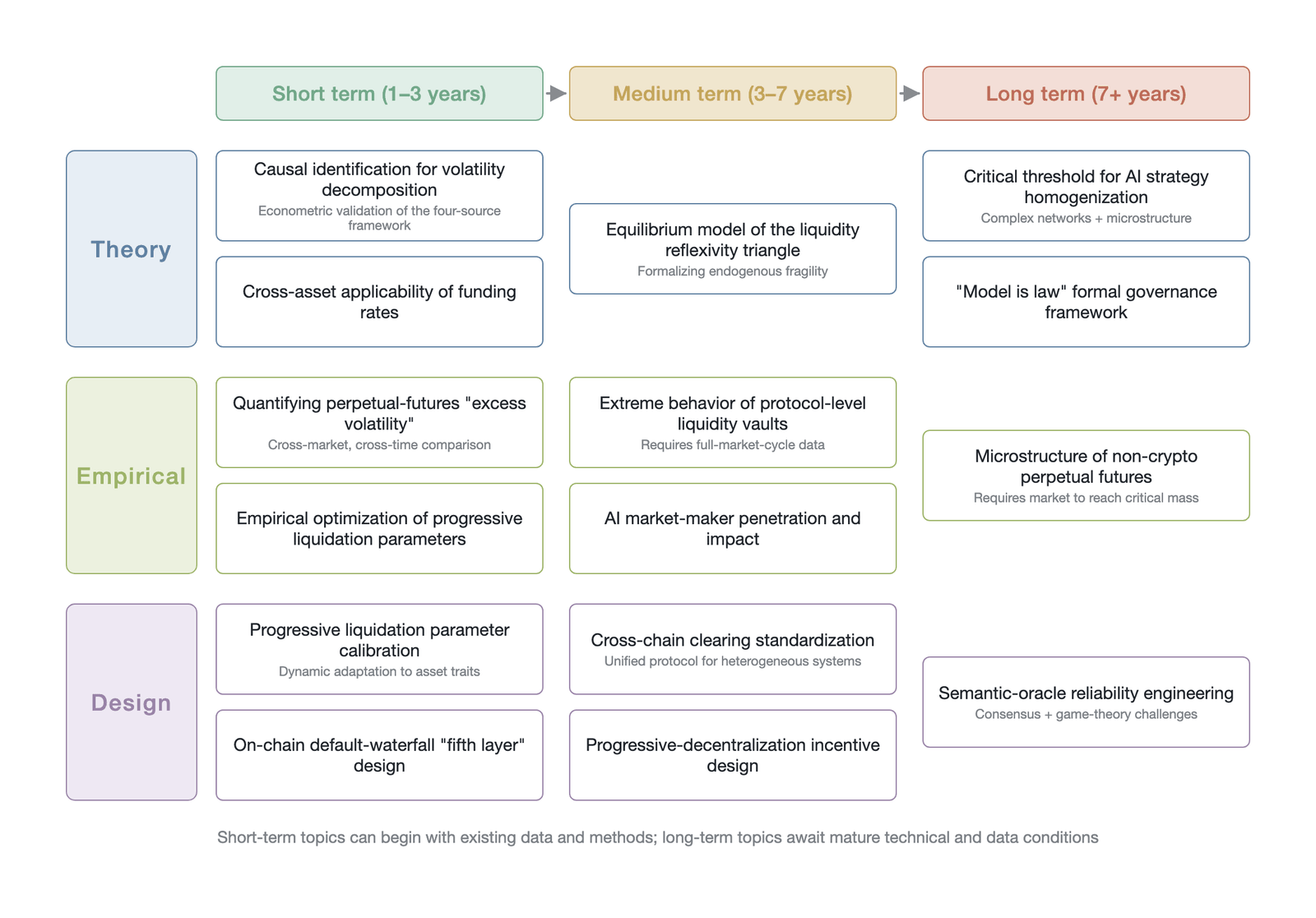
Figure 33-1. Research-agenda roadmap for unresolved problems: a research-priority matrix organized by category (theoretical/empirical/design) and time horizon (short-/medium-/long-term), where the entries are the unresolved problems raised in this book, compiled by the author and not empirical data
On the theoretical side, although the book has proposed a series of conceptual frameworks, translating them into rigorous formal models still faces major challenges. The first is the problem of rigorous causal identification for the four-source volatility decomposition. We deconstruct the volatility of perpetual futures into four sources—informational, liquidity, mechanistic, and transmission—and this conceptual distinction offers an important perspective for understanding market states. With the current econometric toolbox, however, separating these four components within high-frequency price sequences remains an unsolved problem. Existing decomposition methods often rely on strong assumptions—for example, that information shocks and liquidity frictions are mutually independent—but under extreme market conditions this independence assumption tends to fail. Future research will need to develop more refined identification strategies, possibly by introducing nonlinear dynamical models or drawing on higher-dimensional datasets, in order to quantify the different volatility sources precisely.
The second is the formal modeling of the liquidity reflexivity triangle. Through qualitative analysis, the book has revealed the reflexive loop among market-maker inventory, price volatility, and liquidity supply, pointing to the endogenous fragility whereby liquidity is scarcest when it is most needed. But turning this intuitive insight into a closed-form dynamic equilibrium model remains a formidable task. Traditional market-maker models typically assume an exogenous price process, whereas here the price process is itself endogenously determined by the collective behavior of market makers. Building such a macro-microstructure model that encompasses multiple equilibria and nonlinear feedback requires not only overcoming extremely high mathematical complexity but also striking a delicate balance between theoretical elegance and real-world explanatory power.
The third theoretical difficulty is defining the critical threshold for AI-strategy homogenization. As the penetration of algorithmic trading and AI market makers rises, strategy convergence becomes a systemic risk that cannot be ignored. When enough market participants use similar models and data sources, algorithms originally intended to dampen volatility may resonate under particular triggering conditions and set off an instantaneous drain of liquidity. But how much homogenization counts as "too homogeneous"? Is there a critical threshold that can be rigorously defined, beyond which market resilience undergoes a phase-transition-like collapse? Answering this question requires a deep fusion of complex-network theory with microstructure models—undoubtedly a major frontier for future theoretical research.
Finally, a formalized governance framework for "model is law" is likewise urgently needed. In exploring the evolution of AI from market participant to market infrastructure, we have foreseen a future in which algorithmic models may replace traditional code as the core of rule enforcement. Unlike deterministic smart-contract code, however, an AI model is inherently probabilistic, and its decision process often has the uninterpretable character of a black box. How can such a probabilistic, non-deterministic decision mechanism be incorporated into existing legal and economic frameworks of liability? When an autonomously operating risk-control model makes a misjudgment that causes enormous losses, how should responsibility be assigned? Building a formalized governance theory compatible with probabilistic logic is a prerequisite for realizing a truly autonomous financial network.
The validity of theory lies in empirical testing. On the empirical side, because the crypto-asset market has a short history and a complex data structure, many key hypotheses still await further verification. First and foremost is the precise quantification of the "excess volatility" of perpetual futures. Although in theory high leverage and the funding-rate mechanism introduce additional volatility, accurately measuring the specific share of this mechanistic volatility in total volatility requires systematic comparison across markets, across time, and across asset classes. Current empirical research is often limited by a lack of out-of-sample data and struggles to control for confounding variables such as the macroeconomic environment and changes in regulatory policy. Future work will need to build a larger and more standardized microstructure database and apply advanced panel-data techniques before it can deliver statistically significant, definitive conclusions.
In addition, the real-world performance of protocol-based liquidity vaults under extreme market conditions remains an open empirical question. As an institutional innovation for addressing the endogenous fragility of liquidity, such vaults have shown potential to improve liquidity under normal conditions. Yet the true test of any financial institution always comes in a crisis. Because such mechanisms are still young, they have not yet weathered a systemic shock on the scale of the global financial crisis. When faced with the concurrent pressures of extreme selling, oracle failure, and network congestion, will these vaults serve as an effective buffer that stabilizes the market, or will design flaws accelerate their collapse? Answering this empirically will require more time and more "battle testing."
The true penetration and impact of AI market makers in crypto markets is likewise hard to quantify empirically. Although algorithmic trading is widely seen as increasingly prevalent, the anonymity of on-chain identities and the concealment of trading strategies make it hard for researchers to distinguish accurately between the order flow of human traders and that of AI algorithms. The lack of reliable classification data makes it extremely difficult to assess AI's specific impact on market liquidity, price-discovery efficiency, and volatility characteristics. Future empirical research may need to draw on more advanced machine-learning classification techniques, or rely on high-granularity anonymized data provided at the exchange level, before it can gradually shed light on this question.
Finally, the market-microstructure characteristics of non-crypto-asset perpetual futures are an important empirical blind spot. As a thought experiment, the book has explored the possibility of extending the perpetual futures mechanism to traditional assets such as foreign exchange, equities, and commodities. At present, however, the trading volume on platforms attempting to launch such products remains too small to provide enough observations for reliable empirical analysis. Traditional assets and crypto assets differ fundamentally in their underlying value anchor, the structure of market participants, and the regulatory environment; how will these differences reshape the microstructure behavior of perpetual futures? Answering this question must wait until the relevant markets reach a certain degree of maturity and scale of liquidity before substantive empirical exploration can begin.
Beyond the theoretical and empirical challenges, in financial engineering and system design the book also leaves a series of problems unsolved. One of the most pressing is the design of a final recovery and resolution mechanism beyond the on-chain default waterfall. In the traditional central-counterparty clearing system, once all the front-line risk buffers have been breached, the ultimate backstop responsibility is typically borne by the central bank or the sovereign state; this is an external public-credit backstop, not an ordinary tier inside the default waterfall. In an on-chain financial network that pursues decentralization and permissionlessness, however, such an external government backstop does not exist. When an extreme black-swan event causes all clearing mechanisms within the system to fail and the bankruptcy shortfall cannot be covered, how should the system design its last line of defense? Is it an optimal auto-deleveraging mechanism, the issuance of a system debt token, or some socialized loss-mutualization protocol not yet invented? Finding an ultimate risk-buffer solution in the absence of sovereign-credit backing is a necessary path for on-chain finance to reach maturity.
The reliability engineering of semantic oracles (see Section 33.3.4) is another highly challenging design problem. Introducing large-language-model-based AI into an oracle network inevitably brings the risks of "hallucination" and adversarial attacks. How can a robust consensus mechanism be designed to ensure that multiple independent AI nodes, when confronting ambiguous or even maliciously constructed real-world information, output consistent and accurate semantic-parsing results? This is not only a technical problem in natural language processing but also a complex engineering challenge involving game-theoretic incentive design.
On the evolution of organizational architecture, the incentive design for "progressive decentralization" remains a problem not yet fully solved. In their initial phase, many on-chain protocols depend on a core team for centralized development and operation, and promise to hand control gradually to the community. In reality, however, the team often lingers in the centralized phase for a long time—whether out of vested interests or distrust of the community's governance capacity—so that "progressive" becomes "never." How can sophisticated token-economics design and hard-coded smart-contract time-locks create an irreversible incentive mechanism under which the core team is not only willing but mathematically compelled to relinquish power step by step along the roadmap? This requires us to seek more powerful constraint tools within mechanism-design theory.
Finally, the standardization of cross-chain clearing constitutes a major design bottleneck for the future of multi-chain interoperability. As liquidity grows increasingly fragmented across different blockchain networks, it is becoming the norm for users to hold related assets and positions on multiple chains at once. To improve capital efficiency and reduce systemic risk, cross-chain margin sharing and net settlement become especially necessary. Yet blockchains differ enormously in consensus mechanism, finality-confirmation time, and smart-contract execution environment; how can a unified, secure, and efficient cross-chain clearing standard be established among these heterogeneous systems? This requires not only securing cross-chain message passing but also designing a global clearing algorithm that can tolerate asynchronous execution and partial network partitions. The absence of such a standard remains the main obstacle preventing on-chain financial networks from optimizing capital efficiency globally.
33.5 Disciplinary contributions and epistemological legacy
The book's disciplinary contribution lies not in analyzing an emerging market as such but in the way the extreme institutional design of perpetual futures exposes blind spots long obscured within traditional microstructure theory. The institutional infrastructure of traditional markets—designated market makers, central-counterparty clearing, and market-closing conventions—masks several deep contradictions. Once perpetual futures strip away these protective institutional layers, the essential features of microstructure become visible under extreme conditions, giving rise to five epistemological legacies.
The classic framework established by O'Hara (1995) [6] divides volatility into two categories: informational volatility (from fundamental updates) and noise volatility (from liquidity imbalances or irrational behavior). This dichotomy has strong explanatory power in traditional equity and futures markets, where liquidation rules and trading institutions are relatively mild and the frictions they generate are usually subsumed under noise in the broad sense. Perpetual futures, however, break this pattern: high-leverage liquidation engines force selling when a price crosses a trigger threshold, disregarding fundamental information, and periodic funding-rate settlement induces the mechanical repositioning of arbitrage capital at fixed points in time. The mechanical buying and selling pressure this produces [7] neither reflects new information nor stems from trader irrationality but is a direct product of the logic of system design. On this basis, the book expands the information/noise dichotomy into a four-source framework—informational, liquidity, mechanistic, and transmission—making institution-driven volatility explicit as an independent analytical category, and it poses a new question for future research: to what extent does the institutional design of any emerging market endogenously create additional volatility? Only by separating out institution-driven volatility, as far as it can be identified, can regulators distinguish the healthy cost of price discovery from pure friction that architectural optimization can mitigate.
The classic models of Kyle (1985) [21] and Glosten and Milgrom (1985) [5] tend to treat liquidity as an exogenous background condition, reducing the market maker to a passive provider seeking a static equilibrium between adverse-selection costs and inventory costs; and the designated-market-maker system and stable credit support of traditional markets further obscure the intrinsic fragility of liquidity supply. Analysis of perpetual futures markets, by contrast, shows that liquidity is essentially a commodity produced by market makers, and that its production equation contains a structural flaw: production cost is positively correlated with demand. Under normal conditions, adverse selection and inventory risk are low, and market makers tend to supply liquidity far in excess of demand; once the market shifts into a high-volatility state, risk costs balloon exponentially, and the production logic of liquidity collapses with them. This countercyclical fragility is not a matter of any moral failing or irrational panic on the part of market makers but a structural result of profit maximization under the adverse-selection and inventory-cost structure [5]. It rewrites our understanding of market resilience: the effective way to sustain liquidity during a crisis is not to make moral appeals or issue administrative decrees but to change the underlying risk-return structure of market makers, or to reshape the production logic of liquidity through institutional innovations such as protocol-level liquidity vaults.
The mainstream microstructure literature assumes by default that trading takes place within a complete institutional infrastructure, in which central counterparties, securities depositories, and state regulation form a network of trust [6]; asset security, fairness of matching, and settlement finality are treated as given premises, and the question of trust is left to law and institutional economics. The crises in crypto markets [22] [23]—and especially the systemic failures of centralized exchanges—demonstrate, however, that in an environment lacking state backing, trust is a scarce, central variable that can break down at any moment. The book therefore turns trust from an abstract institutional problem into a concrete engineering problem and proposes the concept of the trust stack: it decomposes a financial transaction into five layers—asset custody, matching and execution, clearing and settlement, data feeds, and governance decisions—and explores at each layer the trade-off frontier between trust-minimization and performance-maximization (Chapters 28–29). This provides a new first principle for financial-system design: the designer no longer faces a binary choice between wholesale centralization and wholesale decentralization but independently seeks the optimal architectural solution at each layer; and future microstructure theory must place trust architecture alongside liquidity and volatility as a foundational dimension for assessing market quality.
Most existing microstructure theory is built on the assumption that the market has opening, closing, and non-trading cycles: the closed period is regarded as a buffer for digesting information; the open and the close carry special price-discovery functions; and concepts such as overnight risk, opening gaps, and closing-price manipulation form the core vocabulary of traditional analysis. Even though the foreign-exchange market achieved near-around-the-clock trading well before crypto markets did [24], its weekend breaks and the relatively limited microstructure research devoted to it left this assumption largely unshaken for a long time. Perpetual futures markets combine around-the-clock trading with high leverage and the absence of an expiration date, producing microstructure features different from those of the foreign-exchange market: the lack of a closed-period buffer gives price shocks a stronger long-memory effect over time, and volatility clustering is more pronounced than in traditional markets; around-the-clock pricing, meanwhile, fills the pricing vacuum that traditional assets face during the Asian or European sessions, making the global price-discovery process more continuous. This finding calls for redefining the dynamic relationship between information arrival and price adjustment, for exploring market makers' cross-time-zone inventory-management strategies in the absence of time boundaries, and for designing new dynamic risk-control systems for continuous markets—the traditional time-slice-based circuit-breaker mechanism no longer applies here.
The objects of analysis in traditional financial theory are usually anchored to real assets or their direct derivatives: a stock represents ownership of a company; a commodity future carries an obligation of physical delivery; and even complex derivatives have definite expiration dates and exercise conditions. These rigid constraints force prices to converge over time, and traditional arbitrage models and pricing formulas are essentially organized around the expiry constraint; CFDs and total return swaps, although they likewise provide synthetic exposure, are limited by bilateral counterparty risk and finite market depth (see Section 33.1.1). Perpetual futures, by contrast, create a new class of financial instrument—one with no expiration date, no physical delivery, and price anchoring achieved purely through the funding rate's endogenous game-theoretic mechanism [7]. What the trader trades is nothing but pure exposure to price movements, and its economic nature and risk characteristics pose new challenges to traditional derivatives-pricing theory. The book thus establishes the economics of synthetic exposure as a new analytical category, one that calls for building an entirely new theoretical framework: the anchoring efficiency and failure conditions of the funding rate across different states await systematic study; and when this mechanism extends to domains such as foreign exchange and commodities, its reshaping effect on the global risk-transmission network and the distribution of liquidity must also be assessed. The economics of synthetic exposure thus provides the core theoretical framework for understanding the digitalized financial networks of the future.
33.6 Recommendations for different readers
The book's argument now nears its close. This section offers readers of different backgrounds concrete paths of action that build on this book.
What the book offers academic researchers is not a closed set of conclusions but an open research agenda. The unresolved problems listed in Section 33.4—such as the causal identification of four-source volatility, the formal modeling of the liquidity reflexivity triangle, and the critical threshold of AI-strategy homogenization—can all serve as starting points for independent research projects. Hypotheses that merit priority testing include whether the share of mechanistic volatility in total volatility grows nonlinearly as the leverage ratio rises; whether protocol-level liquidity vaults accelerate rather than relieve liquidity drains under extreme conditions; and whether the anchoring efficiency of the funding rate still holds once it is extended across asset classes. Recommended data sources include the high-frequency order-book data of Kaiko and CoinMetrics, the on-chain metrics of Glassnode, and the public liquidation logs of the various protocols. The book's analytical frameworks—the four-source volatility decomposition, the state-machine model, and trust-stack theory—combined with classical microstructure tools such as market-making quote models [25] and informed-trading models [26], are not confined to crypto markets and can serve as general-purpose theoretical tools for the microstructure analysis of emerging markets.
The book offers practitioners three directly applicable decision frameworks. For market makers, the triple-cost decomposition of the profit equation (adverse selection, inventory, and institutional cost), combined with the four-source identification of volatility, forms the basis for dynamically adjusting quoting strategies under normal and stressed conditions. Specifically, when the share of mechanistic volatility rises, one should give priority to reducing depth rather than widening the spread. For exchange architects and protocol designers, the five-layer decomposition of the trust stack provides an engineering framework for evaluating architectural choices: prioritize trust-minimization at the custody layer, prioritize performance at the matching layer, and adopt a gradual rather than cliff-edge design at the clearing layer. For investors, the five-dimensional market-quality model offers a structured method for evaluating trading venues, while the state-machine perspective is a reminder that, in assessing market resilience, one must distinguish normal-state performance from stressed-state performance.
The book offers regulators tools in three directions. Architectural guarantees of asset segregation and information disclosure are the most direct regulatory instrument: requiring trading platforms to implement verifiable asset segregation at the custody layer is low in cost and measurable in effect. Calibrating leverage limits, by contrast, must rest on microstructure analysis: the book's four-source volatility decomposition shows that the higher the share of mechanistic volatility in a market, the lower the optimal leverage ceiling should be. Embedded compliance—encoding regulatory requirements into the execution logic of smart contracts—offers a technological path for shifting from ex post punishment to real-time monitoring, and its core logic is to use the architectural transparency of on-chain infrastructure to reduce the cost of regulation.
Students are advised to choose one of the following reading paths, according to their interests, as an entry point. Derivatives-pricing track: Chapter 10 (the game theory of funding rates) → Chapter 13 (price discovery) → Chapter 17 (arbitrage risk), with an emphasis on mechanism design and information economics. Market-microstructure track: Chapter 19 (the market maker's profit equation) → Chapter 20 (the endogeneity of liquidity) → Chapters 22–24 (volatility), with an emphasis on the application of classical microstructure theory in a new market. System-design track: Chapter 28 (the trust stack) → Chapter 29 (clearing architecture) → Chapter 31 (AI infrastructure), with an emphasis on engineering and governance design. After exploring a particular topic in depth, one can gradually expand into adjacent areas through the cross-references between chapters.
References
[1] Shiller, R. J. (1993). Macro markets: Creating institutions for managing society's largest economic risks. Clarendon Press.
[2] CoinGlass. (2026). 2025 crypto derivatives market annual report. https://www.coinglass.com/learn/2025-annual-report-en
[3] Alexander, C., Choi, J., Park, H., & Sohn, S. (2020). BitMEX bitcoin derivatives: Price discovery, informational efficiency, and hedging effectiveness. Journal of Futures Markets, 40(1), 23–43.
[4] Makarov, I., & Schoar, A. (2020). Trading and arbitrage in cryptocurrency markets. Journal of Financial Economics, 135(2), 293–319.
[5] Glosten, L. R., & Milgrom, P. R. (1985). Bid, ask and transaction prices in a specialist market with heterogeneously informed traders. Journal of Financial Economics, 14(1), 71–100.
[6] O'Hara, M. (1995). Market microstructure theory. Blackwell.
[7] He, S., Manela, A., Ross, O., & von Wachter, V. (2024). Fundamentals of perpetual futures. arXiv. https://arxiv.org/abs/2212.06888
[8] Duffie, D., Gârleanu, N., & Pedersen, L. H. (2005). Over-the-counter markets. Econometrica, 73(6), 1815–1847. https://doi.org/10.1111/j.1468-0262.2005.00639.x
[9] Myerson, R. B. (1981). Optimal auction design. Mathematics of Operations Research, 6(1), 58–73.
[10] Hurwicz, L. (1972). On informationally decentralized systems. In C. B. McGuire & R. Radner (Eds.), Decision and organization (pp. 297–336). North-Holland.
[11] Budish, E., Cramton, P., & Shim, J. (2015). The high-frequency trading arms race: Frequent batch auctions as a market design response. The Quarterly Journal of Economics, 130(4), 1547–1621. https://doi.org/10.1093/qje/qjv027
[12] Brunnermeier, M. K., & Pedersen, L. H. (2009). Market liquidity and funding liquidity. Review of Financial Studies, 22(6), 2201–2238. https://doi.org/10.1093/rfs/hhn098
[13] Adrian, T., & Shin, H. S. (2010). Liquidity and leverage. Journal of Financial Intermediation, 19(3), 418–437. https://doi.org/10.1016/j.jfi.2008.12.002
[14] Andersen, T. G., Bollerslev, T., Diebold, F. X., & Labys, P. (2003). Modeling and forecasting realized volatility. Econometrica, 71(2), 579–625. https://doi.org/10.1111/1468-0262.00418
[15] Amihud, Y. (2002). Illiquidity and stock returns: Cross-section and time-series effects. Journal of Financial Markets, 5(1), 31–56. https://doi.org/10.1016/s1386-4181(01)00024-6
[16] Brogaard, J., Hendershott, T., & Riordan, R. (2014). High-frequency trading and price discovery. Review of Financial Studies, 27(8), 2267–2306. https://doi.org/10.1093/rfs/hhu032
[17] Hasbrouck, J. (1995). One security, many markets: Determining the contributions to price discovery. The Journal of Finance, 50(4), 1175–1199. https://doi.org/10.1111/j.1540-6261.1995.tb04054.x
[18] Cong, L. W., Li, X., Tang, K., & Yang, Y. (2023). Crypto wash trading. Management Science, 69(11), 6427–6454. https://doi.org/10.1287/mnsc.2021.02709
[19] Grossman, S. J., & Miller, M. H. (1988). Liquidity and market structure. The Journal of Finance, 43(3), 617–633.
[20] Bollerslev, T., Litvinova, J., & Tauchen, G. (2006). Leverage and volatility feedback effects in high-frequency data. Journal of Financial Econometrics, 4(3), 353–384.
[21] Kyle, A. S. (1985). Continuous auctions and insider trading. Econometrica, 53(6), 1315–1335.
[22] Capponi, A., & Jia, R. (2021). The adoption of blockchain-based decentralized exchanges. arXiv. https://arxiv.org/abs/2103.08842
[23] Zetzsche, D. A., Buckley, R. P., Arner, D. W., & Föhr, L. (2019). The ICO gold rush: It's a scam, it's a bubble, it's a super challenge for regulators. Harvard International Law Journal, 60(2), 267–315. https://doi.org/10.2139/ssrn.3072298
[24] Lyons, R. K. (2001). The microstructure approach to exchange rates. MIT Press.
[25] Avellaneda, M., & Stoikov, S. (2008). High-frequency trading in a limit order book. Quantitative Finance, 8(3), 217–224.
[26] Easley, D., & O'Hara, M. (1987). Price, trade size, and information in securities markets. Journal of Financial Economics, 19(1), 69–90. https://doi.org/10.1016/0304-405x(87)90029-8